



Community hub
Recent from talks
Knowledge base stats:
Talk channels stats:
Members stats:
Insect olfaction
Insect olfaction refers to the function of chemical receptors that enable insects to detect and identify volatile compounds for foraging, predator avoidance, finding mating partners (via pheromones) and locating oviposition habitats. Thus, it is the most important sensation for insects. Most important insect behaviors must be timed perfectly which is dependent on what they smell and when they smell it. For example, olfaction is essential for locating host plants and hunting prey in many species of insects, such as the moth Deilephila elpenor and the wasp Polybia sericea, respectively.
The two organs insects primarily use for detecting odors are the antennae and specialized mouth parts called the maxillary palps. However, a recent study has demonstrated the olfactory role of ovipositor in fig wasps. Inside of these olfactory organs there are neurons called olfactory receptor neurons which, as the name implies, house receptors for scent molecules in their cell membrane. The majority of olfactory receptor neurons typically reside in the antenna. These neurons can be very abundant; for example, Drosophila flies have 2,600 olfactory sensory neurons.
Insects are capable of smelling and differentiating between thousands of volatile compounds both sensitively and selectively. Sensitivity is how attuned the insect is to very small amounts of an odorant or small changes in the concentration of an odorant. Selectivity refers to the insects ability to tell one odorant apart from another. Among blood-feeding arthropods, these compounds are commonly broken into three classes: short chain carboxylic acids, aldehydes and low molecular weight nitrogenous compounds.
Insects have been used as a model system to study mammal and especially human olfaction. Yet, unlike vertebrates who use G protein coupled receptors (GPCRs), insects express proteins including ORs (olfactory receptors), GRs (gustatory receptors) and IRs (ionotropic receptors) which are all heteromeric ligand-gated ion channels. A moth species in the order of Lepidoptera known as the black cutworm moth (Agrotis ipsilon) produces even more proteins including OBPs (odorant-binding proteins), CSPs (chemosensory binding proteins), and SNMPs (sensory neuron membrane proteins) that help the moth recognize sex pheromones and odorants such as those released from host plants. Much like in vertebrates, axons from the sensory neurons converge into glomeruli, but differ in where the glomeruli are housed. In mammals they are located in the olfactory bulbs, but in insects they are in the antennal lobe.
Olfaction is metabolically costly. The evolutionary trade-offs involved require further study because as of 2016[update] most such research has been done under laboratory conditions with unrealistically reliable food.
Sensory neurons in the antenna, maxillary palp, and labella generate odor-specific electrical signals called spikes (action potentials) in response to binding of odors to cell surface proteins like the olfactory receptors. The sensory neurons in the antenna and maxillary send this information via their axons to the antennal lobe, while sensory neuron in the labella send this information via axons to the subesophageal ganglion. Inside the antennal lobe they synapse with other neurons in semidelineated (with membrane boundaries) structures called glomeruli.
Specifically the process is as follows: first the odorant wafts towards an insect's antenna or maxillary palp which is covered with hair-like projections called sensilla. The odorant then enters through tiny pores in the exoskeleton (or cuticle) of that sensillum and diffuses into the fluid between the cells called extracellular fluids. There the odorant molecule binds to an odorant binding protein which transports it to a receptor and co-receptor (Orco) team on the surface of the olfactory receptor neuron (ORN). This leads to the neuron firing an action potential down the axon. This signal is sent to the antennal lobe or subesophogeal ganglion of the insects brain where it can then integrate the information with other signals from other sensilla.
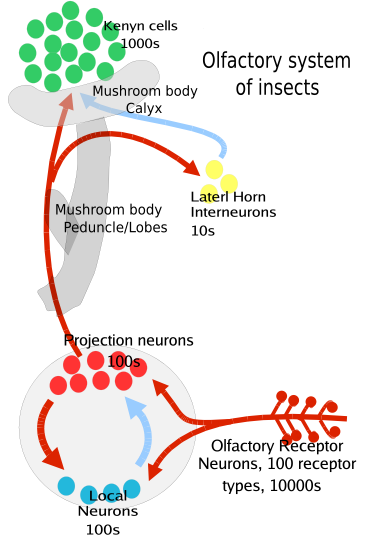
These ORNs are bipolar, on one end are the olfactory dendrites with the receptors for the odors and on the other end are the axons that carry the action potential to the antennal lobe of the brain. The antennal lobes have two kinds of neurons, projection neurons (mostly excitatory) and local neurons (inhibitory, with some excitatory). The projection neurons send their axon terminals to a part of the insect brain called the mushroom bodies (important in regulating learned odor responses) and another part of the brain called the lateral horn (important in regulating innate odor responses). Both of these regions are part of the protocerebrum of the insect brain.
Hub AI
Insect olfaction AI simulator
(@Insect olfaction_simulator)
Insect olfaction
Insect olfaction refers to the function of chemical receptors that enable insects to detect and identify volatile compounds for foraging, predator avoidance, finding mating partners (via pheromones) and locating oviposition habitats. Thus, it is the most important sensation for insects. Most important insect behaviors must be timed perfectly which is dependent on what they smell and when they smell it. For example, olfaction is essential for locating host plants and hunting prey in many species of insects, such as the moth Deilephila elpenor and the wasp Polybia sericea, respectively.
The two organs insects primarily use for detecting odors are the antennae and specialized mouth parts called the maxillary palps. However, a recent study has demonstrated the olfactory role of ovipositor in fig wasps. Inside of these olfactory organs there are neurons called olfactory receptor neurons which, as the name implies, house receptors for scent molecules in their cell membrane. The majority of olfactory receptor neurons typically reside in the antenna. These neurons can be very abundant; for example, Drosophila flies have 2,600 olfactory sensory neurons.
Insects are capable of smelling and differentiating between thousands of volatile compounds both sensitively and selectively. Sensitivity is how attuned the insect is to very small amounts of an odorant or small changes in the concentration of an odorant. Selectivity refers to the insects ability to tell one odorant apart from another. Among blood-feeding arthropods, these compounds are commonly broken into three classes: short chain carboxylic acids, aldehydes and low molecular weight nitrogenous compounds.
Insects have been used as a model system to study mammal and especially human olfaction. Yet, unlike vertebrates who use G protein coupled receptors (GPCRs), insects express proteins including ORs (olfactory receptors), GRs (gustatory receptors) and IRs (ionotropic receptors) which are all heteromeric ligand-gated ion channels. A moth species in the order of Lepidoptera known as the black cutworm moth (Agrotis ipsilon) produces even more proteins including OBPs (odorant-binding proteins), CSPs (chemosensory binding proteins), and SNMPs (sensory neuron membrane proteins) that help the moth recognize sex pheromones and odorants such as those released from host plants. Much like in vertebrates, axons from the sensory neurons converge into glomeruli, but differ in where the glomeruli are housed. In mammals they are located in the olfactory bulbs, but in insects they are in the antennal lobe.
Olfaction is metabolically costly. The evolutionary trade-offs involved require further study because as of 2016[update] most such research has been done under laboratory conditions with unrealistically reliable food.
Sensory neurons in the antenna, maxillary palp, and labella generate odor-specific electrical signals called spikes (action potentials) in response to binding of odors to cell surface proteins like the olfactory receptors. The sensory neurons in the antenna and maxillary send this information via their axons to the antennal lobe, while sensory neuron in the labella send this information via axons to the subesophageal ganglion. Inside the antennal lobe they synapse with other neurons in semidelineated (with membrane boundaries) structures called glomeruli.
Specifically the process is as follows: first the odorant wafts towards an insect's antenna or maxillary palp which is covered with hair-like projections called sensilla. The odorant then enters through tiny pores in the exoskeleton (or cuticle) of that sensillum and diffuses into the fluid between the cells called extracellular fluids. There the odorant molecule binds to an odorant binding protein which transports it to a receptor and co-receptor (Orco) team on the surface of the olfactory receptor neuron (ORN). This leads to the neuron firing an action potential down the axon. This signal is sent to the antennal lobe or subesophogeal ganglion of the insects brain where it can then integrate the information with other signals from other sensilla.
These ORNs are bipolar, on one end are the olfactory dendrites with the receptors for the odors and on the other end are the axons that carry the action potential to the antennal lobe of the brain. The antennal lobes have two kinds of neurons, projection neurons (mostly excitatory) and local neurons (inhibitory, with some excitatory). The projection neurons send their axon terminals to a part of the insect brain called the mushroom bodies (important in regulating learned odor responses) and another part of the brain called the lateral horn (important in regulating innate odor responses). Both of these regions are part of the protocerebrum of the insect brain.