



Community hub
Recent from talks
Knowledge base stats:
Talk channels stats:
Members stats:
Tea Horse Road
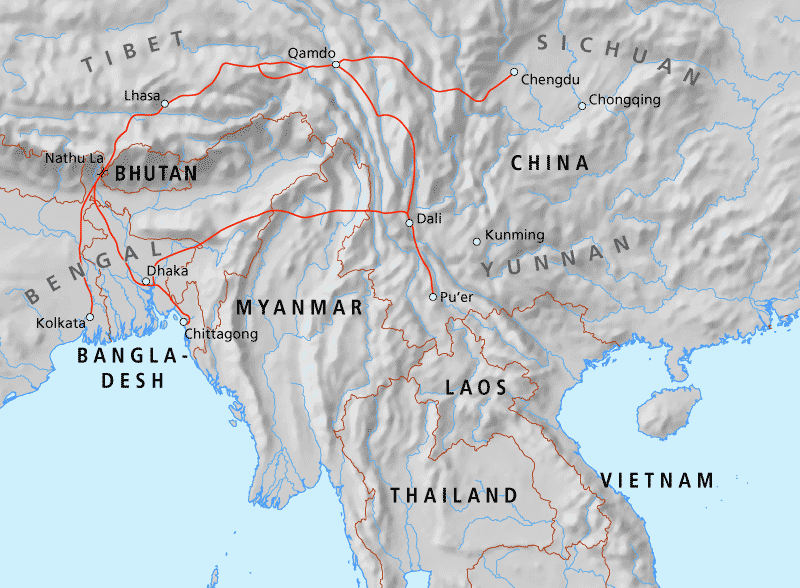
The Tea Horse Road or Chamadao (simplified Chinese: 茶马道; traditional Chinese: 茶馬道), now generally referred to as the Ancient Tea Horse Road or Chamagudao (simplified Chinese: 茶马古道; traditional Chinese: 茶馬古道) was a network of caravan paths winding through the mountains of Sichuan, Yunnan and Tibet in Southwest China. This was also a tea trade route. It is also sometimes referred to as the "Southern Silk Road" or "Southwest Silk Road."
There are numerous surviving archaeological and monumental elements, including trails, bridges, way stations, market towns, palaces, staging posts, shrines and temples along the route.
"Ancient Tea Horse Road" is a historical concept with a specific meaning. It refers to a major traffic road formed by the exchange of tea and horses between Han and Tibet from the Tang and Song Dynasties to the Republic of China.
Shaanxi-Gansu Tea Horse Road (陕甘茶马古道) is the main road for tea in mainland China to travel west and exchange for horses. It is one of the main routes of the ancient Silk Road.
Beginning in the Han dynasty, the Tanggu Road (蹚古道) was formed by Shaanxi merchants and the ancient tea-horse market in the southwest frontier. Since the government of the Ming and Qing dynasties imposed government control on tea sales, tea sales were divided into regions, and the most prosperous tea and horse trading market was in Kangding.
The Yunnan-Tibet Tea Horse Road (滇藏茶马古道) was formed in the late sixth century AD. It started from Yiwu and Pu'er in Xishuangbanna, the main tea producing area of Yunnan, and entered Tibet through today's Dali Bai Autonomous Prefecture, Lijiang City and Shangri-La, and went directly to Lhasa. Some were also re-exported from Tibet to India and Nepal, which was an important trade route between ancient China and South Asia.
The Ancient Sichuan-Tibet Tea-Horse Road (川藏茶马古道) is a part of the Shaanxi-Kangding-Tibet Tea-Horse Road. It starts from Ya'an, the tea producing area of Yazhou in the east, passes through Dartsedo (now Kangding), reaches Lhasa, Tibet in the west, and finally leads to Bhutan, Nepal and India. More than a thousand kilometres, it is an indispensable bridge and link between ancient Tibet and the mainland.
Sichuan and Yunnan are believed to be the first tea-producing regions in the world. The first records of tea cultivation suggest that tea was cultivated on Sichuan's Mount Mengding between Chengdu and Ya'an earlier than 65 BC. Ya'an has been an important hub of tea trading till the 20th century.[citation needed]
Hub AI
Tea Horse Road AI simulator
(@Tea Horse Road_simulator)
Tea Horse Road
The Tea Horse Road or Chamadao (simplified Chinese: 茶马道; traditional Chinese: 茶馬道), now generally referred to as the Ancient Tea Horse Road or Chamagudao (simplified Chinese: 茶马古道; traditional Chinese: 茶馬古道) was a network of caravan paths winding through the mountains of Sichuan, Yunnan and Tibet in Southwest China. This was also a tea trade route. It is also sometimes referred to as the "Southern Silk Road" or "Southwest Silk Road."
There are numerous surviving archaeological and monumental elements, including trails, bridges, way stations, market towns, palaces, staging posts, shrines and temples along the route.
"Ancient Tea Horse Road" is a historical concept with a specific meaning. It refers to a major traffic road formed by the exchange of tea and horses between Han and Tibet from the Tang and Song Dynasties to the Republic of China.
Shaanxi-Gansu Tea Horse Road (陕甘茶马古道) is the main road for tea in mainland China to travel west and exchange for horses. It is one of the main routes of the ancient Silk Road.
Beginning in the Han dynasty, the Tanggu Road (蹚古道) was formed by Shaanxi merchants and the ancient tea-horse market in the southwest frontier. Since the government of the Ming and Qing dynasties imposed government control on tea sales, tea sales were divided into regions, and the most prosperous tea and horse trading market was in Kangding.
The Yunnan-Tibet Tea Horse Road (滇藏茶马古道) was formed in the late sixth century AD. It started from Yiwu and Pu'er in Xishuangbanna, the main tea producing area of Yunnan, and entered Tibet through today's Dali Bai Autonomous Prefecture, Lijiang City and Shangri-La, and went directly to Lhasa. Some were also re-exported from Tibet to India and Nepal, which was an important trade route between ancient China and South Asia.
The Ancient Sichuan-Tibet Tea-Horse Road (川藏茶马古道) is a part of the Shaanxi-Kangding-Tibet Tea-Horse Road. It starts from Ya'an, the tea producing area of Yazhou in the east, passes through Dartsedo (now Kangding), reaches Lhasa, Tibet in the west, and finally leads to Bhutan, Nepal and India. More than a thousand kilometres, it is an indispensable bridge and link between ancient Tibet and the mainland.
Sichuan and Yunnan are believed to be the first tea-producing regions in the world. The first records of tea cultivation suggest that tea was cultivated on Sichuan's Mount Mengding between Chengdu and Ya'an earlier than 65 BC. Ya'an has been an important hub of tea trading till the 20th century.[citation needed]