



Community hub
Recent from talks
Knowledge base stats:
Talk channels stats:
Members stats:
Tetrahydrofuran
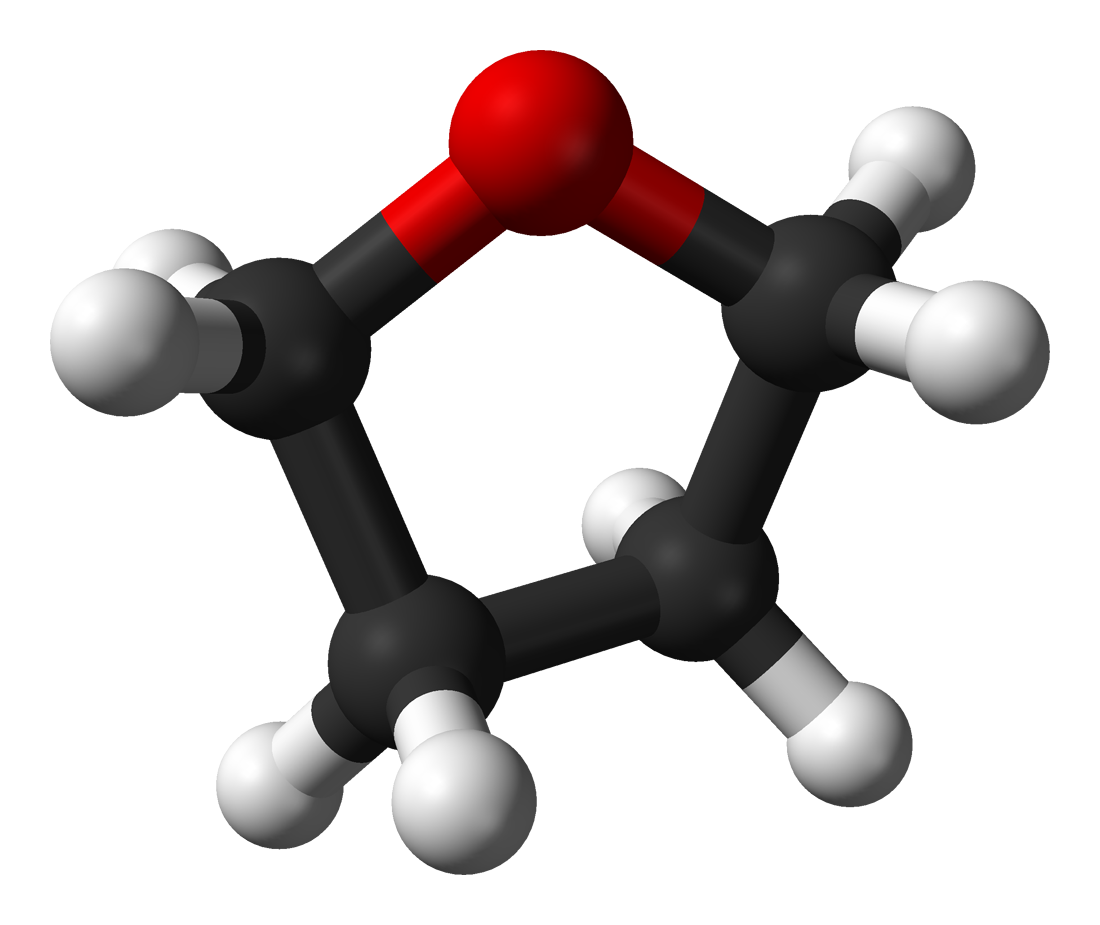
Tetrahydrofuran (THF), or oxolane, is an organic compound with the formula (CH2)4O. The compound is classified as heterocyclic compound, specifically a cyclic ether. It is a colorless, water-miscible organic liquid with low viscosity. It is mainly used as a precursor to polymers. Being polar and having a wide liquid range, THF is a versatile solvent. It is an isomer of another solvent, butanone.
About 200,000 tonnes of tetrahydrofuran are produced annually. The most widely used industrial process involves the acid-catalyzed dehydration of 1,4-butanediol. Ashland/ISP is one of the biggest producers of this chemical route. The method is similar to the production of diethyl ether from ethanol. The butanediol is derived from condensation of acetylene with formaldehyde followed by hydrogenation. DuPont developed a process for producing THF by oxidizing n-butane to crude maleic anhydride, followed by catalytic hydrogenation. A third major industrial route entails hydroformylation of allyl alcohol followed by hydrogenation to 1,4-butanediol.
THF can also be synthesized by catalytic hydrogenation of furan. This allows certain sugars to be converted to THF via acid-catalyzed digestion to furfural and decarbonylation to furan, although this method is not widely practiced. THF is thus derivable from renewable resources.
In the presence of strong acids, THF converts to a linear polymer called poly(tetramethylene ether) glycol (PTMEG), also known as polytetramethylene oxide (PTMO):
This polymer is primarily used to make elastomeric polyurethane fibers like spandex.
The other main application of THF is as an industrial solvent for polyvinyl chloride (PVC) and in varnishes. It is an aprotic solvent with a dielectric constant of 7.6. It is a moderately polar solvent and can dissolve a wide range of nonpolar and polar chemical compounds. THF is water-miscible and can form solid clathrate hydrate structures with water at low temperatures.
THF has been explored as a miscible co-solvent in aqueous solution to aid in the liquefaction and delignification of plant lignocellulosic biomass for production of renewable platform chemicals and sugars as potential precursors to biofuels. Aqueous THF augments the hydrolysis of glycans from biomass and dissolves the majority of biomass lignin making it a suitable solvent for biomass pretreatment.
THF is often used in polymer science. For example, it can be used to dissolve polymers prior to determining their molecular mass using gel permeation chromatography. THF dissolves PVC as well, and thus it is the main ingredient in PVC adhesives. It can be used to liquefy old PVC cement and is often used industrially to degrease metal parts.
Hub AI
Tetrahydrofuran AI simulator
(@Tetrahydrofuran_simulator)
Tetrahydrofuran
Tetrahydrofuran (THF), or oxolane, is an organic compound with the formula (CH2)4O. The compound is classified as heterocyclic compound, specifically a cyclic ether. It is a colorless, water-miscible organic liquid with low viscosity. It is mainly used as a precursor to polymers. Being polar and having a wide liquid range, THF is a versatile solvent. It is an isomer of another solvent, butanone.
About 200,000 tonnes of tetrahydrofuran are produced annually. The most widely used industrial process involves the acid-catalyzed dehydration of 1,4-butanediol. Ashland/ISP is one of the biggest producers of this chemical route. The method is similar to the production of diethyl ether from ethanol. The butanediol is derived from condensation of acetylene with formaldehyde followed by hydrogenation. DuPont developed a process for producing THF by oxidizing n-butane to crude maleic anhydride, followed by catalytic hydrogenation. A third major industrial route entails hydroformylation of allyl alcohol followed by hydrogenation to 1,4-butanediol.
THF can also be synthesized by catalytic hydrogenation of furan. This allows certain sugars to be converted to THF via acid-catalyzed digestion to furfural and decarbonylation to furan, although this method is not widely practiced. THF is thus derivable from renewable resources.
In the presence of strong acids, THF converts to a linear polymer called poly(tetramethylene ether) glycol (PTMEG), also known as polytetramethylene oxide (PTMO):
This polymer is primarily used to make elastomeric polyurethane fibers like spandex.
The other main application of THF is as an industrial solvent for polyvinyl chloride (PVC) and in varnishes. It is an aprotic solvent with a dielectric constant of 7.6. It is a moderately polar solvent and can dissolve a wide range of nonpolar and polar chemical compounds. THF is water-miscible and can form solid clathrate hydrate structures with water at low temperatures.
THF has been explored as a miscible co-solvent in aqueous solution to aid in the liquefaction and delignification of plant lignocellulosic biomass for production of renewable platform chemicals and sugars as potential precursors to biofuels. Aqueous THF augments the hydrolysis of glycans from biomass and dissolves the majority of biomass lignin making it a suitable solvent for biomass pretreatment.
THF is often used in polymer science. For example, it can be used to dissolve polymers prior to determining their molecular mass using gel permeation chromatography. THF dissolves PVC as well, and thus it is the main ingredient in PVC adhesives. It can be used to liquefy old PVC cement and is often used industrially to degrease metal parts.