Hubbry Logo
MiscibilityMiscibilityMain
Open search
Miscibility
Community hub
Miscibility
logo
8 pages, 0 posts
0 subscribers
Be the first to start a discussion here.
Contribute something
Miscibility
Miscibility
from Wikipedia
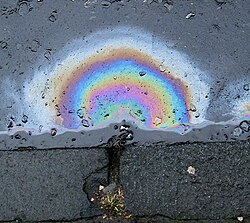
Diesel fuel is immiscible in water. The bright rainbow pattern is the result of thin-film interference.

Miscibility (/ˌmɪsɪˈbɪlɪti/) is the property of two substances to mix in all proportions (that is, to fully dissolve in each other at any concentration), forming a homogeneous mixture (a solution). Such substances are said to be miscible (etymologically equivalent to the common term "mixable"). The term is most often applied to liquids, but also applies to solids and gases. An example in liquids is the miscibility of water and ethanol as they mix in all proportions.[1]

By contrast, substances are said to be immiscible if the mixture does not form a solution for certain proportions. For one example, oil is not soluble in water, so these two solvents are immiscible. As another example, butanone (methyl ethyl ketone) is immiscible in water: it is soluble in water up to about 275 grams per liter, but will separate into two phases beyond that.[2]

Organic compounds

[edit]

In organic compounds, the weight percent of hydrocarbon chain often determines the compound's miscibility with water. For example, among the alcohols, ethanol has two carbon atoms and is miscible with water, whereas 1-butanol with four carbons is not.[3] 1-Octanol, with eight carbons, is practically insoluble in water, and its immiscibility leads it to be used as a standard for partition equilibria.[4] The straight-chain carboxylic acids up to butanoic acid (with four carbon atoms) are miscible with water, pentanoic acid (with five carbons) is partly soluble, and hexanoic acid (with six) is practically insoluble,[5] as are longer fatty acids and other lipids; the very long carbon chains of lipids cause them almost always to be immiscible with water. Analogous situations occur for other functional groups such as aldehydes and ketones.[citation needed]

Thus a practical rule of thumb for determining the solubility of an organic molecule in water (and/or other similarly polar solvents) is to consider the ratio of carbons in the molecule bound to polar functional groups (such as hydroxyl groups), to the number of simple hydrocarbons. If the molecule has a ratio of roughly 1:4 (Polar-to-non-polar carbons), it is soluble in water. It is however necessary to recognise this as a rule of thumb, and not always indicative.[6]

Metals

[edit]

Immiscible metals are unable to form alloys with each other. Typically, a mixture will be possible in the molten state, but upon freezing, the metals separate into layers. This property allows solid precipitates to be formed by rapidly freezing a molten mixture of immiscible metals. One example of immiscibility in metals is copper and cobalt, where rapid freezing to form solid precipitates has been used to create granular GMR materials.[7]

Some metals are immiscible in the liquid state. One with industrial importance is that liquid zinc and liquid silver are immiscible in liquid lead, while silver is miscible in zinc. This leads to the Parkes process, an example of liquid-liquid extraction, whereby lead containing any amount of silver is melted with zinc. The silver migrates to the zinc, which is skimmed off the top of the two-phase liquid, and the zinc is then boiled away, leaving nearly pure silver.[8]

Effect of entropy

[edit]

If a mixture of polymers has lower configurational entropy than the components, they are likely to be immiscible in one another even in the liquid state.[9][10]

Determination

[edit]

Miscibility of two materials is often determined optically. When the two miscible liquids are combined, the resulting liquid is clear. If the mixture is cloudy the two materials are immiscible. Care must be taken with this determination. If the indices of refraction of the two materials are similar, an immiscible mixture may be clear and give an incorrect determination that the two liquids are miscible.[11]

See also

[edit]

References

[edit]
[edit]
Revisions and contributorsEdit on WikipediaRead on Wikipedia
from Grokipedia
Miscibility refers to the ability of two or more substances, typically liquids, to mix completely in all proportions at a given and , forming a homogeneous single-phase solution without separation into distinct layers. This property contrasts with immiscibility, where substances do not blend fully and instead form separate phases, such as and . Miscibility is a fundamental concept in , underpinning the behavior of solutions and influencing processes ranging from everyday mixtures to industrial applications. The thermodynamic basis for miscibility lies in the of mixing, ΔGmix=ΔHmixTΔSmix\Delta G_{mix} = \Delta H_{mix} - T\Delta S_{mix}, which must be negative for spontaneous mixing to occur. For ideal mixtures, the (ΔSmix\Delta S_{mix}) is always positive due to increased disorder, but the enthalpy of mixing (ΔHmix\Delta H_{mix}) depends on intermolecular interactions. Key examples of miscible liquids include and , where bonding allows complete dissolution, and and , facilitated by -induced interactions. In contrast, nonpolar and polar are immiscible because their differing intermolecular forces— dispersion versus bonding—do not favor mixing. Factors influencing miscibility primarily revolve around the principle of "like dissolves like," where substances with similar polarity and intermolecular forces mix readily. Polarity is a dominant factor: polar solvents like mix well with polar solutes, while nonpolar solvents such as prefer nonpolar partners. Temperature often enhances miscibility by increasing molecular motion and weakening intermolecular attractions, though effects vary by system; for instance, higher temperatures can induce in some blends via (UCST) phenomena. plays a role in gas- or high-pressure systems, such as determining the minimum miscibility in processes. In practical contexts, miscibility is essential for selection in chemical reactions, extraction processes in , and formulation of pharmaceuticals and , where homogeneous mixtures ensure efficacy and stability. It also impacts fields like recovery, where miscible gas flooding—using CO₂ at pressures of 2200–3200 psi—improves displacement by 15% or more in pore volume. Understanding miscibility aids in predicting phase in complex systems, such as blends and refrigerant-lubricant mixtures, optimizing material properties and .

Fundamentals

Definition

Miscibility refers to the property of two or more substances, typically liquids, to mix completely and form a homogeneous solution in all proportions at a given and . This arises when the substances can intermingle at the molecular level without , resulting in a . Complete miscibility occurs when the substances are soluble in each other across the entire composition range, whereas partial miscibility is limited to certain ratios, often exhibiting beyond those limits, such as below an upper consolute or above a lower consolute . The observation of miscibility dates back to 19th-century chemistry, where early studies of solution behavior contributed to the foundational understanding of liquid interactions. For instance, and are miscible due to their ability to form hydrogen bonds, allowing polar molecules of to interact favorably with 's polar structure. In contrast, and are immiscible because 's nonpolar chains lack the necessary interactions with 's polar molecules, leading to driven by differing molecular affinities. Although miscibility is most commonly associated with liquid systems, the concept extends to other phases: gases are generally completely miscible unless chemical reactions intervene, solids exhibit miscibility through solid solutions like in alloys, and supercritical fluids demonstrate enhanced miscibility due to their unique properties. This property ultimately depends on thermodynamic favorability, where the free energy of mixing determines whether a homogeneous phase is stable.

Thermodynamic Basis

Miscibility in binary systems is determined by the of mixing, specifically the condition that the of mixing, ΔGmix\Delta G_{\text{mix}}, must be negative for the process to be spontaneous at constant and . This criterion arises from the second law of , where the system evolves toward a state of minimum free energy, favoring the formation of a homogeneous mixture over . The Gibbs free energy of mixing is expressed by the fundamental equation ΔGmix=ΔHmixTΔSmix\Delta G_{\text{mix}} = \Delta H_{\text{mix}} - T \Delta S_{\text{mix}} where ΔHmix\Delta H_{\text{mix}} is the enthalpy of mixing, ΔSmix\Delta S_{\text{mix}} is the entropy of mixing, and TT is the absolute temperature. Miscibility occurs when ΔGmix<0\Delta G_{\text{mix}} < 0, which typically results from a favorable balance between the enthalpic and entropic contributions, with the entropic term often promoting mixing due to increased disorder. In cases where ΔGmix>0\Delta G_{\text{mix}} > 0, the components remain immiscible, leading to phase separation. The enthalpic term ΔHmix\Delta H_{\text{mix}} is influenced by intermolecular forces, such as hydrogen bonding, dipole-dipole interactions, and van der Waals forces, which govern the interactions between like molecules (A-A, B-B) versus unlike molecules (A-B) in the . If A-B interactions are stronger than the of A-A and B-B, ΔHmix\Delta H_{\text{mix}} is negative, enhancing miscibility; conversely, weaker A-B interactions lead to positive ΔHmix\Delta H_{\text{mix}}, opposing mixing. These forces determine the overall favorability of the mixed state relative to the pure components. Solutions are classified as ideal or non-ideal based on their deviation from this thermodynamic behavior. Ideal solutions assume zero (ΔHmix=0\Delta H_{\text{mix}} = 0) and obey , where the partial vapor pressure of each component ii is Pi=xiPiP_i = x_i P_i^\circ, with xix_i as the and PiP_i^\circ as the pure component ; this implies random mixing driven purely by . Non-ideal solutions exhibit ΔHmix0\Delta H_{\text{mix}} \neq 0, leading to positive or negative deviations from . In partially miscible systems, where complete mixing does not occur across all compositions, phase diagrams illustrate the thermodynamic boundaries through curves. These curves delineate the region of single-phase stability from two-phase coexistence; inside the curve (two-phase region), the homogeneous mixture is thermodynamically unstable and separates into two phases in equilibrium, as the free energy of this state exceeds that of the coexisting phases determined by the common tangent construction on the Gibbs free energy-composition curve, while outside it, miscibility prevails. The shape of the reflects temperature-dependent changes in ΔGmix\Delta G_{\text{mix}}, often showing an upper or lower consolute temperature where miscibility gaps close.

Influencing Factors

Enthalpy Contributions

The , denoted as ΔH_mix, represents the change in when two or more components are combined to form a homogeneous at constant and ; it is calculated as the difference between the enthalpy of the and the sum of the enthalpies of the pure components. A negative ΔH_mix indicates exothermic mixing, which provides a thermodynamic driving force that favors miscibility by releasing through attractive intermolecular interactions. Conversely, a positive ΔH_mix signifies endothermic mixing, which opposes miscibility by requiring input to overcome repulsive or mismatched interactions between unlike molecules. In regular solution theory, the enthalpy of mixing is modeled as arising solely from pairwise molecular interactions, assuming random mixing and no volume change upon mixing. The equation for ΔH_mix in this framework is given by ΔHmix=Bϕ1ϕ2V\Delta H_\text{mix} = B \phi_1 \phi_2 V where BB is the interaction parameter (often B=(δ1δ2)2B = (\delta_1 - \delta_2)^2, with δ1\delta_1 and δ2\delta_2 being the Hildebrand solubility parameters of the components), ϕ1\phi_1 and ϕ2\phi_2 are the volume fractions of the two components, and VV is the total volume of the mixture. This formulation highlights how differences in cohesive energy densities between components lead to enthalpic contributions that can either promote or hinder complete miscibility, with positive BB values indicating limited solubility. Key factors influencing ΔH_mix include the matching of molecular polarities, encapsulated in the "like dissolves like" principle, which posits that miscibility is enhanced when solute-solvent interactions are energetically comparable to self-interactions within each pure component. For instance, attempts to mix nonpolar solvents like with polar ones like encounter significant enthalpic barriers, resulting in positive ΔH_mix due to the unfavorable disruption of bonds in and weak van der Waals forces in the hydrocarbon. Unlike effects, which vary strongly with through the TΔST\Delta S term in the , ΔH_mix is typically considered independent of in regular solution approximations, allowing it to dominate miscibility behavior across moderate temperature ranges. In surfactant systems, the (CMC) reflects enthalpic stability by marking the point where amphiphilic molecules aggregate to minimize unfavorable hydrophobic interactions with the aqueous environment, effectively enhancing local miscibility within micellar structures. The enthalpic component of micellization free energy, derived from tail-solvent repulsion, determines the sharpness of the transition and the overall limit before occurs.

Entropy Contributions

The , ΔSmix\Delta S_{\text{mix}}, primarily arises from configurational contributions, reflecting the increased number of possible molecular arrangements when distinct components intermix, thereby enhancing the system's disorder. This entropic gain drives miscibility in scenarios where enthalpic interactions are neutral or unfavorable, as the greater randomness of the mixed state outweighs the ordered pure components. For ideal binary solutions, the is given by the expression ΔSmix=R(x1lnx1+x2lnx2),\Delta S_{\text{mix}} = -R (x_1 \ln x_1 + x_2 \ln x_2), where RR is the and x1x_1, x2x_2 are the mole fractions of the components, assuming random mixing without volume changes or specific interactions. This formula, derived from , quantifies the positive ΔSmix\Delta S_{\text{mix}} that favors spontaneous mixing at constant temperature and pressure. In polymer systems, the Flory-Huggins theory modifies this ideal to account for the asymmetry in molecular sizes and chain stiffness, using volume fractions instead of mole fractions for the configurational term; the interaction parameter χ\chi incorporates entropic penalties arising from reduced conformational freedom in the mixed state. These adjustments highlight how polymeric contributions can limit miscibility compared to small-molecule solvents, emphasizing the role of molecular architecture in entropic effects. Temperature plays a pivotal role in amplifying entropic favorability, as the TΔSmix-T \Delta S_{\text{mix}} term in the becomes more negative with rising TT, often promoting miscibility at elevated temperatures even if lower-temperature mixing is enthalpically hindered. In non-ideal mixtures, excess arises from deviations such as volume contraction or expansion upon mixing, which alter the available configurational space beyond ideal random distribution; positive excess enhances miscibility by further increasing disorder, while negative values impose restrictions. These non-ideal entropic effects, often linked to specific intermolecular associations, provide critical insights into phase behavior in complex systems.

Examples in Chemical Systems

Organic Liquids

Miscibility among organic liquids is primarily governed by the similarity in their molecular structures and intermolecular forces, allowing for complete mixing in various proportions. For instance, benzene and toluene, both nonpolar aromatic hydrocarbons, are fully miscible at room temperature due to their comparable van der Waals interactions and molecular sizes. Similarly, acetone, a polar aprotic solvent, and ethanol, a polar protic solvent, exhibit complete miscibility, facilitated by dipole-dipole interactions and hydrogen bonding between the carbonyl group of acetone and the hydroxyl group of ethanol. These examples illustrate how structural similarities, such as the presence of aromatic rings in nonpolar pairs or polar functional groups in protic/aprotic pairs, promote homogeneous solutions without phase separation. Key factors influencing miscibility in organic liquids include the nature of functional groups and quantitative measures like Hildebrand solubility parameters, which estimate cohesive energy densities. Hydrocarbon chains, being nonpolar, enhance miscibility among similar apolar molecules but reduce compatibility with polar organics; conversely, functional groups like hydroxyl (-OH) or carbonyl (C=O) increase polarity, favoring interactions with other polar species through hydrogen bonding or dipole moments. The Hildebrand parameter (δ) provides a predictive tool: liquids with δ values differing by less than about 2 MPa^{1/2} are typically miscible, as seen in (δ = 18.5 MPa^{1/2}) and (δ = 18.2 MPa^{1/2}), where the close values reflect their nonpolar cohesion. For polar pairs like acetone (δ = 19.9 MPa^{1/2}) and (δ = 26.5 MPa^{1/2}), the larger difference is offset by specific interactions, underscoring Hildebrand's utility primarily for nonpolar systems. Partial miscibility occurs in certain organic pairs where modulates , leading to (UCST) or (LCST) behaviors. In systems exhibiting UCST, the liquids are miscible above a critical but form two phases below it due to dominant unfavorable at lower temperatures. A representative example is the aniline-hexane system, which displays an UCST of approximately 60 °C, resulting in partial miscibility at ambient conditions where specific compositions separate into coexisting layers. Such temperature-dependent phase behavior is less common in simple organic liquids than in polymer solutions but highlights the role of molecular interactions in limiting complete mixing. The impact of chain length on miscibility is evident in homologous series like alkanes, where increasing carbon chain length progressively reduces in polar solvents such as . Short-chain alkanes like or show marginal due to minimal hydrophobic surface area, but as chain length grows (e.g., from to ), the nonpolar dominates, rendering them essentially immiscible and forming distinct layers. This trend arises from the increasing dominance of London dispersion forces over any potential polar interactions, with decreasing exponentially with carbon number. In extraction processes, miscibility patterns of organic liquids are essential for designing efficient separations, as selecting solvents with appropriate polarity ensures the target solute partitions favorably between phases while avoiding unwanted mixing. For example, nonpolar organics like are chosen for extracting nonpolar compounds from aqueous media due to their immiscibility with yet miscibility with similar solutes, enabling clean phase splits and high recovery yields. This principle underpins techniques like liquid-liquid extraction, where solvent compatibility directly impacts purification efficiency in synthesizing pharmaceuticals and fine chemicals.

Inorganic Solutions

Inorganic solutions primarily involve the mixing of ionic compounds or polar inorganic liquids with solvents like , where miscibility is driven by strong ion-dipole interactions and effects. Many common salts, such as (NaCl), exhibit high miscibility in , dissolving to form homogeneous solutions up to saturation limits around 36 g/100 mL at 25°C, due to the exothermic release being offset by favorable hydration energies. Similarly, concentrated acids like (H₂SO₄) and (HCl) are completely miscible with in all proportions, releasing significant heat upon mixing as a result of strong hydrogen bonding and dissociation. Immiscibility arises in systems lacking compatible polarities, such as liquid mercury with , where mercury's and low polarity prevent uniform mixing, forming distinct layers with negligible (approximately 60 μg/L at 25°C). Inorganic salts like NaCl are also immiscible in nonpolar solvents such as or , as the absence of polar interactions hinders , leading to precipitation or . This contrast highlights the role of polarity matching in determining miscibility outcomes. Central to aqueous miscibility of ions is the formation of hydration shells, where molecules orient their oxygen atoms toward cations and atoms toward anions, stabilizing the dissolved state through electrostatic attractions. The energy, often on the order of -400 to -1000 kJ/mol for common ions like Na⁺ and Cl⁻, overcomes the of the solid, enabling dissolution; for instance, in NaCl(aq), the first hydration shell typically coordinates 6 molecules around each . These shells reduce mobility and influence solution properties, with partial occurring at interfaces. In concentrated inorganic solutions, such as brines, miscibility limits lead to phase behaviors like eutectic mixtures, where specific salt-water compositions exhibit the lowest (e.g., -21.1°C for NaCl-H₂O), allowing separation of and concentrated salt via processes like eutectic freeze crystallization. Beyond saturation, further addition of salts can induce into a concentrated aqueous phase and solid precipitates, as seen in multi-component brines where pairing and reduced promote immiscibility. Gas-liquid miscibility in inorganic systems, particularly non-reactive gases in , is limited and described by , which states that the concentration CC is proportional to the PP of the gas above the : C=kHPC = k_H \cdot P, where kHk_H is the Henry's law constant. For oxygen (O₂) in at 25°C and 1 , is low at approximately 8 mg/L, reflecting weak van der Waals interactions and reflecting the upper limit for complete miscibility under ambient conditions.

Applications in Materials

Metal Alloys

In metal alloys, miscibility refers to the ability of two or more metallic elements to form homogeneous solid solutions, where solute atoms substitute for or occupy positions within the solvent's crystal lattice without phase separation. Complete miscibility occurs when elements are fully soluble across all compositions in the solid state, as exemplified by the copper-nickel (Cu-Ni) system. In Cu-Ni alloys, both elements share a face-centered cubic (FCC) crystal structure and have similar atomic radii (approximately 128 pm for Cu and 125 pm for Ni), electronegativities (1.90 for Cu and 1.91 for Ni), and valences, enabling the formation of a single α-phase solid solution over the entire concentration range from pure Cu to pure Ni. This complete solid solubility is thermodynamically favored due to minimal strain energy and favorable mixing enthalpy, resulting in continuous solidus and liquidus lines in the phase diagram without intermediate phases. Partial miscibility arises when is limited, governed by the , which predict the extent of formation based on atomic compatibility. These rules stipulate that for substantial substitutional , the solute and solvent must exhibit: (1) atomic size difference no greater than 15% to minimize lattice strain; (2) identical crystal structures (e.g., both FCC); (3) similar electronegativities to ensure comparable electron affinities and prevent compound formation; and (4) the same count to maintain electronic balance. Violations of these criteria, such as significant size mismatch or electronegativity differences, restrict to narrow composition ranges, leading to multiphase structures. For instance, in systems like Al-Cu, limited (up to about 5.7 wt% Cu in Al at 548°C) follows these rules, promoting rather than full solid solutions. Phase diagrams illustrate miscibility behaviors in alloys, particularly through eutectic and peritectic reactions in partially immiscible systems. In the lead-tin (Pb-Sn) system, the metals exhibit negligible mutual solid solubility (less than 0.1 wt% at ) due to differences in atomic size (Pb: 175 pm, Sn: 158 pm in white tin form) and crystal structures (Pb: FCC, Sn: body-centered tetragonal), resulting in a classic eutectic diagram. The eutectic point occurs at 61.9 wt% Sn and 183°C, where the decomposes into nearly pure Pb-rich α and Sn-rich β phases, facilitating low-melting solders but limiting homogeneous alloying. Peritectic points, as seen in systems like Fe-Ni, mark boundaries where limited miscibility leads to reactions forming new phases, influencing and processes. Solid-state miscibility in alloys is enabled by atomic mechanisms that allow solute atoms to redistribute within the lattice. Vacancy diffusion predominates in substitutional alloys, where atoms exchange positions with lattice vacancies, requiring thermal activation to create and migrate vacancies ( typically 1-3 eV). This mechanism homogenizes compositions during annealing, as seen in Cu-Ni, by countering concentration gradients through Fickian . diffusion, faster due to lower activation barriers (often <1 eV), occurs when small solute atoms (e.g., carbon in iron) move through octahedral or tetrahedral voids without displacing host atoms, enhancing miscibility in systems like austenitic steels. Both processes are exponentially temperature-dependent, with interstitial rates exceeding vacancy rates by factors of 10^4-10^6 at homologous temperatures, enabling equilibrium phase formation. A key application of solid solution miscibility is strengthening in metallurgy, where solute atoms distort the lattice to impede dislocation motion, increasing yield strength without forming second phases. In solid solution strengthening, misfit strains from atomic size differences (e.g., 10-20% mismatch) create elastic barriers, as described by Fleischer's model, which predicts critical resolved shear stress proportional to solute concentration and misfit parameter. Labusch's statistical theory extends this for concentrated solutions, emphasizing collective solute-dislocation interactions and explaining observed concentration exponents near 2/3 in FCC alloys like Cu-Zn. This mechanism is widely applied in alloys such as austenitic stainless steels (e.g., Ni and Cr in Fe) and aluminum alloys (e.g., Mg in Al), enhancing tensile strength by 20-50% while maintaining ductility for structural components in aerospace and automotive industries.

Polymers and Solids

Miscibility in polymer systems is relatively rare due to the entropic penalties associated with mixing long, rigid chains, but certain blends achieve compatibility through favorable specific interactions. A well-known example is the polystyrene (PS) and poly(vinyl methyl ether) (PVME) blend, which remains miscible across a wide composition range owing to intermolecular interactions such as hydrogen bonding between the phenyl groups of PS and the ether oxygen in PVME. These interactions lower the enthalpic contribution to the free energy of mixing, enabling a single-phase morphology confirmed by techniques like differential scanning calorimetry showing a composition-dependent glass transition temperature. Such miscible blends exhibit enhanced mechanical properties compared to their individual components, making them useful in applications like adhesives and coatings. The thermodynamic criterion for miscibility in polymer blends is often evaluated using the Flory-Huggins interaction parameter χ, where values of χ < 0.5 indicate miscibility for high-molecular-weight polymers by favoring a negative free energy of mixing. This parameter, derived from lattice models, quantifies the balance between enthalpic repulsion and entropic mixing in solid polymer matrices. In contrast, most polymer pairs are immiscible because χ > 0.5, leading to into distinct domains that can coarsen over time. For instance, poly() (PVC) blends with rubber (NBR) demonstrate this immiscibility, resulting in a phase-separated microstructure with co-continuous domains that influence and barrier properties. In non-polymeric systems, miscibility is more readily achieved through atomic substitution or doping, particularly in semiconductors where complete solid solutions form. Silicon-germanium (Si-Ge) alloys exemplify this, exhibiting full miscibility across all compositions due to their similar lattice parameters and characteristics, allowing uniform incorporation of Ge into the Si lattice. This - miscibility enables bandgap engineering for devices like high-speed transistors. Factors such as molecular weight in polymers narrow the miscibility window—higher weights increase the critical χ threshold—while processing conditions like elevated temperatures and prolonged mixing times promote better homogeneity by reducing and enhancing . In PVC/NBR blends, for example, optimizing and temperature during minimizes domain size, improving blend performance despite underlying immiscibility.

Determination and Prediction

Experimental Methods

Experimental methods for assessing miscibility involve direct observation and measurement of physical properties in laboratory settings to determine whether substances form a single homogeneous phase or separate into distinct layers. Visual and turbidity-based techniques, such as cloud point determination, are commonly employed for partially miscible liquid systems. In this approach, a mixture is heated or cooled while monitoring for the onset of opacity, indicating phase separation; the temperature at which turbidity appears defines the cloud point, providing insight into the boundaries of the miscible region. This method is particularly useful for binary liquid mixtures where temperature influences solubility limits, allowing construction of phase diagrams through repeated measurements at varying compositions. Refractometry offers a quantitative means to evaluate miscibility by tracking changes in the of mixtures. For fully miscible liquids, the refractive index typically varies linearly or follows a predictable with composition, while deviations signal specific interactions or limited . Instruments like Abbe refractometers measure these indices precisely, enabling calculation of excess properties that confirm homogeneity across the composition range. Similarly, assesses volume changes upon mixing by measuring mixture densities and deriving excess molar volumes. Positive or negative excess volumes indicate expansive or contractive behavior, respectively, which correlates with miscibility; for example, ideal miscible pairs show near-zero excess volumes. Thermal analysis via (DSC) assesses miscibility, particularly in systems, by examining temperatures (Tg). A single Tg indicates a homogeneous miscible blend, while multiple Tgs suggest in partially miscible systems. In cases of partial miscibility, DSC traces may show peaks corresponding to phase transitions, validating miscibility limits against thermodynamic predictions. Spectroscopic techniques, including (NMR) and (IR) spectroscopy, further distinguish homogeneous from heterogeneous states. NMR assesses molecular environments through chemical shift uniformity and line widths, where broadening suggests phase separation in immiscible mixtures. IR spectroscopy detects intermolecular interactions via vibrational band shifts; in miscible liquids, consistent spectra across compositions confirm a single phase, while splitting indicates heterogeneity. Historical methods from the early 20th century, such as shake-flask tests, laid the foundation for miscibility assessment. These involve vigorously agitating equal volumes of two liquids in a flask, allowing settling, and visually inspecting for layer formation; a single layer denotes miscibility, while separation indicates immiscibility. Though qualitative, these tests remain a simple benchmark for initial screening before advanced quantification.

Computational Models

Computational models provide a powerful framework for predicting miscibility in mixtures by simulating molecular interactions and thermodynamic properties at the atomic or group level, enabling predictions without conducting physical experiments. These approaches range from classical simulations to quantum mechanical calculations, often relying on parameters derived from experimental data or first principles to estimate mixing energies, activity coefficients, and phase behaviors. Such models are particularly valuable for screening large chemical spaces in industries like pharmaceuticals and materials design, where empirical testing is resource-intensive. Molecular dynamics (MD) simulations model miscibility by computing the free energy of mixing through trajectories of molecular motions under defined force fields, which approximate intermolecular potentials to capture van der Waals, electrostatic, and hydrogen-bonding interactions. Force fields such as OPLS-AA or CHARMM are commonly employed to parameterize these potentials, allowing calculation of solubility parameters or interfacial tensions that indicate miscibility limits, as demonstrated in predictions of minimum miscibility pressure for CO₂-hydrocarbon systems where MD-derived interfacial tension decreases to zero at the miscibility point. For instance, in polymer-drug formulations, MD has been used to predict miscibility by evaluating the Flory-Huggins interaction parameter χ from simulated radial distribution functions, achieving agreement with experimental solubility limits within 10-20% for small organic molecules. These simulations typically run on the nanosecond timescale for systems of thousands of atoms, providing insights into entropy-driven mixing in liquids. The Conductor-like Screening Model for Real Solvents (COSMO-RS) predicts miscibility in liquid mixtures by combining quantum mechanical surface charge densities (σ-profiles) with statistical thermodynamics to compute activity coefficients and solubility parameters, particularly effective for polar and hydrogen-bonding systems. Developed from COSMO solvation theory, it estimates the chemical potential μ_i(T,x) for components in mixtures, identifying miscibility gaps when the Gibbs free energy of mixing becomes positive, as seen in water-ether binaries where COSMO-RS accurately reproduces liquid-liquid equilibrium compositions with average deviations of 5-15% in phase fractions. For organic liquids, COSMO-RS derives Hansen solubility parameters from σ-moments, enabling predictions of mutual solubilities; for example, it forecasts the upper critical solution temperature in alcohol-hydrocarbon blends by integrating dispersion, electrostatic, and hydrogen-bonding contributions to the excess free energy. This model excels in a priori predictions without fitted parameters beyond universal σ-potentials, making it suitable for screening solvents in formulation design. The UNIversal Functional Activity Coefficient (UNIFAC) group contribution method forecasts miscibility in organic mixtures by decomposing molecules into functional groups and estimating activity coefficients γ_i from group-group interaction parameters, which determine phase stability via the Gibbs excess free energy G^E = RT Σ x_i ln γ_i. Seminal work established UNIFAC parameters from regression of vapor-liquid equilibrium data, allowing prediction of liquid-liquid immiscibility when γ_i exceeds critical values leading to binodal curves; for binary organics like alcohols and alkanes, it predicts miscibility limits with root-mean-square errors in composition below 0.05 mole fraction. In applications to partially miscible systems, modified UNIFAC variants incorporate temperature-dependent interactions to model azeotrope formation and solubility edges, as in ether-water mixtures where group contributions for -OH and -CH₂- accurately delineate the two-phase region. This semi-empirical approach is computationally efficient for multicomponent predictions, relying on a database of over 100 group interactions validated across thousands of systems. Ab initio calculations, grounded in , predict miscibility in small systems by directly computing interaction energies from the without empirical parameters, often using (DFT) or coupled-cluster methods to evaluate dimer binding energies that inform lattice models for . For binary mixtures like hydrogen-helium solids, ab initio calculations yield positive mixing enthalpies, revealing immiscibility due to weak van der Waals forces. In molecular systems, supermolecular approaches compute pairwise interaction energies E_int = E_AB - E_A - E_B with basis set superposition error corrections, enabling derivation of Flory-Huggins χ parameters for predicting upper consolute temperatures in small organics with errors under 5 K. These methods are limited to clusters of 10-50 atoms due to O(N^4) scaling but provide benchmark data for force fields in larger simulations. Despite their strengths, computational models face limitations in accuracy for complex polymers and metals, where MD force fields often underestimate long-range correlations in entangled chains, leading to 20-50% errors in χ for high-molecular-weight systems, and methods are infeasible beyond minimal clusters due to exponential cost. UNIFAC and COSMO-RS struggle with ionic or , overpredicting miscibility gaps in polymer blends by ignoring conformational , with deviations up to 30% in critical compositions for polydisperse materials. Recent post-2020 advances in address these by training neural networks on MD-generated datasets to predict polymer-solvent miscibility, achieving R² > 0.9 for χ in over 1,000 pairs via multitask graph convolutional models that incorporate molecular fingerprints and Flory-Huggins theory. As of 2025, advanced models have enhanced predictions of minimum miscibility pressure for impure CO₂ in , demonstrating high reliability. Hybrid ML frameworks integrate quantum descriptors with empirical data, enhancing predictions for metallic alloys by emulating DFT energies, reducing computational time by orders of magnitude while maintaining sub-10% error in limits.

References

Add your contribution
Related Hubs
Contribute something
User Avatar
No comments yet.