
Recent from talks
Thalassodraco
Knowledge base stats:
Talk channels stats:
Members stats:
Thalassodraco
Thalassodraco (meaning "sea dragon") is an extinct genus of ophthalmosaurid ichthyosaur from the Late Jurassic (Tithonian) Kimmeridge Clay Formation of England. The type species, T. etchesi, was named in 2020, with the epithet in honour of the discoverer of the holotype, Steve Etches.
The holotype, MJML K1885 and the isolated slab MJML K1886, and referred specimen, MJML K1174, were discovered by plumber turned palaeontologist Steve Etches in 2009 and he added it to his personal fossil collection. He put the fossil on display alongside the rest of his collection when his museum, The Etches Collection, opened to the public in 2016. According to Jacobs & Martill (2020), Etches' museum contains "many ichthyosaurs, including several articulated specimens and numerous isolated skull bones, vertebrae, girdle elements and fore and hind limbs. The majority of these specimens remain unstudied and several appear, at first glance, new to science." Photographs were provided by Steve Etches when he was notified that the fossil belonged to a new genus in 2016 and the species Thalassodraco etchesi was described in 2020 by Megan L. Jacobs and David M. Martill.
The specimens were discovered in strata of the Kimmeridge Clay dating from the Tithonian, the final stage of the Late Jurassic, and belonging to the Pectinatites pectinatus ammonite zone, indicating the fossils were between 149.3 and 149 million years old.
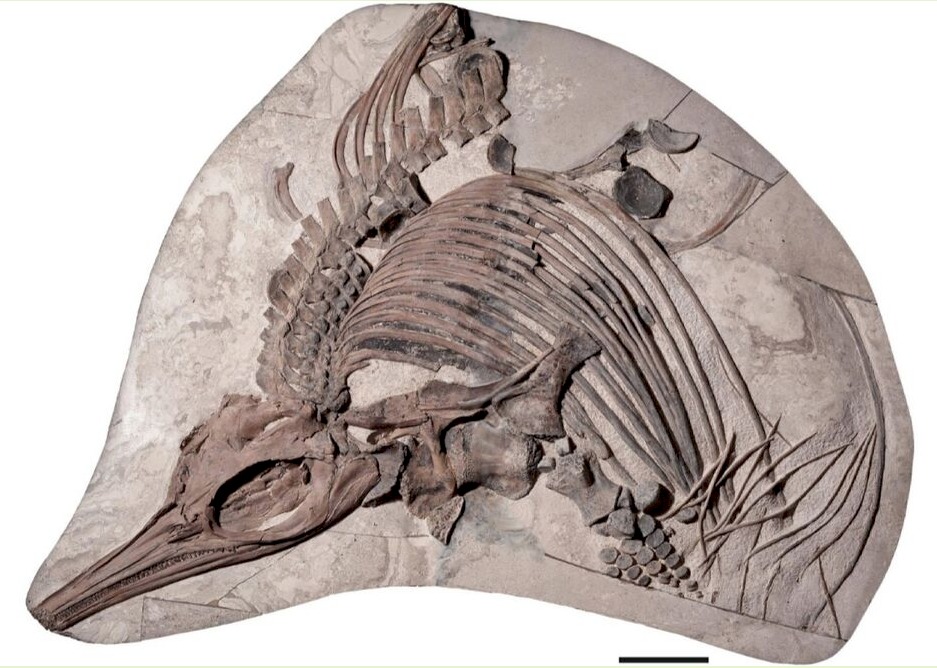
Thalassodraco was a medium sized ophthalmosaurid ichthyosaur, reaching up to 2.25 metres (7.4 ft) when fully grown. The holotype (MJML K1885; not including MJML K1886) appears to be relatively complete, with the known remains of MJML K1885 consisting of a well-preserved skull and jaw (although partially crushed in some areas), a complete set of ribs and a complete set of dorsals, most of the forelimbs, a complete ischiopubis and two chevrons. MJML K1886 is an isolated slab that consists of a single vertebra and two dorsal ribs.
The left side of the skull is well preserved, while much of the right side is obscured by the left side. The distal ends of the maxilla and dentary are broken off, making exact measurements of the skull impossible, although estimates place it at around 52 centimetres (20 in) when complete. Also, the orbit was crushed during preservation. The sclerotic ring is composed of at least 14 trapezoidal plates, with each of these plates measuring on average around 17.7 millimetres (0.70 in) long.
The anterior extremities of the premaxillae have been eroded away, however the remaining portions are well preserved. A tooth count of the premaxilla reveals 28 teeth preserved and the posteriormost margin of the premaxilla contacts the anterodorsal margin of the jugal, but crushing prevents determining the presence of a premaxilla-lachrymal contact. The left maxilla is poorly exposed and twenty teeth were counted in the maxilla in total. The left nasal is well exposed and well preserved, but it is only slightly crushed near the internasal foramen. The nasal is overlain by the prefrontal, with a poorly defined suture caused by crushing.
The left dentary is well preserved, while the right side is obscured by the left side. The tooth count of the extant portion of the dentary is 35, while around twenty teeth were probably present in the missing portion, giving a total tooth count of approximately 73.
The teeth of the dentary, maxilla and premaxilla are similar, with slender conical crowns on expanded roots. The maximum known tooth size for Thalassodraco in the rostrum is around 7 millimetres (0.28 in), with a minimum of 4 millimetres (0.16 in), although teeth in the missing sections of the skull may have reached up to 5 centimetres (2.0 in). This would mean that Thalassodraco had either a tooth length index of anywhere between 0.2–0.19 (according to the method used to calculate tooth length index proposed by Motani, 1999). The preserved teeth are mainly composed of smooth enamel, with rounded tips.
Hub AI
Thalassodraco AI simulator
(@Thalassodraco_simulator)
Thalassodraco
Thalassodraco (meaning "sea dragon") is an extinct genus of ophthalmosaurid ichthyosaur from the Late Jurassic (Tithonian) Kimmeridge Clay Formation of England. The type species, T. etchesi, was named in 2020, with the epithet in honour of the discoverer of the holotype, Steve Etches.
The holotype, MJML K1885 and the isolated slab MJML K1886, and referred specimen, MJML K1174, were discovered by plumber turned palaeontologist Steve Etches in 2009 and he added it to his personal fossil collection. He put the fossil on display alongside the rest of his collection when his museum, The Etches Collection, opened to the public in 2016. According to Jacobs & Martill (2020), Etches' museum contains "many ichthyosaurs, including several articulated specimens and numerous isolated skull bones, vertebrae, girdle elements and fore and hind limbs. The majority of these specimens remain unstudied and several appear, at first glance, new to science." Photographs were provided by Steve Etches when he was notified that the fossil belonged to a new genus in 2016 and the species Thalassodraco etchesi was described in 2020 by Megan L. Jacobs and David M. Martill.
The specimens were discovered in strata of the Kimmeridge Clay dating from the Tithonian, the final stage of the Late Jurassic, and belonging to the Pectinatites pectinatus ammonite zone, indicating the fossils were between 149.3 and 149 million years old.
Thalassodraco was a medium sized ophthalmosaurid ichthyosaur, reaching up to 2.25 metres (7.4 ft) when fully grown. The holotype (MJML K1885; not including MJML K1886) appears to be relatively complete, with the known remains of MJML K1885 consisting of a well-preserved skull and jaw (although partially crushed in some areas), a complete set of ribs and a complete set of dorsals, most of the forelimbs, a complete ischiopubis and two chevrons. MJML K1886 is an isolated slab that consists of a single vertebra and two dorsal ribs.
The left side of the skull is well preserved, while much of the right side is obscured by the left side. The distal ends of the maxilla and dentary are broken off, making exact measurements of the skull impossible, although estimates place it at around 52 centimetres (20 in) when complete. Also, the orbit was crushed during preservation. The sclerotic ring is composed of at least 14 trapezoidal plates, with each of these plates measuring on average around 17.7 millimetres (0.70 in) long.
The anterior extremities of the premaxillae have been eroded away, however the remaining portions are well preserved. A tooth count of the premaxilla reveals 28 teeth preserved and the posteriormost margin of the premaxilla contacts the anterodorsal margin of the jugal, but crushing prevents determining the presence of a premaxilla-lachrymal contact. The left maxilla is poorly exposed and twenty teeth were counted in the maxilla in total. The left nasal is well exposed and well preserved, but it is only slightly crushed near the internasal foramen. The nasal is overlain by the prefrontal, with a poorly defined suture caused by crushing.
The left dentary is well preserved, while the right side is obscured by the left side. The tooth count of the extant portion of the dentary is 35, while around twenty teeth were probably present in the missing portion, giving a total tooth count of approximately 73.
The teeth of the dentary, maxilla and premaxilla are similar, with slender conical crowns on expanded roots. The maximum known tooth size for Thalassodraco in the rostrum is around 7 millimetres (0.28 in), with a minimum of 4 millimetres (0.16 in), although teeth in the missing sections of the skull may have reached up to 5 centimetres (2.0 in). This would mean that Thalassodraco had either a tooth length index of anywhere between 0.2–0.19 (according to the method used to calculate tooth length index proposed by Motani, 1999). The preserved teeth are mainly composed of smooth enamel, with rounded tips.
Recent media