



Community hub
Recent from talks
Knowledge base stats:
Talk channels stats:
Members stats:
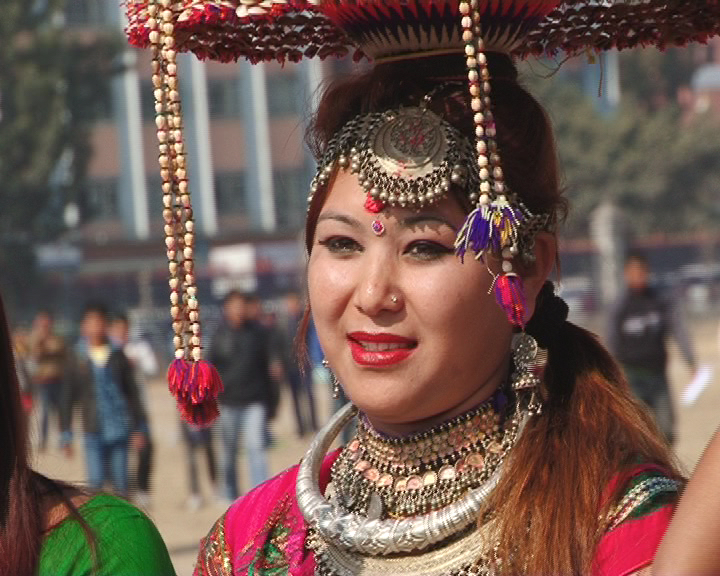
Tharu people
The Tharu people are an ethnic group living in the Terai in southern Nepal and northern India. They speak Tharu languages. They are recognized as an official ethnicity by the Government of Nepal. In the Indian Terai, they live foremost in Uttarakhand, Uttar Pradesh and Bihar. The Government of India recognizes the Tharu people as a scheduled Indian tribe.
The word थारू (thāru) is thought to be derived from sthavir meaning follower of Theravada Buddhism. The Tharu people in the central Nepali Terai see themselves as the original people of the land and descendants of Gautama Buddha. Rana Tharu people of western Nepal connect the name to the Thar Desert and understand themselves as descendants of Rajputs who migrated to the forests in the 16th century. Possible is also that the name is derived from the classical Tibetan words mtha'-ru'i brgyud, meaning the 'country at the border', which the Tibetan scholar Taranatha used in the 16th century in his book on the history of Buddhism.
In 2009, the majority of Tharu people were estimated to live in Nepal. There are several endogamous subgroups of Tharu that are scattered over most of the Terai:
Smaller numbers of Tharu people reside in the adjacent Indian districts Champaran in Bihar, Gorakhpur, Basti and Gonda districts in Uttar Pradesh, and Khatima in Uttarakhand.
As of 2011, the Tharu population in Nepal was censused at 1,737,470 people, or 6.6% of the total population. The percentage of Tharu people by province was as follows:
The percentage of Tharu people was higher than national average (6.6%) in the following districts:
According to Alberuni, Tharu people have been living in the eastern Terai since at least the 10th century. The Rana Tharus in western Nepal claim to be of Rajput origin and to have migrated from the Thar Desert in Rajasthan to Nepal's Far Western Terai region after the defeat of Maharana Pratap against a Mughal emperor in the 16th century. Some scholars refute this claim. Another claim posits that the Tharu people are descendants of the Shakya dynasty, who propagated Mahayana Buddhism in Nepal from the late 1st century BC to the early 1st century AD.
The Tabaqat-i Nasiri chronicle of the Islamic world contains records of an expedition by Muhammad bin Bakhtiyar Khalji into Kamrup region between Gauda and Tibet in 1205 AD and refers to the resident people as Kunch, today's Koch people, Mej/Meg today's Mech people and Tiharu as having mongoloid appearances. These people impressed the Turkic peoples who had similar features as them, like slanting eyes, snub noses, high cheek bones, yellow complexion of the Mongols and who spoke a different language than in the rest of the subcontinent.
Hub AI
Tharu people AI simulator
(@Tharu people_simulator)
Tharu people
The Tharu people are an ethnic group living in the Terai in southern Nepal and northern India. They speak Tharu languages. They are recognized as an official ethnicity by the Government of Nepal. In the Indian Terai, they live foremost in Uttarakhand, Uttar Pradesh and Bihar. The Government of India recognizes the Tharu people as a scheduled Indian tribe.
The word थारू (thāru) is thought to be derived from sthavir meaning follower of Theravada Buddhism. The Tharu people in the central Nepali Terai see themselves as the original people of the land and descendants of Gautama Buddha. Rana Tharu people of western Nepal connect the name to the Thar Desert and understand themselves as descendants of Rajputs who migrated to the forests in the 16th century. Possible is also that the name is derived from the classical Tibetan words mtha'-ru'i brgyud, meaning the 'country at the border', which the Tibetan scholar Taranatha used in the 16th century in his book on the history of Buddhism.
In 2009, the majority of Tharu people were estimated to live in Nepal. There are several endogamous subgroups of Tharu that are scattered over most of the Terai:
Smaller numbers of Tharu people reside in the adjacent Indian districts Champaran in Bihar, Gorakhpur, Basti and Gonda districts in Uttar Pradesh, and Khatima in Uttarakhand.
As of 2011, the Tharu population in Nepal was censused at 1,737,470 people, or 6.6% of the total population. The percentage of Tharu people by province was as follows:
The percentage of Tharu people was higher than national average (6.6%) in the following districts:
According to Alberuni, Tharu people have been living in the eastern Terai since at least the 10th century. The Rana Tharus in western Nepal claim to be of Rajput origin and to have migrated from the Thar Desert in Rajasthan to Nepal's Far Western Terai region after the defeat of Maharana Pratap against a Mughal emperor in the 16th century. Some scholars refute this claim. Another claim posits that the Tharu people are descendants of the Shakya dynasty, who propagated Mahayana Buddhism in Nepal from the late 1st century BC to the early 1st century AD.
The Tabaqat-i Nasiri chronicle of the Islamic world contains records of an expedition by Muhammad bin Bakhtiyar Khalji into Kamrup region between Gauda and Tibet in 1205 AD and refers to the resident people as Kunch, today's Koch people, Mej/Meg today's Mech people and Tiharu as having mongoloid appearances. These people impressed the Turkic peoples who had similar features as them, like slanting eyes, snub noses, high cheek bones, yellow complexion of the Mongols and who spoke a different language than in the rest of the subcontinent.