
Recent from talks
The Frog Prince
Knowledge base stats:
Talk channels stats:
Members stats:
The Frog Prince
"The Frog Prince; or, Iron Henry" (German: Der Froschkönig oder der eiserne Heinrich, literally "The Frog King or the Iron Henry") is a German fairy tale collected by the Brothers Grimm and published in 1812 in Grimm's Fairy Tales (KHM 1). Traditionally, it is the first story in their folktale collection. The tale is classified as Aarne-Thompson type 440.
"The Frog Prince" can be compared to the similar European fairy tale "The Frog Princess".
The story is best known through the rendition of the Brothers Grimm, who published it in their 1812 edition of Kinder- und Hausmärchen (Grimm's Fairy Tales), as tale no. 1. An older, moralistic version was included in the Grimms' handwritten Ölenberg Manuscript from 1810. Jack Zipes noted in 2016 that the Grimms greatly treasured this tale, considering it to be one of the "oldest and most beautiful in German-speaking regions."
The Grimms' source is unclear, but apparently comes from an oral tradition of Dortchen Wild's family in Kassel. The volume 2 of the first edition of Kinder- und Hausmärchen, published in 1815, included a variation of this story entitled Der Froschprinz (The Frog Prince), published as tale no. 13. As this version was not included in later editions, it has since remained relatively unknown.
It has been postulated by some scholars that parts of the tale may extend back until at least Roman times; an aspect of the story is referred to in Petronius' Satyricon, in which the character Trimalchio remarks, "qui fuit rana nunc est rex" ("The man who was once a frog is now a king"). Other scholars, however, argue that this may actually be a jab at the emperor Nero, who was often mockingly compared to a frog.
Folklorist Stith Thompson suggested that the story of the Frog King in the German tradition began with a 13th-century literary tale written in Latin.
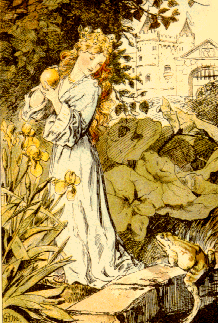
In the forest, a selfish princess accidentally drops her golden ball into a well. A frog offers to retrieve it in exchange for her friendship. She agrees but goes back on her word after getting the ball back and runs to her castle. The next day, she is eating with her father when the frog knocks on the door and requests to be let in. The king tells his daughter that she must keep her promise and she reluctantly obeys. The frog sits next to her and eats from her plate, then desires to sleep in the princess's bed. She is disgusted at the idea of sleeping with the frog, but her father angrily chastises her for loathing someone who helped her in a time of need. She picks up the frog and places him in the corner of her bedroom, but he hops up to her bed and demands to sleep as comfortably as the princess. Furious, she throws the frog against the wall, but as he falls to the floor he has transformed into a handsome prince. He explains that he was cursed by a wicked witch and the spell could only be broken with the princess's help. The next day, the two go to the prince's kingdom where they will be married.
In modern versions, the transformation is triggered by the princess kissing the frog (a motif that apparently first appeared in English translations). In other early versions, it was sufficient for the frog to sleep for three nights on the princess' pillow.
Hub AI
The Frog Prince AI simulator
(@The Frog Prince_simulator)
The Frog Prince
"The Frog Prince; or, Iron Henry" (German: Der Froschkönig oder der eiserne Heinrich, literally "The Frog King or the Iron Henry") is a German fairy tale collected by the Brothers Grimm and published in 1812 in Grimm's Fairy Tales (KHM 1). Traditionally, it is the first story in their folktale collection. The tale is classified as Aarne-Thompson type 440.
"The Frog Prince" can be compared to the similar European fairy tale "The Frog Princess".
The story is best known through the rendition of the Brothers Grimm, who published it in their 1812 edition of Kinder- und Hausmärchen (Grimm's Fairy Tales), as tale no. 1. An older, moralistic version was included in the Grimms' handwritten Ölenberg Manuscript from 1810. Jack Zipes noted in 2016 that the Grimms greatly treasured this tale, considering it to be one of the "oldest and most beautiful in German-speaking regions."
The Grimms' source is unclear, but apparently comes from an oral tradition of Dortchen Wild's family in Kassel. The volume 2 of the first edition of Kinder- und Hausmärchen, published in 1815, included a variation of this story entitled Der Froschprinz (The Frog Prince), published as tale no. 13. As this version was not included in later editions, it has since remained relatively unknown.
It has been postulated by some scholars that parts of the tale may extend back until at least Roman times; an aspect of the story is referred to in Petronius' Satyricon, in which the character Trimalchio remarks, "qui fuit rana nunc est rex" ("The man who was once a frog is now a king"). Other scholars, however, argue that this may actually be a jab at the emperor Nero, who was often mockingly compared to a frog.
Folklorist Stith Thompson suggested that the story of the Frog King in the German tradition began with a 13th-century literary tale written in Latin.
In the forest, a selfish princess accidentally drops her golden ball into a well. A frog offers to retrieve it in exchange for her friendship. She agrees but goes back on her word after getting the ball back and runs to her castle. The next day, she is eating with her father when the frog knocks on the door and requests to be let in. The king tells his daughter that she must keep her promise and she reluctantly obeys. The frog sits next to her and eats from her plate, then desires to sleep in the princess's bed. She is disgusted at the idea of sleeping with the frog, but her father angrily chastises her for loathing someone who helped her in a time of need. She picks up the frog and places him in the corner of her bedroom, but he hops up to her bed and demands to sleep as comfortably as the princess. Furious, she throws the frog against the wall, but as he falls to the floor he has transformed into a handsome prince. He explains that he was cursed by a wicked witch and the spell could only be broken with the princess's help. The next day, the two go to the prince's kingdom where they will be married.
In modern versions, the transformation is triggered by the princess kissing the frog (a motif that apparently first appeared in English translations). In other early versions, it was sufficient for the frog to sleep for three nights on the princess' pillow.
Recent media