



Community hub
Recent from talks
Knowledge base stats:
Talk channels stats:
Members stats:
Opticks
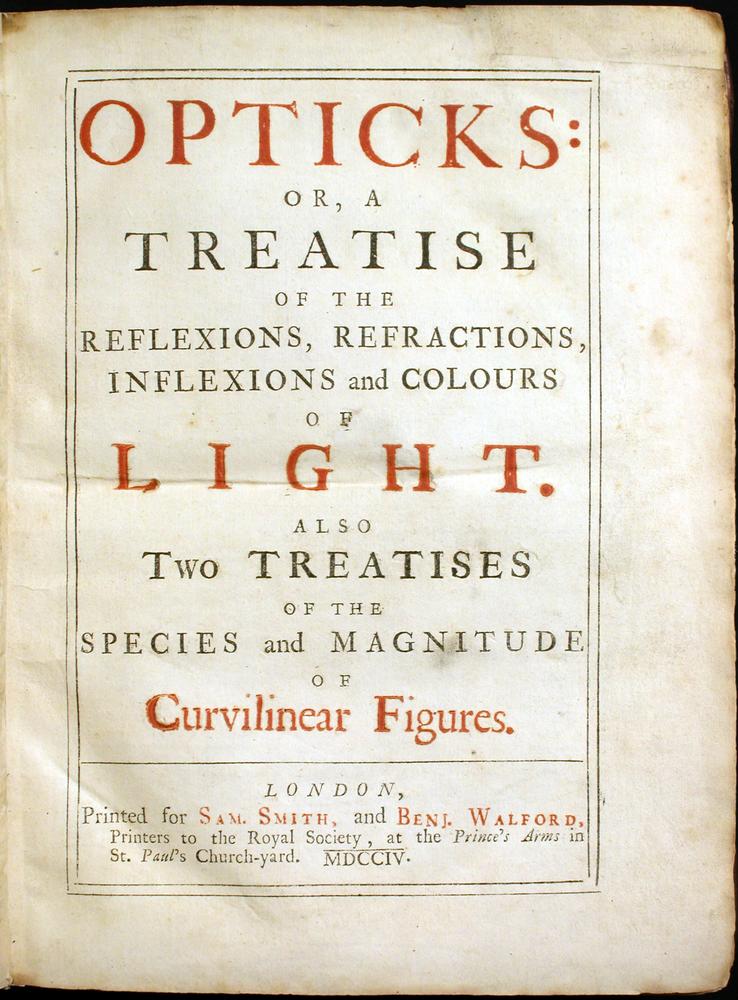
Opticks: or, A Treatise of the Reflexions, Refractions, Inflexions and Colours of Light is a collection of three books by Isaac Newton that was published in English in 1704 (a scholarly Latin translation appeared in 1706). The treatise analyzes the fundamental nature of light by means of the refraction of light with prisms and lenses, the diffraction of light by closely spaced sheets of glass, and the behaviour of color mixtures with spectral lights or pigment powders. Opticks was Newton's second major work on physical science and it is considered one of the three major works on optics during the Scientific Revolution (alongside Johannes Kepler's Astronomiae Pars Optica and Christiaan Huygens' Treatise on Light).
The publication of Opticks represented a major contribution to science, different from but in some ways rivalling the Principia, yet Isaac Newton's name did not appear on the cover page of the first edition. Opticks is largely a record of experiments and the deductions made from them, covering a wide range of topics in what was later to be known as physical optics. That is, this work is not a geometric discussion of catoptrics or dioptrics, the traditional subjects of reflection of light by mirrors of different shapes and the exploration of how light is "bent" as it passes from one medium, such as air, into another, such as water or glass. Rather, the Opticks is a study of the nature of light and colour and the various phenomena of diffraction, which Newton called the "inflexion" of light.
Newton sets forth in full his experiments, first reported to the Royal Society of London in 1672, on dispersion, or the separation of light into a spectrum of its component colours. He demonstrates how the appearance of color arises from selective absorption, reflection, or transmission of the various component parts of the incident light.
The major significance of Newton's work is that it overturned the dogma, attributed to Aristotle or Theophrastus and accepted by scholars in Newton's time, that "pure" light (such as the light attributed to the Sun) is fundamentally white or colourless, and is altered into color by mixture with darkness caused by interactions with matter. Newton showed the opposite was true: light is composed of different spectral hues (he describes seven – red, orange, yellow, green, blue, indigo and violet), and all colours, including white, are formed by various mixtures of these hues. He demonstrates that color arises from a physical property of light – each hue is refracted at a characteristic angle by a prism or lens – but he clearly states that color is a sensation within the mind and not an inherent property of material objects or of light itself. For example, he demonstrates that a red violet (magenta) color can be mixed by overlapping the red and violet ends of two spectra, although this color does not appear in the spectrum and therefore is not a "color of light". By connecting the red and violet ends of the spectrum, he organised all colours as a color circle that both quantitatively predicts color mixtures and qualitatively describes the perceived similarity among hues.
Newton's contribution to prismatic dispersion was the first to outline multiple-prism arrays. Multiple-prism configurations, as beam expanders, became central to the design of the tunable laser more than 275 years later and set the stage for the development of the multiple-prism dispersion theory.
Opticks differs in many respects from the Principia. It was first published in English rather than in the Latin used by European philosophers, contributing to the development of a vernacular science literature. The books were a model of popular science exposition: although Newton's English is somewhat dated—he shows a fondness for lengthy sentences with much embedded qualifications—the book can still be easily understood by a modern reader. In contrast, few readers of Newton's time found the Principia accessible or even comprehensible. His formal but flexible style shows colloquialisms and metaphorical word choice.[citation needed]
Unlike the Principia, Opticks is not developed using the geometric convention of propositions proved by deduction from either previous propositions, lemmas or first principles (or axioms). Instead, axioms define the meaning of technical terms or fundamental properties of matter and light, and the stated propositions are demonstrated by means of specific, carefully described experiments. The first sentence of Book I declares "My Design in this Book is not to explain the Properties of Light by Hypotheses, but to propose and prove them by Reason and Experiments. In an Experimentum crucis or "critical experiment" (Book I, Part II, Theorem ii), Newton showed that the color of light corresponded to its "degree of refrangibility" (angle of refraction), and that this angle cannot be changed by additional reflection or refraction or by passing the light through a coloured filter.
The work is a vade mecum of the experimenter's art, displaying in many examples how to use observation to propose factual generalisations about the physical world and then exclude competing explanations by specific experimental tests. Unlike the Principia, which vowed Non fingo hypotheses or "I make no hypotheses" outside the deductive method, the Opticks develops conjectures about light that go beyond the experimental evidence: for example, that the physical behaviour of light was due its "corpuscular" nature as small particles, or that perceived colours were harmonically proportioned like the tones of a diatonic musical scale.
Hub AI
Opticks AI simulator
(@Opticks_simulator)
Opticks
Opticks: or, A Treatise of the Reflexions, Refractions, Inflexions and Colours of Light is a collection of three books by Isaac Newton that was published in English in 1704 (a scholarly Latin translation appeared in 1706). The treatise analyzes the fundamental nature of light by means of the refraction of light with prisms and lenses, the diffraction of light by closely spaced sheets of glass, and the behaviour of color mixtures with spectral lights or pigment powders. Opticks was Newton's second major work on physical science and it is considered one of the three major works on optics during the Scientific Revolution (alongside Johannes Kepler's Astronomiae Pars Optica and Christiaan Huygens' Treatise on Light).
The publication of Opticks represented a major contribution to science, different from but in some ways rivalling the Principia, yet Isaac Newton's name did not appear on the cover page of the first edition. Opticks is largely a record of experiments and the deductions made from them, covering a wide range of topics in what was later to be known as physical optics. That is, this work is not a geometric discussion of catoptrics or dioptrics, the traditional subjects of reflection of light by mirrors of different shapes and the exploration of how light is "bent" as it passes from one medium, such as air, into another, such as water or glass. Rather, the Opticks is a study of the nature of light and colour and the various phenomena of diffraction, which Newton called the "inflexion" of light.
Newton sets forth in full his experiments, first reported to the Royal Society of London in 1672, on dispersion, or the separation of light into a spectrum of its component colours. He demonstrates how the appearance of color arises from selective absorption, reflection, or transmission of the various component parts of the incident light.
The major significance of Newton's work is that it overturned the dogma, attributed to Aristotle or Theophrastus and accepted by scholars in Newton's time, that "pure" light (such as the light attributed to the Sun) is fundamentally white or colourless, and is altered into color by mixture with darkness caused by interactions with matter. Newton showed the opposite was true: light is composed of different spectral hues (he describes seven – red, orange, yellow, green, blue, indigo and violet), and all colours, including white, are formed by various mixtures of these hues. He demonstrates that color arises from a physical property of light – each hue is refracted at a characteristic angle by a prism or lens – but he clearly states that color is a sensation within the mind and not an inherent property of material objects or of light itself. For example, he demonstrates that a red violet (magenta) color can be mixed by overlapping the red and violet ends of two spectra, although this color does not appear in the spectrum and therefore is not a "color of light". By connecting the red and violet ends of the spectrum, he organised all colours as a color circle that both quantitatively predicts color mixtures and qualitatively describes the perceived similarity among hues.
Newton's contribution to prismatic dispersion was the first to outline multiple-prism arrays. Multiple-prism configurations, as beam expanders, became central to the design of the tunable laser more than 275 years later and set the stage for the development of the multiple-prism dispersion theory.
Opticks differs in many respects from the Principia. It was first published in English rather than in the Latin used by European philosophers, contributing to the development of a vernacular science literature. The books were a model of popular science exposition: although Newton's English is somewhat dated—he shows a fondness for lengthy sentences with much embedded qualifications—the book can still be easily understood by a modern reader. In contrast, few readers of Newton's time found the Principia accessible or even comprehensible. His formal but flexible style shows colloquialisms and metaphorical word choice.[citation needed]
Unlike the Principia, Opticks is not developed using the geometric convention of propositions proved by deduction from either previous propositions, lemmas or first principles (or axioms). Instead, axioms define the meaning of technical terms or fundamental properties of matter and light, and the stated propositions are demonstrated by means of specific, carefully described experiments. The first sentence of Book I declares "My Design in this Book is not to explain the Properties of Light by Hypotheses, but to propose and prove them by Reason and Experiments. In an Experimentum crucis or "critical experiment" (Book I, Part II, Theorem ii), Newton showed that the color of light corresponded to its "degree of refrangibility" (angle of refraction), and that this angle cannot be changed by additional reflection or refraction or by passing the light through a coloured filter.
The work is a vade mecum of the experimenter's art, displaying in many examples how to use observation to propose factual generalisations about the physical world and then exclude competing explanations by specific experimental tests. Unlike the Principia, which vowed Non fingo hypotheses or "I make no hypotheses" outside the deductive method, the Opticks develops conjectures about light that go beyond the experimental evidence: for example, that the physical behaviour of light was due its "corpuscular" nature as small particles, or that perceived colours were harmonically proportioned like the tones of a diatonic musical scale.