Hubbry Logo
OpticksOpticksMain
Open search
Opticks
Community hub
Opticks
logo
8 pages, 0 posts
0 subscribers
Be the first to start a discussion here.
Contribute something
Opticks
Opticks
from Wikipedia

Opticks: or, A Treatise of the Reflexions, Refractions, Inflexions and Colours of Light is a collection of three books by Isaac Newton that was published in English in 1704 (a scholarly Latin translation appeared in 1706).[1] The treatise analyzes the fundamental nature of light by means of the refraction of light with prisms and lenses, the diffraction of light by closely spaced sheets of glass, and the behaviour of color mixtures with spectral lights or pigment powders. Opticks was Newton's second major work on physical science and it is considered one of the three major works on optics during the Scientific Revolution (alongside Johannes Kepler's Astronomiae Pars Optica and Christiaan Huygens' Treatise on Light).

Key Information

Overview

[edit]

The publication of Opticks represented a major contribution to science, different from but in some ways rivalling the Principia, yet Isaac Newton's name did not appear on the cover page of the first edition. Opticks is largely a record of experiments and the deductions made from them, covering a wide range of topics in what was later to be known as physical optics.[1] That is, this work is not a geometric discussion of catoptrics or dioptrics, the traditional subjects of reflection of light by mirrors of different shapes and the exploration of how light is "bent" as it passes from one medium, such as air, into another, such as water or glass. Rather, the Opticks is a study of the nature of light and colour and the various phenomena of diffraction, which Newton called the "inflexion" of light.

Newton sets forth in full his experiments, first reported to the Royal Society of London in 1672,[2] on dispersion, or the separation of light into a spectrum of its component colours. He demonstrates how the appearance of color arises from selective absorption, reflection, or transmission of the various component parts of the incident light.

The major significance of Newton's work is that it overturned the dogma, attributed to Aristotle or Theophrastus and accepted by scholars in Newton's time, that "pure" light (such as the light attributed to the Sun) is fundamentally white or colourless, and is altered into color by mixture with darkness caused by interactions with matter. Newton showed the opposite was true: light is composed of different spectral hues (he describes seven – red, orange, yellow, green, blue, indigo and violet), and all colours, including white, are formed by various mixtures of these hues. He demonstrates that color arises from a physical property of light – each hue is refracted at a characteristic angle by a prism or lens – but he clearly states that color is a sensation within the mind and not an inherent property of material objects or of light itself. For example, he demonstrates that a red violet (magenta) color can be mixed by overlapping the red and violet ends of two spectra, although this color does not appear in the spectrum and therefore is not a "color of light". By connecting the red and violet ends of the spectrum, he organised all colours as a color circle that both quantitatively predicts color mixtures and qualitatively describes the perceived similarity among hues.

Newton's contribution to prismatic dispersion was the first to outline multiple-prism arrays. Multiple-prism configurations, as beam expanders, became central to the design of the tunable laser more than 275 years later and set the stage for the development of the multiple-prism dispersion theory.[3][4]

Comparison to the Principia

[edit]
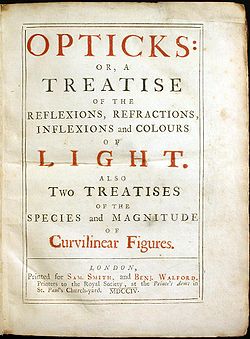
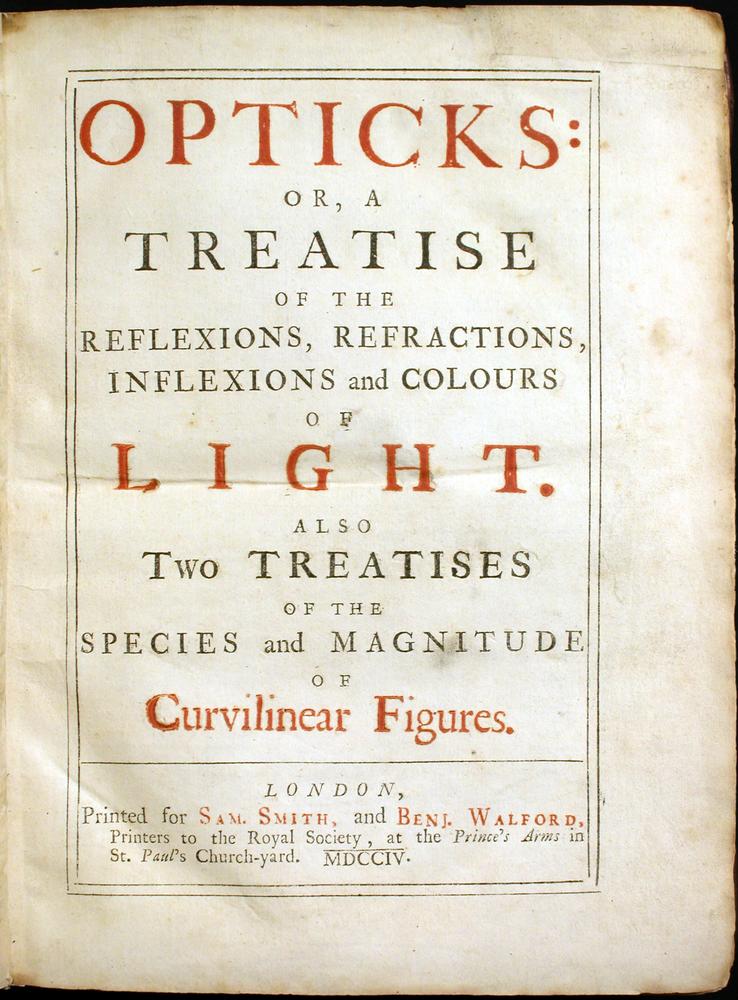
1704 first edition of Opticks in the Science Museum, London.

Opticks differs in many respects from the Principia. It was first published in English rather than in the Latin[5] used by European philosophers, contributing to the development of a vernacular science literature. The books were a model of popular science exposition: although Newton's English is somewhat dated—he shows a fondness for lengthy sentences with much embedded qualifications—the book can still be easily understood by a modern reader. In contrast, few readers of Newton's time found the Principia accessible or even comprehensible. His formal but flexible style shows colloquialisms and metaphorical word choice.[citation needed]

Unlike the Principia, Opticks is not developed using the geometric convention of propositions proved by deduction from either previous propositions, lemmas or first principles (or axioms). Instead, axioms define the meaning of technical terms or fundamental properties of matter and light, and the stated propositions are demonstrated by means of specific, carefully described experiments. The first sentence of Book I declares "My Design in this Book is not to explain the Properties of Light by Hypotheses, but to propose and prove them by Reason and Experiments. In an Experimentum crucis or "critical experiment" (Book I, Part II, Theorem ii), Newton showed that the color of light corresponded to its "degree of refrangibility" (angle of refraction), and that this angle cannot be changed by additional reflection or refraction or by passing the light through a coloured filter.[6]

The work is a vade mecum of the experimenter's art, displaying in many examples how to use observation to propose factual generalisations about the physical world and then exclude competing explanations by specific experimental tests. Unlike the Principia, which vowed Non fingo hypotheses or "I make no hypotheses" outside the deductive method, the Opticks develops conjectures about light that go beyond the experimental evidence: for example, that the physical behaviour of light was due its "corpuscular" nature as small particles, or that perceived colours were harmonically proportioned like the tones of a diatonic musical scale.

Queries

[edit]
Book III to the 1730 edition of Opticks containing queries 1 to 4.

Newton originally considered to write four books, but he dropped the last book on action at a distance.[7] Instead he concluded Opticks a set of unanswered questions and positive assertions referred as queries in Book III. The first set of queries were brief, but the later ones became short essays, filling many pages. In the first edition, these were sixteen such queries;[7][8] that number was increased to 23 in the Latin edition, published in 1706,[7] and then in the revised English edition, published in 1717/18. In the fourth edition of 1730, there were 31 queries.

These queries, especially the later ones, deal with a wide range of physical phenomena that go beyond the topic of optics. The queries concern the nature and transmission of heat; the possible cause of gravity; electrical phenomena; the nature of chemical action; the way in which God created matter; the proper way to do science; and even the ethical conduct of human beings.[8] These queries are not really questions in the ordinary sense. These queries are almost all posed in the negative, as rhetorical questions.[8] That is, Newton does not ask whether light "is" or "may be" a "body." Rather, he declares: "Is not Light a Body?" Stephen Hales, a firm Newtonian of the early eighteenth century, declared that this was Newton's way of explaining "by Quaere."[8]

The first query reads: "Do not Bodies act upon Light at a distance, and by their action bend its Rays; and is not this action (caeteris paribus) strongest at the least distance?" suspecting on the effect of gravity on the trajectory of light rays.[9] This query predates the prediction of gravitational lensing by Albert Einstein's general relativity by two centuries and later confirmed by Eddington experiment in 1919.[9] The first part of query 30 reads "Are not gross Bodies and Light convertible into one another" thereby anticipating mass-energy equivalence.[10] Query 6 of the book reads "Do not black Bodies conceive heat more easily from Light than those of other Colours do, by reason that the Light falling on them is not reflected outwards, but enters into the Bodies, and is often reflected and refracted within them, until it be stifled and lost?", thereby introducing the concept of a black body.[11][12]

The last query (number 31) wonders if a corpuscular theory could explain how different substances react more to certain substances than to others, in particular how aqua fortis (nitric acid) reacts more with calamine that with iron. This 31st query has been often been linked to the origin of the concept of affinity in chemical reactions. Various 18th century historians and chemists like William Cullen and Torbern Bergman, credited Newton for the development affinity tables.[13][a]

Reception

[edit]

The Opticks was widely read and debated in England and on the Continent. The early presentation of the work to the Royal Society stimulated a bitter dispute between Newton and Robert Hooke over the "corpuscular" or particle theory of light, which prompted Newton to postpone publication of the work until after Hooke's death in 1703. On the Continent, and in France in particular, both the Principia and the Opticks were initially rejected by many natural philosophers, who continued to defend Cartesian natural philosophy and the Aristotelian version of color, and claimed to find Newton's prism experiments difficult to replicate. Indeed, the Aristotelian theory of the fundamental nature of white light was defended into the 19th century, for example by the German writer Johann Wolfgang von Goethe in his 1810 Theory of Colours (German: Zur Farbenlehre).

Newtonian science became a central issue in the assault waged by the philosophes in the Age of Enlightenment against a natural philosophy based on the authority of ancient Greek or Roman naturalists or on deductive reasoning from first principles (the method advocated by French philosopher René Descartes), rather than on the application of mathematical reasoning to experience or experiment. Voltaire popularised Newtonian science, including the content of both the Principia and the Opticks, in his Elements de la philosophie de Newton (1738), and after about 1750 the combination of the experimental methods exemplified by the Opticks and the mathematical methods exemplified by the Principia were established as a unified and comprehensive model of Newtonian science. Some of the primary adepts in this new philosophy were such prominent figures as Benjamin Franklin, Antoine-Laurent Lavoisier, and James Black.

Subsequent to Newton, much has been amended. Thomas Young and Augustin-Jean Fresnel showed that the wave theory Christiaan Huygens described in his Treatise on Light (1690) could prove that colour is the visible manifestation of light's wavelength. Science also slowly came to recognize the difference between perception of colour and mathematisable optics. The German poet Goethe, with his epic diatribe Theory of Colours, could not shake the Newtonian foundation – but "one hole Goethe did find in Newton's armour.. Newton had committed himself to the doctrine that refraction without colour was impossible. He therefore thought that the object-glasses of telescopes must for ever remain imperfect, achromatism and refraction being incompatible. This inference was proved by Dollond to be wrong." (John Tyndall, 1880[14])

See also

[edit]

Notes

[edit]

References

[edit]
[edit]
Revisions and contributorsEdit on WikipediaRead on Wikipedia
from Grokipedia
Opticks: or, A Treatise of the Reflections, Refractions, Inflections and Colours of is a seminal work by the English natural philosopher , first published in 1704, that details his experimental studies on the properties of , including its , reflection, , and the production of colors. Written in English rather than Latin to reach a broader audience, the book emphasizes empirical observation over hypothetical explanations, marking a key advancement in the . demonstrates through prism experiments that white decomposes into a of seven colors—, orange, , , , , and violet—and that these colors correspond to rays of different refrangibilities, laying the groundwork for modern . The book is structured into three main parts: Book I, which explores the of and the heterogeneity of colors via propositions, experiments, and observations; Book II, which examines the colors arising from thin transparent plates and natural bodies, including phenomena like ; and Book III, which addresses the inflections (diffractions) of rays and concludes with 31 philosophical queries extending to broader , such as the nature of matter and forces. Later editions, including the 1717 second English edition and the 1730 fourth edition, incorporated revisions and additional queries by Newton himself. Appended to the first edition were two Latin treatises on curvilinear figures, representing Newton's early work on . Opticks significantly influenced subsequent scientific thought by promoting experimentation as the cornerstone of physics, inspiring fields from to , and contributing to the Enlightenment's empirical ethos. Despite Newton's , the work's detailed observations on wave-like behaviors, such as interference, anticipated later developments in . The text remains a foundational document in the , available in modern reprints from sources like .

Background and Publication

Historical Context

During the Great Plague of 1665–1666, which forced the closure of the University of Cambridge, Isaac Newton retreated to his family home at Woolsthorpe Manor in Lincolnshire. In the quiet of his bedroom, he conducted his first significant prism experiments, passing a narrow beam of sunlight through a small hole in the window shutter and a triangular glass prism to project a spectrum onto the far wall. These trials, initially pursued out of curiosity while also grinding telescope lenses, demonstrated that white light decomposes into a spectrum of colors due to rays of differing refrangibility, overturning the common assumption that refraction merely modifies a uniform light to produce hues. Newton detailed these findings in a letter to Henry Oldenburg, secretary of the Royal Society, dated 6 February 1671/72, which was presented at a society meeting on 19 February and published in the Philosophical Transactions. His theory built upon but critiqued prior influences, including ' corpuscular model of propagation in La Dioptrique (1637), which treated as pressure in a medium, and Robert Hooke's suggestions of vibrational pulses in (1665). However, the presentation ignited disputes, notably with Hooke, who favored a wave-like undulatory and challenged Newton's claim that colors are inherent properties of rays rather than modifications imposed by . In a letter to Oldenburg dated 21 December 1675, Newton defended his corpuscular conception of against wave theories, positing that light rays are minute particles impinging on a subtle aethereal medium to explain phenomena like and color, distinct from Hooke's vibrational medium. These exchanges highlighted Newton's commitment to experimental evidence over speculative hypotheses. Later, his work contrasted with ' explicit wave theory in Traité de la Lumière (1690), though early disputes centered on Hooke. After the publication of in 1687, which emphasized mathematical deduction, Newton shifted toward a predominantly experimental approach in , driven by meticulous observations to probe unresolved questions, positioning Opticks as a complementary empirical counterpart to his gravitational treatise.

Publication Details

Opticks was first published anonymously in English in 1704 by the printers Samuel Smith and Benjamin Walford in , who served as official printers to the Royal Society. The work appeared following the death of in 1703, allowing Newton to release his long-developed ideas on without immediate contention from a key rival. This choice of English over Latin, the conventional language of scientific scholarship, reflected Newton's intent to reach a wider readership beyond academic elites, including practical audiences such as instrument makers and craftsmen interested in applied . The first edition featured 19 folding engraved plates, derived directly from Newton's own detailed drawings to illustrate key experiments and phenomena. Appended to the main text were two Latin treatises, "Enumeratio Linearum Tertii Ordinis" and "Tractatus de Enumeratione Linearum Curvarum," representing Newton's early work on to establish his priority over . These illustrations supported the book's experimental emphasis, distinguishing it from the more mathematical published in Latin seventeen years earlier. The volume's accessible prose and visual aids contributed to its rapid dissemination within scientific circles during the Restoration era's burgeoning interest in empirical . Initial copies were presented to the Royal Society, where Newton, as a fellow and later president, ensured alignment with institutional standards. Newton retained oversight of subsequent revisions, particularly for the 1706 Latin translation titled Optice, which he expanded with additional queries while preserving the core English structure. This control allowed him to refine the text amid growing acclaim, solidifying Opticks as a cornerstone of optical theory in the early eighteenth century.

Editions and Revisions

The first significant revision following the original 1704 English edition came in 1706 with the Latin translation titled Optice: sive de reflexionibus, refractionibus, inflexionibus & coloribus lucis, prepared by under Newton's supervision. This edition included minor clarifications to the text for improved precision and an added by Newton, which emphasized the experimental basis of his optical theories while maintaining the core structure of the original. The second English edition, published in 1717 (with a second issue dated 1718), marked a substantial expansion, particularly in the appended Queries section, which grew from 23 to 31. These additions incorporated Newton's maturing ideas on topics beyond optics, including , , and alchemical principles, reflecting his broader philosophical inquiries into natural forces. In the third English edition of 1721, Newton made corrections and minor revisions to the Queries, incorporating further theological reflections without altering the main body of the text. The fourth English edition, released in 1730 after Newton's death in 1727, was based on his final corrections to the third edition and included editorial notes for clarity; it became the standard reference for subsequent reprints throughout the , with at least a dozen additional editions and translations appearing by 1800. Throughout these revisions, Newton approached additions to the Queries with caution, framing them as speculative questions rather than definitive statements to sidestep controversy, as seen in Query 31, which explores God's active role in maintaining the harmony of nature.

Book Structure

Overall Organization

Opticks begins with a preface outlining Newton's intent to explain the properties of light through reason and experiments rather than hypotheses, followed by eight definitions clarifying key terms such as rays and refrangibility, and seven axioms establishing fundamental principles of reflection and refraction. The core of the treatise is divided into three books: Book I, which explores the refraction of light, dispersion, and the heterogeneity of colors via propositions, experiments, and observations; Book II, which examines the colors arising from reflections and refractions in thick and thin transparent substances and natural bodies; and Book III, which addresses the inflections (diffractions) of light rays. Each proposition in Books I and II is rigorously supported by numbered experiments and observations demonstrating the claims, often with accompanying scholia that provide interpretive commentary and references to related findings, reflecting Newton's commitment to an inductive, experimental approach. Book III consists primarily of observations without formal propositions, leading into the Queries. The treatise concludes with a series of Queries (16 in the 1704 first edition, expanded to 31 by the 1730 fourth edition), which shift from demonstrative propositions to speculative inquiries on topics such as the nature of , , and universal forces, inviting further investigation without dogmatic assertion. Later editions, including the 1717 second English edition and the 1730 fourth, incorporated revisions and additional queries by Newton. Overall, the work comprises approximately 400 pages in the 1730 edition, emphasizing qualitative descriptions of phenomena, detailed experimental setups, and illustrative plates over formal mathematical derivations, in marked contrast to the geometric rigor of Newton's . This organization facilitates a progressive build-up of knowledge, from basic properties of and color to observations on natural bodies and speculative extensions.

Part I: Foundations of Light and Color

Part I of Opticks (corresponding to Book I) establishes the foundational principles of light propagation and introduces the concept of color through definitions, axioms, and experimental propositions. conceptualizes light as consisting of rays, defined as the least parts of light—successive or contemporary—that can be stopped alone or propagated independently without alteration. These rays are treated as having sides and endpoints, akin to lines with breadth but no thickness, and they move in straight lines, or rectilinear paths, unless deviated by external forces. This corpuscular-like view underpins the axioms, which assert that rays maintain their direction in uniform media and that interactions with surfaces occur predictably. The initial propositions, numbered I through VI, delineate the laws of based on empirical observations. I posits that lights of differing colors possess different degrees of refrangibility, the tendency to bend upon entering a new medium; experiments demonstrate that blue light refracts more than , with rays converging about 1.5 inches sooner in a lens setup. II extends this to , declaring it a of rays with varying refrangibilities, as evidenced by its dispersion into an oblong roughly 10 inches long when passed through a prism, with deviated least and violet most. Propositions III and IV link higher refrangibility to greater reflexibility—the ease of reflection—and outline methods to separate heterogeneous rays using a lens and with a small , reducing overlap. V clarifies that homogeneous light (rays of equal refrangibility) refracts uniformly without further splitting, producing circular images, while heterogeneous light causes blurring due to differential bending. Finally, VI states that for any given ray in a specific medium, the ratio of the sine of the angle of incidence to the sine of the angle of refraction remains constant, empirically formulated as: sinisinr=k\frac{\sin i}{\sin r} = k where kk is fixed for that ray type and medium, such as approximately 3:2 for red light from air to glass. These six propositions are supported by 15 experiments. Proposition VII addresses imperfections in telescopes due to refraction, proposing reflecting designs to avoid chromatic aberration. Propositions I through XI in Part II of Book I focus on dispersion experiments with prisms and the composition of white light, revealing that refraction varies unequally across colors, thereby separating white light into its spectral components. Violet rays exhibit the greatest deviation, bending most toward the normal, while red rays bend least, producing a linear arrangement of colors from violet (innermost) to red (outermost). A critical setup involves a dark chamber: sunlight enters through a small hole, passes through a prism, and projects onto a white surface 22 feet away, allowing precise measurement of refraction angles without interference from unwanted reflections or scattered light; this yields a spectrum about 10 inches long and 2 inches broad, confirming the prismatic origin of colors. These observations underscore that dispersion arises from inherent differences in ray refrangibility rather than the prism's shape or imperfections. Propositions VIII–XI explain rainbows and halos as refractions in water droplets, with a primary rainbow's radius about 42 degrees, red outermost. The final propositions examine reflection and the mechanisms of color production, with a seminal experiment using two prisms to recombine the spectrum into white light, proving white light's composite nature. This demonstration highlights how reflection and refraction act independently on each ray type.

Part II: Advanced Color Phenomena

Part II of Opticks (corresponding to Book II) extends the foundational experiments on and color to examine phenomena in transparent substances and natural bodies. Book II Part I consists of 12 observations on the colors produced by reflections and refractions from thick transparent plates, such as , demonstrating varying intensities of colors depending on the angle of incidence and plate thickness, without formal propositions. These observations establish that colors in thick media arise from multiple internal reflections and refractions, producing rings or bands similar to but distinct from prism spectra. Book II Part II features 17 observations on colors in thin transparent plates, bubbles, and films, followed by five propositions explaining these as due to the alternate of easy reflection and easy transmission in the rays. Newton articulates that rays acquire periodic dispositions upon entering a medium, alternating between states favoring reflection or transmission based on the film's thickness relative to the ray's "pulsation" interval. This accounts for the iridescent rings () in thin air films between lenses or plates, where colors cycle from black (destructive) through the spectrum as thickness increases, with intervals roughly proportional to (though not explicitly wave-based). For example, in soap bubbles, colors expand outward as the film thins, with at thicker edges and violet near the top. These five propositions (I–V) unify the phenomena under the corpuscular model with ether vibrations inducing , without full wave commitment. Subsequent sections include 10 propositions (I–X) on the permanent colors of natural bodies, analogizing them to thin-plate colors via selective reflection of specific rays by surface particles. No true secondary colors exist; all hues are mixtures of the seven spectral primaries. Atmospheric phenomena like halos are referenced but primarily from Book I.

Part III: Optical Instruments

In Book I of Opticks, Isaac Newton applies his discoveries on light's heterogeneity to the practical limitations of optical instruments, particularly refracting telescopes and microscopes (Proposition VII and scholium). Building on the principle that white light decomposes into rays of different refrangibilities—violet bending more than red—Newton demonstrates chromatic aberration in lens-based systems, where rays of varying colors fail to converge at a single focal point, resulting in blurred, fringed images. For a typical refracting telescope with a 6-foot focal length lens, the focus for violet rays occurs about 1/30th closer than for red, producing a colored halo around point sources. Spherical aberration further distorts marginal rays. Newton proposes reflecting telescopes using catoptrics to avoid dispersion. He describes his 1668 prototype: a 6.25-inch , 1-inch instrument achieving ~40x , with a concave mirror (2:1 copper-tin ) and 45-degree flat secondary, housed in a 6-inch tube. This design eliminates chromatic issues, enabling brighter views despite small size. For microscopes, Newton notes compound lenses suffer amplified aberrations but suggests aspheric or reflecting designs for improved resolution, up to 100x without color distortion. These ideas emphasize reflection's superiority for achromatic . Book III briefly references instrumental applications in observations on inflections but focuses on diffraction fringes around obstacles, observable in telescopes.

Part IV: Wave and Particle Theories

[Content reassigned: Corpuscular theory of light as particles (rays) is foundational throughout Opticks, with refractions explained by attractions in denser media (Book I axioms and Props I–VI). Periodic "fits" of transmission/reflection, hinting at vibratory ether interactions, are detailed in Book II Part II Propositions V–IX, accounting for thin-film colors without full wave adoption. Speculations on ether density, light-matter conversion, and gravity-optics unity appear in the 31 Queries at Book III's end, e.g., Query 31 on active principles at distance. Newton uses fluid analogies (pebble drops, vibrating rods) for pulses but prioritizes particle mechanics. No dedicated Part IV exists; these elements integrate empirically demonstrated and hypothetical aspects.]

Core Theories and Experiments

Refraction and Dispersion

In Opticks, detailed a series of prism experiments to demonstrate that causes the bending of rays according to their inherent degrees of refrangibility, with different colors exhibiting varying amounts of deviation. In one foundational setup (Experiment 3), entered a triangular prism with an of 62.5 degrees, positioned such that the incident rays were at ; this produced an elongated on a screen 18.5 feet away, measuring 10.25 inches in length and 2.125 inches in breadth, with at the least refracted end and violet at the most refracted end, separated by about 30 arcminutes in deviation from the mean. Subsequent trials (Experiment 5) confirmed that passing the dispersed colors through a second prism did not further broaden the but instead recombined them proportionally to their initial separations, establishing that each color consists of rays with fixed refrangibility rather than being altered by the prism. quantified this dispersion by measuring of for spectral colors, noting that violet rays deviated more than ones, yielding a dispersion index where the for violet exceeds that for by a factor reflected in sine ratios differing by approximately 1-2% across the in prisms. Newton's empirical law of refraction stated that the sines of the angles of incidence and refraction for any ray remain in a constant proportion specific to the medium, challenging ' earlier assumption of equal for all rays regardless of color. He expressed this as "The Sines of Incidence are in a given Proportion to the Sines of ," verified through prism trials where, for a prism, the sine of incidence was to the sine of as 5188 to 8047 for mean rays, with slight variations for colors (±30 arcseconds in deviation). This law highlighted dispersion as the key innovation, as Descartes' model predicted uniform bending, whereas Newton's observations showed color-dependent , with blue and violet rays more refrangible than . For quantitative context, Newton reported the of as 4/3 (sine of incidence to sine of as 4:3 for light), while for crown it varied by color around 1.5-1.55, such as 20:31 for green rays, underscoring the medium's dispersive properties. In experiments with lenses (Experiment 2), violet rays focused 5-1/3 inches closer than rays for a 6-foot , highlighting the arising from differing refrangibilities. These findings implied that white light is a heterogeneous mixture of colored rays, each with distinct refrangibility, and that prismatic decomposition is irreversible without additional optical recombination, as the separated rays retain their individual properties through further refractions. This dispersion theory laid the groundwork for understanding in lenses, where violet light converges sooner than , limiting clarity by about 2.75 inches in focal shift for typical setups.

Composition of White Light

In Opticks, demonstrated through a series of experiments that white light is not a uniform entity but a heterogeneous of distinct rays, each with its own degree of refrangibility. This foundational idea, building on his earlier observations of dispersion, established that entering a prism separates into a because the constituent rays are refracted by different amounts, with no alteration to their intrinsic properties. A pivotal experiment involved passing white light through a first prism to produce a dispersed on a screen, then isolating this elongated band of colors and directing it through a second prism oriented inversely to the first. The second prism recombined the colored rays into a single beam of white , parallel to the original but with the same cross-section, proving that the prism merely separates pre-existing heterogeneous rays without modifying their nature or creating new colors. This recombination, observed to restore the original white light's intensity and form, directly refuted notions that imparts color to otherwise colorless . Newton analyzed the resulting as comprising seven principal colors—, orange, , , , , and violet—arranged in a continuous band with boundaries determined by the prism's equal angular separation of rays based on their refrangibility. He drew an to , likening these seven colors to the seven notes of the (from do to si), suggesting a harmonic proportion in the spectrum's division that mirrored the octave's intervals, though he noted the colors form a continuum rather than discrete bands. This division, while not perfectly equal in width, emphasized the orderly progression from least refrangible to most refrangible violet. Further experiments revealed that not all whites or intermediate hues arise from spectral colors alone; for instance, mixing and rays produces a indistinguishable from spectral to the eye, yet distinct in its refrangibility when passed through another prism. Using opaque screens or filters to block specific rays, Newton showed that such mixtures could yield light only by combining all seven spectral components in proper proportions, whereas partial mixtures create non-spectral tints, underscoring the rays' immutability and the spectrum's role as the fundamental source of color perception. Newton explicitly critiqued the prevailing modification theory, advanced by , which posited that colors result from alterations in white light's intensity, density, or pulsation speed during . Hooke's view implied that prisms could generate colors absent in the original light, but Newton's recombination experiment provided decisive against this: the restored white light after the second prism matched the incident beam's properties, showing no net modification and confirming that colors are original, heterogeneous constituents rather than derived modifications. Additional tests, such as reflecting colored rays without changing their hue, reinforced that color depends solely on refrangibility, not variable factors like speed or intensity.

Reflection and Inflection

In Opticks, articulates the law of reflection as a foundational principle, stating that the angle of reflection equals the angle of incidence, with both angles measured from the to the reflecting surface. This is demonstrated geometrically using mirrors, where rays incident on a plane or curved surface are shown to rebound such that the incident and reflected rays lie in the same plane, and the sines of the angles are equal, ensuring predictable without distortion in uniform media. Experiments with mirrors, such as observing the reflection of from a concave speculum, confirm this law by producing sharp images when the object, mirror, and eye are aligned to satisfy the equal-angle condition, highlighting reflection's utility in optical instruments like telescopes. Newton further validates the law through prism experiments, where light incident on a prism's base at oblique angles undergoes if the incidence exceeds the critical angle, with more refrangible rays (e.g., violet) reflecting before less refrangible ones (e.g., ), thus separating colors while adhering to the equal-angle rule. In one such setup (Experiment 16), a prism positioned to reflect cloud-illuminated at approximately 40 degrees incidence produces a distinct bow, illustrating how reflection preserves ray directionality across different media boundaries without altering the fundamental equality of angles. These demonstrations underscore reflection's role in supporting the corpuscular model of , where particles elastically from surfaces. Turning to inflection, Newton describes it as the subtle bending of rays near the edges of opaque bodies, causing illumination to penetrate slightly into geometric shadows and form penumbral fringes, a phenomenon distinct from bulk reflection or . In a key experiment, passes through a small and is partially intercepted by a straight-edged knife blade placed at a ; the blocked portion casts a shadow, but adjacent to the edge, narrow streams of extend into the shadow like comet tails, measuring 6 to 8 inches long at 3 feet from the blade and subtending an of 10 to 14 degrees. These streams reveal three parallel colored fringes—violet innermost, followed by and —indicating that rays grazing the edge are deflected toward the shadow, creating a penumbra broader than expected from straight-line propagation alone. Newton explains inflection within his corpuscular theory as arising from the attraction exerted by particles at the body's edge on passing rays, drawing them slightly toward the denser and curving their paths without collision, akin to gravitational deflection but on a . This attractive acts at a during the ray's passage near the edge, after which the ray resumes straight-line motion in uniform space, supporting the idea that consists of discrete particles susceptible to short-range forces. For comparison, Newton notes similarities to diffraction, where waves bend around obstacles, but emphasizes light's particle-like behavior in producing discrete fringes rather than continuous spreading. Newton described the angle of as proportional to the speed of the ray, with faster rays experiencing less deflection due to the brief duration of the attractive interaction; slower rays, hypothetically in denser media, would bend more sharply, though his experiments with uniform air show minimal inflection angles on the order of seconds of arc for . Newton's qualitative account prioritizes empirical observation of this velocity dependence within the corpuscular framework. Unlike , which occurs at the interface between media of differing densities and follows a sine-law proportionality due to changes within the medium, involves no such boundary crossing; rays bend solely near the edge in a single medium, driven by localized particle attractions rather than variations, thus producing fringes without spectrum-wide dispersion. This distinction reinforces the corpuscular framework, where reveals subtle forces acting on rays without medium transition.

Newton's Rings and Interference

In Book II of Opticks, Isaac Newton detailed an experiment involving a plano-convex lens placed with its curved surface in contact with a flat plate, creating a of air that varies in thickness radially from the point of contact. Monochromatic or white light is directed onto this setup, and the reflected light is observed, typically with the eye positioned perpendicularly above the apparatus to minimize . This configuration produces a pattern of concentric rings centered at the contact point, where the air film thickness is zero. The observations reveal alternating bright and dark rings, with the central spot appearing dark due to the absence of reflected light at zero thickness. In white light, the rings display rainbow-like colors—starting with violet near the center and progressing to outward—while monochromatic yields simpler alternating intensity bands. Newton noted that the squares of the ring diameters increase in arithmetical progression with the ring order, an empirical relation he quantified through measurements, such as finding the thickness at the first dark ring to be approximately 1/89,000th of an inch. Newton attributed the ring formation to periodic "fits" of easy reflection and transmission in rays, where rays reflected from the upper (glass-air) and lower (air-glass) surfaces interfere based on the air film's thickness, which determines the path difference. This concept, elaborated further in Part IV of Opticks, posits that pulses alternate between states favoring reflection or transmission every half- interval. In contemporary wave , the phenomenon is explained as two-beam interference: the ray reflected from the denser medium (air-glass interface) undergoes a π phase shift, while the other does not, resulting in destructive interference at the center (path difference of zero) and subsequent rings where the total path difference 2t equals mλ for dark fringes in reflection, with t ≈ r²/(2R). This yields the empirical form r² = mλR for the radius r of the mth dark ring, where R is the lens and λ the . These measurements allowed indirect determination of light wavelengths by correlating ring radii with known lens curvatures, providing early quantitative insights into optical phenomena without direct . The experiment's reliance on path-dependent interference foreshadowed the full wave theory of , though Newton interpreted it through his particle-like framework of fits.

The Queries

Content and Themes

The Queries in Isaac Newton's Opticks consist of 31 speculative propositions appended to the main text, serving as rhetorical explorations that extend principles of and into broader domains of . Originally, the first 16 Queries appeared in the 1704 edition, focusing primarily on optical phenomena while probing connections to , , and material interactions. For instance, Query 1 questions whether arises from the rapid motion of particles in bodies, akin to the agitation observed in optical experiments with rays. Similarly, Query 13 questions whether several sorts of rays make vibrations of several bignesses, which according to their bignesses excite sensations of several colors, much after the manner that the vibrations of the air, according to their several bignesses excite sensations of several . These early Queries employ a style of probing hypotheses through rhetorical questions, such as "Do not bodies act upon at a distance, and by their action bend its rays?" to invite consideration of 's interactions without definitive assertion. In the expanded 1717 edition, Newton added Queries 17 through 28, shifting toward grander speculative extensions that link optical principles to universal forces and cosmic structures. These additions posit as a pervasive attractive akin to the subtle attractions in optical fluids, operating across scales from microscopic particles to celestial bodies. Query 20, for example, questions whether the ethereal medium in passing out of , , , and other compact and dense bodies into empty spaces grows denser and denser by degrees, and by that means refracts the rays of light not in a point, but by bending them gradually in lines, thereby unifying principles of and . The rhetorical form persists, with questions like "Is not the of bodies towards the ... caused by the same principle acting at a ?" encouraging readers to hypothesize connections between light's and gravitational pull. The final Queries 29 through 31, also introduced in 1717, delve into interdisciplinary speculations encompassing chemistry, , and , framing the as a divine medium that permeates all creation. Query 29 asks whether the rays of are not very small bodies emitted from shining substances. Query 30 extends this to biology, attributing the generation of vegetable spirits and to vital forces analogous to 's emission from luminous bodies. Culminating in Query 31, Newton envisions God as the universal , an omnipresent intelligence sensing all things through the , which serves as both the vehicle for and the subtle medium of divine activity. This Query rhetorically asks, "Is not the Sensory of a living Creature... the place of the sensitive and thinking Substance?" thereby weaving optical into a theological . These later Queries maintain the style to explore untested hypotheses, briefly referencing main text experiments on 's properties only to illustrate broader analogies.

Philosophical and Scientific Extensions

In Query 31 of Opticks, Newton introduces active principles of attraction and repulsion as fundamental forces acting at a , positing that they govern not only optical phenomena like the bending of light rays by bodies but also gravitational interactions and electrical effects, thereby unifying disparate areas of . These principles, described as innate powers in the small particles of matter, extend beyond to explain planetary motions without resistance and the cohesion of bodies, foreshadowing later field theories by suggesting short-range forces that vary with and medium density. For instance, Newton argues that repulsive forces in light emission prevent corpuscles from coalescing, while attractions draw them toward denser matter, linking directly to gravitational-like pulls. Philosophically, Newton rejects Cartesian vortices as untenable hypotheses that fail to account for observed celestial motions without invoking unnecessary mechanical complications, advocating instead for an experimental approach free from speculative frameworks to uncover nature's true mechanisms. He emphasizes hypothesis-free inquiry, where phenomena guide deductions rather than preconceived models, portraying the as a divine craftsmanship wherein forms matter into solid, impenetrable particles endowed with these active powers to maintain order and variety. This view aligns with a broader metaphysics, insisting that the frame of actions established at creation reflects an omnipresent governing all forces. The Queries reveal deep interconnections, with light's corpuscles—briefly akin to the particles underlying —propagated through an elastic that facilitates both transmission and sensory perception via vibrations excited in the medium. Newton speculates that ether's varying density could produce gravitational effects by pressing particles together, while its subtler parts enable light's propagation without impeding motion, thus bridging optical sensations to universal attractions. Controversial elements emerge in later Queries, including alchemical hints that light or its corpuscles might enable transmutations, such as converting gross bodies into rarer forms like those in or , echoing Newton's private pursuits in chymistry. Biblical integration appears overtly, as in Query 31's of divine formation of matter "in ," framing natural forces as instruments of God's ongoing providence rather than autonomous entities.

Reception and Legacy

Initial Responses

Upon its publication in 1704, Opticks received acclaim from the Royal Society, where and endorsed Newton's experimental demonstrations on light and color as a model of rigorous inquiry. A contemporary review in the Society's Philosophical Transactions highlighted the book's empirical depth, commending Newton's methodical approach to , dispersion, and the composition of white light as advancing the boundaries of . The work's release also reignited tensions from Newton's earlier rivalry with , who had criticized his 1672 optical paper. Hooke had advocated wave-based ideas on light, contrasting Newton's corpuscular theory, though Newton avoided direct mention of rivals in Opticks to maintain focus on experimental . This strategic silence reflected Newton's effort to sidestep personal disputes while solidifying his position post-Hooke's death in 1703. On the Continent, adoption of Opticks was slower, partly due to its and prevailing wave theories. Keill's lectures and writings helped promote Newtonian against Cartesian and wave-based critiques but faced resistance amid linguistic barriers and cultural preferences for French . Early controversies extended to philosophical debates, particularly Gottfried Wilhelm Leibniz's 1705 review in Acta Eruditorum, which criticized Newton's corpuscular theory and action-at-a-distance concepts in the Opticks Queries as violating mechanistic principles and implying qualities. These tensions evolved into the 1715–1716 Leibniz-Clarke correspondence, where defended Newton's experimental basis for gravitational and optical attractions as grounded in observable phenomena rather than metaphysics, underscoring broader tensions between Newtonian and Continental .

Long-Term Influence

In the 19th century, Opticks provided the foundational experimental framework for the development of , particularly through Joseph von Fraunhofer's rediscovery and refinement of Newton's prism-based decomposition of light, which revealed the dark absorption lines in the solar spectrum known as . Fraunhofer's observations built directly on Newton's prismatic experiments described in Opticks, enabling the identification of chemical elements in stars and laying the groundwork for . Despite Newton's advocacy for a , his empirical methods in Opticks influenced the revival of the wave theory by Thomas Young and ; Young, for instance, reinterpreted as evidence of interference in 1801, challenging the particle model while extending Newton's observations. Fresnel further advanced this in 1818 by applying wave principles to phenomena first noted by Newton, solidifying the wave theory's acceptance by mid-century. Opticks served as a standard text in education throughout the , remaining the authoritative reference on and color until the mid-1800s due to its detailed experimental descriptions and accessibility. Its influence extended through widespread translations, including a French edition based on the 1719 Latin version published in 1720 by Pierre Coste, which made Newton's work available to continental scholars, and a German translation printed in in 1762, facilitating its integration into German scientific curricula. These translations ensured Opticks shaped university courses on and , emphasizing empirical inquiry over speculative theory. Philosophically, Opticks reinforced in British science by exemplifying from experiments, influencing the empirical tradition exemplified by figures like and , and promoting a where hypotheses arise from observed phenomena rather than innate ideas. engaged with Newtonian science in his (1781), referencing Newton's principles of attraction and to illustrate the limits of reason in understanding physical laws, though he critiqued absolute space; this engagement indirectly drew on Opticks' experimental rigor to bridge and . Key figures adapted Opticks in the 18th and 19th centuries, such as Leonhard Euler in the 1740s, who incorporated Newton's corpuscular into his mathematical treatments of propagation in works like Nova theoria lucis et colorum (1746), blending particle ideas with emerging wave concepts to advance optical mechanics. , developing his atomic theory around 1808, was inspired by Newton's description of as composed of indivisible corpuscles in Opticks, transcribing relevant passages into his notebook and extending the particle model to chemical atoms, which posited fixed weights and indestructibility analogous to particles.

Modern Interpretations

In the twentieth and twenty-first centuries, scholars have reinterpreted Newton's Opticks through the lens of , identifying elements of his work as early precursors to the wave-particle duality of photons. Newton's of "fits," introduced to explain periodic phenomena like the colors in thin films and , posited that particles possess alternating dispositions for reflection and transmission, imposing a wave-like periodicity on corpuscles as they interact with matter. This concept, detailed in the second book of Opticks, anticipated interference patterns later central to quantum descriptions of , where photons exhibit both particle and wave behaviors depending on observation. For instance, the dispersion of into spectra, as Newton demonstrated through prism experiments, aligns with modern quantum derivations where p=h/λp = h / \lambda emerges from combining Newtonian refraction principles with dependencies, forming a foundational step toward de Broglie's hypothesis. This interpretation highlights how Newton's empirical observations of ring patterns—arising from interference in thin air films between lenses—foreshadowed the model's reconciliation of particle trajectories with wave superposition in . Such links underscore Opticks not as a relic of outdated particle theory, but as a conceptual bridge to , where dispersion and interference remain key to understanding propagation. Historiographical analyses of Opticks have increasingly emphasized its alchemical undertones, revealing how Newton's scientific inquiries intertwined with esoteric pursuits. In his biography Never at Rest, Richard S. Westfall portrays Opticks as infused with alchemical symbolism, where queries on light's nature echo Newton's private studies of transmutation and active principles in , suggesting a unified quest for hidden forces underlying phenomena. Westfall argues that these undertones, veiled in the book's experimental , reflect Newton's resistance to mechanistic , influencing his rejection of fully wave-based explanations. Complementing this, Steven Shapin's social constructivist framework, developed in (1985) with , extends to Newton's by examining how experimental authority was socially negotiated in the seventeenth century. Shapin and Schaffer demonstrate that Newton's prism demonstrations gained credibility through literary technologies—detailed narratives and virtual witnessing—that established "matters of fact" like spectral dispersion as unassailable, sidelining philosophical disputes over light's essence. This approach critiques as a product of emerging scientific culture, where experimental reliability trumped theoretical speculation, shaping modern norms of evidentiary trust. Later applications to Newton's work, such as in analyses of his experimentum crucis, reinforce how social consensus on replicability solidified corpuscular against rivals. Scholarly discussions also address gaps in traditional histories of optics, particularly the underrepresentation of gender dynamics during Newton's era. Women were systematically excluded from institutional spaces like the Royal Society, where Opticks-inspired experiments on refraction and color required access to prisms, lenses, and collaborative observation—privileges reserved for elite men. This marginalization obscured potential female contributions, as seen in the rarity of documented women engaging with Newtonian optics until popularizations like Francesco Algarotti's Newtonianism for Ladies (1737), which adapted Opticks for female audiences but reinforced domestic boundaries on scientific practice. Historians note that such exclusions perpetuated a male-centric narrative in optics historiography, limiting diverse perspectives on light's properties until twentieth-century feminist scholarship. Digital humanities initiatives have revitalized access to Opticks, addressing these historiographical oversights through comprehensive editions. The Newton Project, launched in the late 1990s and expanding by 2003 with high-resolution scans of Newton's manuscripts, provides transcribed and annotated versions of Opticks, enabling global analysis of its revisions and alchemical marginalia. As of 2025, ongoing updates to the project include enhanced digital tools for querying texts, supporting interdisciplinary studies on light's affinities and influencing computational modeling in . In contemporary , Newton's principles from Opticks underpin technologies exploiting dispersion and , such as wavelength-division multiplexing in fiber optics, where spectral separation enables high-speed data transmission. His informs photonic crystals and metamaterials, which manipulate light's propagation to achieve —extending Newton's corpuscular insights into engineered wave behaviors. Critiques of Newton's wave rejection often invoke , cautioning against judging his corpuscular stance by quantum standards; as historians argue, Newton's empirical fidelity to observed was rational given the era's evidence, avoiding anachronistic dismissal of his methodological rigor.

References

Add your contribution
Related Hubs
Contribute something
User Avatar
No comments yet.