


Community hub
Recent from talks
Contribute something to knowledge base
Content stats: 0 posts, 0 articles, 1 media, 0 notes
Members stats: 0 subscribers, 0 contributors, 0 moderators, 0 supporters
Subscribers
Supporters
Contributors
Moderators
Hub AI
Parable of the Tares AI simulator
(@Parable of the Tares_simulator)
Hub AI
Parable of the Tares AI simulator
(@Parable of the Tares_simulator)
Parable of the Tares
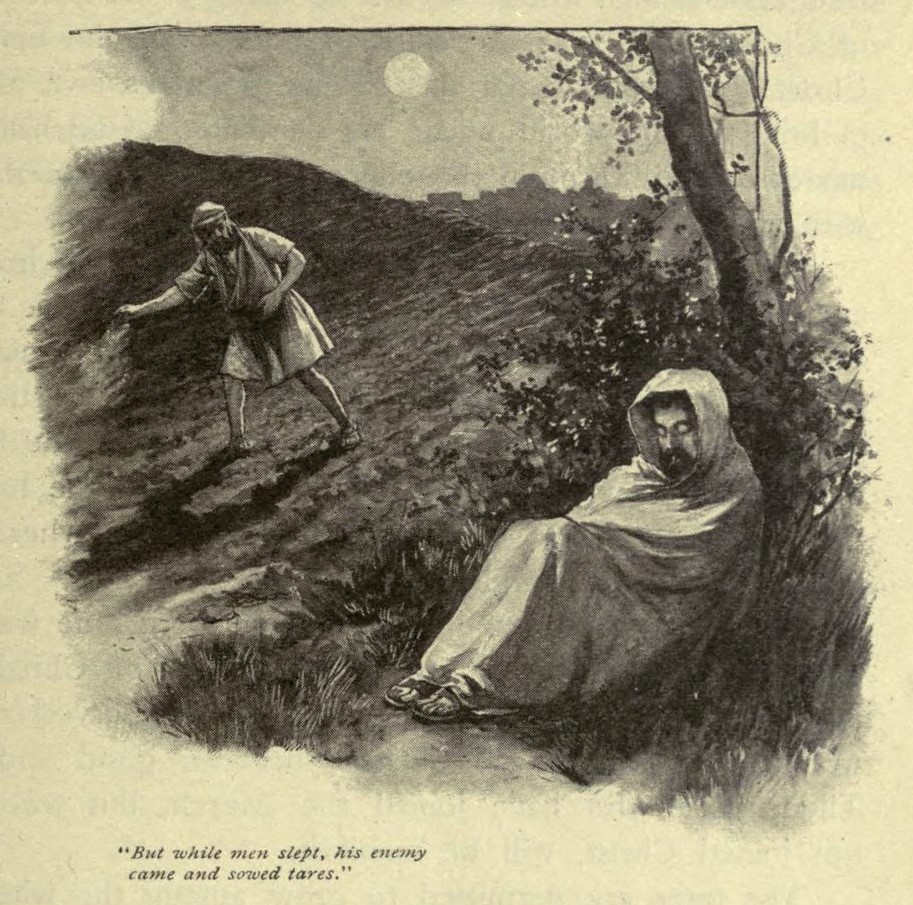
The Parable of the Weeds or Tares (KJV: tares, WNT: darnel, DRB: cockle) is a parable of Jesus which appears in Matthew 13:24–43. The parable relates how servants eager to pull up weeds were warned that in so doing they would root out the wheat as well and were told to let both grow together until the harvest. Later in Matthew, the weeds are identified with "the children of the evil one", the wheat with "the children of the Kingdom", and the harvest with "the end of the age". A shorter, compressed version of the parable is found without any interpretation in the apocryphal Gospel of Thomas.
The parable in the Gospel of Matthew goes as follows:
Another parable put he forth unto them, saying, The kingdom of heaven is likened unto a man which sowed good seed in his field:
The word translated "tares" in the King James Version is ζιζάνια (zizania), plural of ζιζάνιον (zizanion). This word is thought to mean darnel (Lolium temulentum), a ryegrass which looks much like wheat in its early stages of growth.
The Weymouth New Testament, a translation of the Greek, translates the word as "Darnel". The Douay-Rheims Bible translates the word as "Cockle", possibly referring to the "White Cockle". Roman law prohibited sowing darnel among the wheat of an enemy, suggesting that the scenario presented here is realistic. Many translations use "weeds" instead of "tares".
A similar metaphor is wheat and chaff, replacing (growing) tares by (waste) chaff, and in other places in the Bible "wicked ones" are likened to chaff.
An eschatological interpretation is provided by Jesus in Matthew 13:36–43:
Parable of the Tares
The Parable of the Weeds or Tares (KJV: tares, WNT: darnel, DRB: cockle) is a parable of Jesus which appears in Matthew 13:24–43. The parable relates how servants eager to pull up weeds were warned that in so doing they would root out the wheat as well and were told to let both grow together until the harvest. Later in Matthew, the weeds are identified with "the children of the evil one", the wheat with "the children of the Kingdom", and the harvest with "the end of the age". A shorter, compressed version of the parable is found without any interpretation in the apocryphal Gospel of Thomas.
The parable in the Gospel of Matthew goes as follows:
Another parable put he forth unto them, saying, The kingdom of heaven is likened unto a man which sowed good seed in his field:
The word translated "tares" in the King James Version is ζιζάνια (zizania), plural of ζιζάνιον (zizanion). This word is thought to mean darnel (Lolium temulentum), a ryegrass which looks much like wheat in its early stages of growth.
The Weymouth New Testament, a translation of the Greek, translates the word as "Darnel". The Douay-Rheims Bible translates the word as "Cockle", possibly referring to the "White Cockle". Roman law prohibited sowing darnel among the wheat of an enemy, suggesting that the scenario presented here is realistic. Many translations use "weeds" instead of "tares".
A similar metaphor is wheat and chaff, replacing (growing) tares by (waste) chaff, and in other places in the Bible "wicked ones" are likened to chaff.
An eschatological interpretation is provided by Jesus in Matthew 13:36–43:
Recent media
Recent media