


Community hub
Recent from talks
Contribute something to knowledge base
Content stats: 0 posts, 0 articles, 1 media, 0 notes
Members stats: 0 subscribers, 0 contributors, 0 moderators, 0 supporters
Subscribers
Supporters
Contributors
Moderators
Hub AI
The Triumph of Death AI simulator
(@The Triumph of Death_simulator)
Hub AI
The Triumph of Death AI simulator
(@The Triumph of Death_simulator)
The Triumph of Death
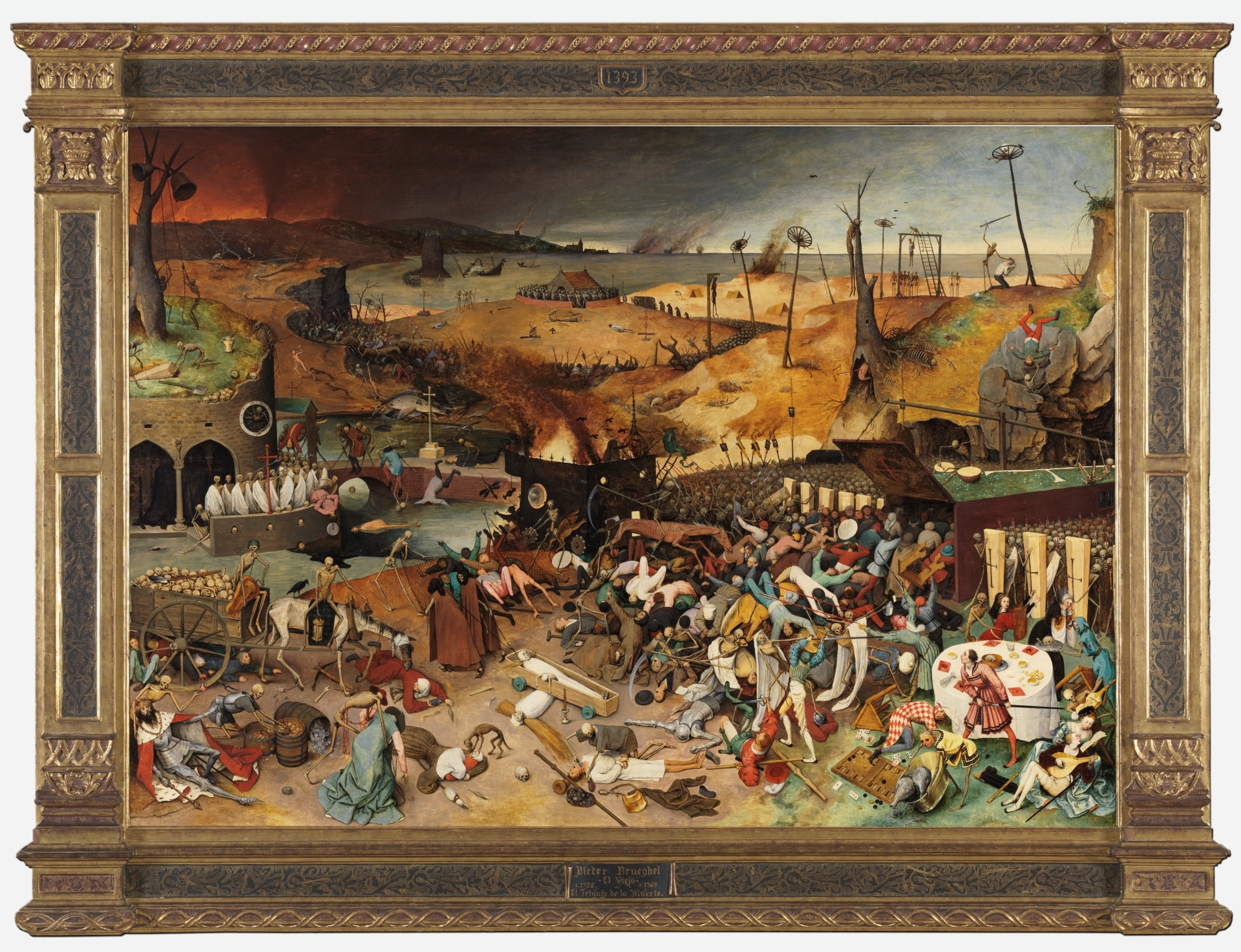
The Triumph of Death is an oil panel painting by Pieter Bruegel the Elder painted c. 1562. It has been in the Museo del Prado in Madrid since 1827.
This painting is part of the BBC's 100 Great Paintings.
The painting shows a panorama of an army of skeletons wreaking havoc across a blackened, desolate landscape. Fires burn in the distance, and the sea is littered with shipwrecks.
A few leafless trees stud hills otherwise bare of vegetation. Fish lie rotting on the shores of a corpse-choked pond. Art historian James Snyder emphasizes the "scorched, barren earth, devoid of any life as far as the eye can see."
In this setting, legions of skeletons advance on the living, who either flee in terror or try in vain to fight back. In the foreground, skeletons haul a wagon full of skulls. In the upper left corner, others ring the bell that signifies the death knell of the world. People are herded into a coffin-shaped trap decorated with crosses, while skeletons, some on horseback, kill people with scythes. The horse-riding skeletons probably allude to the Four Horsemen of the Apocalypse. The painting depicts people of different social backgrounds – from peasants and soldiers to nobles as well as a king and a cardinal – being taken by death indiscriminately.
A skeleton parodies human happiness by playing a hurdy-gurdy, while the wheels of his cart crush a man as if his life is of no importance. A woman has fallen in the path of the death cart. She has a slender thread which is about to be cut by the scissors in her other hand—Bruegel's interpretation of Atropos. Nearby, another woman in the path of the cart holds in her hand a spindle and distaff, classical symbols of the fragility of human life—another Bruegel interpretation of Clotho and Lachesis.
A starving dog nibbles at the face of a dead child lying still within its dead mother's embrace. Just beside her, a cardinal is helped towards his fate by a skeleton who mockingly wears the red hat, while a dying king's barrels of gold and silver coins are looted by yet another skeleton, oblivious to the fact that a skeleton is warning him with an empty hourglass that his life is about to literally run out of time. The foolish and miserly monarch's last thoughts still compel him to reach out for his useless and vain wealth, seeming unaware of the need for repentance. In the centre, an awakening religious pilgrim has his throat cut by a robber-skeleton for his money purse. Above the murder, skeleton-fishermen catch people in a net.
In the bottom right-hand corner, a dinner has been broken up and the diners are putting up a futile resistance. They have drawn their swords in order to fight the skeletons dressed in winding-sheets. No less hopelessly, the court jester takes refuge beneath the dinner table. The backgammon board and the playing cards have been scattered, while a skeleton thinly disguised with a mask (possibly the face of a corpse) empties away the wine flasks. Of the menu of the interrupted meal, all that can be seen are a few pallid rolls of bread and an appetiser apparently consisting of a pared human skull. Above the table are two women. The one on the left struggles in vain while being embraced by a skeleton, in a hideous parody of after-dinner amorousness. The woman on the right is horrified with the realisation of mortality when a skeleton in a hooded robe mockingly seems to bring another dish, also consisting of human bones, to the table.
The Triumph of Death
The Triumph of Death is an oil panel painting by Pieter Bruegel the Elder painted c. 1562. It has been in the Museo del Prado in Madrid since 1827.
This painting is part of the BBC's 100 Great Paintings.
The painting shows a panorama of an army of skeletons wreaking havoc across a blackened, desolate landscape. Fires burn in the distance, and the sea is littered with shipwrecks.
A few leafless trees stud hills otherwise bare of vegetation. Fish lie rotting on the shores of a corpse-choked pond. Art historian James Snyder emphasizes the "scorched, barren earth, devoid of any life as far as the eye can see."
In this setting, legions of skeletons advance on the living, who either flee in terror or try in vain to fight back. In the foreground, skeletons haul a wagon full of skulls. In the upper left corner, others ring the bell that signifies the death knell of the world. People are herded into a coffin-shaped trap decorated with crosses, while skeletons, some on horseback, kill people with scythes. The horse-riding skeletons probably allude to the Four Horsemen of the Apocalypse. The painting depicts people of different social backgrounds – from peasants and soldiers to nobles as well as a king and a cardinal – being taken by death indiscriminately.
A skeleton parodies human happiness by playing a hurdy-gurdy, while the wheels of his cart crush a man as if his life is of no importance. A woman has fallen in the path of the death cart. She has a slender thread which is about to be cut by the scissors in her other hand—Bruegel's interpretation of Atropos. Nearby, another woman in the path of the cart holds in her hand a spindle and distaff, classical symbols of the fragility of human life—another Bruegel interpretation of Clotho and Lachesis.
A starving dog nibbles at the face of a dead child lying still within its dead mother's embrace. Just beside her, a cardinal is helped towards his fate by a skeleton who mockingly wears the red hat, while a dying king's barrels of gold and silver coins are looted by yet another skeleton, oblivious to the fact that a skeleton is warning him with an empty hourglass that his life is about to literally run out of time. The foolish and miserly monarch's last thoughts still compel him to reach out for his useless and vain wealth, seeming unaware of the need for repentance. In the centre, an awakening religious pilgrim has his throat cut by a robber-skeleton for his money purse. Above the murder, skeleton-fishermen catch people in a net.
In the bottom right-hand corner, a dinner has been broken up and the diners are putting up a futile resistance. They have drawn their swords in order to fight the skeletons dressed in winding-sheets. No less hopelessly, the court jester takes refuge beneath the dinner table. The backgammon board and the playing cards have been scattered, while a skeleton thinly disguised with a mask (possibly the face of a corpse) empties away the wine flasks. Of the menu of the interrupted meal, all that can be seen are a few pallid rolls of bread and an appetiser apparently consisting of a pared human skull. Above the table are two women. The one on the left struggles in vain while being embraced by a skeleton, in a hideous parody of after-dinner amorousness. The woman on the right is horrified with the realisation of mortality when a skeleton in a hooded robe mockingly seems to bring another dish, also consisting of human bones, to the table.
Recent media
Recent media