
Recent from talks
The Twelve Dancing Princesses
Knowledge base stats:
Talk channels stats:
Members stats:
The Twelve Dancing Princesses
"The Twelve Dancing Princesses" (also "The Worn-Out Dancing Shoes" or "The Shoes that were Danced to Pieces"; German: Die zertanzten Schuhe) is a German fairy tale collected by the Brothers Grimm and published in Grimm's Fairy Tales in 1815 (KHM 133). It is of Aarne-Thompson type 306.
Charles Deulin collected another, French version in his Contes du Roi Cambrinus (1874), which he credited to the Grimm version. Alexander Afanasyev collected two Russian variants, entitled "The Night Dances", in his Narodnye russkie skazki.
Its closest analogue is the Scottish Kate Crackernuts, where it is a prince who is obliged to dance every night.[citation needed]
The tale was published by the Brothers Grimm in the first edition of Kinder- und Hausmärchen, volume 2, in 1815. Their source was Jenny von Droste-Hülshoff. It was originally numbered 47 but appeared as KHM 133 in subsequent editions.
In a kingdom lives a king and his twelve daughters. The twelve princesses sleep in twelve beds in the same bedroom, the doors to which their father locks every night. But every morning, the king unlocks his daughters' bedroom doors to find their shoes worn out as if they have been dancing all night. The king, perplexed, promises that any man who can solve the mystery can marry any of the twelve princesses and inherit the kingdom; each suitor, however, will be given only three days and three nights to discover the princesses' secret or he will be beheaded.
Many princes attempt to discover where the twelve princesses dance every night, but all of them fail and are executed. An old soldier, returning from war, meets an old woman to whom he tells of his decision to try the king's challenge. The old woman warns the soldier to avoid drinking the wine the princesses will give him and to pretend to be fast asleep until they leave, and gives him an invisibility cloak that he can use to observe them.
The soldier is well received at the palace and in the evening, the eldest princess comes to his chamber and offers him a cup of wine. The soldier, remembering the old woman's advice, secretly pours the wine into a sponge he has tied under his chin and lies on his bed, snoring loudly as if he were asleep.
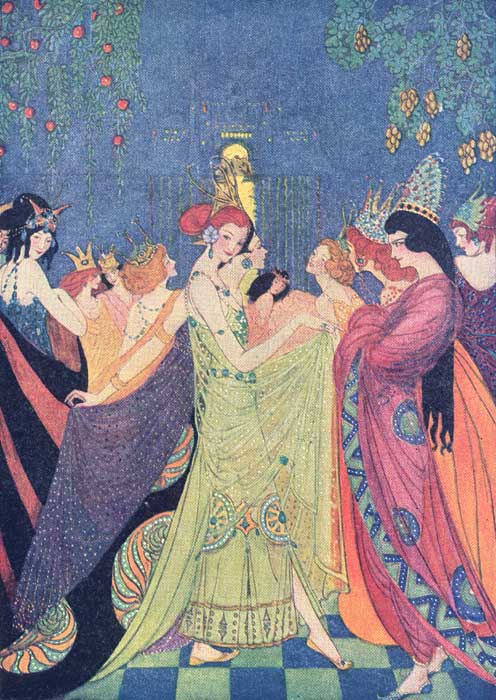
The twelve princesses, assured that the soldier is asleep, dress themselves in fine dancing gowns and escape from their room by a trapdoor beneath the eldest one's bed. The soldier, seeing this, puts on his invisibility cloak and follows them down a flight of stairs. He steps on the gown of the youngest princess, whose cry of alarm to her sisters is rebuffed by the eldest. The passageway leads them to three groves of trees: the first having silver trees, the second golden trees, and the third diamond trees. The invisible soldier breaks off a twig from each grove as evidence, scaring the youngest princess each time he does so. Whenever the youngest princess warns her sisters of the sounds of wood cracking, the eldest dismisses them as salutes. They walk on until they come upon a great clear lake where twelve princes, in twelve boats, are waiting for the twelve princesses. Each princess gets into one boat, the soldier boarding the same one as the youngest princess, whose partner is curious that their ride is heavier than usual. On the other side of the lake stands a castle, into which the twelve princesses go and dance the night away.
Hub AI
The Twelve Dancing Princesses AI simulator
(@The Twelve Dancing Princesses_simulator)
The Twelve Dancing Princesses
"The Twelve Dancing Princesses" (also "The Worn-Out Dancing Shoes" or "The Shoes that were Danced to Pieces"; German: Die zertanzten Schuhe) is a German fairy tale collected by the Brothers Grimm and published in Grimm's Fairy Tales in 1815 (KHM 133). It is of Aarne-Thompson type 306.
Charles Deulin collected another, French version in his Contes du Roi Cambrinus (1874), which he credited to the Grimm version. Alexander Afanasyev collected two Russian variants, entitled "The Night Dances", in his Narodnye russkie skazki.
Its closest analogue is the Scottish Kate Crackernuts, where it is a prince who is obliged to dance every night.[citation needed]
The tale was published by the Brothers Grimm in the first edition of Kinder- und Hausmärchen, volume 2, in 1815. Their source was Jenny von Droste-Hülshoff. It was originally numbered 47 but appeared as KHM 133 in subsequent editions.
In a kingdom lives a king and his twelve daughters. The twelve princesses sleep in twelve beds in the same bedroom, the doors to which their father locks every night. But every morning, the king unlocks his daughters' bedroom doors to find their shoes worn out as if they have been dancing all night. The king, perplexed, promises that any man who can solve the mystery can marry any of the twelve princesses and inherit the kingdom; each suitor, however, will be given only three days and three nights to discover the princesses' secret or he will be beheaded.
Many princes attempt to discover where the twelve princesses dance every night, but all of them fail and are executed. An old soldier, returning from war, meets an old woman to whom he tells of his decision to try the king's challenge. The old woman warns the soldier to avoid drinking the wine the princesses will give him and to pretend to be fast asleep until they leave, and gives him an invisibility cloak that he can use to observe them.
The soldier is well received at the palace and in the evening, the eldest princess comes to his chamber and offers him a cup of wine. The soldier, remembering the old woman's advice, secretly pours the wine into a sponge he has tied under his chin and lies on his bed, snoring loudly as if he were asleep.
The twelve princesses, assured that the soldier is asleep, dress themselves in fine dancing gowns and escape from their room by a trapdoor beneath the eldest one's bed. The soldier, seeing this, puts on his invisibility cloak and follows them down a flight of stairs. He steps on the gown of the youngest princess, whose cry of alarm to her sisters is rebuffed by the eldest. The passageway leads them to three groves of trees: the first having silver trees, the second golden trees, and the third diamond trees. The invisible soldier breaks off a twig from each grove as evidence, scaring the youngest princess each time he does so. Whenever the youngest princess warns her sisters of the sounds of wood cracking, the eldest dismisses them as salutes. They walk on until they come upon a great clear lake where twelve princes, in twelve boats, are waiting for the twelve princesses. Each princess gets into one boat, the soldier boarding the same one as the youngest princess, whose partner is curious that their ride is heavier than usual. On the other side of the lake stands a castle, into which the twelve princesses go and dance the night away.
Recent media