Hubbry Logo
ThethThethMain
Open search
Theth
Community hub
Theth
logo
8 pages, 0 posts
0 subscribers
Be the first to start a discussion here.
Theth
Theth
from Wikipedia

Theth (Albanian definite form: Thethi) is a small village within Shkodër County, Albania.[1] Following the 2015 local government reform it became part of the municipality Shkodër, and has been declared a Protected Historic Center and a National Park by the Albanian Government.[2][3] The community is at the centre of the Theth National Park, an area of outstanding natural beauty.

Key Information

A new official information center on Rruga Fushe near the Thethi bridge is set to open by the Albanian Protected Areas Agency (AKZM), and administered by the Shkoder County Protected Areas Administration (ADZM Shkoder ).

History

[edit]

Local tradition asserts a single common ancestor for the community (one Ded Nika) and suggests that the population moved to Theth some 300 to 350 years ago in order to preserve their (Catholic) Christian traditions.[4]

Visiting Theth in the early 20th century, the traveller Edith Durham said:

I think no place where human beings live has given me such an impression of majestic isolation from all the world.[5]

Durham described Theth as a "bariak" of some 180 houses and also observed that it was almost free from the tradition of blood feud (known in the Albanian language as Gjakmarrja) which so blighted other parts of the Albanian highlands.[5]

Other notable travellers visited Theth in the early 20th century, including Rose Wilder Lane, Franz Nopcsa, and others. These travelers often detailed and praised the environment, culture and lifestyles of the locals.[6]

Lock-in Tower of Thethi
Grunas waterfall
Thethi Blue Eye

Theth remains remote. The single road leading there from the village of Boga has been recently paved and upgraded but is still mostly impassable during the winter months until April.

Although the Kanun (traditional Albanian law) remains influential, Theth has not suffered from the recent (post-Communist) reappearance of the blood feud which has troubled other areas of Northern Albania.[4] Theth boasts one of the very few remaining "lock-in towers", a historical form of protection for families that were "in blood".[7]

Depopulation represents a serious long-term challenge for the community. The population has been greatly reduced over the past few decades and the majority of those remaining occupy Theth only during the summer months. However, the community has a nine-grade school and recent efforts have been made to stimulate tourism. A number of local families offer board and lodging to visitors who come to Theth to hike in the National Park - or merely to admire the mountain scenery.[7]

Apart from the lock-in tower, other attractions include spectacular waterfalls, a working watermill (still used to grind the local inhabitants' corn) and a modest ethnographic museum.[7]

There are now two projects working in the vicinity, aiming at improving and helping the tourist infrastructure in the area. A Balkans Peace Park Project is working towards the creation of a park extending across the borders of Albania, and Kosovo and has taken a lead in recent years in encouraging sustainable and ecologically sensitive tourism in and around Theth (for example by funding the marking of footpaths). Project Albanian Challenge has built a new bridge, which connects Theth to the nearby Grunas waterfalls over river Nanrreth. The project has also improved the marking of the trail to Curraj i Epërm, and has marked another approx. 80 kilometers of brand new trails in the nearby valleys, and created an opensource, free map of the area.[8]

In media

[edit]

The feature film The Forgotten Mountain (2018) by Ardit Sadiku was filmed in Theth while the last scene was filmed in Nderlysa.[9]

Burials

[edit]
Grave site of Robert Elsie in Theth cemetery

During his lifetime, Albanian studies scholar Robert Elsie developed a fondness for Theth, seeing it as an Albanian "Shangri-La". On October 18, 2017, he was buried in Theth Cemetery.[10]

See also

[edit]

References

[edit]
Revisions and contributorsEdit on WikipediaRead on Wikipedia
from Grokipedia
Theth (Albanian definite form: Thethi) is a small mountain village in , nestled in a dramatic valley within the Albanian Alps and part of , with a permanent population of around 400 residents. Located approximately 70 kilometers from the city of , it serves as the central hub of Theth National Park, a renowned for its rugged peaks, alpine meadows, clear rivers, and , adjacent to protected areas like National Park and Gashi Nature Reserve. The village's isolation, accessible primarily via the high Tërthorë Pass at approximately 1,685 meters elevation, has preserved its traditional lifestyle and made it a premier destination for and , drawing over 78,000 visitors between January and September 2021 alone, with numbers growing to around 150,000 annually by 2024 for Theth and adjacent areas. Theth's cultural heritage is deeply rooted in its Catholic traditions and , featuring stone-built houses and historic kullas—fortified towers originally constructed for defense during periods of blood feuds and clan conflicts. A key landmark is the Church of Theth, a Roman Catholic structure erected in 1892 on ancient foundations, which endured communist-era repurposing as a storage facility and school before restoration efforts by the in the 1990s. The village's intangible heritage includes ancient practices, rhapsodic folk songs, and traditional garments like the xhubleta, reflecting the resilient mountain culture of the region. As part of broader initiatives for , Theth has been highlighted in studies for leveraging its tangible and intangible assets to combat rural depopulation and enhance local identity. In recent years, Theth has gained prominence as a European tourist hotspot, with government efforts focusing on infrastructure improvements, such as upgraded roads to nearby Ndërlysaj, and enforcement against illegal constructions to protect its pristine environment—exemplified by demolitions in 2025. Popular activities include multi-day treks across the (Malesia e Madhe), visits to waterfalls like the Grunas, and exploration of alpine pastures, underscoring the village's role as a gateway to Albania's wild northern wilderness. Despite its growing popularity, Theth remains a model for balanced that honors its historical and ecological integrity.

Geography

Location and Setting

Theth is situated in at coordinates 42°24′N 19°46′E. The village lies at an elevation of approximately 750 meters above . Administratively, Theth forms part of and is included in the Shkodër Municipality, specifically within the Shalë Administrative Unit. It is integrated into Theth , which was established in 1966 and encompasses 2,630 hectares. Nestled within the Albanian Alps, also known as the , Theth is bordered by prominent peaks including Jezerca at 2,694 meters and at 2,534 meters. The central feature of the area is the Theth Valley, a glacial formation shaped by ancient ice movements. Located about 70 kilometers northwest of the city of , Theth lies near the Valbonë Pass, which provides a connection to via the broader trail network.

Climate and Environment

Theth's is classified as a warm-summer humid continental type (Köppen Dfb) with Mediterranean influences, resulting in distinct seasonal variations. The average annual temperature ranges from 10°C to 12°C, with cold winters where temperatures can drop to -10°C or lower, and mild summers peaking at around 25°C. This climatic regime supports a temperate environment conducive to both and diverse ecosystems in the surrounding Albanian Alps. Precipitation in Theth is abundant, averaging 1,500 to 2,000 mm annually, with the highest levels occurring in autumn, particularly in . This heavy rainfall, combined with from higher elevations, fosters lush vegetation across the valley and feeds notable natural features, such as the Grunas Waterfall, which plunges 25 meters into a basin below. The consistent moisture contributes to the region's verdant landscapes, including dense forests and alpine meadows that thrive despite the rugged terrain. The area's is rich, encompassing endemic and protected adapted to the montane environment. Notable fauna includes the critically endangered (Lynx lynx balcanicus) and brown bears (Ursus arctos), alongside and wolves, while the flora features diverse alpine plants such as edelweiss (Leontopodium alpinum). These ecosystems are safeguarded within Theth National Park, established to conserve the region's unique wildlife and habitats spanning over 2,630 hectares. Environmental challenges in Theth include exacerbated by historical and , which have led to rates of up to 90 tons per annually in affected Albanian mountain areas. Additionally, is accelerating the retreat of small glaciers in the Prokletije Mountains, reducing water availability and altering local , with studies indicating significant ice loss since the late . These pressures threaten the stability of the valley's ecosystems and require ongoing conservation efforts.

History

Origins and Early Settlement

The origins of Theth are deeply rooted in local oral traditions, which attribute the village's founding to Ded Nika, a 17th-century Catholic figure from the region who led a small group of families to the remote Shala Valley approximately 300–350 years ago. This migration was driven by the need to escape intensifying Ottoman pressures for , allowing the settlers to preserve their Catholic faith in isolation amid the rugged . Theth is first mentioned in historical records in a 1485 document from , noting 7 houses. As descendants of Ded Nika, the initial inhabitants formed tight-knit patrilineal clans, establishing Theth as a Catholic enclave that resisted broader Islamization trends in during the Ottoman period. Theth appears in later 17th-century Ottoman defters and ecclesiastical reports, highlighting its role in maintaining Christian resistance. By 1671, Franciscan priest Gaspari documented 32 households and around 200 individuals in the broader area, including early Theth settlements, underscoring the community's modest scale and strategic seclusion from Ottoman administrative control. These records portray Theth as a peripheral nahiye within the of , where inhabitants evaded taxation and conversion through geographic isolation, contributing to the preservation of Albanian Catholic identity in the highlands. In the , Theth's profound isolation nurtured a distinctive variant of the dialect and unique social customs governed by the Kanun, the code emphasizing honor, , and solidarity. Early ethnographers, such as , noted the village's social structure under the Kanun. Demographically, the settlement expanded from a handful of founding families to approximately 200 households by the late , supporting an agro-pastoral economy in extended patriarchal units averaging nine members each. This growth reflected gradual clan branching while architectural remnants, like fortified stone towers (kullas), provided defense against external threats during this era.

20th Century and Modern Era

During the communist era from 1945 to 1991, Theth remained largely isolated under Enver Hoxha's regime, which enforced strict controls on movement and access to remote mountain areas as part of Albania's broader policy of and seclusion from the West. Basic developments, aligned with the regime's emphasis on and collectivization, were implemented in remote areas like Theth. Following the collapse of in 1991, Theth experienced rapid depopulation driven by widespread , as economic hardships and lack of opportunities prompted many residents to seek better prospects abroad, significantly reducing the permanent to an estimated 370 by the 2020s. in the post-communist period gradually opened Theth to , transforming it from a secluded settlement into an emerging destination while straining local resources and traditional ways of life. In recent decades, infrastructure improvements have enhanced accessibility, including the paving of the road from , completed in 2021, which replaced the previously treacherous dirt track and facilitated year-round travel. EU-funded initiatives, such as the Balkans Peace Park project launched in the early , have supported cross-border trail maintenance and environmental conservation efforts in the Albanian Alps, including areas around Theth, to promote and regional cooperation. As of 2025, the Albanian Protected Areas Agency has advanced revitalization through projects like enhanced visitor facilities, including demolitions of illegal constructions to preserve the cultural landscape, though challenges persist. Ongoing migration continues to threaten Theth's demographic viability, with younger generations leaving for urban centers or overseas, exacerbating labor shortages and the of traditional structures. Preservation efforts focus on safeguarding the village's , recognized for its unique Ottoman-era and integration with the natural environment, amid growing pressures from expansion.

Culture and Society

Architecture and Built Heritage

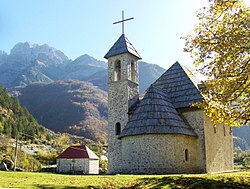
The of Theth exemplifies traditional Albanian highland building practices, primarily employing dry-stone with local riverbed for thick, load-bearing walls that taper upward for stability and defense. These structures, often two to four stories high, incorporate timber for internal supports, galleries, and steep slate roofs designed to shed heavy alpine snow, while small, narrow windows—wider on the exterior for shooting—enhance against intruders. Houses are densely clustered along the narrow Grunas River valley to maximize and communal protection, with ground floors typically reserved for storage and stabling to integrate agricultural needs with defensive layouts. Key landmarks highlight this heritage's functional and cultural depth. The Lock-in Tower (Kulla e Ngujimit), a fortified stone structure approximately 400 years old, served as a refuge for individuals in isolation during blood feuds under the Kanun , featuring meter-thick walls, minimal openings, and spartan interiors across its two main floors. The Church of Theth, dedicated to the Blessed Virgin Mary, Mother of Good Counsel and built in 1892 as a robust stone edifice with a steeply pitched roof resembling a small fortress, contains traditional interior frescoes depicting religious scenes. Supporting rural life, a historic —still operational for grinding corn—demonstrates vernacular engineering, while the of Dukagjin, installed in a restored 19th-century home of the Keçi family, displays household artifacts, tools, and furnishings to illustrate past domestic routines. Albania's and Institute of Cultural Monuments designated Theth a protected historic center to preserve its architectural ensemble amid tourism pressures and natural decay. Since the , NGOs such as the Balkan Peace Park Project have funded restoration initiatives, including structural reinforcements and of homes into cultural sites, to mitigate weathering and seismic risks. The evolved from 18th-century Ottoman-period fortifications with timber-framed galleries for communal living, to more robust 19th-century stone towers adapted for isolation practices, incorporating 20th-century concrete elements in some reinforcements for enhanced resilience against alpine conditions.

Traditions and Social Customs

The Kanun of , a traditional code originating in the and codified in the early , profoundly shapes social norms in Theth, emphasizing principles like through besa—a sacred pledge of protection for guests that overrides even blood ties—and regulating marriage customs such as arranged unions to maintain family alliances. Blood feuds, known as gjakmarrja, are addressed in the Kanun as a means to restore honor but have historically been rare in Theth due to the village's tight-knit community and self-governing structure; British traveler noted in 1909 the relative peace of Theth compared to other northern Albanian regions. These customs foster a strong sense of communal honor, with violations traditionally resolved through tribal assemblies rather than violence. Festivals and rites reinforce social bonds in Theth, particularly the annual Assumption Day celebration on August 15, when families reunite for feasts, prayers at the local church, and performances of traditional dances that symbolize unity and heritage. During funerals, the rite of Gjâma e Burrave—the Men's Lament—sees men form a circle around the deceased, beating their chests and chanting improvised laments to honor the departed and express collective grief, a practice rooted in ancient highland traditions and performed exclusively for male honorees. Theth's is a northern of , characterized by nasal vowels, archaic vocabulary preserved from medieval times, and unique phonetic features that distinguish it from central and southern forms, reflecting the village's isolation. thrives through oral epics recounting tales of highland heroes battling invaders or mythical foes, often sung during gatherings to instill values of bravery and resilience, drawing from the broader Albanian këngë kreshnikësh tradition. Society in Theth remains patrilineal, with inheritance and family leadership passing through male lines as per the Kanun, while traditional roles assign men to herding in the rugged and women to textiles and managing households. However, the influx of has begun to evolve these dynamics, empowering women through involvement in guesthouses, guiding, and ventures, thereby enhancing economic independence and challenging rigid gender norms.

Religion and Community Life

Theth's community is overwhelmingly Roman Catholic, with residents maintaining strong ties to the faith inherited from the village's founding as a refuge for Catholics during the Ottoman era. The village falls under the jurisdiction of the Roman Catholic Archdiocese of –Pult, which oversees Catholic activities in the region and connects Theth to broader ecclesiastical structures centered in . This high concentration of Catholicism distinguishes Theth among northern Albanian highland settlements, where the church serves as a focal point for spiritual and communal identity. The permanent population of Theth numbers approximately 70 residents from 17 families in the , predominantly elderly individuals who remain through the harsh winters, while younger generations have migrated abroad for work. This small, aging demographic reflects broader depopulation trends in remote Albanian villages, leading to a seasonal influx of members during summer months, who return to maintain family homes and participate in community gatherings. Funerary practices in Theth adhere to traditional Roman Catholic rites, with burials conducted in the village adjacent to the Church of Theth, emphasizing swift interment within 24 to 48 hours of death. Highland customs add layers to these observances, including multi-day wakes featuring ritual laments known as gjama e burrave (men's lament), performed by groups of men to honor the deceased through organized wailing and gatherings that can extend over several days. A notable example is the 2017 burial of Canadian-Albanian scholar in Theth ; Elsie, who succumbed to motor neuron disease in , had specified in his will that the village—whom he regarded as his spiritual haven in —serve as his final resting place, drawing international attention to the site's cultural significance. Social organization in Theth revolves around the (clan) system, a patrilineal structure typical of northern Albanian highlands, where extended families dominate specific hamlets and manage land inheritance collectively. The Church of Theth, constructed in 1892, plays a pivotal role beyond worship, historically facilitating —such as the first Albanian-language opened by Shtjefën Gjeçovi in 1917—and serving as the venue for key community events like festivals and assemblies that reinforce social bonds. This integration of and functions underscores the church's enduring influence in sustaining Theth's tight-knit, tradition-bound way of life.

Economy and Tourism

Economic Activities

The traditional economy of Theth revolves around subsistence farming and livestock herding, shaped by the village's steep, mountainous terrain that limits arable land to small valleys along the Shala River. Residents cultivate hardy crops such as potatoes and corn on terraced plots, often relying on manual labor and traditional methods to sustain households through the harsh winters. , primarily sheep and , form the backbone of livelihoods, providing for cheese production, wool for textiles, and meat for local consumption, with herding practices dating back to the village's highland pastoral traditions. Forestry activities, including selective timber harvesting and gathering for fuel, supplement income but are constrained by the protected status of , which encompasses much of the surrounding area. Since the early 2000s, has emerged as the dominant economic driver in Theth, shifting the village from isolation to a key destination in the Albanian Alps and providing primary income through homestays, guided hikes, and local services. Families have converted traditional stone houses into guesthouses, offering authentic experiences like meals and guiding, which leverage the area's pristine landscapes and . Handicrafts, particularly wool from local sheep herds, have gained as souvenirs sold to visitors, preserving artisanal skills while generating supplemental revenue. This transition has been facilitated by improved access via the Theth-Valbona , part of the Peaks of the Balkans route, which attracts hikers and nature enthusiasts. Prior to the tourism boom, Theth faced high and , with many residents migrating seasonally for work due to limited opportunities in and amid rural depopulation. By 2025, annual visitor numbers to Theth and nearby Valbona National Parks have reached approximately 150,000, significantly boosting local incomes and reducing reliance on subsistence activities. has become the primary economic driver in the region, supporting job creation in and guiding while stimulating ancillary sectors like transport and food production. However, this growth has introduced challenges such as seasonal employment fluctuations and pressure on limited . Sustainability efforts in Theth emphasize eco-tourism to balance economic gains with environmental preservation, including initiatives by the Albanian Challenge organization that focus on trail maintenance and infrastructure development. The group has marked over 110 kilometers of hiking paths connecting Theth to sites like Valbona and Koman Lake, built pedestrian bridges such as the one to Grunas Waterfalls, and promoted low-impact practices to minimize . These projects aid through community education on "" principles and support local upkeep of trails to prevent erosion, ensuring long-term viability for tourism-dependent livelihoods. In October 2025, authorities demolished illegal buildings in the park, with Prime Minister Rama vowing further crackdowns to safeguard the environment.

Tourist Attractions and Development

Theth's primary tourist attractions revolve around its dramatic natural landscapes and historic structures, drawing hikers and nature enthusiasts to the Albanian Alps. The Grunas Waterfall, a 30-meter cascade nestled in a lush canyon, is accessible via a short, scenic trail that takes approximately 45 minutes to an hour round trip, offering visitors stunning views of the surrounding greenery and opportunities for . Nearby, the Blue Eye of Theth, a striking natural pool formed by a freshwater spring, captivates with its vivid color and clarity, serving as a refreshing spot for swimmers during warmer months despite the chilly waters. These sites highlight the area's pristine environment, with the Blue Eye trail extending approximately 16 kilometers round trip (8 km one way) from the village for a moderate to challenging hike that takes 5-7 hours and combines canyon exploration and waterfall detours. For more adventurous visitors, the renowned Valbonë-Theth trekking route stands out as a signature experience, spanning 17-18 kilometers across rugged mountain passes with an elevation gain of up to 1,100 meters, typically requiring 6-8 hours to complete. This moderate-to-challenging hike traverses alpine meadows, forests, and peaks, providing panoramic vistas of the and connecting Theth village to Valbonë in the adjacent valley. Complementing these natural draws, tours of the Lock-in Tower, a 17th-century stone structure originally used for blood feud mediation, offer insights into local history through guided visits that explore its architecture and cultural significance. Tourism development in Theth has accelerated in recent years, enhancing while preserving its remote charm. The paved road from , completed in the summer of 2021, spans about 70 kilometers and allows standard vehicles to reach the village year-round, reducing travel time to around 2-3 hours and boosting visitor numbers by eliminating the need for off-road transport. Accommodation has expanded with numerous family-run guesthouses, providing traditional and home-cooked meals, contributing to an economic uplift for locals through sustainable lodging options. Visitor trends show a peak season from June to , when warm weather idealizes , though the area gains all-season appeal with winter snowshoeing and opportunities for experienced adventurers, albeit with potential road closures due to snow. Efforts to balance growth with conservation include park regulations that limit environmental impact, such as trail maintenance funded partly by entry fees, ensuring the longevity of attractions like the Grunas and Blue Eye amid rising foot traffic.

Representation in Media

Film and Literature

Theth's remote alpine setting and preserved traditions have inspired depictions in film that emphasize its isolation and natural splendor. The 2018 Albanian The Forgotten Mountain (original title: Mali i Harrum), directed by Ardit Sadiku, was largely filmed on location in Theth, capturing the village's rugged beauty and the daily struggles of its inhabitants amid the surrounding mountains. Earlier documentaries have portrayed the highland customs of the region, such as the DW Documentary Albania's Mysterious North (2024), which explores the unique cultural practices and seclusion of northern Albanian communities, including Theth. In , Theth features prominently as a symbol of untamed Albanian heritage. British traveler and writer Edith Durham's High Albania (1909) offers an early romanticized account of the village, depicting its deep valleys and stone houses as a bastion of ancient customs isolated from modern influences. Albanologist Robert Elsie's works on Albanian , including A Passion for Theth: Albania's Rugged (2007), reference the village as a living archive of oral traditions and tribal lore, illustrated through photographs that highlight its cultural endurance. Travelogues by early 20th-century European explorers further cemented Theth's allure as an exotic frontier. Austrian explorer Karl Steinmetz's accounts from his 1903 expedition describe the perilous journeys into Theth's mountains and encounters with local highlanders, underscoring the area's inaccessibility. In contemporary media, photographs and articles in outlets like have promoted Theth as a prime eco-tourism destination, showcasing its trails and to global audiences. These portrayals have significantly influenced Theth's visibility, contributing to a surge in after ; visitor numbers in the Albanian Alps, including Theth, rose from around 15,000 annually in the mid-2010s to over 50,000 by the early 2020s, driven by international media exposure. However, this growth has raised concerns about over-tourism, straining the village's limited infrastructure and threatening its ecological balance.

Scholarly and Cultural References

Early 20th-century ethnographic studies of Theth highlighted its unique highland customs, particularly through the work of German anthropologist Reimer Schulz. In 1937, Schulz participated in a German-Italian expedition to the northern Albanian mountains, focusing on the Dukagjin region including Theth, where he documented rites and traditional attire during the of local farmer Ujk Vuksani. His collection includes over 200 photographs capturing ceremonial wailing, tribal lamentations, and symbolic grave preparations, providing a rare visual record of pre-modern Albanian highland practices. Prominent Albanian scholar Robert Elsie further advanced ethnographic understanding of Theth through his extensive research on Albanian folklore, literature, and cultural history, authoring over 60 books including translations of epic works like Gjergj Fishta's The Highland Lute. Elsie's deep affinity for Theth, which he regarded as a preserved enclave of ancient Albanian traditions, culminated in his there in 2017, fulfilling his wish to rest in the village he studied for decades; a formal honored his contributions to promoting Albanian heritage globally. Theth symbolizes a bastion of pre-Ottoman Catholic traditions in , often idealized for its isolation that shielded highland customs such as communal rites and stone architecture from external influences. This cultural preservation has drawn scholarly interest in its role within Albanian identity, emphasizing Theth's embodiment of resilient, archaic social structures amid broader Balkan transformations. Post-2000 scholarship has increasingly examined Theth's challenges with depopulation and the push for . Studies reveal that while tourism influxes have partially reversed rural exodus by generating income through guesthouses and guiding, they risk and social strain without community-led planning; for instance, unclear land rights hinder local empowerment in development initiatives. The Balkan Peace Park Project, launched in 2001, integrates Theth into cross-border efforts spanning , , and , fostering cultural exchange through youth programs that teach and hospitality skills, thereby linking highland with regional . Notable scholarly activities include ongoing visits by anthropologists via projects like the Shala Valley Project, which conducts archaeological and ethnographic surveys in Theth to explore tribal persistence in highland landscapes, alongside periodic workshops on Balkan that attract international researchers to the site.

References

Add your contribution
Related Hubs
User Avatar
No comments yet.