


Community hub
Recent from talks
Contribute something
Nothing was collected or created yet.
Thompson Autorifle
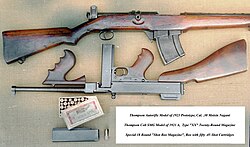
View on WikipediaThe Thompson Autorifle, (also referred to as the Thompson Model 1923 Autoloading Rifle; and the .30-06 Model 1923 Semi-Automatic Rifle, among others, etc.) was a semi-automatic rifle that used a Blish Lock to delay the action of the weapon. It was chambered in .30-06, with the 1923 model in 7.62×54mmR Russian rifle rounds.[1]
Key Information


Several prototypes of the Autorifle were submitted by Auto-Ordnance to the military for the semi-automatic rifle trials, but it was not adopted.[2] The Autorifle Model 1929, in .276 Pedersen, was tested in a competition with the rifles by J.D. Pedersen (delayed blowback) and John C. Garand (gas-operated), which culminated in the adoption of the M1 Garand.
On the positive side, the Autorifle action avoided the complexity of recoil-operated and gas-operated actions. On the negative side, the Autorifle required lubricated ammunition for proper functioning and the ejection of spent cartridge casings was so violent as to be hazardous to bystanders.[3]
Function
[edit]For reloading, the Thompson Autorifle uses an interrupted screw delayed blowback operation where the bolt has 85° angled interrupted rear locking lugs that have to overcome a rotation of 110° ( 90° to unlock before the angle blend of 70°/40° and 6°) that delays the action until the gas pressure drops to a safe level to eject. The bolt cocks the striker on opening (a la Mauser) and fires from a closed position. When firing, the trigger when pulled pushes a lever connected to a sear to fire the weapon. The receiver is of a round section with the safety switch at the rear along with the rear sight. The magazine is stripper fed holding 5 rounds and lubricated by oiled pads; later prototypes used 20-round M1918 BAR magazines.[4]
Variants
[edit]BSA Autorifle
[edit]The BSA Autorifle was a British automatic rifle designed by Birmingham Small Arms Co. This rifle was manufactured by BSA under their licensing agreement with the Auto-Ordnance Corp. It was offered for British Army trials during the 1920s.[5]
The weapon was an improved derivative of the Thompson Autorifle that could be operated manually if the two curved 'shutters' around the bolt head are moved into the down position. By this means the mechanism is disconnected and the rifle can be used as a manual loader. This facility was a requirement in self-loaders offered for British trials at this period. The weapon took part in trials during 1927 against a Colt-made Thompson, an 'improved' BSA Thompson, a gas-operated BSA and the Farquhar Hill. Although in 1928 reports it narrowly beat the 'improved' BSA and the Farquhar Hill in the third place, it never advanced past prototype stages as none were found acceptable and development of the BSA Autorifle waned.
BSA Guns Ltd, a licensee of protecting the patents of the Thompson Autorifle made a handful of the 1923 model Thompsons as 'heavy rifles' with folding bipods and finned barrels. Surviving examples suggest there were Rifle and Light Machine Gun variants and 6 of both types were manufactured. The first examples were made in 1924 and an 'improved' variant in 1926. The 'improved' BSA Thompson had a shorter operation with a straight pull cocking handle installed at the rear of a cocking sleeve.
The BSA Autorifle is a delayed blowback–operated rifle chambered in the .303 British round and fed from a removable 10-round box magazine. Much like its predecessor, it uses a bolt with 85° angled threads delayed by a 90° twist to unlock from a bronze nut until the gas pressure drops to a safe level to eject. The bolt cocks the striker on opening (a la Mauser) and fires from a closed position. When firing, the trigger when pulled pushes a lever connected to a sear to fire the weapon. The receiver is of a round section with the safety switch at the rear along with the rear sight.
See also
[edit]References
[edit]- ^ The Ultimate Thompson Book by Tracie L. Hill, 2009 ISBN 0889354960
- ^ Sturmgewehr!: From Firepower to Striking Power, R. Blake Stevens, Thompsons(!) in Weimar Germany p.24 ISBN 0889353565
- ^ Julian S. Hatcher, Hatcher's Notebook, MSPC 1947, pp.44-46, 155-156, 165-166.
- ^ Tracie L. Hill, Thompson: The American Legend 1996 by Collector Grade Publications Inc. Cobourg, Ontario Canada, ISBN 0-88935-208-9, pp.6-14, 31-36.
- ^ Rifles of the World, Page 579
External links
[edit]| Lever delayed |  | |
|---|---|---|
| Roller delayed | ||
| Gas delayed | ||
| Hesitation locked | ||
| Flywheel delayed | ||
| Radial delayed | ||
| Screw/Turnbolt delayed | ||
| Toggle delayed | ||
| Vector delayed | ||
Thompson Autorifle
View on GrokipediaHistory and Development
Origins
Following World War I, retired U.S. Army Brigadier General John T. Thompson sought to develop an automatic military rifle to provide infantry with greater firepower, drawing from his observations of trench warfare limitations and his prior work in ordnance at facilities like Springfield Armory and Remington Arms.[5] His vision emphasized a shoulder-fired weapon capable of sustained fire, initially conceptualized as a full-power rifle to supplant or supplement the standard bolt-action service rifle, though it later influenced scaled-down submachine gun designs when rifle-caliber challenges arose.[2] Thompson's ideas built on wartime demands for portable automatic arms, aiming to enable a single soldier to deliver machine-gun-like output without crew-served equipment.[5] To realize this, Thompson co-founded the Auto-Ordnance Corporation in 1916 with financier Thomas Fortune Ryan and naval officer John Bell Blish, establishing the company specifically to research and produce automatic firearms for military applications.[6] Headquartered initially in New York with an engineering office in Cleveland, Ohio, Auto-Ordnance focused on innovative mechanisms for reliable automatic operation, securing private investment exceeding $1 million to fund prototyping and testing amid the U.S. Army's post-war interest in semi-automatic rifles.[5] The corporation collaborated with firms like Warner & Swasey for early machining and employed engineers such as Theodore Eickhoff and Oscar V. Payne to refine designs.[5] Central to the project was the Blish Lock principle, patented by John Bell Blish in 1915 and introduced commercially in 1916, which relied on friction-based adhesion between dissimilar metals—typically steel and bronze—under high pressure to delay bolt movement in a blowback system.[6] Blish joined Auto-Ordnance to adapt his mechanism for rifle use, initially demonstrating it in a modified .30 Luger pistol before applying it to higher-pressure rifle cartridges.[5] This friction-delayed blowback action was selected to simplify operation compared to gas or recoil systems, though it proved challenging with full rifle power.[2] The initial design goals centered on a semi-automatic rifle for standard infantry issue, chambered in the .30-06 Springfield cartridge to ensure compatibility with U.S. service ammunition and logistics.[2] Conceptual work intensified around 1920, with Auto-Ordnance producing early experimental models that year, followed by more refined prototypes submitted for U.S. Army trials by 1921.[2] By 1923, the first production-oriented prototypes, including the Model 1923 manufactured by Colt's Patent Fire Arms Manufacturing Company, emerged as viable testbeds for the Blish system in a full-length rifle configuration.[2]Prototypes and Trials
The development of the Thompson Autorifle's 1923 prototype marked a significant step in its evolution as a semi-automatic rifle chambered in .30-06 Springfield, with Colt Firearms Manufacturing Company producing a limited batch of 20 units specifically for testing purposes.[3][7] These prototypes, completed in 1923, incorporated the Blish Lock mechanism for delayed blowback operation and were designed as semi-automatic only, reflecting Auto-Ordnance Corporation's focus on reliability for military applications.[3] During prototyping, adaptations addressed initial design limitations, including a shift from early 5-round fixed box magazines loaded via stripper clips to 20-round detachable box magazines to improve sustained fire capacity.[3] Experiments also explored the .276 Pedersen cartridge as a means to reduce recoil and weight while maintaining effectiveness, with prototypes tested in this configuration to evaluate performance improvements.[3] Production of these early models by Auto-Ordnance involved limited runs, often requiring extensive hand-fitting due to manufacturing tolerances and the complexity of the Blish system, which complicated mass production efforts.[3] Internal testing by Auto-Ordnance preceded formal military evaluation, culminating in the submission of the 1923 model to the U.S. Army Ordnance Department in 1924 for comprehensive trials at facilities like Aberdeen Proving Ground.[8] These trials assessed key attributes such as accuracy at various ranges, reliability under repeated cycling (including dependence on lubricated ammunition), and endurance through prolonged firing sequences, where the rifle demonstrated challenges like high bolt velocities and extraction pressures but provided valuable data on semi-automatic rifle feasibility.[8][3]Evaluation and Rejection
In the late 1920s, the U.S. Army conducted semi-automatic rifle trials to evaluate potential replacements for the M1903 Springfield bolt-action rifle, with the Thompson Autorifle Model 1929 chambered in .276 Pedersen emerging as a key contender alongside John D. Pedersen's delayed-blowback design and early gas-operated prototypes by John C. Garand.[9][2] These trials, peaking between 1927 and 1929 at facilities like Aberdeen Proving Ground, focused on reliability, ease of maintenance, and performance under simulated field conditions using the lighter .276 Pedersen cartridge to reduce recoil and weight compared to the standard .30-06.[9] The Autorifle's retarded-blowback mechanism, reliant on the Blish Lock principle of metallic adhesion, was tested against competitors emphasizing simpler gas or primer actuation systems.[2] Specific criticisms during these evaluations centered on the Autorifle's operational demands and mechanical shortcomings. The Blish Lock system, intended to delay bolt opening through surface friction, paradoxically required lubricated ammunition to mitigate excessive extraction pressures in rifle calibers, rendering it impractical for troops in dusty or muddy environments where dry or fouled rounds could cause failures to feed or extract.[9] Additionally, the violent ejection of spent cases—reportedly powerful enough to embed brass into wooden backstops during 1924 preliminary tests—posed safety risks to nearby personnel and contributed to occasional jams when casings ricocheted or interfered with the action.[3] High production costs, stemming from the rifle's intricate machined components and the need for specialized lubricated .276 Pedersen rounds, further diminished its viability amid the Army's budget constraints post-World War I.[5] The 1929 trials exposed significant reliability issues under field-like conditions, including inconsistent cycling and feeding from stripper clips, culminating in the catastrophic failure of the rifle's bolt after just 1,106 rounds in an endurance test.[9] Although earlier inconclusive comparisons, such as the 1927 matchup against Garand's M1924, kept the Autorifle in contention briefly, it was ultimately withdrawn as unsatisfactory by 1930, paving the way for Garand's design to prevail in subsequent 1932 evaluations leading to the M1's adoption.[2] Internationally, the Autorifle garnered brief interest, with samples offered for British Army trials in the mid-1920s, but no foreign militaries adopted it due to these persistent mechanical flaws.[4]Design and Operation
Operating Mechanism
The Thompson Autorifle employs a delayed blowback operating mechanism centered on the Blish Lock principle, a friction-based system designed to retard the bolt's rearward movement until chamber pressure has sufficiently decreased. Developed by U.S. Navy Commander John Blish, this mechanism relies on the interaction of angled surfaces between the bolt and barrel extension, where high gas pressure generates frictional resistance to prevent premature unlocking, allowing the rifle to safely handle high-pressure cartridges like the .30-06 Springfield.[10] Unlike traditional locked-breech designs that use mechanical interlocks, the Blish Lock achieves delay through the adhesion of dissimilar or inclined metal surfaces under pressure, with the friction diminishing as pressure falls to a safe level, such as below 500 pounds per square inch.[10] In practice, the Autorifle's implementation features an interrupted screw or steep-threaded arrangement on the bolt face that engages the barrel extension, creating oblique contact points that exploit this pressure-induced friction for temporary locking.[8] The cycle of operation is strictly semi-automatic, initiating when the trigger releases the bolt from its forward, cocked position. The firing pin, carried in the bolt, strikes the primer of the chambered round, igniting the propellant and generating gas pressure that propels the bullet down the barrel. During this phase, the Blish Lock's angled surfaces—typically inclined at around 71 degrees to the barrel axis—clamp the bolt firmly to the barrel extension, resisting rearward force until the bullet exits and pressure drops. Once the critical low pressure is reached, friction releases, allowing the bolt to accelerate rearward under residual gas impulse, extracting and violently ejecting the spent cartridge case via a fixed or pivoting ejector. The recoil spring then drives the bolt forward, stripping a new round from the detachable box magazine and chambering it, while the bolt rotates slightly to re-engage the interrupted threads for the next cycle. A manual safety prevents unintended firing, and the system lacks selective-fire capability in standard Auto-Ordnance models, relying instead on the bolt's interrupted screw for secure closure when not in operation.[8][2] This delayed blowback approach distinguishes the Autorifle from simple blowback systems, which depend solely on bolt mass and recoil spring tension to control high-pressure rifle rounds and often require heavier components or lower-powered ammunition. By introducing a pressure-dependent delay without full mechanical locking, the Blish system enables the use of potent .30-06 cartridges in a lighter semi-automatic design, though it demands precise engineering to balance friction and timing.[8] A unique operational requirement is the lubrication of ammunition, typically achieved by oil-soaked pads in the magazine that coat cartridge cases to minimize friction on the angled surfaces and prevent extraction failures or case ruptures during the high-pressure phase.[8]Specifications
The Thompson Autorifle was chambered primarily in the .30-06 Springfield cartridge, with a standard muzzle velocity of approximately 2,700 feet per second from its rifle-length barrel.[11] Later variants, including prototypes submitted for U.S. Army trials in the mid-1920s, were adapted to the .276 Pedersen cartridge to reduce recoil and weight while maintaining comparable ballistic performance.[12] Unloaded, the rifle weighed 9 pounds 10 ounces, making it lighter than many contemporary full-power battle rifles like the M1903 Springfield.[13] It featured adjustable iron sights suitable for engagement distances up to an effective range of around 500 yards, consistent with .30-06 ballistics in semi-automatic platforms.[14] The Autorifle employed a semi-automatic action, allowing a practical sustained rate of fire limited by the shooter's ability to aim and reload, typically 40–60 rounds per minute in controlled fire. Feeding was via detachable box magazines holding 10 or 20 rounds of .30-06 ammunition, though some prototypes included provisions for fixed magazines or stripper clip loading directly into the internal magazine.[13]| Specification | Model 1923 (.30-06) Details |
|---|---|
| Caliber | .30-06 Springfield[13] |
| Barrel Length | 24 in[7] |
| Weight (unloaded) | 9 lb 10 oz[13] |
| Magazine Capacity | 10 or 20 rounds (detachable box)[13] |
| Muzzle Velocity | ~2,700 fps[11] |
| Effective Range | ~500 yards[14] |
| Sights | Adjustable iron sights |