


Community hub
Recent from talks
Contribute something
Nothing was collected or created yet.
FAMAS
View on Wikipedia | This article needs additional citations for verification. (December 2020) |
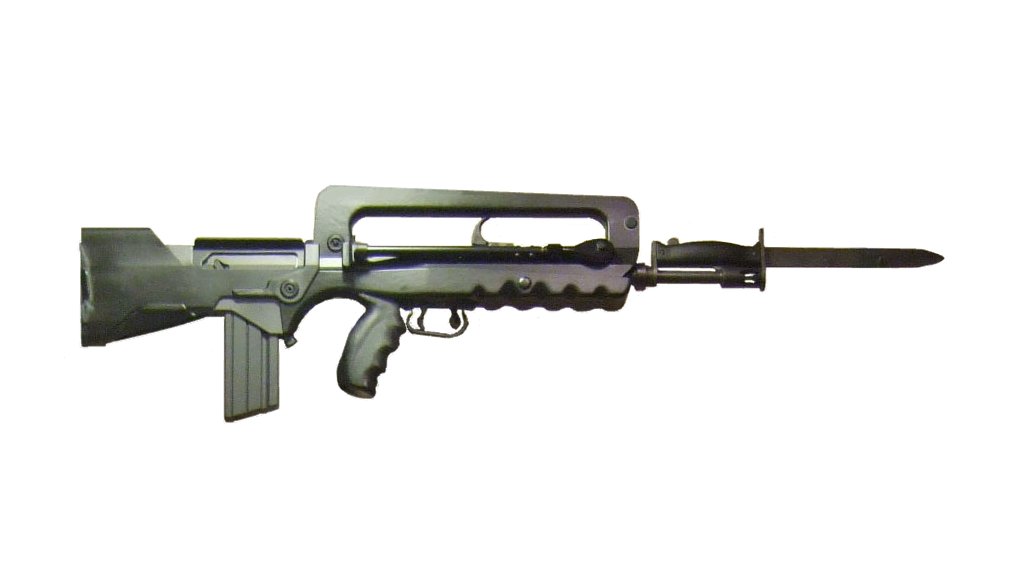
The FAMAS (French: Fusil d'Assaut de la Manufacture d'Armes de Saint-Étienne, lit. 'Assault rifle from the Saint-Étienne Weapon Factory') is a bullpup assault rifle designed and manufactured in France by MAS in 1978.
Key Information


Beginning in 2017, the FAMAS was replaced in most frontline units in the French Army by the HK416F, and the FAMAS is expected to remain in limited service until 2028.[4]
History
[edit]The first French bullpup rifles were developed between 1946 and 1950 at the AME (French: Atelier Mécanique de Mulhouse) and MAS, testing rounds such as .30 US Carbine, 7.92×33mm Kurz, 7.65×38mm (Made by Cartoucherie de Valence) and some other intermediate calibres.[citation needed]
Since France was engaged in the First Indochina War at the time, and was also the second-largest contributor to NATO, the research budgets for new types of weapons were limited and priority was given to the modernisation and production of existing service weapons.
Nevertheless, approximately forty different 7.62×51mm NATO calibre prototype rifles were developed between 1952 and 1962, most notably the FA-MAS Type 62. However, the United States' adoption of the M16 rifle and 5.56×45mm cartridge caused the French to rethink their approach, and consequently, the Type 62 was not adopted.[5][6][7]
In the 1960s, MAS began to manufacture under licence the Heckler & Koch G3 battle rifle and later on the Heckler & Koch HK33 assault rifle as temporary substitutes.[citation needed]
At the same time, the French embraced the idea of developing a new 5.56 mm automatic rifle. However, adopting the German-designed HK33 was considered unsatisfactory for many members of the French high command.
General Marcel Bigeard was also against the idea of relying on foreign weapons. While visiting the Manufacture d'Armes de Saint-Étienne, he asked the engineers to develop a homemade French 5.56 mm automatic rifle, which subsequently led to the creation and adoption of the FAMAS.
The FAMAS project began in 1967 under the direction of General Paul Tellié (1919-2014) and the first prototype was completed in 1971, with French military evaluation of the rifle beginning in 1972.[1]
When production problems delayed the general issue of the new rifles, and with the 1978 Battle of Kolwezi showing an immediate need for a more modern weapon to be comparable with the assault rifles of enemy forces, the French Army began searching for an emergency temporary rifle until the FAMAS came into full production.
While the Heckler & Koch HK33 was considered, with a batch of 1,200 examples tested, it was ultimately turned down in favour of the SIG SG 540, made under licence by Manurhin as a temporary resort until enough domestically built FAMAS were produced to issue to French forces.
In late 1978, the French military accepted the FAMAS as their standard-issue rifle, the FAMAS F1.
Service
[edit]The FAMAS first saw service in Chad during Operation Manta and again in desert operations during Operation Desert Storm and in other various missions.[8]
Officially, operational conditions proved the weapon to be reliable and trustworthy under combat conditions. It is known affectionally by French troops as "The Bugle" (French: Le Clairon) due to its distinctive shape.[9][10]
Replacement
[edit]
In 2017, the French armed forces began retiring the FAMAS in favour of the German-made HK-416.
When the Manufacture d'Armes de Saint-Etienne (MAS) factory closed in 2002, no more domestic rifles could be made. The last batch of newly produced FAMAS, built in 2002, saw more than a decade of heavy service by 2016. As of 2014, the French armed forces currently use an estimated 400,000 FAMAS F1 and G2 rifles still stored in their arsenal.[11] The military also ceased manufacture of special steel-case ammunition for the FAMAS.[12] Because the FAMAS did not function properly with NATO standard brass-cased ammunition (chamber fluting can allow the F1 to use brass cases but only G2 rifles can use common STANAG magazines),[12] and coupled with concern over the age of existing weapons, the French military sought a replacement for the FAMAS.
In May 2014, the French Ministry of Armed Forces announced a European Union-wide tender for a minimum of 90,000 rifles and carbines to be issued across the entire French armed forces.[13] In August 2016, the Ministry selected Heckler and Koch's HK416 to replace the FAMAS as the new general-issue service rifle.[14][15] Under the contract, the new rifle was designated as the HK416F, with 'F' standing for French version.[16] 16,000 rifles will be annually purchased until a final total of 90,000 to 102,000 rifles are delivered. The new rifles are expected to remain in active French service for at least 30 years.[15][17]
The FAMAS will be issued to the French National Guard and domestic police units, and will continue to serve in reserve and non-combat units until 2028, when a phaseout of the FAMAS with the HK416 can occur.[18]
Design details
[edit]Action
[edit]
The FAMAS is a bullpup assault rifle, where the ammunition feed is behind the trigger. The receiver housing is made of a special steel alloy, and the rifle furniture is made of fibreglass.
The FAMAS uses a lever-delayed blowback action, an action type also used in the French AA-52 machine gun derived from the prototypes built during Army Technical Department tests having taken place between the First and Second World Wars.
The FAMAS is known[19] for its high rate of fire of around 900–1,100 rounds per minute.[3]
Ergonomics
[edit]
Fire mode is controlled by a selector within the trigger guard, with three settings: safe (central position), single shot (to the right), and automatic fire (to the left). Automatic fire can be in three-shot bursts (French: rafale) or fully automatic; this is determined by another selector, located under the housing and behind the magazine.
The FAMAS G2 weighs 3.8 kg (8.38 lb). The G1 and G2 have a large, grip-length trigger guard like that of the Steyr AUG to allow easy access to the trigger when wearing gloves.
Both F1 and G2 models of the FAMAS feature a bipod attached to the upper hand-guard.
The FAMAS-G2 and some F1 sport a "polyvalent hand-guard" which features a standard NATO Accessory Rail, allowing a variety of sights to be mounted, notably red dot sights and night vision units.
Ammunition
[edit]

The FAMAS uses a delayed blowback operating system that functions best with French-specified steel-casing 5.56×45mm ammunition. Using standard brass-casing 5.56×45mm NATO ammunition employed by other armies can create over-pressure and case ruptures in the FAMAS during extraction, which can lead to severe malfunctions.[12]
Using incorrectly built ammunition also results in approximately two minor injuries for every million rounds fired from a FAMAS.[12] As a result, the French military has discreetly banned the use of foreign-produced ammunition in all French-issued FAMAS.[12]
However, fluting the chamber will completely remove these malfunctions, although the brass casings will still be deformed and will not be able to be reloaded without reshaping.
The FAMAS F1 uses a proprietary 25-round magazine. It has a chrome-lined barrel with 1 turn in 12 inch (1:12 inch) rifling and functions best with the 55 gr (3.6 g) (M193 type) ammunition. When using the French made 5.56 mm 55 gr (3.6 g) ammo it has a muzzle velocity of 3,150 ft/s (960 m/s).[20]
The FAMAS G2 uses M16-type, NATO-compatible 30-round STANAG magazines.[20] It has a chrome-lined barrel with 1 turn in 9 inch (1:9 inch) rifling and functions equally well with both the older 55 gr (3.6 g) (M193 type) ammo and the newer 62 gr (4.0 g) (SS109 type) ammo.[20] When using the French made 5.56 mm 62 gr (4.0 g) ammo it has a muzzle velocity of 3,035 ft/s (925 m/s).[20]
During training with blank ammunition, a special plug is added to the muzzle of the FAMAS. This plug is necessary for automatic or semi-automatic blank fire operation, and functions by blocking part of the gas used in a blank cartridge.
Rifle grenades
[edit]
The FAMAS can use a variety of rifle grenades up to 500 g (18 oz). Notable examples include the antipersonnel APAV40 and the anti-tank AC58.
The FAMAS features two alidades for aiming rifle grenades with several modes:
- direct fire at 75 to 100 m (246 to 328 ft), in anti-vehicle role
- indirect fire, in anti-personnel role:
- with the FAMAS inclined by 45°, allowing fire from 120 to 340 m (390 to 1,120 ft)
- with the FAMAS inclined by 75°, allowing fire from 60 to 170 m (200 to 560 ft)
In indirect fire mode, the grenade support (more exactly named "grenade enforcement ring" in French) is moved forward or backwards on the barrel which has markings (12/13?). This changes the position of the grenade on the barrel and automatically the volume of the chamber in which the gas expands to push the grenade forward.
Each position of the grenade support has a number which is multiplied by a certain fixed number depending on the alidade position, 45° or 75°; this will accurately indicate the firing distance of the grenade.
The FAMAS can also accommodate an external grenade launcher as an add-on module under the hand guard; the US M203 grenade launcher is sometimes used.
Variants
[edit]FAMAS F1
[edit]
- Rubber buttpad
- Removable stock
- Cheek rest. Can be reversed for right or left-handed shooter.
- Mobile assembly and ejection port
- Pins
- Bipod
- Handguard
- Charging Handle
- Grenade launcher sight
- Grenade support
- Flash hider/22 mm rifle grenade launcher
- Barrel
- Fire control selector: Safety, semi-automatic, automatic
- Trigger
- Magazine release
- Magazine block (safety device)
- Serial number
- (right): 3-round burst or full automatic selector
(left): Sling ring
After adoption by the French military, the FAMAS F1 replaced both the aging MAS 49/56 rifle and MAT-49 submachine gun. Approximately 400,000 FAMAS F1 assault rifles were produced by MAS.
While a capable rifle, the F1 had numerous problems to overcome. For instance, many plastic pieces on the rifle easily broke, including critical parts like the cheek riser. The FAMAS was also susceptible to malfunction on occasion due to poorly built, or rather improperly used, magazines.
The FAMAS was designed around the concept of single-use, disposable magazines; when the limited budget of the French military forced soldiers to repeatedly reuse the disposable magazines, the FAMAS would experience malfunctions.
MAS would eventually manufacture more durable magazines for the FAMAS that improved reliability.
FAMAS G1
[edit]The F1 was followed by the G1 version that included several minor improvements, such as redesigned grips and an enlarged trigger guard for operation with gloves.[citation needed] However, the G1 remained conceptual and was never actually produced.
FAMAS G2
[edit]
The FAMAS G2 was developed in 1994 to comply with NATO standards by accepting standard NATO magazines and by employing tighter barrel rifling to accurately fire both older 5.56 mm 55 gr (3.6 g) ammunition and new standard 5.56×45mm NATO 62 gr (4.0 g) ammunition.[21]
The ammunition specific lever-delayed blowback mechanism of the FAMAS F1 designed around French 55 gr (3.6 g) steel cased ammunition was slightly revised for reliably using 5.56×45mm NATO ammunition.
The FAMAS G2 features a larger trigger guard compared to the F1, a redesigned magwell and magazine catch accepting STANAG magazines, a small hand-guard protrusion (bump) on the front of fore-stock under the muzzle, a 1/9 inch rifling twist, instead of the 1/12 inch rifling twist of the F1.
The FAMAS G2 also included several other upgrades taken from the G1 model, such as an enlarged trigger guard and improved hand guards made from reinforced fiberglass instead of plastic, and also the ability to take standard brass cased ammunition as well as French made steel ammunition.
The French Navy purchased the FAMAS G2 in 1995 and issued it to their Fusiliers Marins and Commandos Marine. However, the French army refused to purchase the G2, preferring to rely on the FAMAS F1 as their primary rifle.
FAMAS Infantry
[edit]The FAMAS Infantry is an improvement of the FAMAS F1, obtained by retrofitting an accessory rail onto the top of the handguard. This allows mounting combat optics, most notably reflex sights or the 4×26.4 SCROME J4 telescopic sight.[22]
FAMAS FÉLIN
[edit]The FAMAS FÉLIN was developed from the G2 as part of the Infantryman programme with integrated equipment and links (Félin). An improved version of the FAMAS F1 is integrated in the Félin system.
FAMAS Valorisé
[edit]A FAMAS F1 whose carry handle has been replaced by the new version intended for the FAMAS Félin, lowered and originally equipped with 2 Picatinny rails.
In addition, the bipod joint has been moved back about ten centimetres and each foot is now bent in 2 points forward, so that in the folded position they do not interfere with the ejection of empty cases.
FAMAS Commando
[edit]The FAMAS Commando was a short-barrelled version of the FAMAS G2 for international exports, with a barrel length of 285mm (11.2 in) without the integrated bipod. Prototypes of the weapon differ, with different iron sights and ergonomics.
The FAMAS Commando saw no international interest and only initial prototypes exist and solely kept by the French Ministry of the Interior.[23]
Conflicts
[edit]The FAMAS has been used in the following conflicts:
- 1982 Lebanon War[24]
- Chadian–Libyan conflict[24]
- Ouvéa cave hostage taking[25]
- Gulf War[26]
- Rwandan Civil War[27]
- Bosnian War[28]
- War in Afghanistan (2001–2021)[29]
- Opération Licorne[29]
- Iraq War[30]
- Operation Serval[31]
- Operation Barkhane[32]
- Syrian Civil War[33]
- War in Iraq (2013–2017)
- Russian invasion of Ukraine[34][35]
Users
[edit]
.jpg)

 Argentina: G2 types bought in the 1990s for the Amphibious Commando Group.[36]
 Brazil: Special forces.[37]
 Cambodia: Used by Cambodian troops during the coup in 1997.[36]
 Cameroon: Used by BIR.[38]
 Central African Republic[39]
 Chad: Presidential Guard[40] and Army.[41]
 Djibouti[42]
 France: Used by the GIGN and French Armed Forces since 1979, with over 700,000 rifles purchased.[26] Began to be replaced by the Heckler & Koch HK416 starting in 2017.[43] Also used by several law enforcement agencies.[26]
 Gabon[44]
 Indonesia: Komando Pasukan Katak (KOPASKA) tactical diver group and Komando Pasukan Khusus (Kopassus) special forces group.[45]
 Iraqi insurgents[46]
 Ivory Coast:[47] Alassane Ouattara's FRCI are said to have received some FAMAS in 2011[48] but that claim is disputed.[49]
 Kanak and Socialist National Liberation Front[25]
 Lebanon[42]
 Papua New Guinea: Used in 2012 mutiny, likely "acquired" from F1 rifle stocks in Vanuatu.[36][50]
 Russia: Some captured by Russian troops in the Russo-Ukrainian War.[51]
 Senegal[52]
 Suriname: On September 14-15, 2023, an unknown number of FAMAS were donated to the Suriname army to help them fight against illegal fishing and gold mining.[53]
 Syria: FAMAS F1s used by the Syrian Arab Army, Islamic State and Kurds.[33]
 Ukraine: 1,000 FAMAS delivered by France in response to the Russian invasion of Ukraine.[34]
 United Arab Emirates[24]
 Vanuatu: Provided by France as military assistance to Vanuatu Mobile Forces to replace their L1A1 Self-Loading Rifles in 2009.[54] Reportedly used FAMAS F1s in 1994.[36]


Non-state actors
[edit]

See also
[edit]- HS Produkt VHS – (Croatia)
- IFAR 22 – (Indonesia)
Sources and references
[edit]- ^ a b "Modern Firearms – FAMAS". World.guns.ru. 24 January 2011. Archived from the original on 26 August 2010. Retrieved 30 May 2011.
- ^ "FAMAS Commando Prototypes". 26 August 2023. Archived from the original on 26 August 2023. Retrieved 26 August 2023.
- ^ a b Mizokami, Kyle (21 November 2019). "Everything You Need to Know About France's Prized FAMAS Rifle". National Interest.
- ^ "POTD: FAMAS in the 126e Régiment d'Infanterie". The Firearm Blog. 14 April 2021. Retrieved 14 April 2021.
- ^ "French MAS Type 1955". Forgotten Weapons. Archived from the original on 17 June 2011. Retrieved 30 May 2011.
- ^ "French MAS Type 62". Forgotten Weapons. Archived from the original on 17 June 2011. Retrieved 30 May 2011.
- ^ "FA-MAS Type 62". Securityarms.com. Archived from the original on 16 July 2011. Retrieved 30 May 2011.
- ^ "Meet Heckler & Koch's HK416: The Rifle You Need To Know About". National Interest. 19 March 2019.
- ^ Eger, Chris. "FAMAS BULLPUP ASSAULT RIFLES: LE 'BUGLE' (VIDEO)". Guns.com.
- ^ "FA-MAS F1 Manual English" (PDF). FA-MAS 5,56 F1.
- ^ France launches FAMAS replacement tender Archived 24 May 2014 at the Wayback Machine – IHS Jane's Defence Weekly, 22 May 2014
- ^ a b c d e "L'armée rencontre de sérieuses difficultés avec les munitions du fusil Famas". Archived from the original on 11 January 2015. Retrieved 3 June 2019.
- ^ "France Launches Program to Replace FAMAS Rifle - The Firearm Blog". The Firearm Blog. 20 May 2014. Archived from the original on 17 July 2015. Retrieved 30 January 2016.
- ^ "BREAKING: The Next French Infantry Rifle Is German - Heckler & Koch Reportedly WINS French AIF Rifle Competition - The Firearm Blog". 30 August 2016. Archived from the original on 13 September 2016. Retrieved 10 September 2016.
- ^ a b http://www.janes.com/article/64230/french-army-selects-hk416-to-replace-famas Archived 3 October 2016 at the Wayback Machine French Army selects HK416 to replace FAMAS. Nicholas de Larrinaga. London. IHS Jane's Defence Weekly. 30 September 2016
- ^ "La DGA attribue le marché de l'Arme Individuelle Future (AIF)". Archived from the original on 14 October 2016. Retrieved 13 October 2016.
- ^ BREAKING: Heckler & Koch CONFIRMED Winner of French AIF Rifle Contract; FN to Appeal French Decision Archived 18 September 2016 at the Wayback Machine - Thefirearmblog.com, 14 September 2016
- ^ "FAMAS to Equip New 84,000 Man National Guard, Stay in Service Until 2028 | FieldJournals". Archived from the original on 12 October 2017. Retrieved 12 October 2017.
- ^ "FAMAS Commando Prototypes". 26 August 2023. Archived from the original on 26 August 2023. Retrieved 26 August 2023.
- ^ a b c d Hogg, Ian V.; Weeks, John S. (2000). Military Small Arms of the 20th Century (7 ed.). Krause Publications. pp. 238–239. ISBN 978-0873418249.
- ^ Morgan, Martin. "Classic Guns: French FAMAS Bullpup Rifle". Shooting Illustrated.
- ^ "SCROME J4 F1 telescopic sight for FAMAS and MINIMI". Archived from the original on 21 March 2017. Retrieved 1 November 2020.
- ^ "FAMAS Commando Prototypes". 17 July 2020.
- ^ a b c Bishop, Chris. Guns in Combat. Chartwell Books, Inc (1998). ISBN 0-7858-0844-2.
- ^ a b c Jean-Paul, Mari. "Nouvelle-Calédonie : la tragédie d'Ouvéa". Le Nouvel Observateur (in French). Archived from the original on 1 September 2018. Retrieved 31 August 2018 – via grands-reporters.com.
- ^ a b c Marchington, James (2004). The Encyclopedia of Handheld Weapons. Lewis International, Inc. ISBN 1-930983-14-X
- ^ "Arming Rwanda: The Arms Trade and Human Rights, Abuses in the Rwandan War" (PDF). Human Rights Watch Arms Project. Vol. 6, no. 1. January 1994. p. 24. Archived (PDF) from the original on 18 March 2016. Retrieved 7 December 2018.
- ^ Edinger, B. (25 May 2012). "27 mai 1995 : les marsouins reprennent le pont de Vrbanja…". defense.gouv.fr (in French). Archived from the original on 2 September 2018. Retrieved 31 August 2018.
- ^ a b Richard, Christophe (Spring 2014). "Shooting practice with the " Steel battalion "" (PDF). Fantassins. No. 32. p. 28. Archived from the original (PDF) on 15 December 2018. Retrieved 12 December 2018.
- ^ "Why France Loves the Heckler & Koch HK416 Rifle". National Interest. 24 February 2019.
- ^ Capdeville, Thibault (Spring 2014). "Infantry units fires during OP Serval" (PDF). Fantassins. No. 32. pp. 55–58. Archived from the original (PDF) on 15 December 2018. Retrieved 12 December 2018.
- ^ "Protests against French forces in Mali turn deadly - France 24". 18 April 2016. Archived from the original on 11 July 2016. Retrieved 16 July 2016.
- ^ a b c d e "Des Famas en Syrie, preuve que la France arme les islamistes?". France-Soir (in French). 30 August 2018. Archived from the original on 12 September 2018. Retrieved 12 September 2018.
- ^ a b Ministry of Armed Forces (France) (4 March 2024). "Ukraine: la France dresse le bilan des équipements militaires livrés". Ministère des Armées (in French). Retrieved 4 March 2024.
- ^ "Ukrainian Defense Forces Integrate FAMAS Felin Rifles". Militarnyi. 14 December 2023. Retrieved 4 March 2024.
- ^ a b c d https://www.safar-publishing.com/post/non-french-use-of-the-famas-rifle
- ^ "ELITES OF THE EXÉRCITO BRASILEIRO – Small Arms Review". 11 March 2011. Retrieved 19 October 2022.
- ^ "Des militaires camerounais arrêtés au Tchad". BBC News (in French). 9 May 2017. Archived from the original on 12 September 2018. Retrieved 12 September 2018.
- ^ Berman, Eric G.; Lombard, Louisa N. (December 2008). The Central African Republic and Small Arms: A Regional Tinderbox (PDF). Small Arms Survey. pp. 82, 94. ISBN 978-2-8288-0103-8. Archived from the original (PDF) on 7 January 2017. Retrieved 4 September 2018.
- ^ "L'opposant tchadien Saleh toujours porté disparu". France 24. 18 March 2008. Archived from the original on 16 October 2018. Retrieved 16 October 2018.
- ^ "Tchad : Instruction de 70 élèves-officiers tchadiens au combat d'infanterie". ecpad.fr. French Ministry of Defense. 30 March 2015. Archived from the original on 16 October 2018. Retrieved 16 October 2018.
- ^ a b Jones, Richard D. Jane's Infantry Weapons 2009/2010. Jane's Information Group; 35 edition (27 January 2009). ISBN 978-0-7106-2869-5.
- ^ Mizokami, Kyle (13 December 2019). "How The FAMAS Rifle Became A Game-Changer for the French Military". National Interest.
- ^ Kemp, Ian (April–May 2007). "Assault rifles in a 5.56 mm evolution: the fielding of new designs and the upgrade of existing weapons will ensure that 5.56 mm remains the predominant assault rifle calibre". Armada International. Archived from the original on 12 September 2018. Retrieved 12 September 2018.
- ^ "Kopassus & Kopaska – Specijalne Postrojbe Republike Indonezije" (in Croatian). Hrvatski Vojnik Magazine. Archived from the original on 22 August 2010. Retrieved 12 June 2010.
- ^ a b Small Arms Survey (2012). "Surveying the Battlefield: Illicit Arms in Afghanistan, Iraq, and Somalia". Small Arms Survey 2012: Moving Targets. Cambridge University Press. pp. 320–321. ISBN 978-0-521-19714-4. Archived from the original (PDF) on 31 August 2018. Retrieved 30 August 2018.
- ^ Anders, Holger (June 2014). Identifier les sources d'approvisionnement: Les munitions de petit calibre en Côte d'Ivoire (PDF) (in French). Small Arms Survey and United Nations Operation in Côte d'Ivoire. p. 15. ISBN 978-2-940-548-05-7. Archived from the original (PDF) on 9 October 2018. Retrieved 5 September 2018.
- ^ Marot, Jean-Baptiste (7 April 2011). "Comment les forces pro-Ouattara ont préparé l'offensive contre Gbagbo". France 24. Archived from the original on 7 September 2018. Retrieved 7 September 2018.
- ^ Duhem, Vincent (13 April 2011). "La France les deux pieds dans le plat ivoirien". Slate.fr (in French). Archived from the original on 24 November 2018. Retrieved 23 November 2018.
- ^ "PNG's mutineers trade guns for amnesty". The Australian. 31 January 2012. Archived from the original on 7 February 2012. Retrieved 29 February 2012.
- ^ "FAMAS in Ukraine". 9 June 2024.
- ^ Binnie, Jeremy; de Cherisey, Erwan (2017). "New-model African armies" (PDF). Jane's. Archived from the original (PDF) on 22 June 2017.
- ^ "L'armée française donne ses fusils FAMAS désormais inutilisés à l'armée du Suriname". Le Figaro. 24 September 2023. Retrieved 25 September 2023.
- ^ https://www.rnz.co.nz/international/pacific-news/187375/vanuatu-mobile-force-replaces-its-firearms
External links
[edit]
- Official Nexter FAMAS page
- Buddy Hinton: FAMAS Photo Collection
- FELIN article, with FAMAS pictured as part of FELIN system
- Modern Firearms: FAMAS Archived 26 August 2010 at the Wayback Machine
- REMTEK - ARMS: FAMAS
- The Firearm Blog: R.I.P General Paul Tellié, Father of the FAMAS
- Nazarian's Gun's Recognition Guide: MAS .223 semi-automatic rifle Manual (.pdf)
| Lever delayed | | |
|---|---|---|
| Roller delayed | ||
| Gas delayed | ||
| Hesitation locked | ||
| Flywheel delayed | ||
| Radial delayed | ||
| Screw/Turnbolt delayed | ||
| Toggle delayed | ||
| Vector delayed | ||

| Authority control databases: National |
|---|
