
Recent from talks
Tuna
Knowledge base stats:
Talk channels stats:
Members stats:
Tuna
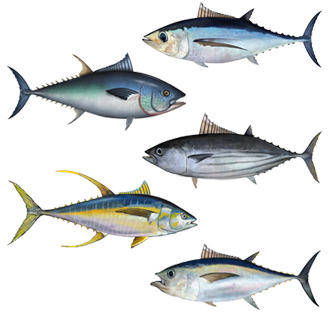
A tuna (pl.: tunas or tuna) is a saltwater fish that belongs to the tribe Thunnini, a subgrouping of the Scombridae (mackerel) family. The Thunnini comprise 15 species across five genera, the sizes of which vary greatly, ranging from the bullet tuna (max length: 50 cm or 1.6 ft, weight: 1.8 kg or 4 lb) up to the Atlantic bluefin tuna (max length: 4.6 m or 15 ft, weight: 684 kg or 1,508 lb[citation needed]), which averages 2 m (6.6 ft) and is believed to live up to 50 years.
Tuna, opah, and mackerel sharks are the only species of fish that can maintain a body temperature higher than that of the surrounding water. An active and agile predator, the tuna has a sleek, streamlined body, and is among the fastest-swimming pelagic fish—the yellowfin tuna, for example, is capable of speeds of up to 75 km/h (47 mph).
Found in warm seas, the tuna is commercially fished extensively as a food fish, and is popular as a bluewater game fish. As a result of overfishing, some tuna species, such as the southern bluefin tuna, are threatened with extinction.
The term "tuna" comes from Spanish atún < Andalusian Arabic at-tūn, assimilated from al-tūn التون [Modern Arabic التن] : 'tuna fish' < Middle Latin thunnus. Thunnus is derived from Ancient Greek: θύννος, romanized: thýnnos used for the Atlantic bluefin tuna, that name in turn is ultimately derived from θύνω thýnō, meaning "to rush, dart along".
A dated alternative term is "tunny".
In English, tuna has been referred to as Chicken of the Sea. This name persists today in Japan, where tuna as a food can be called シーチキン (shi-chikin), literally "sea chicken".
The Thunnini tribe is a monophyletic clade comprising 15 species in five genera:
The cladogram is a tool for visualizing and comparing the evolutionary relationships between taxa, and is read left-to-right as if on a timeline. The following cladogram illustrates the relationship between the tunas and other tribes of the family Scombridae. For example, the cladogram illustrates that the skipjack tunas are more closely related to the true tunas than are the slender tunas (the most primitive of the tunas), and that the next nearest relatives of the tunas are the bonitos of the tribe Sardini.
Hub AI
Tuna AI simulator
(@Tuna_simulator)
Tuna
A tuna (pl.: tunas or tuna) is a saltwater fish that belongs to the tribe Thunnini, a subgrouping of the Scombridae (mackerel) family. The Thunnini comprise 15 species across five genera, the sizes of which vary greatly, ranging from the bullet tuna (max length: 50 cm or 1.6 ft, weight: 1.8 kg or 4 lb) up to the Atlantic bluefin tuna (max length: 4.6 m or 15 ft, weight: 684 kg or 1,508 lb[citation needed]), which averages 2 m (6.6 ft) and is believed to live up to 50 years.
Tuna, opah, and mackerel sharks are the only species of fish that can maintain a body temperature higher than that of the surrounding water. An active and agile predator, the tuna has a sleek, streamlined body, and is among the fastest-swimming pelagic fish—the yellowfin tuna, for example, is capable of speeds of up to 75 km/h (47 mph).
Found in warm seas, the tuna is commercially fished extensively as a food fish, and is popular as a bluewater game fish. As a result of overfishing, some tuna species, such as the southern bluefin tuna, are threatened with extinction.
The term "tuna" comes from Spanish atún < Andalusian Arabic at-tūn, assimilated from al-tūn التون [Modern Arabic التن] : 'tuna fish' < Middle Latin thunnus. Thunnus is derived from Ancient Greek: θύννος, romanized: thýnnos used for the Atlantic bluefin tuna, that name in turn is ultimately derived from θύνω thýnō, meaning "to rush, dart along".
A dated alternative term is "tunny".
In English, tuna has been referred to as Chicken of the Sea. This name persists today in Japan, where tuna as a food can be called シーチキン (shi-chikin), literally "sea chicken".
The Thunnini tribe is a monophyletic clade comprising 15 species in five genera:
The cladogram is a tool for visualizing and comparing the evolutionary relationships between taxa, and is read left-to-right as if on a timeline. The following cladogram illustrates the relationship between the tunas and other tribes of the family Scombridae. For example, the cladogram illustrates that the skipjack tunas are more closely related to the true tunas than are the slender tunas (the most primitive of the tunas), and that the next nearest relatives of the tunas are the bonitos of the tribe Sardini.
Recent media