Hubbry Logo
Medieval LatinMedieval LatinMain
Open search
Medieval Latin
Community hub
Medieval Latin
logo
8 pages, 0 posts
0 subscribers
Be the first to start a discussion here.
Contribute something
Medieval Latin
Medieval Latin
from Wikipedia

Medieval Latin
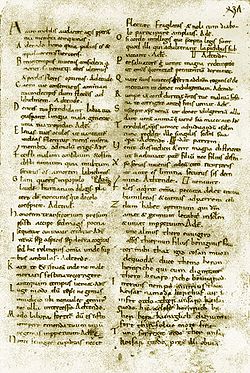
Carmina Cantabrigiensia, Medieval Latin manuscript
Native toNumerous small states
RegionLatin Christianity
(Most of Europe. Also among Mozarabs and Roman Africans)
EraDeveloped from Late Latin between 4th and 10th centuries; replaced by Renaissance Latin from the 14th century
Early forms
Latin alphabet 
Official status
Official language in
De facto in most Catholic and/or Romance-speaking states during the Middle Ages[a]
Language codes
ISO 639-3
lat-med
Glottologmedi1250
Europe, AD 1000

Medieval Latin was the form of Literary Latin used in Roman Catholic Western Europe during the Middle Ages. It was also the administrative language in the former Roman Provinces of Mauretania, Numidia and Africa Proconsularis under the Vandals, the Byzantines and the Romano-Berber Kingdoms, until it declined after the Arab Conquest. Medieval Latin in Southern and Central Visigothic Hispania, conquered by the Arabs immediately after North Africa, experienced a similar fate, only recovering its importance after the Reconquista by the Northern Christian Kingdoms. In this region, it served as the primary written language, though local languages were also written to varying degrees. Latin functioned as the main medium of scholarly exchange, as the liturgical language of the Church, and as the working language of science, literature, law, and administration.

Medieval Latin represented a continuation of Classical Latin and Late Latin, with enhancements for new concepts as well as for the increasing integration of Christianity. Despite some meaningful differences from Classical Latin, its writers did not regard it as a fundamentally different language. There is no real consensus on the exact boundary where Late Latin ends and Medieval Latin begins. Some scholarly surveys begin with the rise of early Ecclesiastical Latin in the middle of the 4th century, others around 500,[1] and still others with the replacement of written Late Latin by written Romance languages starting around the year 900.

The terms Medieval Latin and Ecclesiastical Latin are sometimes used synonymously, though some scholars draw distinctions. Ecclesiastical Latin refers specifically to the form that has been used by the Roman Catholic Church (even before the Middle Ages in Antiquity), whereas Medieval Latin refers to all of the (written) forms of Latin used in the Middle Ages. The Romance languages spoken in the Middle Ages were often referred to as Latin, since the Romance languages were all descended from Vulgar Latin itself.[2] Medieval Latin would be replaced by educated humanist Renaissance Latin, otherwise known as Neo-Latin.

Influences

[edit]

Christian Latin

[edit]

Medieval Latin had an enlarged vocabulary, which freely borrowed from other sources. It was heavily influenced by the language of the Vulgate, which contained many peculiarities alien to Classical Latin that resulted from a more or less direct translation from Greek and Hebrew; the peculiarities mirrored the original not only in its vocabulary but also in its grammar and syntax. Greek provided much of the technical vocabulary of Christianity. The various Germanic languages spoken by the Germanic tribes, who invaded southern Europe, were also major sources of new words. Germanic leaders became the rulers of parts of the Roman Empire that they conquered, and words from their languages were freely imported into the vocabulary of law. Other more ordinary words were replaced by coinages from Vulgar Latin or Germanic sources because the classical words had fallen into disuse.

An illuminated manuscript of a Book of Hours contains prayers in Medieval Latin.

Latin was also spread to areas such as Ireland and Germany, where Romance languages were not spoken, and which had never known Roman rule. Works written in those lands where Latin was a learned language, having no relation to the local vernacular, also influenced the vocabulary and syntax of Medieval Latin.

Since subjects like science and philosophy, including Rhetoric and Ethics, were communicated in Latin, the Latin vocabulary that developed for them became the source of a great many technical words in modern languages. English words like abstract, subject, communicate, matter, probable and their cognates in other European languages generally have the meanings given to them in Medieval Latin, often terms for abstract concepts not available in English.[3]

Vulgar Latin

[edit]

The influence of Vulgar Latin was also apparent in the syntax of some Medieval Latin writers, although Classical Latin continued to be held in high esteem and studied as models for literary compositions. The high point of the development of Medieval Latin as a literary language came with the Carolingian Renaissance, a rebirth of learning kindled under the patronage of Charlemagne, king of the Franks. Alcuin was Charlemagne's Latin secretary and an important writer in his own right; his influence led to a rebirth of Latin literature and learning after the depressed period following the final disintegration of the authority of the Western Roman Empire.

Although it was simultaneously developing into the Romance languages, Latin itself remained very conservative, as it was no longer a native language and there were many ancient and medieval grammar books to give one standard form. On the other hand, strictly speaking there was no single form of "Medieval Latin". Every Latin author in the medieval period spoke Latin as a second language, with varying degrees of fluency and syntax. Grammar and vocabulary, however, were often influenced by an author's native language. This was especially true beginning around the 12th century, after which the language became increasingly adulterated: late Medieval Latin documents written by French speakers tend to show similarities to medieval French grammar and vocabulary; those written by Germans tend to show similarities to German, etc. For instance, rather than following the classical Latin practice of generally placing the verb at the end, medieval writers would often follow the conventions of their own native language instead. Whereas Latin had no definite or indefinite articles, medieval writers sometimes used forms of unus as an indefinite article, and forms of ille (reflecting usage in the Romance languages) as a definite article or even quidam (meaning "a certain one/thing" in Classical Latin) as something like an article. Unlike classical Latin, where esse ("to be") was the only auxiliary verb, Medieval Latin writers might use habere ("to have") as an auxiliary, similar to constructions in Germanic and Romance languages. The accusative and infinitive construction in classical Latin was often replaced by a subordinate clause introduced by quod or quia. This is almost identical, for example, to the use of que in similar constructions in French. Many of these developments are similar to Standard Average European and the use of medieval Latin among the learned elites of Christendom may have played a role in the spread of those features.

In every age from the late 8th century onwards, there were learned writers (especially within the Church) who were familiar enough with classical syntax to be aware that these forms and usages were "wrong" and resisted their use. Thus the Latin of a theologian like St Thomas Aquinas or of an erudite clerical historian such as William of Tyre tends to avoid most of the characteristics described above, showing its period in vocabulary and spelling alone; the features listed are much more prominent in the language of lawyers (e.g. the 11th-century English Domesday Book), physicians, technical writers and secular chroniclers. However the use of quod to introduce subordinate clauses was especially pervasive and is found at all levels.[4]

Changes in vocabulary, syntax, and grammar

[edit]

Medieval Latin had ceased to be a living language and was instead a scholarly language of the minority of educated men (and a tiny number of women) in medieval Europe, used in official documents more than for everyday communication. This resulted in two major features of Medieval Latin compared with Classical Latin, though when it is compared to the other vernacular languages, Medieval Latin developed very few changes.[4] There are many prose constructions written by authors of this period that can be considered "showing off" a knowledge of Classical or Old Latin by the use of rare or archaic forms and sequences. Though they had not existed together historically, it is common that an author would use grammatical ideas of the two periods Republican and archaic, placing them equally in the same sentence. Also, many undistinguished scholars had limited education in "proper" Latin, or had been influenced in their writings by Vulgar Latin.

  • Word order usually tended towards that of the vernacular language of the author, not the word order of Classical Latin. Conversely, an erudite scholar might attempt to "show off" by intentionally constructing a very complicated sentence. Because Latin is an inflected language, it is technically possible to place related words at opposite ends of a paragraph-long sentence, and owing to the complexity of doing so, it was seen by some as a sign of great skill. The preferred word order in Latin is Subject-Object-Verb; most vernaculars of medieval Latin authors tend to or mandate Subject-Verb-Object which thus is more prevalent in medieval than in classical Latin.
  • Typically, prepositions are used much more frequently (as in modern Romance languages) for greater clarity, instead of using the ablative case alone. Furthermore, in Classical Latin the subject of a verb was often left implied, unless it was being stressed: videt = "he sees". For clarity, Medieval Latin more frequently includes an explicit subject: is videt = "he sees" without necessarily stressing the subject. Classical Latin is a pro-drop language whereas most Germanic (including standard English) and some Romance languages are not.
  • Various changes occurred in vocabulary, and certain words were mixed into different declensions or conjugations. Many new compound verbs were formed. Some words retained their original structure but drastically changed in meaning: animositas specifically means "wrath" in Medieval Latin while in Classical Latin, it generally referred to "high spirits, excited spirits" of any kind.
  • Owing to heavy use of biblical terms, there was a large influx of new words borrowed from Greek and Hebrew and even some grammatical influences. That obviously largely occurred among priests and scholars, not the laity. In general, it is difficult to express abstract concepts in Latin, as many scholars admitted. For example, Plato's abstract concept of "the Truth" had to be expressed in Latin as "what is always true". Medieval scholars and theologians, translating both the Bible and Greek philosophers into Latin out of the Koine and Classical Greek, cobbled together many new abstract concept words in Latin.

Syntax

[edit]
  • Indirect discourse, which in Classical Latin was achieved by using a subject accusative and infinitive, was now often simply replaced by new conjunctions serving the function of English "that" such as quod, quia, or quoniam. There was a high level of overlap between the old and new constructions, even within the same author's work, and it was often a matter of preference. A particularly famous and often cited example is from the Venerable Bede, using both constructions within the same sentence: "Dico me scire et quod sum ignobilis" = "I say that I know [accusative and infinitive] and that I am unknown [new construction]". The resulting subordinate clause often used the subjunctive mood instead of the indicative. This new syntax for indirect discourse is among the most prominent features of Medieval Latin, the largest syntactical change. However, such use of quod or quia also occurred in the Latin of the late Roman Empire,[5] e.g. the Vulgate's Matthew 2:22: "Audiens autem quod Archelaus regnaret in Judaea pro Herode..." = "But hearing that Archelaus reigned in Judaea in Herod's place..."
  • Several substitutions were often used instead of subjunctive clause constructions. They did not break the rules of Classical Latin but were an alternative way to express the same meaning, avoiding the use of a subjunctive clause.
    • The present participle was frequently used adverbially in place of qui or cum clauses, such as clauses of time, cause, concession, and purpose. That was loosely similar to the use of the present participle in an ablative absolute phrase, but the participle did not need to be in the ablative case.
    • Habeo (I have [to]) and Debeo (I must) would be used to express obligation more often than the gerundive.
      • Given that obligation inherently carries a sense of futurity ("Carthage must be destroyed" at some point in the future), this parallels the Romance languages' use of habeo as the basis of their future tenses (abandoning the Latin forms of the future tense). While in Latin amare habeo is the indirect discourse "I have to love", in the French equivalent, aimerai (habeo > ayyo > ai, aimer+ai), it has become the future tense, "I shall love", losing the sense of obligation. In Medieval Latin, however, it was only indirect discourse and not used as simply a future tense.
    • Instead of a clause introduced by ut or ne, an infinitive was often used with a verb of hoping, fearing, promising, etc.
  • Conversely, some authors might haphazardly switch between the subjunctive and indicative forms of verbs, with no intended difference in meaning.
  • The usage of sum changed significantly: it was frequently omitted or implied. Further, many medieval authors did not feel that it made sense for the perfect passive construction "laudatus sum" to use the present tense of esse in a past tense construction so they began using fui, the past perfect of sum, interchangeably with sum.
  • Chaos in the usage of demonstrative pronouns. Hic, ille, iste, and even the intensive ipse are often used virtually interchangeably. As in the Romance languages, hic and ille were also frequently used simply to express the definite article "the", which Classical Latin did not possess. Unus was also used for the indefinite article "a, an".
  • Use of reflexives became much looser. A reflexive pronoun in a subordinate clause might refer to the subject of the main clause. The reflexive possessive suus might be used in place of a possessive genitive such as eius.
  • Comparison of adjectives changed somewhat. The comparative form was sometimes used with positive or superlative meaning. Also, the adverb magis was often used with a positive adjective to indicate a comparative meaning, and multum and nimis could be used with a positive form of adjective to give a superlative meaning.
  • Classical Latin used the ablative absolute, but as stated above, in Medieval Latin examples of nominative absolute or accusative absolute may be found. This was a point of difference between the ecclesiastical Latin of the clergy and the "Vulgar Latin" of the laity, which existed alongside it. The educated clergy mostly knew that traditional Latin did not use the nominative or accusative case in such constructions, but only the ablative case. These constructions are observed in the medieval era, but they are changes that developed among the uneducated commoners.
  • Classical Latin does not distinguish progressive action in the present tense, thus laudo can mean either "I praise" or "I am praising". In imitation of Greek, Medieval Latin could use a present participle with sum to form a periphrastic tense equivalent to the English progressive. This "Greek Periphrastic Tense" formation could also be done in the past and future tenses: laudans sum ("I am praising"), laudans eram ("I was praising"), laudans ero ("I shall be praising").
  • Classical Latin verbs had at most two voices, active and passive, but Greek (the original language of the New Testament) had an additional "middle voice" (or reflexive voice). One use was to express when the subject is acting upon itself: "Achilles put the armor onto himself" or "Jesus clothed himself in the robe" would use the middle voice. Because Latin had no middle voice, Medieval Latin expresses such sentences by putting the verb in the passive voice form, but the conceptual meaning is active (similar to Latin deponent verbs). For example, the Medieval Latin translation of Genesis states literally, "the Spirit of God was moved over the waters" (spiritus Dei ferebatur super aquas, Genesis 1:2), but it is just expressing a Greek middle-voice verb: "God moved [himself] over the waters".
  • Overlapping with orthography differences (see below), certain diphthongs were sometimes shortened: "oe" to "e", and "ae" to "e". Thus, oecumenicus becomes the more familiar ecumenicus (more familiar in this later form because religious terms such as "ecumenical" were more common in Medieval Latin). The "oe" diphthong is not particularly frequent in Latin, but the shift from "ae" to "e" affects many common words, such as caelum (heaven) being shortened to celum; even puellae (girls) was shortened to puelle.
  • Often, a town would lose its name to that of the tribe which was either accusative or ablative plural; two forms that were then used for all cases, or in other words, considered "indeclinable".[6][clarification needed]

Orthography

[edit]
The Prüfening dedicatory inscription from Bavaria, dated to 1119, composed in Medieval Latin. It was printed rather than carved.

Many striking differences between classical and Medieval Latin are found in orthography. Perhaps the most striking difference is that medieval manuscripts used a wide range of abbreviations by means of superscripts, special characters etc.: for instance the letters "n" and "s" were often omitted and replaced by a diacritical mark above the preceding or following letter. Apart from this, some of the most frequently occurring differences are as follows. Clearly many of these would have been influenced by the spelling, and indeed pronunciation,[6] of the vernacular language, and thus varied between different European countries.

  • Following the Carolingian reforms of the 9th century, Carolingian minuscule was widely adopted, leading to a clear differentiation between capital and lowercase letters.
  • A partial or full differentiation between v and u, and between j and i.
  • The diphthong ae is usually collapsed and simply written as e (or e caudata, ę); for example, puellae might be written puelle (or puellę). The same happens with the diphthong oe, for example in pena, Edipus, from poena, Oedipus. This feature is already found on coin inscriptions of the 4th century (e.g. reipublice for reipublicae). Conversely, an original e in Classical Latin was often represented by ae or oe (e.g. aecclesia and coena), also reflected in English spellings such as foetus.
  • Because of a severe decline in the knowledge of Greek, in loanwords and foreign names from or transmitted through Greek, y and i might be used more or less interchangeably: Ysidorus, Egiptus, from Isidorus, Aegyptus. This is also found in pure Latin words: ocius ("more swiftly") appears as ocyus and silva as sylva, this last being a form which survived into the 18th century and so became embedded in modern botanical Latin (also cf. Pennsylvania).
  • h might be lost, so that habere becomes abere, or mihi becomes mi (the latter also occurred in Classical Latin); or mihi may be written michi, indicating that the h had come to be pronounced as [k] or perhaps [x]. This pronunciation is not found in Classical Latin, but had existed very early in vulgar speech.
  • The loss of h in pronunciation also led to the addition of h in writing where it did not previously belong, especially in the vicinity of r, such as chorona for corona, a tendency also sometimes seen in Classical Latin.
  • -ti- before a vowel is often written as -ci- [tsi], so that divitiae becomes diviciae (or divicie), tertius becomes tercius, vitium vicium.
  • The combination mn might have another plosive inserted, so that alumnus becomes alumpnus, somnus sompnus.
  • Single consonants were often doubled, or vice versa, so that tranquillitas becomes tranquilitas and Africa becomes Affrica.
  • Syncopation became more frequent: vi, especially in verbs in the perfect tense, might be lost, so that novisse becomes nosse (this occurred in Classical Latin as well but was much more frequent in Medieval Latin).

These orthographical differences were often due to changes in pronunciation or, as in the previous example, morphology, which authors reflected in their writing. By the 16th century, Erasmus complained that speakers from different countries were unable to understand each other's form of Latin.[7]

The gradual changes in Latin did not escape the notice of contemporaries. Petrarch, writing in the 14th century, complained about this linguistic "decline", which helped fuel his general dissatisfaction with his own era.

Medieval Latin literature

[edit]

The corpus of Medieval Latin literature encompasses a wide range of texts, including such diverse works as sermons, hymns, hagiographical texts, travel literature, histories, epics, and lyric poetry.

The first half of the 5th century saw the literary activities of the great Christian authors Jerome (c. 347–420) and Augustine of Hippo (354–430), whose texts had an enormous influence on theological thought of the Middle Ages, and of the latter's disciple Prosper of Aquitaine (c. 390 – c. 455). Of the later 5th century and early 6th century, Sidonius Apollinaris (c. 430 – after 489) and Ennodius (474–521), both from Gaul, are well known for their poems, as is Venantius Fortunatus (c. 530 – c. 600). This was also a period of transmission: the Roman patrician Boethius (c. 480–524) translated part of Aristotle's logical corpus, thus preserving it for the Latin West, and wrote the influential literary and philosophical treatise De consolatione Philosophiae; Cassiodorus (c. 485 – c. 585) founded an important library at the monastery of Vivarium near Squillace where many texts from Antiquity were to be preserved. Isidore of Seville (c. 560–636) collected all scientific knowledge still available in his time into what might be called the first encyclopedia, the Etymologiae.

Gregory of Tours (c. 538–594) wrote a lengthy history of the Frankish kings. Gregory came from a Gallo-Roman aristocratic family, and his Latin, which shows many aberrations from the classical forms, testifies to the declining significance of classical education in Gaul. At the same time, good knowledge of Latin and even of Greek was being preserved in monastic culture in Ireland and was brought to England and the European mainland by missionaries in the course of the 6th and 7th centuries, such as Columbanus (543–615), who founded the monastery of Bobbio in Northern Italy. Ireland was also the birthplace of a strange poetic style known as Hisperic Latin. Other important Insular authors include the historian Gildas (c. 500 – c. 570) and the poet Aldhelm (c. 640–709). Benedict Biscop (c. 628–690) founded the monastery of Wearmouth-Jarrow and furnished it with books which he had taken home from a journey to Rome and which were later used by Bede (c. 672–735) to write his Ecclesiastical History of the English People.

Many Medieval Latin works have been published in the series Patrologia Latina, Corpus Scriptorum Ecclesiasticorum Latinorum and Corpus Christianorum.

Medieval Latin and everyday life

[edit]

Medieval Latin was separated from Classical Latin around 800 and at this time was no longer considered part of the everyday language. The speaking of Latin became a practice used mostly by the educated high class population. Even then it was not frequently used in casual conversation. An example of these men includes the churchmen who could read Latin, but could not effectively speak it. Latin's use in universities was structured in lectures and debates, however, it was highly recommended that students use it in conversation. This practice was kept up only due to rules.[8] One of Latin's purposes, writing, was still in practice; the main uses being charters for property transactions and to keep track of the pleadings given in court. Even then, those of the church still used Latin more than the rest of the population. At this time, Latin served little purpose to the regular population but was still used regularly in ecclesiastical culture.[8] Latin also served as a lingua franca among the educated elites of Christendom — long distance written communication, while rarer than in Antiquity, took place mostly in Latin. Most literate people wrote Latin and most rich people had access to scribes who knew Latin for use when the need for long distance correspondence arose. Long-distance communication in the vernacular was rare, but Hebrew, Arabic and Greek served a similar purpose among Jews, Muslims and Eastern Orthodox respectively.

Important Medieval Latin authors

[edit]

6th–8th centuries

[edit]

9th century

[edit]

10th century

[edit]

11th century

[edit]

12th century

[edit]

13th century

[edit]

14th century

[edit]

Literary movements

[edit]

Works

[edit]

Notes

[edit]

References

[edit]

Further reading

[edit]
[edit]
Revisions and contributorsEdit on WikipediaRead on Wikipedia
from Grokipedia
Medieval Latin is the form of the Latin language used throughout from approximately 500 to 1500 CE, functioning as the principal medium for ecclesiastical, scholarly, legal, and administrative communication during the . It emerged as a continuation of Late Antique Latin after the fall of the , evolving under the influence of , the Bible, and regional vernaculars while striving to emulate standards. This period of Latin usage marked a shift from a spoken vernacular to a learned lingua franca, preserved and adapted by monks, scholars, and clerics across Europe. The history of Medieval Latin reflects broader cultural and intellectual developments, beginning with its preservation in Irish monasteries during the 6th to 8th centuries, where it safeguarded classical texts amid the decline of Roman infrastructure. The under in the late 8th and 9th centuries revitalized Latin education and standardized its through monastic scriptoria, fostering a resurgence in and administration. By the 12th and 13th centuries, renewed contact with scholarship via translations in centers like Toledo further enriched Medieval Latin, enabling works in , , and by figures such as . Its dominance persisted into the , when humanists began critiquing and reforming it to align more closely with Ciceronian ideals, though it remained the language of the Catholic Church's until the mid-20th century. Linguistically, Medieval Latin exhibited greater flexibility than , with innovations in , , and driven by practical needs and influences. Orthographic changes included the simplification of diphthongs (e.g., ae and oe often rendered as e) and variable spellings reflecting pronunciation shifts, such as ci for ti before vowels. Vocabulary expanded through neologisms, semantic shifts (e.g., regulariter denoting monastic observance), and borrowings from Greek, , and emerging , while favored constructions like quod-clauses over the Classical accusative-and-infinitive for reported speech. Deponent verbs increasingly appeared in active forms, and prepositional usages with cases became more varied, allowing for rhythmic and rhymed that distinguished medieval compositions. As the vehicle for an extensive body of literature, Medieval Latin produced diverse genres, from hagiographies and chronicles to scientific treatises and satirical verse, underscoring its role in transmitting knowledge across linguistic barriers. Key works include the Rule of Saint Benedict for monastic life, the Carmina Burana anthology of secular songs, and theological masterpieces like Anselm's Cur Deus Homo. Its study today relies on specialized dictionaries and corpora, such as the Dictionary of Medieval Latin from British Sources, which highlight regional variations and the language's adaptability to medieval society's multifaceted needs.

Overview

Definition and Scope

Medieval Latin refers to the form of the Latin language employed primarily in from approximately the , following the fall of the around 476 AD, through the , until the onset of the . This period marks a transitional phase in the evolution of Latin, serving as a bridge between the standardized literary of antiquity and the revived humanistic of the early . As a learned and predominantly , Medieval Latin functioned as the primary medium for intellectual, , legal, and administrative purposes across , rather than as a native spoken . It was cultivated by scholars, , and officials in monasteries, universities, and courts, enabling the transmission of knowledge in fields ranging from and to and . While not the everyday speech of the populace—where regional emerged from influences—Medieval Latin both drew from and impacted these evolving vernaculars through its widespread use in documentation and education. Medieval Latin is distinguished from , which represented the refined, grammatically normative literary standard of authors like and from the late and early , by its greater flexibility and incorporation of Christian and non-classical elements. Unlike , a post-medieval development that sought to emulate classical purity through renewed study of ancient texts, Medieval Latin adapted to contemporary needs without strict adherence to antique models. Among its defining traits, Medieval Latin exhibited remarkable adaptability to diverse genres and contexts, frequently incorporating loanwords from tongues, Greek, and Hebrew to express new concepts in religion, , and . This adaptability manifested in regional variations, such as distinct stylistic preferences in Anglo-Latin versus Carolingian texts, and purposeful differences based on function, like the formal of charters versus the rhythmic of liturgical works.

Historical Periodization

The historical periodization of Medieval Latin is commonly divided into three phases—Early Medieval (c. 500–1000), High Medieval (c. 1000–1300), and Late Medieval (c. 1300–1500)—reflecting its adaptation to Europe's shifting political, religious, and cultural landscapes following the decline of . This framework highlights the language's evolution from a fragmented, regionally varied form used mainly in contexts to a more standardized tool of administration, , and institutional power under the influences of the Church and emerging empires. The Early Medieval period (c. 500–1000) began in the aftermath of the fall of the in 476 CE, when the deposition of Emperor by the Germanic leader signaled the end of centralized Roman authority and ushered in an era of barbarian invasions and cultural fragmentation across . In this context, Medieval Latin served primarily as the vehicle for patristic texts—writings by early —and was preserved through monastic communities, which copied and transmitted both classical and Christian works amid widespread illiteracy and instability. The language during this time retained aspirations toward classical norms but increasingly incorporated elements of , reflecting the spoken dialects of post-Roman societies. The High Medieval period (c. 1000–1300) marked a resurgence, catalyzed by the initiated under Charlemagne's reforms in the late , including his coronation as in 800 CE, which promoted educational reforms, scriptoria, and the standardization of Latin through the Admonitio generalis of 789. This era saw the growth of and institutional uses of Latin in burgeoning cathedrals, courts, and early universities, with the language adapting to administrative needs and the intellectual revival of the , often termed the . Latin's role expanded beyond preservation to active composition in , , and , fostering a more uniform orthography and vocabulary suited to the feudal and ecclesiastical structures of the time. The Late Medieval period (c. 1300–1500) represented the zenith of Latin's institutional dominance, yet it also foreshadowed its gradual displacement by languages, influenced by events like the (1347–1351), which decimated populations and accelerated social changes, including labor shifts and the questioning of traditional authorities. Latin remained central to the universities of , , and , supporting the synthesis of Aristotelian philosophy with in scholastic works, while precursors to emerged in through efforts to purify the language by emulating classical models. By the , as the gained momentum, Latin evolved into a more rhetorical and secular medium, bridging medieval traditions and the humanist revival that would culminate in the printing press's dissemination of texts around 1450.

Origins and Influences

Transition from Classical Latin

The collapse of the Western Roman Empire's centralized imperial structures in the prompted a shift toward simplified and practical Latin usage, as administrative and educational systems fragmented without the support of a unified . With the deposition of in 476 CE, Latin transitioned from the refined, rhetorical medium of imperial governance to a more utilitarian form suited to local provincial needs, reflecting the loss of resources for and literary production. Barbarian invasions by groups such as the and further disrupted Latin's continuity in former Roman provinces, as these migrations led to the establishment of Germanic kingdoms in , , and , where Latin persisted primarily among the Romanized elite but faced pressures from bilingual environments. In , for instance, Visigothic rule from the early 5th century onward maintained Latin as the administrative language, though invasions scattered populations and reduced the production of classical-style texts, fostering a more localized and pragmatic variant. The ' conquest of around 429 CE similarly isolated Latin-speaking communities, contributing to its evolution into regional forms amid declining urban centers. By the 5th and 6th centuries, Latin prose moved away from Ciceronian ideals of elaborate periodicity and oratorical flourish toward direct, administrative styles evident in documents and legal texts. This change accommodated the demands of fragmented polities under Ostrogothic and other barbarian rule, prioritizing clarity in edicts and correspondence over aesthetic complexity. Late antique authors like and played crucial roles in preserving classical elements during this decline, bridging the gap between imperial traditions and emerging medieval practices. (c. 480–524 CE), writing from prison under Ostrogothic king , produced works such as the Consolation of Philosophy in a style echoing classical philosophers like and Seneca, while translating Aristotle's logical treatises to sustain Greek-Latin intellectual continuity. (c. 485–585 CE), serving as a high in the same regime, compiled the Variae—a collection of administrative letters from 507–537 CE—that blended classical with practical chancery prose, and later founded the to copy and preserve Latin classics, ensuring their transmission through monastic scriptoria.

Vulgar Latin Contributions

Vulgar Latin refers to the colloquial, spoken varieties of Latin used by the general population across the from the late onward, characterized by deviations from the standardized classical norms taught in schools and employed in elite literature. This form of Latin, often termed "sermo plebeius" or popular speech, emerged as the everyday language of soldiers, merchants, and common folk, gradually influencing written traditions as spread beyond educated circles. Unlike post-classical Latin, which retained more formal structures, Vulgar Latin represented organic linguistic evolution driven by regional usage and social variation. Key phonetic simplifications in included the loss of final nasal consonants, such as the -m in accusative endings (e.g., classical vinum pronounced without the final sound by the classical period, becoming fully apocopated in spoken forms). Morphological reductions were equally prominent, with the collapse of the classical case system—ablative and accusative often merging—and simplification of verb conjugations, reducing the complexity of inflectional endings. These changes reflected practical adaptations for faster speech and comprehension among diverse populations, laying the groundwork for Medieval Latin's more streamlined grammar in non-literary contexts. Vocabulary from significantly reshaped Medieval Latin, introducing everyday terms that supplanted classical equivalents and foreshadowed . A notable example is the replacement of the classical equus (noble ) with caballus (workhorse or nag), which appears in late antique inscriptions and persists in medieval administrative texts as the standard word for , influencing terms like Italian cavallo and Spanish caballo. Such shifts prioritized utilitarian over poetic or formal registers, enriching Medieval Latin with concrete, regionally attuned words for daily life. These elements were incorporated into written Medieval Latin primarily through administrative documents, legal charters, and early chronicles, where scribes—often less formally educated—reflected spoken patterns in their output. For instance, Merovingian-era papyri and Italian notarial records from the show phonetic and lexical Vulgarisms, bridging oral traditions with official writing. Regional differences further distinguished this influence: in Italic areas, Vulgar Latin retained closer ties to dialects with minimal Celtic substrate, while Gallo-Romance variants in northern and incorporated and shifts, evident in texts like Gregory of Tours's Historia Francorum (late 6th century), which incorporates local spoken features into its Latin. Christian writers occasionally adapted these traits for broader accessibility, though secular documents preserved the core evolutions.

Christian and Biblical Influences

The adoption of the Latin , translated primarily by in the late , profoundly shaped Medieval Latin by establishing a scriptural model that influenced syntax and phrasing in ecclesiastical texts. 's translation, commissioned by in 382 CE, drew on Hebrew and Greek originals while preserving structures, yet its widespread use in and introduced Hebraisms and syntactic patterns—such as participial constructions and inverted —that deviated from pure classical norms and permeated medieval writing. This version became the standard in the Western Church by the , serving as a linguistic benchmark for scribes and scholars across . Patristic fathers like and of further transformed Latin into a vehicle for by integrating classical with doctrinal exposition, creating a hybrid style that bridged antiquity and the medieval period. Augustine, in works such as (c. 397–426 CE), adapted Ciceronian techniques of eloquence to interpret scripture and convey theological truths, emphasizing persuasion through humility and divine inspiration rather than secular ornamentation. Similarly, employed rhetorical mastery in his sermons and hymns, such as those defending Nicene against , to embed theological concepts in accessible prose and verse, influencing later medieval preachers and theologians. Their writings not only preserved but evolved Latin's expressive capacity for abstract Christian ideas, setting precedents for medieval . Christian theology necessitated the creation of specialized vocabulary in Latin, with early coining terms to articulate doctrines absent in classical usage. (c. 160–225 CE), in Adversus Praxean, first introduced "trinitas" to describe the threefold unity of God, combining "tri-" (three) and "-nitas" (unity) to encapsulate Trinitarian belief. The term "sacramentum," originally denoting a in , was repurposed by and later patristic writers to signify sacred rites and mysteries, evolving under Augustine to encompass visible signs of invisible grace, such as and the . These neologisms enriched Medieval Latin's lexicon, enabling precise theological discourse and appearing frequently in doctrinal texts. Liturgical Latin, rooted in the and patristic traditions, played a pivotal role in standardizing language across medieval , fostering uniformity in worship despite regional variations. By the Carolingian era (8th–9th centuries), reforms under figures like of promoted the Roman rite's Latin texts—such as the Missale Romanum—as a supranational standard, disseminated through monastic scriptoria and church councils. This koine ensured that prayers, chants, and rituals in Latin transcended vernacular differences, reinforcing the Church's cultural and linguistic cohesion from to .

Linguistic Features

Phonology and Pronunciation

Medieval Latin phonology diverged considerably from due to ongoing evolutions rooted in and influenced by regional vernaculars across . These shifts affected both vowels and consonants, leading to a more varied spoken form that adapted to local phonetic systems while maintaining a written standard. The sound changes were not uniform, reflecting temporal developments from the early Middle Ages onward and geographical differences, with evidence drawn from contemporary sources like poetic rhymes and glosses that capture spoken realizations rather than classical ideals. A key feature of vowel phonology was the reduction of diphthongs inherited from . The ae (/ai/), as in caelum ("sky"), monophthongized to a simple /e/ in and persisted in Medieval pronunciation, often spelled inconsistently in manuscripts to reflect this simplification. Similarly, oe (/oi/) reduced to /e/, contributing to a streamlined seven-vowel system in stressed syllables across many regions. Nasalization losses also occurred, particularly in non-Romance areas, where vowels following nasals lost their nasal quality, as seen in northern European glosses where words like sanctus were pronounced without the nasal twang common in Italian varieties. These changes, originating in , reduced the complexity of the classical system and aligned Medieval Latin more closely with emerging Romance phonologies. Consonant changes further marked the , with prominent palatalization processes altering velars before front vowels. The voiceless velar c (/k/) before e or i shifted to an or /ts/ or /tʃ/, as in centum ("hundred") pronounced approximately /ˈtʃentum/ in many medieval contexts, a feature evident in rhymed where such forms paired with words sharing the palatal sound. The voiced g underwent analogous palatalization to /dʒ/ or /j/, affecting words like gelu ("frost"). Additionally, the intervocalic h, already weak in late , was fully lost in Medieval pronunciation, rendering mihi ("to me") as /ˈmiː/ without aspiration, a simplification confirmed by the absence of h-related distinctions in glosses and verse. These modifications, building on trends, facilitated easier articulation in spoken Latin. Regional variations highlighted the adaptability of Medieval Latin phonology to local influences. In Italy and southern Europe, an Italianate pronunciation prevailed, characterized by soft palatals (/tʃ/, /dʒ/) and open vowels close to modern Italian, as preserved in ecclesiastical chants and texts. In contrast, northern Europe saw Germanic-influenced variants, where consonants remained harder—retaining /k/ and /g/ before front vowels in some areas—and vowels were affected by Germanic phonotactics, such as stronger stress patterns, evident in Anglo-Saxon and Frankish glosses. Poetic rhymes provide key evidence for these spoken forms; for instance, in the Dies Irae sequence, pairings like illa - favilla - Sibylla indicate vowel homophony (/i/ equivalence) and disregard for classical length, reflecting a leveled pronunciation common in 13th-century central European verse. Similarly, glosses from Hiberno-Latin texts show disyllabic rhymes suggesting Celtic-tinged vowel qualities distinct from continental norms. These sources underscore how Medieval Latin's sound system was dynamic, shaped by both continuity from Vulgar Latin and local adaptation.

Vocabulary Expansion

Medieval Latin's expanded significantly to accommodate the intellectual, social, and technological demands of the period, incorporating loanwords from other languages and creating neologisms that extended beyond the classical corpus. This growth was driven by cultural exchanges, particularly through translations and interactions in scholarly, administrative, and ecclesiastical contexts, resulting in a more flexible and adaptive . Loanwords from Greek enriched theological and philosophical discourse, with terms like theologia (from Greek θεολογία, meaning "discourse on ") entering Latin via patristic writings and later scholastic texts to denote systematic study of . Arabic contributions, facilitated by 12th-century translations in Toledo and , introduced scientific and technical terminology, such as alembicus (from al-anbīq, referring to a distillation apparatus in ), reflecting the influx of knowledge in , astronomy, and chemistry. Germanic languages provided words for warfare and social structures amid the integration of , including guerra (from Frankish werra, signifying armed conflict) and feudum (from Frankish fehu, denoting a or holding in feudal systems). Neologisms emerged to describe emerging institutions and concepts, such as universitas, originally a classical term for a or totality, which by the acquired a specific sense for corporate bodies like guilds and universities, as seen in papal privileges and charters. Semantic shifts also played a key role, with classical words adapting to new realities; for instance, miles, once denoting a generic soldier in Roman usage, evolved in the 11th-12th centuries to signify a mounted of noble status, particularly in Frankish and Capetian contexts. These lexical innovations were propagated through key textual genres: scientific treatises, such as those by incorporating Arabic-derived terms; legal codes like the Libri Feudorum (c. 1140), which codified feudal vocabulary; and chronicles, including those of , which documented Germanic-influenced military and social terminology in narrative form. This expansion not only mirrored societal changes but also enabled Latin's continued vitality as a across diverse regions.

Grammar and Syntax

Medieval Latin grammar underwent significant simplifications from its Classical foundations, adapting to the practical demands of ecclesiastical, administrative, and scholarly writing while incorporating influences from Vulgar Latin and emerging Romance vernaculars. These changes prioritized clarity and efficiency over the intricate morphological precision of Classical Latin, leading to a more analytic structure reliant on prepositions, auxiliary verbs, and flexible word order. Such adaptations reflected the spoken realities of Late Antiquity and facilitated the language's endurance as a learned tongue across Europe. The case system, particularly the ablative, saw reduced usage as Medieval Latin writers increasingly favored prepositional phrases to express spatial, temporal, and relations. For instance, the , common in Classical for circumstantial clauses, declined by about 30% from the 2nd to 6th centuries, often replaced by clauses or periphrastic equivalents in Christian and legal texts. This shift extended into the Medieval period, where prepositions like de, ad, per, and cum substituted for bare ablatives and genitives, simplifying possession and origin expressions—such as domus de rege instead of the Classical genitive domus regis. These modifications eased the burden on inflectional endings, which were prone to in scribal transmission, and aligned with the analytic tendencies of . Syntactic structures evolved toward greater word order flexibility, influenced by Vulgar Latin's object-verb (OV) dominance, though Medieval Latin retained much of Classical variability while trending toward subject-verb-object (SVO) patterns in vernacular-influenced contexts. Absolute constructions, including the ablative absolute, waned in favor of integrated clauses, reducing hypotactic embedding in favor of parataxis in narrative genres. Verb conjugations innovated with periphrastic forms, notably the future tense using habere + infinitive (e.g., cantare habeo for "I shall sing"), which emerged in Late Latin as a possessive construction (habeo cantare "I have to sing") and gained prominence in Medieval texts, supplanting synthetic futures like cantabo for greater expressiveness. This periphrasis, documented in administrative and theological works, bridged Classical morphology and Romance auxiliaries. Textual examples illustrate these shifts: legal documents, such as charters, employed with complex prepositional phrases and subordinate clauses for precision (e.g., embedding causal relations via ergo or itaque in sentences averaging 15 words), ensuring unambiguous interpretation in formal contexts. In contrast, chronicles like Egeria's favored , chaining main clauses with shorter sentences (averaging 12 words) and frequent explicative insertions (id est), mimicking while accommodating narrative flow. These genre-specific patterns highlight how Medieval Latin balanced fidelity to Classical models with pragmatic adaptations.

Orthography and Paleography

Scripts and Letter Forms

The scripts used in Medieval Latin manuscripts underwent significant evolution, reflecting technological, cultural, and administrative changes across Europe from the onward. In the 6th to 8th centuries, and half-uncial scripts dominated the production of Latin texts, particularly in religious and literary manuscripts. , derived from late antique , featured rounded, majuscule letter forms without ascenders or descenders, promoting a uniform and elegant appearance suitable for high-status codices like biblical texts. Half-uncial, a related minuscule variant, introduced smaller letters with ascenders (e.g., in 'b' and 'd') and descenders (e.g., in 'p' and 'q'), allowing for more compact writing while maintaining readability; it was widely employed in Insular manuscripts from and Britain, where regional adaptations added distinctive ligatures and flourishes. The 9th century marked a pivotal with the development of , a standardized script promoted under to unify ecclesiastical and scholarly writing across the Frankish Empire. This script refined half-uncial forms into a clear, proportional minuscule with consistent height, open letter shapes, and minimal ornamentation, enhancing legibility for both scribes and readers; it became the basis for most European book hands until the 12th century. By the 11th and 12th centuries, Romanesque scripts emerged as transitional styles, often rounded and robust, bridging Carolingian clarity with increasing density to accommodate growing textual output in monastic scriptoria. From the 12th to 15th centuries, Gothic scripts proliferated, characterized by angular, compressed letter forms that maximized page space and conveyed a sense of verticality and intricacy. Variants like textualis (or textura) featured tall, narrow letters with fused strokes, ideal for densely packed theological and legal works, while cursiver forms appeared in administrative documents. Regional variations persisted, such as the Insular script in Britain, which retained half-uncial influences with elaborate initials and was used in works like the Lindisfarne Gospels. These medieval scripts profoundly influenced early printing: Carolingian minuscule inspired the rounded roman typefaces of Italian humanists like Nicolas Jenson, while Gothic forms shaped blackletter (or Fraktur) types used by Gutenberg and in northern Europe.

Abbreviations and Scribal Practices

In medieval Latin manuscripts, scribes employed abbreviations extensively to conserve , expedite copying, and manage the demands of textual production, resulting in a that included tachygraphic signs derived from ancient as well as literal suspensions and contractions. Tachygraphic elements often featured symbolic notations such as 9 for "con-" or "com-", 7 or & for "et", and ÷ for "est", while suspensions typically truncated words after one or more initial letters, as in SPQR for "Senatus Populusque Romanus". Common literal abbreviations included "q" for "que", "p̄" for "per", "pͥ" for "pri", and "p̅" for "pr(a)e", marked by supralinear strokes to indicate truncation. A distinct scribal convention involved nomina sacra, abbreviated forms reserved for sacred names in Christian texts to denote reverence, a practice originating in early Christian manuscripts and persisting through the medieval period. Examples include "Ih̅s" for "Iesus", "Xp̅s" for "Christus", "DS" for "Deus", and "sp̅s sc̅s" for "spiritus sanctus", often using contractions of the first and last letters overlined with a horizontal bar. These were applied consistently in religious works, aiding in ritual reading and emphasizing theological significance. Regional and contextual variations in abbreviation use reflected differences in scribal environments, with monastic scriptoria favoring denser abbreviation rates compared to courtly productions. For instance, the chronicle of Hugh of Flavigny exhibited around 20% abbreviated words, indicative of monastic efficiency, whereas a from Charles IV showed only about 5%, suggesting more formal and expansive courtly styles. Such practices were integrated into scripts like to enhance readability within constrained spaces. These abbreviation systems facilitated the preservation and widespread transmission of texts across centuries but also introduced ambiguities and variants, as forms like "mr̅m" could expand to "matrimonium", "martyrum", or other terms depending on context. Scribal inconsistencies in expansion contributed to textual variants in later copies, complicating modern editorial reconstructions and necessitating comprehensive dictionaries such as Cappelli's with 15,000 entries or the Abbreviationes database exceeding 70,000. Despite these challenges, the relative consistency in individual scribes' habits—ranging from 7% to 9.8% abbreviation density across pages—supported reliable transmission in monastic traditions.

Contexts of Use

Medieval Latin served as the primary language of administration and governance across from the onward, facilitating the documentation of laws, decrees, and official acts in a standardized form that transcended linguistic barriers. In the , for instance, Latin was employed in —royal legislative decrees issued by and his successors—to promulgate policies on , military obligations, and reforms, ensuring uniformity in the administration of a vast, multilingual realm. The (779), one such document, outlines fiscal and judicial measures in precise Latin phrasing, reflecting the language's adaptability for bureaucratic precision. In legal contexts, Medieval Latin evolved to encompass specialized terminology for both canon and civil law, particularly with the systematization of jurisprudence in the 12th century. Gratian's Decretum, compiled around 1140, marked a pivotal development by integrating patristic texts, conciliar decisions, and Roman legal principles into a cohesive framework, introducing phrases like ius naturale (natural law) and excommunicatio (excommunication) that became foundational to ecclesiastical courts. This work not only standardized legal discourse but also influenced secular law codes, as seen in the integration of similar Latin terms in later medieval statutes. Forgeries like the Donation of Constantine, purportedly an 8th-century imperial grant but exposed as a mid-8th-century fabrication, exemplify how Latin's authoritative style was manipulated in legal documents to assert papal territorial claims, blending administrative rhetoric with pseudohistorical narrative. Diplomatic correspondence further underscored Medieval Latin's role in international relations, with imperial and royal chanceries adopting formulaic styles to draft treaties, alliances, and envoys' letters. The Holy Roman Empire's chancery under Frederick I Barbarossa (1155–1190) standardized Latin for papal-imperial negotiations, using elaborate preambles and clauses to convey sovereignty and obligations, as in the 1153 Treaty of Constance. In , the (1086), commissioned by , records land surveys and tenurial rights in abbreviated Latin, serving as a comprehensive fiscal and administrative ledger that quantified holdings across shires with terms like hidage (a unit of assessment). These applications highlight Latin's endurance as a lingua franca for elite governance, drawing on an expanded administrative that included borrowings for fiscal and jurisdictional .

Everyday and Vernacular Integration

Medieval Latin's integration into was evident in educational settings, where bilingualism facilitated learning among students accustomed to Romance vernaculars. In thirteenth- and fourteenth-century , schoolmasters employed the to elucidate , vocabulary, and texts, marking a shift from purely Latin instruction to hybrid methods that made classical learning more accessible. This approach is illustrated in surviving school commentaries and primers, where Italian vernacular explanations accompanied Latin exercises, reflecting the practical necessities of teaching in a multilingual society. Commercial activities further highlighted the seamless blending of Latin and vernaculars, as merchants and scribes adapted to the demands of and record-keeping. Market accounts and specialized glossaries often incorporated local words into Latin frameworks to denote , quantities, and transactions, ensuring clarity in daily economic exchanges. A prime example comes from fourteenth- and fifteenth-century , where documents like the London Bridge accounts (1381–1538) and the Mercers Company Wardens’ Accounts (1348, 1390–1464) utilized a systematic mix of Medieval Latin, Anglo-Norman, and , creating a code-intermediate variety suited to efficiency. This linguistic fusion underscored Latin's role as a stable matrix language while allowing vernacular elements to convey nuanced, region-specific . The reciprocal influence between Latin and vernaculars extended to spoken and semi-formal practices, where Latin phrases permeated vernacular expressions in oaths and . In Old French epics, Latin terms for concepts like honor or divine invocation appeared embedded in the , enriching vernacular with authoritative echoes of and classical traditions. Similarly, German legal oaths from the medieval period incorporated vernacular formulae for , as seen in the ninth-century Strassburg Oaths, where oaths in Romance and Teutonic were framed by the Latin structure of the recording document, symbolizing cross-linguistic fidelity in alliances. A concrete instance of such integration occurs in thirteenth-century Italian notarial practices, where acts blended Latin formality with the local Ligurian to document everyday disputes. In Martino’s Cartulario (1203–1206), depositions from peasants and shepherds about thefts and property boundaries were initially voiced in the local Ligurian —capturing colloquial immediacy, such as phrases like “Magister bone”—before being rendered into Latin for official recording. This mediation by notaries preserved vitality within Latin documents, aiding comprehension among diverse witnesses and clients in routine legal interactions. Regional variations in this blending were pronounced, with Romance areas showing deeper fusion than Germanic ones due to linguistic proximity.

Regional and Dialectal Variations

Medieval Latin exhibited significant regional variations shaped by local languages and cultural contexts across , resulting in distinct stylistic, lexical, and syntactic features that deviated from classical norms while maintaining a shared written standard. These variations arose from the integration of indigenous elements into Latin usage, particularly in administrative, , and scholarly texts, reflecting the diverse linguistic landscapes of the former and its periphery. In the , Insular Latin emerged as a distinctive variant influenced by , incorporating loanwords and idiomatic expressions that highlighted the region's non-Romance heritage. This form of Latin, used extensively in monastic and scholarly works from the 6th to 12th centuries, drew from Irish and British Celtic substrates, as seen in glossaries and texts where Celtic terms were adapted for Latin contexts, such as in descriptions of local , , and practices. For instance, early Irish Latin texts and glosses on works like Bede's De Temporum Ratione reveal Celtic vernacular intrusions that enriched the lexicon, demonstrating how missionary networks and trade facilitated these borrowings. The Dictionary of Medieval Latin from Celtic Sources documents such influences across , , and , underscoring the role of Celtic-speaking regions in producing a Latin infused with native elements. In northern , particularly among Franco-Germanic speakers, Medieval Latin tended toward simplifications in and morphology, influenced by , while southern Romance-influenced areas preserved closer proximities to evolving vernaculars. Northern texts, such as those from Carolingian and Ottonian , often featured streamlined constructions and Germanic loanwords for legal and administrative terms, reflecting the substrate of Frankish and , which prioritized clarity over classical complexity. In contrast, in regions like and , Latin maintained stronger ties to emerging Romance forms, with vocabulary and phrasing that mirrored local dialects, as evidenced in charters and chronicles where Romance subtly infiltrated Latin . These north-south divides illustrate how Germanic substrates promoted pragmatic adaptations, whereas Romance continuities fostered gradual convergence. Mediterranean variants of Medieval Latin further diversified through contacts with Greek and Arabic, particularly in Italy and Iberia, where bilingualism introduced specialized terminology into Latin frameworks. In Byzantine-controlled southern Italy (6th–11th centuries), Latin texts incorporated Greek loanwords and calques, especially in theological and administrative documents, as Greek remained a liturgical and scholarly alongside Latin, influencing hybrid forms in monastic and imperial records. Similarly, in Iberian Latin under Muslim rule (8th–13th centuries), Arabic exerted lexical impact through translations and scientific treatises, borrowing terms for , astronomy, and —such as algebrista derivations—into Latin via Mozarabic intermediaries, enriching the vocabulary in Toledan and Aragonese scholarship. These influences highlight the Mediterranean's role as a conduit for non-Latin elements into European Latinity. Evidence for these regional idioms is preserved in glossaries and commentaries, which served as pedagogical tools revealing localized interpretations and vocabulary. British glossaries, for example, often interlineated Celtic equivalents for Latin terms, while continental ones from incorporated Germanic clarifications, and Iberian commentaries blended Arabic-derived explanations in Latin exegeses of classical and patristic works. Such resources, compiled in monastic scriptoria, provide concrete attestation of dialectal divergences, underscoring the adaptive nature of Medieval Latin across geographies.

Literature and Intellectual Traditions

Major Genres and Forms

Medieval Latin literature encompassed a rich array of genres and forms that reflected the intellectual, religious, and cultural priorities of the period, blending classical heritage with . Primary genres included , , and , while key forms ranged from epics and rhythmic verse to and scientific treatises. These categories often emphasized moral , using narratives to instruct readers on , , and divine order, and frequently imitated classical models such as Virgil's epic style or rhetorical structures to lend authority and elegance. Hagiography, or saints' lives, formed one of the most prolific genres, characterized by biographical narratives that highlighted miraculous deeds, martyrdoms, and spiritual exemplars to inspire devotion and ethical behavior. These texts typically followed a structured progression from the saint's birth and conversion to death and posthumous , employing vivid, emotive language to evoke and communal identity. The genre evolved from early allegorical accounts rooted in biblical typology to more realistic portrayals in the later , incorporating historical details and psychological depth while maintaining a focus on moral edification. Classical imitation appeared in rhetorical flourishes and episodic structures reminiscent of ancient biographies. Historiography, particularly in the form of chronicles, documented historical events through a lens of providential interpretation, blending factual reporting with theological reflection to underscore God's role in human affairs. Characteristics included annalistic listings of events in early examples, progressing to continuity with moral judgments on rulers and societies, often using biblical parallels for didactic effect. This genre imitated classical historians like or in its rhetorical organization and emphasis on causation, while evolving from terse, year-by-year entries to expansive, analytical works in the high and late medieval periods, reflecting growing secular interests alongside religious ones. Representative chronicles, such as those akin to ' model, exemplified this shift toward integrated storytelling with ethical undertones. Poetry in Medieval Latin spanned hymns and epics, serving both liturgical and secular purposes with a strong emphasis on , , and metrical innovation to enhance memorability and emotional impact. Hymns, often structured in stanzas with accentual verse, praised divine attributes or liturgical feasts, prioritizing and repetition for communal while embedding lessons on and redemption. Epics, by contrast, employed longer, narrative forms to recount heroic or mythical tales infused with Christian , drawing on Virgilian dactyls or hexameters for grandeur. The poetry's evolution moved from predominantly allegorical and symbolic content in the —focusing on spiritual journeys—to more realistic depictions of contemporary events and human emotions in later centuries, though remained central. Classical imitation was evident in hexametric echoes and epic similes, adapted to convey theological truths. Among the distinctive forms, the epic often utilized rhythmic verse, a departure from classical quantitative meter toward accent-based patterns that facilitated oral performance and vernacular influences, allowing for fluid, song-like narratives with and heroic themes. Liturgical drama emerged as a performative form, typically short plays enacted during church services, featuring in trope-like insertions into chants to dramatize biblical scenes such as the , with characteristics including antiphonal exchanges and symbolic gestures to reinforce doctrinal teachings. These plays evolved from static readings to more dynamic enactments by the , blending and for immersive instruction. Scientific treatises adopted systematic forms like the summa, organizing knowledge into hierarchical questions and responses, or commentaries on authoritative texts, emphasizing logical exposition and empirical observation within a theological framework. This form evolved from encyclopedic compilations in the early period to rigorous, university-style analyses in the later , imitating classical treatises in structure while prioritizing didactic clarity on and cosmology. Overall, these genres and forms transitioned from heavily allegorical modes toward greater realism, mirroring broader intellectual developments while consistently upholding and classical underpinnings.

Literary Movements and Revivals

The of the 8th and 9th centuries marked a pivotal revival in Medieval Latin , driven by efforts to restore classical metrics, , and rhetorical styles amid broader educational reforms. This movement emphasized a return to Roman literary traditions, standardizing Latin usage and fostering a renewed appreciation for antique forms in and . By promoting the study of classical texts, it elevated literary culture, connecting intellectual pursuits to political and goals. Building on this foundation, the 12th-Century Renaissance introduced scholastic , blending rigorous dialectical methods with a humanistic focus on classical sources to invigorate Latin literary expression. This era saw the integration of rational inquiry into and , influencing the development of more expressive and individualistic poetic styles. Courtly influences permeated Latin verse, bridging scholarly discourse with emerging secular themes and enhancing the prestige of Latin as a vehicle for cultural exchange. In the late medieval period, further critiqued the perceived "barbarous" qualities of earlier medieval Latin styles, advocating a purer, more elegant emulation of classical models to refine administrative, diplomatic, and oratorical . This movement sought to restore Latin's rhetorical sophistication, distancing it from the utilitarian adaptations of prior centuries and aligning it closer to Ciceronian and Virgilian ideals. Such efforts laid the groundwork for , emphasizing clarity and prestige in literary and educational contexts. Parallel to these revivals, the Goliardic poetry movement, flourishing among wandering scholars in the 12th and 13th centuries, represented a vibrant, satirical within Medieval Latin . Characterized by irreverent verses that mocked clerical and celebrated worldly pleasures, it employed rhythmic, song-like forms to blend classical meters with wit. This tradition highlighted the mobility and irreverence of intellectual youth, contributing to a diverse tapestry of Latin poetic expression. Marian devotion literature emerged as a significant devotional strand in Medieval Latin, particularly from the onward, intertwining theological depth with lyrical and narrative forms to exalt the Virgin Mary. These works, often in hymns and sequences, emphasized affective and intercessory themes, drawing on classical to evoke emotional and doctrinal nuance. This movement reflected broader cultural shifts toward personal , influencing genres like sequence poetry and narratives.

Key Figures and Works

Early Medieval Period (6th–9th Centuries)

The Early Medieval Period marked a foundational phase for Medieval Latin, where monastic communities played a central role in preserving and adapting classical and patristic traditions amid the fragmentation of the . Monastic scholarship flourished in institutions following the Rule of St. Benedict, which emphasized daily reading and copying of Latin texts, including the and works by Augustine, to sustain spiritual and intellectual life. This era's Latin writings focused on theological consolidation, integrating Christian doctrine with emerging regional identities, while early emerged as a tool for documenting ecclesiastical history and conversion narratives. A pivotal work was the Regula Sancti Benedicti, composed by St. around 529–540 CE, which became the cornerstone of Western by the under Carolingian endorsement. Written in straightforward Latin, the Rule outlined communal practices like the Divine Office—chanted eight times daily in Latin—and balanced prayer, labor, and study, thereby standardizing monastic discipline across . Its influence extended to theological consolidation by promoting a unified Christian in Latin, influencing later reforms and preserving literacy in an age of oral vernaculars. Similarly, of Seville's Etymologiae, completed around 636 CE, served as an encyclopedic compendium of knowledge, structured into 20 books covering , , , and derived from Latin and Greek roots. This work consolidated theological and scholarly traditions by synthesizing classical learning with Christian exegesis, becoming a primary reference for medieval and cited in over 180 subsequent sources. Pope Gregory the Great (r. 590–604) exemplified monastic scholarship through his Dialogues, a four-book collection of hagiographical narratives and miracle stories written in 593 CE, which reinforced ascetic values and the role of saints in Christian life. Composed in rhythmic prose to enhance memorability and liturgical use, the Dialogues contributed to theological consolidation by promoting a Latin European identity centered on ecclesiastical narrative, influencing monastic reading practices from the 7th to 10th centuries. In , the Venerable (c. 673–735) advanced early with his Historia Ecclesiastica Gentis Anglorum (completed 731 CE), a five-book of England's written in pure, efficient Latin that unified diverse linguistic communities under the Church's tongue. 's style varied from simple declarative sentences to periodic structures and for emphasis, drawing on a monastic of 130–250 volumes to model historical accuracy and piety, thus shaping medieval narrative traditions. Alcuin of (c. 735–804), a key figure in the , produced educational treatises that revitalized Latin , including grammatical works and dialogues modeled after Bede's question-and-answer method. As master of Charlemagne's palace school, Alcuin's texts emphasized the —grammar, , and logic—standardizing Latin usage and fostering a revival of classical forms within a Christian framework. His efforts supported monastic scholarship by training scribes and clerics, ensuring the transmission of texts like the and Dialogues. This period also saw innovations in rhythmic , evident in Gregory's and Alcuin's writings, where cadences like cursus velox and planus emerged in the from earlier papal and chancery traditions, serving as precursors to metrical by blending fluency with poetic intonation. These developments laid groundwork for later medieval verse, prioritizing oral delivery in liturgical and educational settings.

High Medieval Period (10th–12th Centuries)

The High Medieval period marked a resurgence in Latin intellectual production, exemplified by key figures whose works advanced theological dialectic and visionary expression. Anselm of Canterbury (c. 1033–1109), in his Proslogion (c. 1077–1078), formulated the ontological argument for God's existence, positing that God, as "that than which nothing greater can be conceived," must exist in reality as well as in the understanding, since existence in reality is greater than existence in the mind alone. He also authored Cur Deus Homo (c. 1098), a seminal work on the atonement exploring why God became man, integrating rational inquiry with Christian soteriology. This argument and methodology represented a pinnacle of dialectical theology, integrating faith and reason to explore divine attributes without empirical reliance. Anselm's methodology influenced subsequent scholastic debates by emphasizing logical necessity in theological proofs. Peter Abelard (1079–1142) further propelled dialectical theology through (c. 1120), a compendium of 158 theological questions juxtaposing seemingly contradictory patristic authorities to demonstrate the need for rational inquiry and contextual interpretation. Abelard's approach innovated debate forms by treating authoritative texts as starting points for dialectical resolution rather than infallible dogmas, fostering a proto-scholastic method that prioritized human reason in reconciling inconsistencies. His autobiographical Historia Calamitatum (c. 1132–1136), written in Latin, detailed his intellectual and romantic tribulations, including his relationship with , blending personal narrative with reflections on fortune and to illustrate the tensions between worldly passion and spiritual vocation. This work introduced proto-romantic elements into Latin prose, humanizing theological discourse through intimate self-examination. Hildegard of Bingen (1098–1179), a Benedictine abbess, contributed visionary theology and musical innovation in Latin works such as (c. 1141–1151), where she documented divine visions revealing cosmic order, human salvation, and the harmony of creation, often accompanied by symbolic illustrations. Her visions emphasized (greening power) as a for divine vitality infusing and the , integrating mystical insight with . Hildegard composed over 70 Latin liturgical songs, including sequences and antiphons, which she claimed were divinely inspired during visions, blending melodic innovation with theological depth to elevate chant as an expression of celestial harmony. These compositions advanced medieval Latin music by expanding modal structures and syllabic settings to convey visionary ecstasy. The period's literary landscape also featured epic narratives with romantic elements, as seen in Latin versions of the Song of Roland tradition, such as the 12th-century Latin poem De Tradicione Guenonis, which adapted the betrayal at Roncevaux (778) into a chivalric tale emphasizing loyalty, heroism, and Christian valor against foes. This work exemplified proto-romantic narratives by portraying Roland's sacrifice as a fusion of martial duty and emotional bonds, influencing later vernacular epics while rooted in Latin historiographical style. Concurrently, scientific translations from into Latin, such as Adelard of Bath's rendering of Euclid's Elements (c. 1145) and al-Khwarizmi's astronomical tables, enriched Latin scholarship by introducing Greek and Islamic knowledge, fueling advancements in , astronomy, and . These efforts, part of the broader 12th-century revival, bridged with medieval thought, enabling conceptual innovations in empirical inquiry.

Late Medieval Period (13th–15th Centuries)

The Late Medieval Period in Latin literature and thought represented a culmination of scholastic rigor alongside emerging humanistic impulses, with key figures producing works that synthesized theology, philosophy, and classical revival within institutional frameworks like universities and papal courts. (c. 1225–1274), a Dominican and theologian, exemplified through his monumental , composed between 1265 and 1274, which organized Christian doctrine into a comprehensive question-and-answer format drawing on , Scripture, and patristic sources to reconcile faith and reason. This work, intended as an instructional manual for novices and teachers, addressed topics from God's existence to moral virtues, influencing profoundly and establishing a model for dialectical inquiry in Latin . Aquinas's integration of Aristotelian logic into Christian metaphysics marked a peak in the institutional depth of medieval Latin, fostering debates that persisted into the . The Carmina Burana, a manuscript anthology compiled around 1230 containing over 250 poems and dramatic texts from the 11th to 13th centuries, mostly in Latin with some German, exemplifies goliardic poetry with its secular, satirical, and love themes, highlighting the diversity of Medieval Latin literature. Dante Alighieri (1265–1321), while renowned for vernacular poetry, contributed significantly to Latin discourse through treatises like De Vulgari Eloquentia (c. 1302–1305), an unfinished defense of the Italian vernacular as a literary medium capable of rivaling Latin's elevated style. Written in Latin during his exile, the work advocated for vernacular eloquence in epic and tragic poetry, arguing that no single dialect sufficed but a refined volgare illustre could express profound political and ethical ideas, thus framing vernacular advocacy within classical Latin rhetorical traditions. Dante's De Monarchia (c. 1312–1313), also in Latin, explored political theory by positing a universal monarchy under the Holy Roman Emperor to ensure peace and justice, separate from papal spiritual authority, reflecting tensions between secular and ecclesiastical power in late medieval Europe. These texts positioned Latin as a bridge to vernacular innovation, influencing later debates on language and governance. William of Ockham (c. 1287–1347), an English Franciscan philosopher, advanced through Latin tracts such as his Summa Logicae (c. 1323) and commentaries on Aristotle, challenging realist metaphysics by asserting that universals exist only as mental concepts or names (nomina), not as real entities independent of particulars. His principle of parsimony, later termed "Ockham's Razor," urged avoiding unnecessary entities in explanations, impacting logic, theology, and science by simplifying ontological commitments in scholastic debates. Ockham's works, including political treatises like Dialogus (c. 1334–1347), critiqued papal absolutism and defended Franciscan poverty, contributing to nominalist innovations that undermined medieval realism and paved the way for empirical approaches in the fourteenth century. Francesco Petrarch (1304–1374), often hailed as the father of humanism, composed the epic Africa (c. 1338–1373), a Latin hexameter poem celebrating the Roman general Scipio Africanus's victory over Hannibal in the Second Punic War, drawing on Livy, Virgil, and medieval sources to revive classical epic form. Intended as his crowning achievement, the unfinished work embodied early Renaissance classicism by emphasizing moral virtue, rhetorical elegance, and historical exemplarity over scholastic abstraction, signaling a shift toward secular and individualistic themes in Latin literature. Petrarch's advocacy for studying ancient texts influenced the waning of medieval Latin's theological dominance, fostering a classicizing revival that bridged scholasticism and humanism. Giovanni Boccaccio (1313–1375), though primarily vernacular in Decameron (c. 1348–1353), incorporated Latin frameworks in its prologues and dedications, while his Latin works like De Mulieribus Claris (c. 1361–1362) exemplified biographical classicism, profiling women from myth and history to explore ethical themes. These figures' contributions highlighted themes of in Aquinas, political theory in Dante and Ockham, and early in Petrarch and Boccaccio, while innovations like and vernacular advocacy in Latin contexts reflected the period's intellectual transitions. Regional variations appeared in late texts, such as Ockham's English influences on continental debates.

References

Add your contribution
Related Hubs
Contribute something
User Avatar
No comments yet.