
| Tuna | |
|---|---|

| |
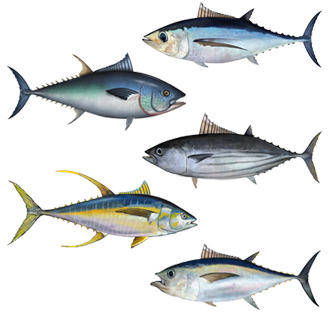
| Tunas (from top): albacore, Atlantic bluefin, skipjack, yellowfin, bigeye | |
Scientific classification 
| |
| Kingdom: | Animalia |
| Phylum: | Chordata |
| Class: | Actinopterygii |
| Order: | Scombriformes |
| Family: | Scombridae |
| Subfamily: | Scombrinae |
| Tribe: | Thunnini Starks, 1910 |
| Genera | |
| |
A tuna (pl.: tunas or tuna) is a saltwater fish that belongs to the tribe Thunnini, a subgrouping of the Scombridae (mackerel) family. The Thunnini comprise 15 species across five genera,[2] the sizes of which vary greatly, ranging from the bullet tuna (max length: 50 cm or 1.6 ft, weight: 1.8 kg or 4 lb) up to the Atlantic bluefin tuna (max length: 4.6 m or 15 ft, weight: 684 kg or 1,508 lb[citation needed]), which averages 2 m (6.6 ft) and is believed to live up to 50 years.
Tuna, opah, and mackerel sharks are the only species of fish that can maintain a body temperature higher than that of the surrounding water. An active and agile predator, the tuna has a sleek, streamlined body, and is among the fastest-swimming pelagic fish—the yellowfin tuna, for example, is capable of speeds of up to 75 km/h (47 mph).[3]
Found in warm seas, the tuna is commercially fished extensively as a food fish, and is popular as a bluewater game fish. As a result of overfishing, some tuna species, such as the southern bluefin tuna, are threatened with extinction.[4]
| This article is part of a series on |
| Commercial fish |
|---|
 |
| Large predatory |
| Forage |
| Demersal |
| Mixed |
Etymology
[edit]The term "tuna" comes from Spanish atún < Andalusian Arabic at-tūn, assimilated from al-tūn التون [Modern Arabic التن] : 'tuna fish' < Middle Latin thunnus.[5] Thunnus is derived from Ancient Greek: θύννος, romanized: thýnnos used for the Atlantic bluefin tuna,[6] that name in turn is ultimately derived from θύνω thýnō, meaning "to rush, dart along".[7][8]
A dated alternative term is "tunny".
In English, tuna has been referred to as Chicken of the Sea. This name persists today in Japan, where tuna as a food can be called シーチキン (shi-chikin), literally "sea chicken".
Taxonomy
[edit]The Thunnini tribe is a monophyletic clade comprising 15 species in five genera:
- family Scombridae
- tribe Thunnini: tunas
- genus Allothunnus: slender tunas
- genus Auxis: frigate tunas
- genus Euthynnus: little tunas
- genus Katsuwonus: skipjack tunas
- genus Thunnus: albacores and true tunas
- subgenus Thunnus (Thunnus): bluefin group
- subgenus Thunnus (Neothunnus): yellowfin group
- tribe Thunnini: tunas
- family Scombridae
The cladogram is a tool for visualizing and comparing the evolutionary relationships between taxa, and is read left-to-right as if on a timeline. The following cladogram illustrates the relationship between the tunas and other tribes of the family Scombridae. For example, the cladogram illustrates that the skipjack tunas are more closely related to the true tunas than are the slender tunas (the most primitive of the tunas), and that the next nearest relatives of the tunas are the bonitos of the tribe Sardini.[2]
| The Tunas: Thunnini tribe, within the Family Scombridae | |||||||||||||||||||||||||||||||||||||||||||||||||||||||||||||||||||||||||||||||||
| |||||||||||||||||||||||||||||||||||||||||||||||||||||||||||||||||||||||||||||||||
| Cladogram: Tunas are classified into the tribe Thunnini (bottom-center in the above diagram) – one of four tribes in the family Scombridae.[2] |


True species
[edit]
The "true" tunas are those that belong to the genus Thunnus. Until recently, it was thought that there were seven Thunnus species, and that Atlantic bluefin tuna and Pacific bluefin tuna were subspecies of a single species. In 1999, Collette established that based on both molecular and morphological considerations, they are in fact distinct species.[9][10]
The genus Thunnus is further classified into two subgenera: Thunnus (Thunnus) (the bluefin group), and Thunnus (Neothunnus) (the yellowfin group).[11]
Thunnus, the true tunas Image Common name Scientific name Maximum
lengthCommon
lengthMaximum
weightMaximum
ageTrophic
levelSource IUCN status Thunnus (Thunnus) – the bluefin group 
Albacore tuna T. alalunga
(Bonnaterre, 1788)1.4 m
(4.6 ft)1.0 m
(3.3 ft)60.3 kg
(133 lb)9–13 yrs 4.31 [12][13]  Least Concern[13]

Southern bluefin tuna T. maccoyii
(Castelnau, 1872)2.45 m
(8.0 ft)1.6 m
(5.2 ft)260 kg
(570 lb)20–40 yrs 3.93 [14][4]  Endangered[4]

Bigeye tuna T. obesus
(Lowe, 1839)2.5 m
(8.2 ft)1.8 m
(5.9 ft)210 kg
(460 lb)5–16 yrs 4.49 [15][16]  Vulnerable[16]
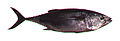
Pacific bluefin tuna T. orientalis
(Temminck & Schlegel, 1844)3.0 m
(9.8 ft)2.0 m
(6.6 ft)450 kg
(990 lb)15–26 yrs 4.21 [17][18]  Near Threatened[18]

Atlantic bluefin tuna T. thynnus
(Linnaeus, 1758)4.6 m
(15 ft)2.0 m
(6.6 ft)684 kg
(1,508 lb)35–50 yrs 4.43 [19][20] Least Concern[20]
Thunnus (Neothunnus) – the yellowfin group 
Blackfin tuna T. atlanticus
(Lesson, 1831)1.1 m
(3.6 ft)0.7 m
(2.3 ft)22.4 kg
(49 lb)4.13 [21] Least concern[22]

Longtail tuna,
northern bluefin tuna,
tongol tunaT. tonggol
(Bleeker, 1851)1.45 m
(4.8 ft)0.7 m
(2.3 ft)35.9 kg
(79 lb)18 years 4.50 [23][24]  Data deficient[24]
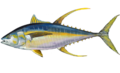
Yellowfin tuna T. albacares
(Bonnaterre, 1788)2.4 m
(7.9 ft)1.5 m
(4.9 ft)200 kg
(440 lb)5–9 yrs 4.34 [25][26] Least Concern[26]


Other species
[edit]The Thunnini tribe also includes seven additional species of tuna across four genera. They are:
Other tuna species Common name Scientific name Maximum
lengthCommon
lengthMaximum
weightMaximum
ageTrophic
levelSource IUCN status Slender tuna Allothunnus fallai
(Serventy, 1948)1.05 m
(3.4 ft)0.86 m
(2.8 ft)13.7 kg
(30 lb)3.74 [27] Least concern[28]
Bullet tuna Auxis rochei
(Risso, 1810)0.5 m
(1.6 ft)0.35 m
(1.1 ft)1.8 kg
(4.0 lb)5 years 4.13 [29][30] Least concern[30]
Frigate tuna Auxis thazard
(Lacépède, 1800)0.65 m
(2.1 ft)0.35 m
(1.1 ft)1.7 kg
(3.7 lb)5 years 4.34 [31] Least concern[32]
Mackerel tuna,
KawakawaEuthynnus affinis
(Cantor, 1849)1.0 m
(3.3 ft)0.6 m
(2.0 ft)13.6 kg
(30 lb)6 years 4.50 [33][34] Least concern[34]
Little tunny Euthynnus alletteratus
(Rafinesque, 1810)1.2 m
(3.9 ft)0.8 m
(2.6 ft)16.5 kg
(36 lb)10 years 4.13 [35] Least concern[36]
Black skipjack tuna Euthynnus lineatus
(Kishinouye, 1920)0.84 m
(2.8 ft)0.6 m
(2.0 ft)11.8 kg
(26 lb)3.83 [37][38] Least concern[38]
Skipjack tuna Katsuwonus pelamis
(Linnaeus, 1758)1.1 m
(3.6 ft)0.8 m
(2.6 ft)34.5 kg
(76 lb)6–12 yrs 3.75 [39][40] Least concern[40]
Biology
[edit]_diagram_cropped.GIF)
Drawing by Dr Tony Ayling.
Description
[edit]The tuna is a sleek, elongated and streamlined fish, adapted for speed. It has two closely spaced but separated dorsal fins on its back; The first fin is "depressible" – it can be laid down, flush, in a groove that runs along its back; it is supported by spines.[41] Seven to ten yellow finlets run from the dorsal fins to the tail, which is lunate – curved like a crescent moon – and tapered to pointy tips.[42] A tuna's pelvic fins are located below the base of the pectoral fins. Both dorsal and pelvic fins retract when the fish is swimming fast.[41]
The tuna's body is countershaded to camouflage itself in deeper water when seen from above, its dorsal side is generally a metallic dark blue while the ventral or under side is silvery, often with an iridescent shine.[43][42] The caudal peduncle, to which the tail is attached, is quite thin, with three stabilizing horizontal keels on each side.[42]
Physiology
[edit]Thunnus are widely but sparsely distributed throughout the oceans of the world, generally in tropical and temperate waters at latitudes ranging between about 45° north and south of the equator.[44] All tunas are able to maintain the temperature of certain parts of their body above the temperature of ambient seawater. For example, bluefin can maintain a core body temperature of 25–33 °C (77–91 °F), in water as cold as 6 °C (43 °F). Unlike other endothermic creatures such as mammals and birds, tuna do not maintain temperature within a relatively narrow range.[45]
Tunas achieve endothermy by conserving the heat generated through normal metabolism. In all tunas, the heart operates at ambient temperature, as it receives cooled blood, and coronary circulation is directly from the gills.[46] The rete mirabile ("wonderful net"), the intertwining of veins and arteries in the body's periphery, allows nearly all of the metabolic heat from venous blood to be "re-claimed" and transferred to the arterial blood via a counter-current exchange system, thus mitigating the effects of surface cooling.[47] This allows the tuna to elevate the temperatures of the highly-aerobic tissues of the skeletal muscles, eyes and brain,[45][46] which supports faster swimming speeds and reduced energy expenditure, and which enables them to survive in cooler waters over a wider range of ocean environments than those of other fish.[citation needed]
Also unlike most fish, which have white flesh, the muscle tissue of tuna ranges from pink to dark red. The red myotomal muscles derive their color from myoglobin, an oxygen-binding molecule, which tuna express in quantities far higher than most other fish. The oxygen-rich blood further enables energy delivery to their muscles.[45]
For powerful swimming animals like dolphins and tuna, cavitation may be detrimental, because it limits their maximum swimming speed.[48] Even if they have the power to swim faster, dolphins may have to restrict their speed, because collapsing cavitation bubbles on their tail are too painful. Cavitation also slows tuna, but for a different reason. Unlike dolphins, these fish do not feel the bubbles, because they have bony fins without nerve endings. Nevertheless, they cannot swim faster because the cavitation bubbles create a vapor film around their fins that limits their speed. Lesions have been found on tuna that are consistent with cavitation damage.[48]
Fishing
[edit] | This section needs additional citations for verification. (July 2021) |

Commerce
[edit]Tuna is an important commercial fish. The International Seafood Sustainability Foundation (ISSF) compiled a detailed scientific report on the state of global tuna stocks in 2009, which includes regular updates. According to the ISSF, the most important species for commercial and recreational tuna fisheries are yellowfin (Thunnus albacares), bigeye (T. obesus), bluefin (T. thynnus, T. orientalis, and T. macoyii), albacore (T. alalunga), and skipjack (Katsuwonus pelamis).[44]
Based on catches from 2007, the report states:
Between 1940 and the mid-1960s, the annual world catch of the five principal market species of tunas rose from about 300 thousand tons to about 1 million tons, most of it taken by hook and line. With the development of purse-seine nets, now the predominant gear, catches have risen to more than 4 million tons annually during the last few years. Of these catches, about 68 percent are from the Pacific Ocean, 22 percent from the Indian Ocean, and the remaining 10 percent from the Atlantic Ocean and the Mediterranean Sea. Skipjack makes up about 60 percent of the catch, followed by yellowfin (24 percent), bigeye (10 percent), albacore (5 percent), and bluefin the remainder. Purse-seines take about 62 percent of the world production, longline about 14 percent, pole and line about 11 percent, and a variety of other gears the remainder.[44]
The Australian government alleged in 2006 that Japan had illegally overfished southern bluefin by taking 12,000 to 20,000 tonnes per year instead of the agreed upon 6,000 tonnes; the value of such overfishing would be as much as US$2 billion.[49] Such overfishing has severely damaged bluefin stocks.[50] According to the WWF, "Japan's huge appetite for tuna will take the most sought-after stocks to the brink of commercial extinction unless fisheries agree on more rigid quotas".[51] Japan's Fisheries Research Agency counters that Australian and New Zealand tuna fishing companies under-report their total catches of southern bluefin tuna and ignore internationally mandated total allowable catch totals.[52]
In recent years, opening day fish auctions at Tokyo's Tsukiji fish market and Toyosu Market have seen record-setting prices for bluefin tuna, reflecting market demand. In each of 2010, 2011, 2012, 2013 and 2019, new record prices have been set for a single fish – the current record is 333.6 million japanese yen (US$3.1 million) for a 278 kg (613 lb) bluefin, or a unit price of JP¥ 1,200,000/kg (US$5,057/lb). The opening auction price for 2014 plummeted to less than 5% of the previous year's price, which had drawn complaints for climbing "way out of line".[53] A summary of record-setting auctions are shown in the following table (highlighted values indicate new world records):
| Record bluefin tuna auctions at Tokyo's Tsukiji fish market and Toyosu Market | ||||||
|---|---|---|---|---|---|---|
| (Highlighted field indicates new record price for a single fish) | ||||||
| Year | Total weight |
Total sale | Unit price | Source | ||
| (JP ¥) | (US $) | (¥ / kg) | ($ / lb) | |||
| 2001 | 202 kg (445 lb) |
¥20.2 million | $173,600 | ¥100,000 / kg | $386 / lb | [54] |
| 2010 | 232 kg (511 lb) |
¥16.28 million | $175,000 | ¥70,172 / kg | $343 / lb | [55] |
| 2011 | 342 kg (754 lb) |
¥32.49 million | $396,000 | ¥95,000 / kg | $528 / lb | [54] |
| 2012 | 269 kg (593 lb) |
¥56.49 million | $736,000 | ¥210,000 / kg | $1,247 / lb | [56] |
| 2013 | 221 kg (487 lb) |
¥155.4 million | $1.76 million | ¥703,167 / kg | $3,603 / lb | [57] |
| 2019 | 278 kg (613 lb) |
¥333.6 million | $3.1 million | ¥1,200,000 / kg | $5,057 / lb | [58] |
In November 2011, a different record was set when a fisherman in Massachusetts caught an 881 lb (400 kg) tuna. It was captured inadvertently using a dragnet. Due to the laws and restrictions on tuna fishing in the United States, federal authorities impounded the fish because it was not caught with a rod and reel. Because of the tuna's deteriorated condition as a result of the trawl net, the fish sold for just under $5,000.[59]
-
 Tuna being weighed on Greek quay-side
 -
 Tuna at Tsukiji fish market, Tokyo
 -
 Tuna cut in half for processing at Tsukuji fish market


Methods
[edit]| External videos | |
|---|---|
 Tuna pole and line fishing BBC Two Tuna pole and line fishing BBC Two |
Besides for edible purposes, many tuna species are caught frequently as game, often for recreation or for contests in which money is awarded based on weight. Larger specimens are notorious for putting up a fight while hooked, and have been known to injure people who try to catch them, as well as damage their equipment.
- Phoenician technique for trapping and catching Atlantic bluefin tuna called Almadraba, still used today in Portugal, Spain, Morocco and Italy which uses a maze of nets. In Sicily, the same method is called Tonnara.
- Fish farming (cage system)[60]
- Tuna ranching
- Longline fishing
- Purse seines
- Pole and line
- Harpoon gun
- Big game fishing
- Fish aggregating device
Association with whaling
[edit]In 2005, Nauru, defending its vote from Australian criticism at that year's meeting of the International Whaling Commission, argued that some whale species have the potential to devastate Nauru's tuna stocks, and that Nauru's food security and economy relies heavily on fishing.[61] Despite this, Nauru does not permit whaling in its own waters and does not allow other fishing vessels to take or intentionally interact with marine mammals in its Exclusive Economic Zone. In 2010 and 2011, Nauru supported Australian proposals[62] for a western Pacific-wide ban on tuna purse-seining in the vicinity of marine mammals – a measure which was agreed by the Western and Central Pacific Fisheries Commission at its eighth meeting in March 2012.
Association with dolphins
[edit]Dolphins swim beside several tuna species. These include yellowfin tuna in the eastern Pacific Ocean, but not albacore. Tuna schools are believed to associate themselves with dolphins for protection against sharks, which are tuna predators.[63]
Commercial fishing vessels used to exploit this association by searching for dolphin pods. Vessels would encircle the pod with nets to catch the tuna beneath.[64] The nets were prone to entangling dolphins, injuring or killing them. Public outcry and new government regulations, which are now monitored by NOAA have led to more dolphin-friendly methods, now generally involving lines rather than nets. There are neither universal independent inspection programs nor verification of dolphin safety, so these protections are not absolute. According to Consumers Union, the resulting lack of accountability means claims of tuna that is "dolphin safe" should be given little credence.
Fishery practices have changed to be dolphin friendly, which has caused greater bycatch including sharks, turtles and other oceanic fish. Fishermen no longer follow dolphins, but concentrate their fisheries around floating objects such as fish aggregation devices, also known as FADs, which attract large populations of other organisms. Measures taken thus far to satisfy the public demand to protect dolphins can be potentially damaging to other species as well.[65]
Aquaculture
[edit]Increasing quantities of high-grade tuna caught at sea are reared in net pens and fed bait fish. In Australia, former fishermen raise southern bluefin tuna (Thunnus maccoyii) and another bluefin species.[60] Farming its close relative, the Atlantic bluefin tuna, Thunnus thynnus, is beginning in the Mediterranean, North America and Japan. Hawaiʻi approved permits for the first U.S. offshore farming of bigeye tuna in water 1,300 feet (400 m) deep in 2009.[66]
Japan is the biggest tuna consuming nation and is also the leader in tuna farming research.[67] Japan first successfully farm-hatched and raised bluefin tuna in 1979. In 2002, it succeeded in completing the reproduction cycle and in 2007, completed a third generation.[68][69][70] The farm breed is known as Kindai tuna. Kindai is the contraction of Kinki University in Japanese (Kinki daigaku).[71] In 2009, Clean Seas, an Australian company which has been receiving assistance from Kinki University[72][73][74] managed to breed southern bluefin tuna in captivity and was awarded the second place in World's Best Invention of 2009 by Time magazine.[75][76]
Food
[edit]
Fresh and frozen
[edit]The fresh or frozen flesh of tuna is widely regarded as a delicacy in most areas where it is shipped, being prepared in a variety of ways. When served as a steak, the meat of most species is known for its thickness and firm texture. In the U.K., supermarkets began flying in fresh tuna steaks in the late 1990s, which helped to increase the popularity of using fresh tuna in cooking; by 2009, celebrity chefs regularly featured fresh tuna in salads, wraps, and char-grilled dishes.[77]
Served raw
[edit]Various species of tuna are often served raw in Japanese cuisine as sushi or sashimi.[77]
Commercial sashimi tuna may have their coloration fixated by pumping carbon monoxide (CO) into bags containing the tuna, and holding it at 4°C. For a 2-inch tuna steak, this requires 24 hours. The fish is then vacuum sealed and frozen. In Japan, color fixation using CO is prohibited.[78]
-

-

-
 Tuna steak served in a French bistro
 -

-
 Katsuobushi shavings
 -


Canned
[edit]
Tuna is canned in edible oils, in brine, in water, and in various sauces. Tuna may be processed and labeled as "solid", "chunked" ("chunk") or "flaked". When tuna is canned and packaged for sale, the product is sometimes called tuna fish (U.S.), a calque (loan translation) from the German Thunfisch. Canned tuna is sometimes used as food for pets, especially cats.
- Australia
Canned tuna was first produced in Australia in 1903 and quickly became popular.[79]
In the early 1980s canned tuna in Australia was most likely southern bluefin, as of 2003[update] it was usually yellowfin, skipjack, or tongol (labelled "northern bluefin" or "longtail").[79]
Australian standards once required cans of tuna to contain at least 51% tuna, but those regulations were dropped in 2003.[80][81] The remaining weight is usually oil or water.
- United States
The product became more plentiful in the United States in the late 1940s. In 1950, 8,500,000 pounds of canned tuna were produced, and the U.S. Department of Agriculture classified it as a "plentiful food".[82]
In the United States, 52% of canned tuna is used for sandwiches; 22% for tuna salads; and 15% for tuna casseroles and dried, prepackaged meal kits, such as General Mills's Tuna Helper line.[83] Other canned tuna dishes include tuna melts (a type of sandwich where the tuna is mixed with mayonnaise and served on bread with cheese melted on top); salade niçoise (a salad made of tuna, olives, green beans, potatoes, hard-boiled eggs and anchovy dressing); and tuna burgers (served on buns).
In the United States, the Food and Drug Administration (FDA) regulates canned tuna (see part c).[84]
- Precooked
As tunas are often caught far from where they are processed, poor interim conservation can lead to spoilage. Tuna is typically gutted by hand, and later precooked for prescribed times of 45 minutes to three hours. The fish are then cleaned and filleted, canned (and sealed), with the dark lateral blood meat often separately canned for pet food (cat or dog). The sealed can is then heated under pressure (called "retort cooking") for 2–4 hours.[85] This process kills any bacteria, but retains the histamine that may have been produced by those bacteria, and so may still taste spoiled. The international standard sets the maximum histamine level at 200 milligrams per kilogram. An Australian study of 53 varieties of unflavored canned tuna found none to exceed the safe histamine level, although some had "off" flavors.[79]
- Light and white
In some markets, depending upon the color of the flesh of the tuna species, the can is marked as "light" or "white" meat, with "light" meaning a greyish pink color and "white" meaning a light pink color. In the United States, only albacore can legally be sold in canned form as "white meat tuna";[86] in other countries, yellowfin is also acceptable.
- Ventresca tuna
Ventresca tuna (from ventre, the Italian word for belly),[87] is a luxury canned tuna,[88] from the fatty bluefin tuna belly, also used in sushi as toro.[89][90]
Nutrition
[edit]| Nutritional value per 100 g (3.5 oz) | |||||||||||||||||||||||||||||||
|---|---|---|---|---|---|---|---|---|---|---|---|---|---|---|---|---|---|---|---|---|---|---|---|---|---|---|---|---|---|---|---|
| Energy | 830 kJ (200 kcal) | ||||||||||||||||||||||||||||||
0 g | |||||||||||||||||||||||||||||||
8 g | |||||||||||||||||||||||||||||||
29 g | |||||||||||||||||||||||||||||||
| |||||||||||||||||||||||||||||||
| Other constituents | Quantity | ||||||||||||||||||||||||||||||
| Water | 60 g | ||||||||||||||||||||||||||||||
| †Percentages estimated using US recommendations for adults,[91] except for potassium, which is estimated based on expert recommendation from the National Academies.[92] | |||||||||||||||||||||||||||||||
Canned light tuna in oil is 29% protein, 8% fat, 60% water, and contains no carbohydrates, while providing 200 calories in a 100 gram reference amount (table). It is a rich source (20% or more of the Daily Value, DV) of phosphorus (44% DV) and vitamin D (45% DV), and a moderate source of iron (11% DV).
Mercury and health
[edit]Mercury content in tuna can vary widely. Among those calling for improved warnings about mercury in tuna is the American Medical Association, which adopted a policy that physicians should help make their patients more aware of the potential risks.[93] A study published in 2008 found that mercury distribution in the meat of farmed tuna is inversely related to the lipid content, suggesting that higher lipid concentration within edible tissues of tuna raised in captivity might, other factors remaining equal, have a diluting effect on mercury content.[94] Mackerel tuna is one species of tuna that is lower in mercury concentration than skipjack or yellowfin,[95] but this species is known as "black meat" or "dark meat" tuna, which is a lower grade for canning because of the color, unfavorable flavor, and poor yield.[96]
In March 2004, the United States FDA issued guidelines recommending that pregnant women, nursing mothers, and children limit their intake of tuna and other predatory fish.[97] The Environmental Protection Agency provides guidelines on how much canned tuna is safe to eat. Roughly speaking, the guidelines recommend one 6-ounce (170 g) can of light tuna per week for individuals weighing less than 110 pounds (50 kg), and two cans per week for those who weigh more.[98] In 2007, it was reported that some canned light tuna such as yellowfin tuna[99] is significantly higher in mercury than skipjack, and caused Consumers Union and other activist groups to advise pregnant women to refrain from consuming canned tuna.[100] In 2009, a California appeals court upheld a ruling that canned tuna does not need warning labels as the methylmercury is naturally occurring.[101]
A January 2008 report revealed potentially dangerous levels of mercury in certain varieties of sushi tuna, reporting levels "so high that the Food and Drug Administration could take legal action to remove the fish from the market."[102]
Management and conservation
[edit]
The main tuna fishery management bodies are the Western and Central Pacific Fisheries Commission, the Inter-American Tropical Tuna Commission, the Indian Ocean Tuna Commission, the International Commission for the Conservation of Atlantic Tunas, and the Commission for the Conservation of Southern Bluefin Tuna.[103] The five gathered for the first time in Kobe, Japan in January 2007. Environmental organizations made submissions[104] on risks to fisheries and species. The meeting concluded with an action plan drafted by some 60 countries or areas. Concrete steps include issuing certificates of origin to prevent illegal fishing and greater transparency in the setting of regional fishing quotas. The delegates were scheduled to meet at another joint meeting in January or February 2009 in Europe.[105]
In 2010, Greenpeace International added the albacore, bigeye tuna, Pacific bluefin tuna, Atlantic bluefin tuna, southern bluefin tuna, and yellowfin tuna to its seafood red list, which are fish "commonly sold in supermarkets around the world, and which have a very high risk of being sourced from unsustainable fisheries."[106][107]
Bluefin tuna have been widely accepted as being severely overfished, with some stocks at risk of collapse.[108][109] According to the International Seafood Sustainability Foundation (a global, nonprofit partnership between the tuna industry, scientists, and the World Wide Fund for Nature), Indian Ocean yellowfin tuna, Pacific Ocean (eastern and western) bigeye tuna, and North Atlantic albacore tuna are all overfished. In April 2009, no stock of skipjack tuna (which makes up roughly 60% of all tuna fished worldwide) was considered to be overfished.[110]
The BBC documentary South Pacific, which first aired in May 2009, stated that, should fishing in the Pacific continue at its current rate, populations of all tuna species could collapse within five years. It highlighted huge Japanese and European tuna fishing vessels, sent to the South Pacific international waters after overfishing their own fish stocks to the point of collapse.[111]
A 2010 tuna fishery assessment report, released in January 2012 by the Secretariat of the Pacific Community, supported this finding, recommending that all tuna fishing should be reduced or limited to current levels and that limits on skipjack fishing be considered.[112]
Research[113] indicates that increasing ocean temperatures are taking a toll on the tuna in the Indian Ocean, where rapid warming of the ocean has resulted in a reduction of marine phytoplankton. The bigeye tuna catch rates have also declined abruptly during the past half century, mostly due to increased industrial fisheries, with the ocean warming adding further stress to the fish species.[113]
See also
[edit]
References
[edit]- ^ "Tribe Thunnini Starks 1910". The Paleobiology Database. Archived from the original on 21 January 2019. Retrieved 20 January 2019.
- ^ a b c Graham, Jeffrey B.; Dickson, Kathryn A. (2004). "Tuna Comparative Physiology". The Journal of Experimental Biology. 207 (23): 4015–4024. Bibcode:2004JExpB.207.4015G. doi:10.1242/jeb.01267. PMID 15498947.
- ^ Block, Barbara A.; Booth, David; Carey, Francis G. (1992). "Direct measurement of swimming speeds and depth of blue marlin". Journal of Experimental Biology. 166 (1): 278. Bibcode:1992JExpB.166..267B. doi:10.1242/jeb.166.1.267.
- ^ a b c Collette, B.; et al. (2021). "Thunnus maccoyii". IUCN Red List of Threatened Species. 2021. Retrieved 29 March 2022.
- ^ "tuna". American Heritage Dictionary. Houghton Mifflin Harcourt Publishing Company. 2015. Archived from the original on 24 May 2015. Retrieved 24 May 2015.
- ^ Lewis, Charlton T.; Short, Charles (1879). "thunnus". A Latin Dictionary. Perseus Digital Library.
- ^ θύννος in Liddell, Henry George; Scott, Robert (1940) A Greek–English Lexicon, revised and augmented throughout by Jones, Sir Henry Stuart, with the assistance of McKenzie, Roderick. Oxford: Clarendon Press. In the Perseus Digital Library, Tufts University.
- ^ θύνω in Liddell and Scott.
- ^ Collette, B.B. (1999). "Mackerels, molecules, and morphology" (PDF). In Séret, B.; Sire, J.Y. (eds.). Proceedings. 5th Indo-Pacific Fish Conference: Nouméa, New Caledonia, 3–8 November 1997. Paris: Société Française d'Ichtyologie [u.a.] pp. 149–164. ISBN 978-2-9507330-5-4.
- ^ Tanaka, Y.; Satoh, K.; Iwahashi, M.; Yamada, H. (2006). "Growth-dependent recruitment of Pacific bluefin tuna Thunnus orientalis in the northwestern Pacific Ocean". Marine Ecology Progress Series. 319: 225–235. Bibcode:2006MEPS..319..225T. doi:10.3354/meps319225. INIST 18108521.
- ^ Ueda, Hiroshi (2018). "Migration and Navigation in Fish". Encyclopedia of Reproduction. pp. 84–89. doi:10.1016/B978-0-12-809633-8.20540-2. ISBN 978-0-12-815145-7.
- ^ Froese, Rainer; Pauly, Daniel (eds.). "Thunnus alalunga". FishBase. January 2012 version.
- ^ a b Collette, B.; et al. (2021). "Thunnus alalunga". IUCN Red List of Threatened Species. 2021. Retrieved 29 March 2022.
- ^ Froese, Rainer; Pauly, Daniel (eds.). "Thunnus maccoyii". FishBase. January 2012 version.
- ^ Froese, Rainer; Pauly, Daniel (eds.). "Thunnus obesus". FishBase. January 2012 version.
- ^ a b Collette, B.; et al. (2021). "Thunnus obesus". IUCN Red List of Threatened Species. 2021. Retrieved 29 March 2022.
- ^ Froese, Rainer; Pauly, Daniel (eds.). "Thunnus orientalis". FishBase. January 2012 version.
- ^ a b Collette, B.; et al. (2021). "Thunnus orientalis". IUCN Red List of Threatened Species. 2021. Retrieved 29 March 2022.
- ^ Froese, Rainer; Pauly, Daniel (eds.). "Thunnus thynnus". FishBase. January 2012 version.
- ^ a b Collette, B.; et al. (2021). "Thunnus thynnus". IUCN Red List of Threatened Species. 2021. Retrieved 9 January 2015.
- ^ Froese, Rainer; Pauly, Daniel (eds.). "Thunnus atlanticus". FishBase. January 2012 version.
- ^ Collette, B.; et al. (2010). "Thunnus atlanticus". IUCN Red List of Threatened Species. 2010. Retrieved 29 March 2022.
- ^ Froese, Rainer; Pauly, Daniel (eds.). "Thunnus tonggol". FishBase. January 2012 version.
- ^ a b Collette, B.; et al. (2009). "Thunnus tonggol". IUCN Red List of Threatened Species. 2009. Retrieved 29 March 2022.
- ^ Froese, Rainer; Pauly, Daniel (eds.). "Thunnus albacares". FishBase. January 2012 version.
- ^ a b Collette, B.; et al. (2021). "Thunnus albacares". IUCN Red List of Threatened Species. 2021. Retrieved 29 March 2022.
- ^ Froese, Rainer; Pauly, Daniel (eds.). "Allothunnus fallai". FishBase. January 2012 version.
- ^ Collette, B.; Amorim, A.F.; Boustany, A.; Carpenter, K.E.; de Oliveira Leite Jr.; N.; Di Natale, A.; Fox, W.; Fredou, F.L.; Graves, J.; Viera Hazin, F.H.; Juan Jorda, M.; Minte Vera, C.; Miyabe, N.; Nelson, R.; Oxenford, H.; Sun, C.; Teixeira Lessa, R.P.; Pires Ferreira Travassos, P.E.; Uozumi, Y. (2011). "Allothunnus fallai". IUCN Red List of Threatened Species. 2011 e.T170349A6761139. doi:10.2305/IUCN.UK.2011-2.RLTS.T170349A6761139.en. Retrieved 12 November 2021.
- ^ Froese, Rainer; Pauly, Daniel (eds.). "Auxis rochei". FishBase. January 2012 version.
- ^ a b Collette, B.; Acero, A.; Amorim, A.F.; Boustany, A.; Canales Ramirez, C.; Cardenas, G.; Carpenter, K.E.; de Oliveira Leite Jr.; N.; Di Natale, A.; Fox, W.; Fredou, F.L.; Graves, J.; Guzman-Mora, A.; Viera Hazin, F.H.; Juan Jorda, M.; Kada, O.; Minte Vera, C.; Miyabe, N.; Montano Cruz, R.; Nelson, R.; Oxenford, H.; Salas, E.; Schaefer, K.; Serra, R.; Sun, C.; Teixeira Lessa, R.P.; Pires Ferreira Travassos, P.E.; Uozumi, Y.; Yanez, E. (2011). "Auxis rochei". IUCN Red List of Threatened Species. 2011 e.T170355A6765188. doi:10.2305/IUCN.UK.2011-2.RLTS.T170355A6765188.en. Retrieved 12 November 2021.
- ^ Froese, Rainer; Pauly, Daniel (eds.). "Auxis thazard". FishBase. January 2012 version.
- ^ Collette, B.; Acero, A.; Amorim, A.F.; Boustany, A.; Canales Ramirez, C.; Cardenas, G.; Carpenter, K.E.; de Oliveira Leite Jr.; N.; Di Natale, A.; Fox, W.; Fredou, F.L.; Graves, J.; Guzman-Mora, A.; Viera Hazin, F.H.; Juan Jorda, M.; Kada, O.; Minte Vera, C.; Miyabe, N.; Montano Cruz, R.; Nelson, R.; Oxenford, H.; Salas, E.; Schaefer, K.; Serra, R.; Sun, C.; Teixeira Lessa, R.P.; Pires Ferreira Travassos, P.E.; Uozumi, Y.; Yanez, E. (2011). "Auxis thazard". IUCN Red List of Threatened Species. 2011 e.T170344A6757270. doi:10.2305/IUCN.UK.2011-2.RLTS.T170344A6757270.en. Retrieved 12 November 2021.
- ^ Froese, Rainer; Pauly, Daniel (eds.). "Euthynnus affinis". FishBase. January 2012 version.
- ^ a b Collette, B.; Chang, S.-K.; Fox, W.; Juan Jorda, M.; Miyabe, N.; Nelson, R.; Uozumi, Y. (2011). "Euthynnus affinis". IUCN Red List of Threatened Species. 2011 e.T170336A6753804. doi:10.2305/IUCN.UK.2011-2.RLTS.T170336A6753804.en. Retrieved 12 November 2021.
- ^ Froese, Rainer; Pauly, Daniel (eds.). "Euthynnus alletteratus". FishBase. January 2012 version.
- ^ Collette, B.; Amorim, A.F.; Boustany, A.; Carpenter, K.E.; de Oliveira Leite Jr.; N.; Di Natale, A.; Fox, W.; Fredou, F.L.; Graves, J.; Viera Hazin, F.H.; Juan Jorda, M.; Kada, O.; Minte Vera, C.; Miyabe, N.; Nelson, R.; Oxenford, H.; Teixeira Lessa, R.P.; Pires Ferreira Travassos, P.E. (2011). "Euthynnus alletteratus". IUCN Red List of Threatened Species. 2011 e.T170345A6759394. doi:10.2305/IUCN.UK.2011-2.RLTS.T170345A6759394.en. Retrieved 12 November 2021.
- ^ Froese, Rainer; Pauly, Daniel (eds.). "Euthynnus lineatus". FishBase. January 2012 version.
- ^ a b Collette, B.; Acero, A.; Canales Ramirez, C.; Cardenas, G.; Carpenter, K.E.; Di Natale, A.; Guzman-Mora, A.; Montano Cruz, R.; Nelson, R.; Schaefer, K.; Serra, R.; Yanez, E. (2011). "Euthynnus lineatus". IUCN Red List of Threatened Species. 2011 e.T170320A6747016. doi:10.2305/IUCN.UK.2011-2.RLTS.T170320A6747016.en. Retrieved 12 November 2021.
- ^ Froese, Rainer; Pauly, Daniel (eds.). "Katsuwonus pelamis". FishBase. January 2012 version.
- ^ a b Collette, B.B.; Boustany, A.; Fox, W.; Graves, J.; Juan Jorda, M.; Restrepo, V. (2021). "Katsuwonus pelamis". IUCN Red List of Threatened Species. 2021 e.T170310A46644566. doi:10.2305/IUCN.UK.2021-2.RLTS.T170310A46644566.en. Retrieved 12 November 2021.
- ^ a b Biological characteristics of tuna. Fisheries and Aquaculture Department, Food and Agriculture Organization. n.d. Archived from the original on 7 June 2023. Retrieved 17 December 2022.
- ^ a b c Gibbs, E. "Fact Sheet: Tuna #P1412". Rhode Island Sea Grant. Archived from the original on 12 July 2012. Retrieved 20 September 2012.
- ^ Argo, Emily (21 April 2017). "Countershading". Fishionary. American Fisheries Society. Retrieved 17 December 2022.
- ^ a b c "Status of the World Fisheries for Tuna: Section A-1 – Introduction" (PDF). International Seafood Sustainability Foundation. 15 April 2009. Archived from the original (PDF) on 27 March 2010. Retrieved 10 November 2009.
- ^ a b c Sepulveda, C.A.; Dickson, K.A.; Bernal, D.; Graham, J.B. (1 July 2008). "Elevated red myotomal muscle temperatures in the most basal tuna species, Allothunnus fallai". Journal of Fish Biology. 73 (1): 241–249. Bibcode:2008JFBio..73..241S. doi:10.1111/j.1095-8649.2008.01931.x.
- ^ a b Landeira-Fernandez, A.M.; Morrissette, J.M.; Blank, J.M.; Block, B.A. (16 October 2003). "Temperature dependence of the Ca2+-ATPase (SERCA2) in the ventricles of tuna and mackerel". American Journal of Physiology. Regulatory, Integrative and Comparative Physiology. 286 (2): R398 – R404. doi:10.1152/ajpregu.00392.2003. PMID 14604842.
- ^ Cech, J.J.; Laurs, R.M.; Graham, J.B. (1984). "Temperature-induced changes in blood gas equilibria in the albacore, Thunnus alalunga, a warm-bodied tuna". Journal of Experimental Biology. 109 (1): 21–34. Bibcode:1984JExpB.109...21C. doi:10.1242/jeb.109.1.21.
Oxygenated blood that has just reached thermal equilibrium with ambient sea water in the gills enters the rete on the arterial side, while warmed, deoxygenated, and carbon dioxide-laden blood enters on the venous end. In the rete, countercurrent flow and the high surface area contact between the two blood supplies facilitate the transfer of nearly all of the metabolic heat in the venous blood to arterial blood, thus conserving muscle temperature. After exiting the rete, arterial blood continues to the red muscle capillary beds, and cooled venous blood flows to the gills where carbon dioxide is excreted and oxygen is loaded.
- ^ a b Iosilevskii, G; Weihs, D (6 March 2008). "Speed limits on swimming of fishes and cetaceans". Journal of the Royal Society Interface. 5 (20): 329–338. doi:10.1098/rsif.2007.1073. PMC 2607394. PMID 17580289.
Lacking pain receptors on their caudal fins, scombrids may temporarily cross the cavitation limit, and cavitation-induced damage has been observed (Kishinouye 1923); on the other hand, delphinids probably cannot cross it without pain (Lang 1966)
- ^ Bradford, Gillian (16 October 2006). "Bluefin Tuna Plundering Catches Up With Japan". ABC News. Retrieved 11 August 2013.
- ^ Eilperin, Juliet (29 November 2009). "Global approach now favored for marine conservation". Washington Post. Retrieved 11 August 2013.
- ^ McCurry, Justin (22 January 2007). "Japan warned tuna stocks face extinction". The Guardian. London. Retrieved 2 April 2008.
- ^ Wright, Hillel (9 January 2011). "Are Japan's fish lovers eating tuna to extinction?". Japan Times. p. 7. Retrieved 11 August 2013.
- ^ "Price of tuna nosedives at famous Tokyo auction despite dwindling stocks". The Toronto Star. 5 January 2014. Retrieved 8 February 2014.
- ^ a b "Fish story: Big tuna sells for record $396,000". NBCNews.com. 5 January 2011. Retrieved 19 September 2012.
- ^ Buerk, Roland (5 January 2010). "Tuna hits highest price in nine years at Tokyo auction". BBC News. Retrieved 19 September 2012.
- ^ "A single fish sells for nearly three-quarters of a million dollars". NBCNews.com. 5 January 2012. Retrieved 19 September 2012.
- ^ "A bluefin tuna sells for record $1.76M in Tokyo". usatoday.com. 4 January 2013. Retrieved 4 January 2013.
- ^ "Tuna sells for record $3 million in auction at Tokyo's new fish market". Reuters. 5 January 2019. Retrieved 4 September 2019.
- ^ "Man catches 881-pound tuna, seized by feds | The Sideshow – Yahoo! News". News.yahoo.com. 15 November 2011. Retrieved 16 June 2012.
- ^ a b Whyte, P.; Doolette, D. J.; Gorman, D. F.; Craig, D. S. (2001). "Positive Reform of Tuna Farm Diving in South Australia in Response to Government Intervention". Occupational and Environmental Medicine. 58 (2): 124–128. doi:10.1136/oem.58.2.124. JSTOR 27731455. PMC 1740091. PMID 11160991.
- ^ Dorney, Sean (28 June 2005). "Nauru defends whaling vote. 28/06/2005. ABC News Online". Abc.net.au. Retrieved 12 April 2012.
- ^ Western and Central Pacific Fisheries Commission. "Australia Proposals to Address the Impact of Purse Seine Fishing Activity on Cetaceans" (PDF). WCPFC. Archived from the original (PDF) on 1 November 2012. Retrieved 11 April 2012.
- ^ "ENSENADA: El Puerto del Atun". Journalism.berkeley.edu. Archived from the original on 24 May 2010. Retrieved 22 September 2010.
- ^ "Dolphin-safe tuna". Whale and Dolphin Conservation. Archived from the original on 27 September 2013.
- ^ "The ecological disaster that is dolphin safe tuna". Southern Fried Science. 16 February 2009.
- ^ McAvoy, Audrey (24 October 2009). "Hawaii regulators approve first US tuna farm". Associated Press. Retrieved 11 August 2013.
- ^ Susannah F. Locke (17 March 2008). "Breeding the Overfished Bluefin Tuna". LiveScience. Retrieved 13 May 2013.
- ^ "The holy grail of fish breeding".
- ^ "Cultivation, seedling production, and selective breeding of bluefin tuna and other fish at the Kinki University Fisheries Laboratory". Flku.jp. Archived from the original on 24 June 2011. Retrieved 22 September 2010.
- ^ Jung, Carolyn (21 May 2008). "The rarest tuna of all – Japan's farmed Kindai". The San Francisco Chronicle.
- ^ Raisfeld, Robin (4 May 2008). "Can a Farmed Bluefin Tuna Save the Planet? – New York Magazine". Nymag.com. Retrieved 16 June 2012.
- ^ "FNArena". FNArena. 15 May 2009. Retrieved 22 September 2010.
- ^ "Stateline South Australia". Abc.net.au. Archived from the original on 13 November 2012. Retrieved 22 September 2010.
- ^ Austin, Nigel (23 September 2008). "Clean Seas teams up with Japan's Kinki Uni for tuna research". The Advertiser. Archived from the original on 2 December 2012. Retrieved 24 November 2009.
- ^ "The Tank-Bred Tuna". The 50 Best Inventions of 2009. Time. 12 November 2009. Archived from the original on 15 November 2009. Retrieved 21 January 2013.
- ^ "Aussies Win 'Best Invention' Award". ThinkingAustralia.com. Archived from the original on 3 April 2013. Retrieved 21 January 2013.
- ^ a b Hickman, Martin (9 June 2009). "How Tuna Conquered the World". www.independent.co.uk. The Independent. Archived from the original on 31 January 2019. Retrieved 30 January 2019.
- ^ Hui, Y. H.; et al. (2004). Handbook of Frozen Foods. CRC Press. p. 328. ISBN 0-203-02200-9.
- ^ a b c Choice: Jan/Feb 2004.
- ^ Choice, August 2003.
- ^ Test: Canned tuna (archived) Canned or conned? Archived 1 August 2008 at the Wayback Machine
- ^ Casa-Emellosthe, Ruth P. (1 March 1951). "News of Food: Tuna Provides Tempting Dishes; Canned Fish Plentiful Now and a Good Buy for Budget-Minded". New York Times. p. 30. Retrieved 17 April 2021.
- ^ "Tuna". Modern Marvels, 4 February 2010.
- ^ "CFR – Code of Federal Regulations Title 21". Accessdata.fda.gov. Archived from the original on 15 September 2003. Retrieved 22 September 2010.
- ^ "The tuna processing industry". U.S. Department of Labor. Archived from the original on 12 August 2013. Retrieved 11 August 2013.
- ^ Ellis, Richard. Tuna: A Love Story. New York: Random House, 2009, p. 119. ISBN 0-307-38710-0
- ^ Rosengarten, David (31 July 2012). "Name That Tuna! The Little-Known, Sexy Varieties that Are Vastly Superior to the Supermarket Cans". Wine4Food. Archived from the original on 14 May 2021. Retrieved 14 May 2021.
What is ventresca? The name comes from the Italian word for belly, which is "ventre." Yup, you guessed it, ventresca is canned tuna made from the tuna's belly, from the sexy, velvety hunk known in sushi bars as "toro." Happily, there are a good many ventresca brands in the U.S. right now from Italy and Spain. (Originally Published: ROSENGARTEN REPORT, April 2003.)
- ^ "Luxury Canned Tuna". www.splendidtable.org. 18 November 2010. Archived from the original on 14 May 2021. Retrieved 14 May 2021.
Ventresca Tuna: This tuna comes from the belly of the fish, that velvety chunk known in sushi bars as toro. It has deep, buttery, complex flavors and a creamy texture. This one stands alone. The less you do to it the better. Be prepared to pay dearly for this unabashed luxury
- ^ Fraioli, James O.; Sato, Chef Kaz (2008). The Complete Idiot's Guide to Sushi and Sashimi. New York, NY: Alpha Books. ISBN 978-1-59257-782-8.
- ^ "Sushi Menu". Sushi Encyclopedia. 2007. Archived from the original on 20 May 2017. Retrieved 12 February 2016.
The sushi menu consists of basic Edo style sushi and they are grouped in their styles.
- ^ United States Food and Drug Administration (2024). "Daily Value on the Nutrition and Supplement Facts Labels". FDA. Archived from the original on 27 March 2024. Retrieved 28 March 2024.
- ^ "TABLE 4-7 Comparison of Potassium Adequate Intakes Established in This Report to Potassium Adequate Intakes Established in the 2005 DRI Report". p. 120. In: Stallings, Virginia A.; Harrison, Meghan; Oria, Maria, eds. (2019). "Potassium: Dietary Reference Intakes for Adequacy". Dietary Reference Intakes for Sodium and Potassium. pp. 101–124. doi:10.17226/25353. ISBN 978-0-309-48834-1. PMID 30844154. NCBI NBK545428.
- ^ Roe, Sam; Hawthorne, Michael (13 December 2005). "How safe is tuna?". Chicago Tribune. Archived from the original on 26 November 2009.
- ^ Balshaws, S.; Edwards, J.W.; Ross, K.E.; Daughtry, B.J. (December 2008). "Mercury distribution in the muscular tissue of farmed southern bluefin tuna (Thunnus maccoyii) is inversely related to the lipid content of tissues". Food Chemistry. 111 (3): 616–621. doi:10.1016/j.foodchem.2008.04.041.
- ^ Sompongchaiyakul, Penjai; Hantow, Jinnathum; Sornkrut, Somjet; Sumontha, Montri; Jayasinghe, Rankiri P.P. Krishantha (September 2008). "An assessment of mercury concentration in fish tissues caught from three compartments of the Bay of Bengal" (PDF). The Ecosystem-Based Management Fishery in the Bay of Bengal. Department of Fisheries, (DOF); Ministry of Agriculture and Cooperatives, Thailand. pp. 221–232.
- ^ Balachandran KK, Vijayan PK, Joseph J (1982). "Improving the acceptability of canned Mackerel tuna (Euthynnus affinis)". Fish Technology. 19 (1): 59–60.
- ^ "What You Need to Know About Mercury in Fish and Shellfish". March 2004. Archived from the original on 19 May 2007. Retrieved 19 May 2007.
- ^ "PROTECT YOURSELF AND YOUR FAMILY: Eating Tuna Safely". 2 April 2012. Archived from the original on 17 June 2012. Retrieved 2 April 2012.
- ^ "FDA to check tuna". Chicago Tribune. Retrieved 21 June 2007.
- ^ "Mercury in tuna". June 2006. Archived from the original on 10 April 2007. Retrieved 19 May 2007.
- ^ People ex rel. Brown v. Tri-Union Seafoods, LLC, 171 Cal.App.4th 1549 (Cal. App. Ct. 2009).
- ^ Burros, Marian (23 January 2008). "High Mercury Levels Are Found in Tuna Sushi". New York Times. Retrieved 11 September 2009.
- ^ "WWF demands tuna monitoring system". The Age. Melbourne. 19 January 2007. Retrieved 19 May 2008.
- ^ "Briefing: Joint Tuna RFMO Meeting, Kobe 2007". 23 January 2007. Archived from the original on 23 March 2008. Retrieved 19 May 2008.
- ^ "Conference approves global plan to save tuna stocks". Australian Broadcasting Corporation. 26 January 2007. Archived from the original on 11 January 2008. Retrieved 10 May 2008.
- ^ "Greenpeace International Seafood Red list". Greenpeace.org. 17 March 2003. Archived from the original on 20 August 2010. Retrieved 22 September 2010.
- ^ Greenberg, Paul (21 June 2010). "Tuna's End". The New York Times.
- ^ Black, Richard (17 October 2007). "Last rites for a marine marvel?". BBC News. Retrieved 17 October 2007.
- ^ Ito, Masami, "Does Japan's affair with tuna mean loving it to extinction?", Japan Times, 31 August 2010, p. 3. [dead link]
- ^ "Status of the World Fisheries for Tuna: Section A-2 – Summary" (PDF). ISSF. 15 April 2009. Archived from the original (PDF) on 27 March 2010. Retrieved 10 November 2009.
- ^ Produced and directed by Jonathan Clay (14 June 2009). "Fragile Paradise". South Pacific. BBC. BBC Two.
- ^ "Tuna overfishing continues". Cook Islands News. 12 January 2012. Archived from the original on 15 November 2013. Retrieved 19 May 2012.
- ^ a b Roxy, Mathew Koll; Modi, Aditi; Murtugudde, Raghu; Valsala, Vinu; Panickal, Swapna; Prasanna Kumar, S.; Ravichandran, M.; Vichi, Marcello; Lévy, Marina (28 January 2016). "A reduction in marine primary productivity driven by rapid warming over the tropical Indian Ocean". Geophysical Research Letters. 43 (2): 826–833. Bibcode:2016GeoRL..43..826R. doi:10.1002/2015GL066979.
Further references
[edit]- Clover, Charles. 2004. The End of the Line: How Overfishing Is Changing the World and What We Eat. Ebury Press, London. ISBN 0-09-189780-7
- FAO: Species Catalog Vol. 2 Scombrids of the World. FAO Fisheries Synopsis No. 125, Volume 2. FIR/S125 Vol. 2.ISBN 92-5-101381-0
- FAO: Review of the state of world marine fishery resources: Tuna and tuna-like species – Global, 2005 Rome.
- Majkowski, Jacek (1995) "Tuna and tuna-like species" In: Review of the state of world marine fishery resources, FAO Fisheries technical paper 457, FAO, Rome. ISBN 978-92-5-107023-9.
- Majkowski J, Arrizabalaga H, Carocci F and Murua H (2011) "Tuna and tuna-like species" Archived 3 March 2016 at the Wayback Machine In: Review of the state of world marine fishery resources, pages 227–244, FAO Fisheries technical paper 569, FAO, Rome. ISBN 978-92-5-107023-9.
- Standard of Identity for Canned Tuna (United States), Code of Federal Regulations: 21 CFR 161.190[dead link] – Canned tuna.
- Viñas J and Tudela S (2009) "A validated methodology for genetic identification of tuna species (genus Thunnus)" PLoS One, 4(10): e7606.
Further reading
[edit]

- Bluefin Tuna, Chinese Cobra and Others Added to Red List of Threatened Species, Scientific American, 18 November 2014
- How Hot Tuna (and Some Sharks) Stay Warm Archived 20 April 2021 at the Wayback Machine National Science Foundation, 27 October 2005
Principal commercial fishery species groups | ||||||||||||||||||||
|---|---|---|---|---|---|---|---|---|---|---|---|---|---|---|---|---|---|---|---|---|
| Wild |
|  .png)  | ||||||||||||||||||
| Farmed | ||||||||||||||||||||
| Poultry |   | ||||
|---|---|---|---|---|---|
| Livestock | |||||
| Game | |||||
| Fish | |||||
| Shellfish and other seafood | |||||
| Insects | |||||
| Cuts and preparation |
| ||||
| List articles |
| ||||
| Ethics and psychology | |||||
| Alternatives | |||||
| Meat science | |||||
| Meat industry | |||||
| Related subjects | |||||


| Fish | |
|---|---|
| Shellfish | |
| Other seafood | |
| Processed seafood | |
| Seafood dishes | |
| Health hazards | |
| Advisory services | |
| Animal welfare | |
| Related topics | |
| International | |
|---|---|
| National | |
| Other | |

Names and Historical Context
Etymology
The English word tuna, denoting certain large marine fishes of the family Scombridae, entered the language in 1881 as a borrowing from American Spanish tuna, an alteration of Spanish atún.[6][7] This Spanish term traces to Andalusian Arabic at-tūn (modern Arabic al-tun), referring to the tunny fish, which itself derives from Latin thunnus.[7] The Latin form stems from Ancient Greek θύννος (thunnos), denoting a swift-darting sea fish of the mackerel family, likely alluding to its rapid swimming.[8] An older English synonym, tunny, appeared earlier via Middle English from Old French thon or directly from Latin thunnus, reflecting the same Greek root and used interchangeably for species now classified as tunas.[8] The adoption of tuna in English coincided with increased commercial fishing in the Americas, distinguishing the fish from the Spanish tuna for prickly pear cactus fruit, though the aquatic sense predominates in modern usage.[9]Historical Exploitation and Cultural Significance
Archaeological evidence indicates that humans harvested tuna as early as 42,000 years ago, with tuna bones discovered in a cave site on a small Pacific island off Papua New Guinea, alongside shell fish hooks suggesting deep-sea fishing capabilities.[10] Prehistoric tuna bones have also been excavated from Stone Age sites, pointing to early exploitation in coastal diets.[11] Indigenous peoples along the Pacific Coast from Canada to Baja California targeted tuna for over 5,000 years using traditional methods, though it was not always a primary resource.[12] In the Mediterranean, Phoenicians established systematic bluefin tuna fisheries around 3,000 years ago, employing trap systems like the precursor to the almadraba—a maze of nets guiding fish into enclosures—and processing catches into salted products for trade across the region, including high-value exports from the Strait of Gibraltar as early as the 6th century BCE.[13] [14] This industrial-scale activity, evidenced by ancient salt factories, supported commerce and preservation techniques that extended tuna's shelf life for long-distance transport.[15] Ancient Greeks documented tuna in texts such as Aristotle's History of Animals around 350 BCE, while Romans valued it as a staple and medicinal food, with Pliny the Elder recommending it for ulcers; Egyptian bas-reliefs from millennia prior depict tuna, underscoring its dietary role in early civilizations.[16] [17] Culturally, tuna held ritual and economic prominence in Mediterranean societies, as seen in the Sicilian mattanza—a ceremonial slaughter within tonnara traps dating back over 3,000 years, blending fishing with communal rites and influencing local gastronomy like Cádiz's tuna-based dishes since Phoenician settlement.[18] [13] In ancient Rome, the largest tuna from catches symbolized elite feasts, akin to a pure banquet highlight.[19] Japan presents a contrasting trajectory: tuna fishing dates to over 5,000 years ago, but until the Edo period (1603–1868), species were deemed gez kana or "inferior fish" due to rapid spoilage and metallic taste, consumed mainly by the poor after heavy processing; its elevation to a sushi delicacy occurred post-World War II with refrigeration and global demand.[20] [21] These patterns reflect tuna's adaptation from subsistence and trade good to culturally emblematic protein, driven by technological advances in capture and preservation rather than inherent scarcity in ancient contexts.[16]Taxonomy and Systematics
True Tunas (Genus Thunnus)
The genus Thunnus consists of eight species of oceanic ray-finned fishes in the mackerel family Scombridae, commonly known as true tunas due to their shared physiological adaptations for sustained high-speed swimming and regional endothermy.[22] These species are distinguished from other tuna-like fishes by anatomical features such as a specialized vascular rete in the swim bladder for heat retention and specific osteological traits in the vertebrae and jaws.[23] True tunas maintain body temperatures up to 10–15°C above ambient water via counter-current heat exchangers, enabling enhanced metabolic rates and muscle performance during long migrations.[24] Systematically, Thunnus has undergone taxonomic revisions merging former subgenera and genera like Neothunnus, Germo, and Parathunnus based on comparative anatomy of myomeres, fin supports, and dentition, confirming monophyly within the tribe Thunnini.[23] The recognized species are:- Thunnus thynnus (Atlantic bluefin tuna)[25]
- Thunnus orientalis (Pacific bluefin tuna)[25]
- Thunnus maccoyii (Southern bluefin tuna)[25]
- Thunnus obesus (bigeye tuna)[25]
- Thunnus albacares (yellowfin tuna)[25]
- Thunnus alalunga (albacore)[25]
- Thunnus atlanticus (blackfin tuna)[25]
- Thunnus tonggol (longtail tuna)[25]
Related Species Commonly Referred to as Tuna
Several species within the tribe Thunnini of the family Scombridae, excluding the genus Thunnus, are commonly marketed and referred to as tunas due to their morphological similarities, schooling behavior, and use in commercial fisheries, despite distinct taxonomic classifications.[28] These include the skipjack tuna (Katsuwonus pelamis), little tunas of the genus Euthynnus, and frigate or bullet tunas of the genus Auxis. These species typically exhibit streamlined bodies, metallic blue backs, and silvery sides akin to true tunas, but often possess shorter pectoral fins and different finlet arrangements.[29] The skipjack tuna (Katsuwonus pelamis), the only species in its genus, is the most abundant and widely harvested non-Thunnus tuna, accounting for over 60% of global tuna catch in many years, primarily canned as "light" tuna. It inhabits tropical and subtropical waters worldwide, growing to a maximum length of about 1 meter and weight of 18 kg, forming large schools near the surface where it feeds on small fish and crustaceans.[28] Unlike Thunnus species, skipjack lacks the regional endothermy that enables sustained deep-water pursuits, relying instead on bursts of speed for hunting.[30] Genus Euthynnus comprises little tunas, such as the little tunny (E. alletteratus) in the Atlantic and kawakawa (E. affinis) in the Indo-Pacific, which reach lengths up to 1 meter but are generally smaller and less migratory than true tunas. These species are often caught in coastal waters and used fresh or as bait, with E. alletteratus featuring distinctive "tunny spots" on its belly for species identification.[29] They share the pelagic lifestyle of tunas but are distinguished by shorter pectoral fins and a more restricted latitudinal range.[28] Frigate tunas of genus Auxis, including the frigate tuna (A. thazard) and bullet tuna (A. rochei), are smaller pelagic species, typically under 50 cm, found in tropical oceans and frequently utilized as baitfish in tuna fisheries rather than direct human consumption. These are characterized by their compact bodies and are less commercially significant on a global scale compared to skipjack.[29] Bonitos of genus Sarda, such as the Atlantic bonito (S. sarda), belong to a separate tribe (Sardini) but are occasionally referred to as tuna-like or substituted in markets due to comparable flesh texture and color when young, though they possess more pronounced striping and are generally not classified as tunas. Their meat serves as a cheaper alternative to skipjack in some canned products.[31]Biological Characteristics
Morphology and Anatomy
Tunas of the genus Thunnus possess a fusiform body shape, robust and elongated with a streamlined profile that tapers to a slender tail base, facilitating high-speed cruising.[2] This torpedo-like form, often nearly circular in cross-section, reduces hydrodynamic drag and supports sustained velocities up to 45 km/h.[32] [2] The external integument features small, reduced scales concentrated in an anterior corselet, minimizing surface friction during locomotion.[33] Coloration provides countershading, with metallic blue-green or dark dorsal hues transitioning to silvery white ventrally, aiding camouflage in pelagic environments.[34] Fins include two separated dorsal fins—the first spiny and the second soft-rayed—both retractable into body grooves; a similarly retractable anal fin; and 5–9 finlets along the dorsal and ventral margins.[2] The caudal fin is deeply emarginate or lunate, reinforced by lateral keels on the peduncle, with some species exhibiting a median keel for enhanced thrust efficiency.[2] Pectoral fins vary by species, extending up to 30% of body length in forms like albacore (T. alalunga), while pelvic fins are positioned thoracic or jugular.[33] Internally, the myotomal musculature is stratified: outer white fibers in longitudinal blocks enable anaerobic bursts for acceleration, while deeper red fibers, rich in myoglobin (yielding pink-to-red flesh), form a central aerobic core extending from the vertebral column laterally for endurance propulsion.[33] [2] This arrangement, vascularized extensively, supports regional endothermy without a swim bladder, necessitating continuous ram ventilation via gill arches adapted for high water throughput.[33] The head is conical with large eyes in many species, optimizing sensory input in open water.[33] Fin rays in species like northern bluefin (T. thynnus) incorporate hydraulic-like pressurization for precise maneuvering, distinct from typical teleost mechanisms.[35]Physiology and Adaptations
Tunas possess regional endothermy, elevating temperatures in specific tissues such as slow-twitch oxidative muscle, brain, eyes, and viscera to levels 10–20°C above ambient seawater through metabolic heat retention rather than full homeothermy.[1][36] This partial endothermy is facilitated by specialized vascular counter-current heat exchangers known as rete mirabile, networks of arteries and veins that minimize conductive heat loss to the environment by recapturing warmth from venous blood returning from active tissues.[37] In species like the Pacific bluefin tuna (Thunnus orientalis), these structures develop early in juveniles, enabling rapid onset of elevated body temperatures and supporting foraging in cooler, nutrient-rich waters inaccessible to strictly ectothermic fishes.[38] The efficiency of these retia approaches 99% in bluefin tunas, coupling intrinsic muscle contraction inefficiencies—where only about 20% of energy converts to mechanical work—with heat conservation to sustain elevated aerobic performance.[37][39] Physiological adaptations for sustained high-speed cruising include a high aerobic metabolic scope, with oxygen consumption rates up to 10–15 times those of comparably sized ectothermic teleosts during exercise, driven by enlarged gill surface areas and hemoglobin with high oxygen-binding affinity.[40][3] Tunas lack a swim bladder, necessitating continuous swimming via undulating caudal propulsion (thunniform locomotion), which is powered primarily by laterally positioned red muscle fibers optimized for endurance through high myoglobin content and mitochondrial density.[1] White glycolytic muscle supplements bursts, but the reliance on aerobic pathways—supported by cardiac outputs modulated by heart rate rather than stroke volume—allows speeds exceeding 20 body lengths per second in bursts, with cruising efficiencies enhanced by streamlined fusiform morphology and fin hydraulics.[35][41] These traits expand thermal niches into colder habitats and boost predatory success, as endothermy correlates with faster contraction kinetics and higher power output in locomotory muscles independent of direct thermal expansion of ranges.[42][43]Behavior and Life Cycle
Tunas exhibit schooling behavior, forming large aggregations often segregated by size and species, which facilitates coordinated movement and predator avoidance. Juveniles, in particular, display strong schooling tendencies that are visually oriented, enabling synchronized swimming at high speeds.[27][44] Adults may school with related scombrids like albacore or skipjack, enhancing foraging efficiency through collective hunting strategies.[44] Feeding behavior is predatory and opportunistic, with tunas targeting schooling prey such as herring, anchovies, sardines, cephalopods, and crustaceans. Smaller juveniles consume planktonic organisms, transitioning to larger fish as they grow, which supports rapid biomass accumulation.[45] Vertical migrations, especially in species like bigeye tuna (Thunnus obesus), involve daytime descents to colder, prey-rich depths despite physiological costs, optimizing energy intake via dynamic foraging models.[46] Tunas achieve burst speeds up to 80 km/h during pursuits, relying on ram ventilation to maintain oxygen delivery during sustained activity.[47] Migrations are extensive and seasonally driven, classified primarily as feeding or spawning movements across oceanic basins. For instance, Atlantic bluefin tuna (Thunnus thynnus) traverse from feeding grounds in the North Atlantic to spawning areas in the Gulf of Mexico or Mediterranean, retaining collective spatial memory over thousands of kilometers.[48][49] Yellowfin tuna (Thunnus albacares) undertake annual long-distance migrations aligned with reproductive cycles, often near fish aggregating devices during juvenile phases.[50] Tunas are oviparous batch spawners with asynchronous oocyte development, releasing pelagic eggs directly into warm oceanic waters during extended seasons. Spawning intervals average 2 days for mature females, with some daily spawning observed; peak activity occurs in temperatures above 24°C, yielding millions of eggs per female per season.[51][47] Eggs hatch into 3 mm larvae within days, which drift pelagically and feed on zooplankton, experiencing high mortality rates before metamorphosing into juveniles.[52] Growth is rapid post-larval stages, enabling tunas to reach substantial sizes within years, though rates vary by species and environmental factors. Sexual maturity onset differs: Atlantic bluefin at 4–6 years and ~45 kg, Pacific bluefin (Thunnus orientalis) at ~5 years and 150 cm, and southern bluefin at 10–12 years.[52][53][54] Lifespans extend to 16+ years in wild populations, with slower growth and late maturity contributing to vulnerability from overexploitation in long-lived species.[55]Distribution and Ecology
Global Habitats
Tunas primarily occupy pelagic habitats in the open oceans of the Atlantic, Pacific, and Indian basins, ranging from equatorial to temperate latitudes between approximately 0° and 55° N/S.[56] These species are adapted to epipelagic zones near the surface but exhibit vertical migrations, with adults typically residing at depths of 100–400 meters and capable of diving to 500–1,000 meters or deeper to pursue prey or access cooler waters.[57][58] They avoid nearshore, coastal, or brackish environments, favoring expansive oceanic realms with stable salinity and oxygen levels conducive to their high-metabolic demands.[2] Tropical tunas, such as yellowfin (Thunnus albacares) and skipjack (Katsuwonus pelamis), thrive in warm, stratified waters with sea surface temperatures (SST) of 18–30°C, optimally around 24°C, and low oxygen conditions that limit competitors.[59][60] Yellowfin distributions concentrate in subtropical pelagic zones, where they form schools over vast areas, supported by upwelling-driven productivity.[61] In contrast, temperate species like albacore (Thunnus alalunga) and bluefin (Thunnus thynnus, T. maccoyii) prefer cooler SSTs (as low as 3–20°C for southern bluefin) and higher chlorophyll concentrations indicating nutrient-rich fronts, often associating with oceanic gyres or convergence zones.[60][62] Atlantic bluefin tuna exemplify broad habitat versatility, spanning subtropical to temperate surface waters while making transoceanic migrations; western stocks inhabit the Gulf of Mexico to Newfoundland, diving routinely to exploit mesopelagic prey layers.[27][32] Bigeye tuna (Thunnus obesus) similarly occupy tropical to subtropical realms but venture deeper into oxygen minimum zones, overlapping with yellowfin in mixed-layer habitats during spawning seasons.[63] These preferences reflect physiological adaptations to endothermy, enabling sustained activity in variable thermal regimes, though climate-driven shifts in SST and stratification may compress suitable habitats for tropical species.[60]Migration and Population Dynamics
Tunas exhibit extensive migratory behaviors driven by spawning, feeding, and environmental factors, often traversing thousands of kilometers across oceanic basins as highly migratory species. Archival tagging studies reveal that juvenile Pacific bluefin tuna (Thunnus orientalis) migrate from spawning grounds in the Sea of Japan and East China Sea westward across the North Pacific to foraging areas off Baja California and the U.S. West Coast, covering distances up to 9,000 km in 18 months before returning to the western Pacific.[64] Atlantic bluefin tuna (Thunnus thynnus) demonstrate transatlantic movements, with western stock individuals spawning in the Gulf of Mexico from April to June and foraging northward to Canadian waters, while eastern stock fish migrate from Mediterranean spawning sites to North Atlantic feeding grounds, occasionally crossing the Mid-Atlantic to mix with western populations.[65][66] These patterns are influenced by ocean currents, temperature gradients, and prey availability, with recent data indicating climate-driven northward shifts in catch distributions at rates of 4–10 km per year for bluefin tuna in the Atlantic.[67] Yellowfin tuna (Thunnus albacares) display regional migrations tied to trophic and reproductive needs, with individuals in the northeast tropical Atlantic following counter-clockwise circuits year-round, aggregating in upwelling zones for feeding and moving to warmer equatorial waters for spawning.[68][69] Pacific albacore (Thunnus alalunga) undertake seasonal inshore migrations along the U.S. West Coast in late summer, driven by cooler surface waters, before shifting to subtropical western Pacific regions in winter.[70] Skipjack (Katsuwonus pelamis) and bigeye (Thunnus obesus) tunas show similar broad-scale movements, with bigeye exhibiting deeper dives and vertical migrations to access mesopelagic prey, complicating horizontal tracking.[68] Tagging and isotopic analyses confirm variable residency, with some populations maintaining fidelity to specific foraging sites while others undertake trans-oceanic transits, influenced by El Niño-Southern Oscillation cycles that alter migration timing and routes.[71] Population dynamics of tuna stocks are characterized by high fecundity, rapid growth, and vulnerability to overexploitation due to schooling behavior and slow recovery from depletion, as modeled in age-structured assessments incorporating migration and mixing.[72] Western Atlantic bluefin tuna biomass has increased since the 2017 stock assessment, attributed to quota reductions under ICCAT management, with spawning stock biomass estimated at 1.4 million metric tons in 2020, above levels producing maximum sustainable yield.[72] Pacific bluefin stocks, however, remain depleted, with a 2024 assessment showing recruitment variability and ongoing recovery dependent on international catch limits.[73] Yellowfin tuna populations exhibit stark declines, particularly in the Indian Ocean where biomass fell 50% from 2005 to 2020 due to excessive purse-seine fishing, projecting potential collapse by 2027 without 20% catch reductions.[74][75] Stock assessments for eastern Pacific yellowfin integrate spatial structure and environmental covariates, revealing overfished status as of 2025 with biomass below sustainable thresholds, exacerbated by illegal, unreported, and unregulated fishing.[76] Bigeye and skipjack dynamics show similar pressures, with models emphasizing the need to account for transboundary movements to avoid misestimation of fishing mortality.[77] Climate variability introduces uncertainty, as warming oceans may expand suitable habitats for tropical species like yellowfin but contract temperate ones like albacore, altering stock productivity and migration overlaps with fisheries.[78] Effective management requires multinational coordination, as evidenced by rebuilding successes in Atlantic bluefin contrasting ongoing depletions elsewhere, underscoring the causal role of harvest rates in driving population trajectories.[32]Commercial Fisheries
Fishing Techniques and Gear
Purse seine fishing dominates commercial tuna harvests, particularly for skipjack (Katsuwonus pelamis) and juvenile yellowfin (Thunnus albacares), comprising over 60% of global catch volumes in equatorial regions like the western and central Pacific Ocean.[79][80] This method involves deploying a large, deep net—typically 1-2 km long and 100-200 m deep—from vessels 45-110 m in length, encircling detected schools via onboard sonar, radar, or helicopter spotters.[81] The net's bottom is then closed using a purse line threaded through rings, forming a barrier that hauls the catch aboard via power blocks, with associated gear including floats, lead weights, and winches for efficient operation.[81][82] Longline fishing targets larger, higher-value species such as bigeye (Thunnus obesus), albacore (Thunnus alalunga), and bluefin tuna (Thunnus thynnus), using a monofilament mainline extending 10-100 km with 1,000-5,000 branch lines each bearing baited hooks spaced 30-50 m apart.[83][84] Gear configurations vary: surface longlines float near the top for albacore, while deep-set versions sink to 100-400 m depths using weights and buoys to reach bigeye, deployed from vessels 30-150 m long equipped with line haulers, bait freezers, and hook dispensers.[84] Bait typically consists of squid or mackerel, with circle hooks increasingly mandated to minimize bycatch entanglement.[79] Pole-and-line fishing, a more selective artisanal-to-industrial method, focuses on skipjack tuna aggregated by chumming with live bait like sardines or anchovies and water sprays from vessels 20-60 m long.[85][86] Crews use short bamboo or fiberglass poles (2-4 m) with barbless hooks to gaff fish individually near the vessel's side, enabling rapid release of non-target species and reducing waste, though it requires skilled labor and is less efficient for large volumes.[85][86] This method is regarded as sustainable and recommended for canned skipjack tuna, as its selectivity minimizes bycatch while targeting smaller, younger fish that accumulate lower mercury levels.[86][87] Auxiliary gear includes bait storage wells and canning facilities on board for immediate processing.[85] Handlining and trolling serve niche commercial roles, with handlines using vertical monofilament lines (50-200 m) dropped to depths with single or multi-hook rigs for yellowfin near seamounts or FADs, operated from smaller vessels.[88] Trolling deploys 4-10 lines with lures or bait behind moving boats at 5-10 knots, effective for surface-swimming tunas like albacore in temperate waters.[83] Drift gillnets, though less common due to regulatory restrictions, involve 1-3 km panels of multifilament netting set vertically to entangle migrating schools.[89]Global Catch Trends and Statistics
Global capture production of principal market tunas and tuna-like species has expanded substantially since the mid-20th century, rising from under 0.6 million metric tons (MT) in 1950 to approximately 5 million MT annually in recent decades.[90] This growth reflects technological advances in fishing gear, such as purse seines and longlines, alongside expanding demand for canned and fresh tuna products. However, catches of major commercial tunas stabilized around 5 million MT from 2020 onward, with 4.9 million MT in 2020, 5.1 million MT in 2021, and 5.2 million MT in 2022, indicating a modest 2% year-over-year increase into the early 2020s before signs of slight decline in preliminary 2024-2025 data from major fishing grounds.[91][92][93] Skipjack tuna (Katsuwonus pelamis) dominates global catches, comprising about 57% of the total for major species, followed by yellowfin (Thunnus albacares) at 29%, bigeye (Thunnus obesus) at 8%, albacore (Thunnus alalunga) at 5%, and bluefin species at 1%.[91] In 2023, specific volumes reached 2.95 million MT for skipjack, 1.60 million MT for yellowfin, 346,000 MT for bigeye, and 201,000 MT for albacore, underscoring the reliance on tropical species caught primarily in purse seine fisheries.[94]| Species | 2023 Catch (MT) |
|---|---|
| Skipjack | 2,954,736 |
| Yellowfin | 1,601,369 |
| Bigeye | 346,047 |
| Albacore | 201,286 |
Economic Value and Trade
The tuna industry represents a cornerstone of global seafood trade, with international commerce in fresh, frozen, and processed forms valued at USD 15 billion in 2023, supporting employment for millions primarily in Asia-Pacific nations through harvesting, processing, and distribution activities.[98][99] Trade volumes reached 3.39 million tonnes that year, dominated by canned skipjack for mass markets and premium fresh bluefin for high-end consumption. In 2024, global tuna trade rebounded with a 28% increase in quantity and 3.32% rise in value relative to 2023, driven by heightened demand for canned products amid stabilizing supplies.[100] Leading exporters include Indonesia, the Philippines, Ecuador, and Spain, which process substantial catches of skipjack and yellowfin into canned goods for export, while Thailand and Vietnam contribute significantly to loining operations.[101] Vietnam alone exported tuna worth USD 989 million in 2024, a 17% increase from the prior year, reflecting expanded processing capacity.[102] Primary importers are Japan, the European Union, and the United States, which together absorb over two-thirds of global tuna products; Japan favors sashimi-grade yellowfin and bluefin, whereas the EU and US prioritize affordable canned varieties.[103] Economic value varies sharply by species and form, with skipjack commanding wholesale prices around USD 1.9 per kilogram in major markets like the US, yellowfin fetching USD 8-18 per kilogram for fresh products, and bluefin attaining premium status due to scarcity and demand in auctions.[104][105] Overall, the end-market value of commercial tuna species averages USD 40 billion annually, underscoring the sector's role in food security and revenue for developing coastal economies, though fluctuating catches from environmental factors like El Niño can pressure prices and profitability.[101][106] Trade regulations, including sustainability certifications and tariffs, further influence flows, with premium segments benefiting from traceability demands in affluent markets.[107]Aquaculture Production
Methods: Ranching versus Closed-Cycle Farming
Tuna ranching, a form of capture-based aquaculture, entails the capture of wild juvenile or sub-adult tuna—typically using purse seine nets—and their subsequent fattening in offshore net pens or cages until reaching marketable size, often over periods of 6 to 24 months depending on species and initial size.[108][109] This method dominates bluefin tuna production, with major operations in the Mediterranean (e.g., Croatia, Spain, and Malta for Atlantic bluefin Thunnus thynnus), Australia for southern bluefin (T. maccoyii), and Mexico's Baja California for Pacific bluefin (T. orientalis).[110][111] Fish are fed baitfish like sardines or mackerel, achieving weight gains of 1-2 kg per month, but the process relies entirely on diminishing wild stocks for initial stocking, exerting additional harvest pressure beyond direct commercial fishing.[112][113] In contrast, closed-cycle farming involves complete domestication: inducing spawning in captive broodstock, hatching eggs in controlled hatcheries, rearing larvae through vulnerable early stages, and growing juveniles to harvest in land-based or contained systems without wild inputs.[114] This approach remains nascent for tuna due to physiological challenges, including high larval mortality rates exceeding 90% in early trials, difficulties replicating natural schooling and ram ventilation behaviors in tanks, and nutritional demands requiring live feeds like rotifers and Artemia initially.[115][116] Successes include Japan's Kindai University achieving full-cycle Pacific bluefin production since 2019, with commercial-scale hatchery outputs reaching thousands of juveniles annually by 2023, and Spain's Instituto Español de Oceanografía reporting the first tank-bred Atlantic bluefin juveniles in 2023 via hormonal induction of broodstock spawning.[117][118] Startups like Germany's Next Tuna are advancing land-based recirculating aquaculture systems (RAS) for Atlantic bluefin, targeting commercial operations by 2025-2028 with projected capacities of 500-1,000 tonnes annually, though high energy costs for maintaining water flows mimicking oceanic currents pose scalability barriers.[119][120][121]| Aspect | Ranching | Closed-Cycle Farming |
|---|---|---|
| Wild Stock Reliance | High; juveniles captured annually (e.g., 20,000-50,000 for Croatian operations) | None; self-sustaining via hatchery spawning |
| Sustainability Impact | Increases juvenile mortality, potentially undermining recruitment; no genetic control | Reduces wild harvest pressure; enables stock enhancement but risks inbreeding without diverse broodstock |
| Production Scale (2025) | Dominant; ~20,000-30,000 tonnes global bluefin ranching output | Pilot-scale; <1,000 tonnes, expanding to 5,000+ tonnes by 2030 in optimistic projections |
| Key Challenges | Feed sourcing (wild baitfish), disease transmission from wild, quota limits | Larval survival (<10% typical), high CAPEX (~€50-100 million for RAS facilities), welfare in confined systems |
| Economic Viability | Lower startup costs; quick returns from fattening | High initial investment; longer grow-out (2-3 years) but premium pricing for "hatchery-raised" label |
Recent Advances and Limitations
In 2023, researchers at Spain's Instituto Español de Oceanografía achieved the first successful tank-bred Atlantic bluefin tuna (Thunnus thynnus) larvae to juvenile stage using controlled spawning and rearing techniques, marking a breakthrough toward closed-cycle production independent of wild captures.[118] Similarly, the Blue Life Hub project in Croatia demonstrated viable rearing of Atlantic bluefin tuna juveniles via land-based recirculating aquaculture systems (RAS) in 2023, optimizing water quality and feed conversion to support higher survival rates beyond traditional ocean ranching.[124] Companies like Germany's Next Tuna advanced floating marine RAS designs by 2024, enabling closed-containment trials that reduced escape risks and pathogen exposure while mimicking oceanic conditions for species like Pacific bluefin (Thunnus orientalis), with pilot-scale production targeting commercial viability by 2025.[125] These developments build on broodstock maturation progress, where hormonal induction and enriched diets have increased egg viability from under 1% fertilization in early trials to over 20% in optimized setups by 2024.[126] Despite these gains, closed-cycle tuna farming remains constrained by tuna physiology, including obligate ram ventilation requiring constant swimming, which demands high-energy RAS with flow rates exceeding 1 body length per second, elevating operational costs to 2-3 times those of salmonid farming.[114] Larval rearing faces high mortality (often >90%) from cannibalism and nutritional deficiencies, as juveniles require live feeds like enriched Artemia, which are inefficient and disease-prone compared to formulated pellets used in domesticated species.[127] Welfare concerns persist, with non-domesticated tunas exhibiting stress in confined systems, evidenced by elevated cortisol levels and skeletal deformities in trials, prompting critiques from NGOs on ethical viability without genetic selection for captivity tolerance.[114] Environmentally, intensified land-based operations risk localized pollution from uneaten feed and antibiotics, while economic scalability is limited by feed conversion ratios averaging 15-20:1, far higher than ranching's 10:1, hindering profitability amid fluctuating wild juvenile supply.[118] Ranching, still comprising over 95% of tuna aquaculture output in 2024, continues to pressure overfished stocks, underscoring the need for hybrid models until full closure achieves consistent yields above 1 ton per cycle.[113]Culinary and Nutritional Role
Preparation and Consumption Forms
Tuna is consumed globally in diverse forms, with canned products dominating due to their shelf stability, affordability, and convenience, comprising over 75% of processed catch volume, while fresh, frozen, or raw preparations account for the remaining approximately 25% directed toward immediate or high-value culinary uses.[128] Canned tuna, primarily from skipjack (65% of raw material), yellowfin, or albacore species, undergoes precooking via baking or steaming before packing in oil, water, or brine; olive oil-packed varieties are often preferred for their richer flavor compared to water-packed options, enabling applications in sandwiches, salads, pasta dishes, and casseroles, particularly in North America and Europe where per capita consumption exceeds 2 pounds annually for canned varieties alone. In canned tuna products (commonly called "tuna fish" in the US), manufacturers differentiate between "white tuna" and "light tuna." White tuna refers exclusively to albacore tuna (Thunnus alalunga), which has a mild flavor, firm texture, and white to light pink flesh. Light tuna typically comes from skipjack (Katsuwonus pelamis) or yellowfin (Thunnus albacares) tuna, which has a darker color, softer texture, and more pronounced flavor. This labeling is regulated by the FDA to distinguish species and characteristics.[129][96][130][87][131] In the United States, 88% of households purchase canned tuna, with nearly half consuming it monthly, reflecting its role as a staple protein source.[132] Sustainability considerations are important when selecting canned tuna. To minimize bycatch and environmental impact, prefer products from pole-and-line or troll-caught methods, which avoid the use of fish aggregating devices (FADs) associated with higher bycatch of sharks, turtles, and other marine life. Recommended sustainable brands include Wild Planet, Safe Catch, and American Tuna, which often emphasize these practices, low mercury levels through testing, and ethical sourcing. Fresh tuna, often in steak or loin form from species like yellowfin, bigeye, or bluefin, supports premium preparations such as pan-searing—where the exterior is briefly cooked to form a crust while the interior remains rare (recommended internal temperatures: rare at 105–115°F (41–46°C), nearly raw to very moist and slightly firmed; medium rare at 125–135°F (52–57°C), warm center with some firmness—these are culinary guidelines for optimal texture, whereas the FDA recommends 145°F (63°C) for fish safety, though tuna is often served rarer)—or grilling to impart smoky flavors, methods that highlight the meat's firm texture and mild taste without overcooking, which can lead to dryness.[133][134][135][136] Raw consumption prevails in East Asian cuisines, notably Japan, where bluefin, bigeye, and yellowfin are sliced thinly for sashimi or incorporated into sushi, prized for their fatty marbling and umami, with such products driving demand for sashimi-grade tuna distinct from canning species.[137] Frozen tuna loins, common in export markets, are thawed for similar searing, baking, or broiling techniques, often marinated briefly in soy, ginger, or sesame to enhance flavor without "cooking" the flesh via acidity.[138][139] In sushi and sashimi contexts, yellowtail (Japanese amberjack, hamachi) is often compared to tuna species. While tuna offers leaner cuts with higher vitamin B12 and selenium, amberjack provides a fattier, buttery texture with lower mercury levels, making it preferable for some consumers concerned about heavy metals. Less prevalent forms include smoked tuna, typically albacore fillets cured and cold-smoked for salads or appetizers, and pouched tuna, a modern variant offering drained, flavored options akin to canning but with reduced liquid content for portability.[140] Regional variations feature tuna in stews or curries in Pacific Island nations, or as poke bowls in Hawaiian-style raw diced preparations with vegetables and sauces, underscoring tuna's versatility across processed and minimally altered states.[128]Storage of Canned Tuna
Unopened canned tuna has an indefinite shelf life if stored properly and remains safe as long as the can is undamaged. Once opened, transfer the tuna to an airtight glass or plastic container and refrigerate at 40°F (4°C) or below. According to USDA guidelines, it remains safe for 3 to 4 days. For best quality, use sooner and check for spoilage signs before consuming.Nutritional Composition
Tuna flesh is characterized by high-quality protein content, typically ranging from 23 to 30 grams per 100 grams of raw edible portion across species such as yellowfin (Thunnus albacares) and skipjack (Katsuwonus pelamis), providing complete proteins with essential amino acids including leucine, lysine, and valine in proportions supporting muscle repair and growth.[141] [142] Fat content varies significantly by species and fatness at capture, from under 1 gram per 100 grams in leaner skipjack to 5-15 grams in oilier bluefin (Thunnus thynnus), predominantly unsaturated fatty acids with substantial omega-3 polyunsaturated fatty acids (PUFAs) like eicosapentaenoic acid (EPA) and docosahexaenoic acid (DHA), totaling 0.2-1.5 grams per 100 grams.[143] [144] These variations are evident in bluefin tuna cuts, particularly in raw preparations: akami, the lean portion, offers high protein and low calories for diet and muscle maintenance, with iron aiding anemia prevention and selenium providing antioxidant effects; chutoro delivers balanced protein and fats suitable for daily consumption; otoro, the fatty belly, is rich in DHA and EPA for cardiovascular health, blood flow, and brain support, though higher in calories requiring moderate intake. Specific approximate values per 100 g raw edible portion, based on the Japanese Standard Tables of Food Composition (8th ed.), include:| Part | Energy | Protein | Fat | DHA | EPA | Features |
|---|---|---|---|---|---|---|
| Akami | 115-125 kcal | ~26 g | 1-2 g | 200-500 mg | 50-200 mg | Iron/selenium rich, low-calorie |
| Chutoro | 150-250 kcal | 23-25 g | 7-20 g | 1000-2000 mg | 500-1000 mg | Balanced |
| Otoro | 300-344 kcal | ~20 g | 25-30 g | 2500-3200 mg | 1000-1400 mg | DHA/EPA richest |
| Nutrient (per 100g raw yellowfin tuna) | Amount | % Daily Value* |
|---|---|---|
| Calories | 108 | - |
| Protein | 24g | 48% |
| Total Fat | 1g | 1% |
| Omega-3 Fatty Acids (EPA + DHA) | 0.2g | - |
| Niacin (B3) | 22mg | 138% |
| Selenium | 68mcg | 123% |
| Vitamin B12 | 2.5mcg | 104% |
| Phosphorus | 200mg | 16% |
Health Implications: Benefits versus Mercury Risks
Canned tuna is a convenient, affordable, and shelf-stable source of high-quality protein (typically 20-30 g per serving) and omega-3 fatty acids, with water-packed varieties being low in saturated fat and cholesterol. Pros include its versatility in meals (salads, sandwiches, casseroles), nutrient density, and long shelf life; cons encompass potential mercury accumulation (advising limits on albacore), variable and relatively modest omega-3 density compared to fattier fish, and minor effects from processing. Health authorities recommend 8-12 oz of low-mercury seafood weekly to gain benefits while managing risks, with canned tuna fitting well when selected thoughtfully and diversified with other sources. Tuna provides high-quality protein, typically 20-25 grams per 3-ounce serving, supporting muscle maintenance and satiety with low caloric density around 100-150 calories.[156] It is also rich in omega-3 fatty acids, including DHA and EPA, which observational studies link to reduced cardiovascular disease risk through anti-inflammatory effects and improved lipid profiles, such as lowering triglycerides by 15-30% in supplemented populations.[157] Additional nutrients include vitamin D (up to 200 IU per serving), vitamin B12, selenium, and iron, contributing to bone health, neurological function, and antioxidant defense. Some observational studies have associated canned fish consumption, including tuna, with reduced colorectal cancer risk.[158] Canned tuna is not classified as processed meat by the International Agency for Research on Cancer (IARC), which focuses on cured or smoked red meats classified as Group 1 carcinogens.[159][160] In addition to general cardiovascular benefits from omega-3s (such as triglyceride reduction), canned tuna—particularly water-packed varieties—is low in both dietary cholesterol (typically 30-50 mg per serving) and saturated fat, making it an appropriate protein choice in diets aimed at lowering blood cholesterol levels. By substituting tuna for red meats or higher-saturated-fat proteins, individuals may improve lipid profiles. The American Heart Association recommends consuming non-fried fish (including tuna) about twice weekly as part of a heart-healthy pattern to support these outcomes, balancing nutritional gains against mercury considerations detailed below. However, tuna accumulates methylmercury, a neurotoxin that biomagnifies in longer-lived, larger species due to their position in the marine food chain.[161] Average mercury concentrations vary: canned light tuna (primarily skipjack) measures about 0.12 ppm, while albacore reaches 0.32 ppm, and bigeye or bluefin can exceed 0.5-1.0 ppm in some samples.[160] Chronic exposure risks include neurological impairments, with fetal and child development most vulnerable; epidemiological data from high-exposure cohorts show associations with cognitive deficits at blood mercury levels above 5-10 µg/L.[162] Federal guidelines from the FDA and EPA recommend 8-12 ounces weekly of low-mercury fish for pregnant or breastfeeding women and children to maximize benefits like enhanced child IQ from omega-3s while minimizing risks, noting that mercury from tuna can pass into breast milk and reach the infant, potentially risking developing nervous system with high or frequent intake, though breastfeeding benefits and fish omega-3s outweigh risks when guidelines are followed; these categorize canned light tuna as a "best choice" (2-3 servings/week) and albacore as "good" (1 serving/week), but advise avoidance of high-mercury types like bigeye.[163] For the general adult population, risk-benefit analyses indicate net health gains from moderate tuna intake, as omega-3 cardioprotection and selenium's mercury-binding properties (forming inert complexes) often offset low-level exposure in typical diets.[164][165] Nonetheless, individuals with high consumption—exceeding 12 ounces weekly of albacore—may approach reference dose limits, prompting diversification to smaller species or alternatives.[166]| Tuna Type | Mercury Category (FDA/EPA) | Recommended Servings/Week (Adults) | Notes |
|---|---|---|---|
| Canned Light (Skipjack) | Best Choice (Low Mercury) | 2-3 (4 oz each) | Primary for vulnerable groups; average 0.12 ppm Hg.[160] |
| Albacore (White) | Good Choice (Moderate Mercury) | 1 (4 oz) | Higher in omega-3s but limit for pregnancy; average 0.32 ppm Hg.[160] |
| Bigeye, Bluefin | Choices to Avoid (High Mercury) | 0 | Apex predators; levels often >0.5 ppm, neurotoxicity risk elevated.[160] |
Bycatch and Ecosystem Interactions
Dolphin and Other Marine Mammal Associations
In the eastern tropical Pacific Ocean (ETP), yellowfin tuna (Thunnus albacares) commonly form mixed-species aggregations with pantropical spotted dolphins (Stenella attenuata) and other delphinids, where tuna schools position themselves beneath dolphin pods, facilitating exploitation by purse-seine fisheries that encircle the dolphins to capture the tuna.[167] This association is most prevalent in the warm, shallow mixed-layer waters where habitat compression drives species overlap, though the precise biological drivers—such as dolphins providing enhanced prey detection via echolocation or herding baitfish schools to the surface for mutual foraging benefits—remain incompletely understood based on observational data.[168] [169] Similar, less intensive tuna-dolphin associations occur in regions like the Indian Ocean and northeast Atlantic, often linked to shared predatory behaviors on epipelagic prey, but these are not as routinely targeted by fisheries.[170] [171] Purse-seine fishing in the ETP, which accounts for a significant portion of global yellowfin and skipjack tuna harvests, historically caused high dolphin bycatch mortality due to encirclement and net trauma, with estimates exceeding 350,000 dolphins killed annually in the mid-20th century based on extrapolated observer data from U.S. fleets.[172] Cumulative deaths since the late 1950s are estimated at over 6 million across dolphin stocks, primarily spotted and spinner dolphins (Stenella longirostris), prompting international concern over population declines.[173] Mitigation techniques introduced under the International Dolphin Conservation Program (IDCP), including the "backdown" maneuver to lower nets and release encircled dolphins, alongside mandatory observer coverage (now at 100% for U.S. vessels since 2010), have reduced observed mortalities to levels below 0.1% of estimated dolphin population sizes annually as of the latest assessments.[174] [175] Reported dolphin deaths in 2024 remained low, though updated abundance surveys are recommended to refine potential biological removal thresholds.[175] The "dolphin-safe" labeling standard, codified in the U.S. Dolphin Protection Consumer Information Act of 1990 and enforced via the IDCP, permits labeling only for tuna from sets without intentional dolphin encirclement or observed marine mammal deaths, correlating with a near-99% decline in direct dolphin bycatch from peak levels.[176] [174] However, this has incentivized shifts to unassociated purse-seine sets (using fish aggregating devices) or other gears, potentially elevating bycatch of non-target marine mammals like porpoises and smaller cetaceans in regions outside the ETP, as well as sharks and sea turtles, without proportionally addressing ecosystem-wide impacts.[177] Associations with other marine mammals, such as common dolphins (Delphinus delphis) in pole-and-line or Atlantic purse-seine fisheries, are rarer and yield lower bycatch rates, but gillnet fisheries in the Indian Ocean have incidentally entangled dolphins signaling tuna presence.[178] [179] Overall, while dolphin-specific mortality has been curtailed effectively in monitored fleets, unverified incidental takes in non-ETP fisheries underscore ongoing data gaps in global assessments.[174]Broader Ecological Impacts of Harvesting
Tuna species function as apex and mesopredators in open-ocean pelagic ecosystems, exerting top-down control on prey populations including small schooling fishes, squid, and crustaceans, which helps maintain trophic balance and prevents unchecked proliferation of mid-level consumers. Intensive harvesting reduces tuna biomass, alleviating this predatory pressure and allowing prey species to expand, potentially leading to overexploitation of lower trophic resources such as zooplankton or forage fish, with cascading effects on primary productivity and habitat integrity like coral reefs and kelp forests.[180][181] Ecological modeling of Pacific and Indian Ocean systems, using Ecopath with Ecosim frameworks calibrated to historical data through 2000, reveals that tuna catches—alongside those of sharks and billfishes—have lowered biomass at upper trophic levels (above 4.0), compressing food web structure and reducing energy flow to higher predators while elevating relative abundances at intermediate levels. These shifts diminish overall ecosystem productivity and stability, as evidenced by simulated declines in predatory fish biomass exceeding 50% in heavily fished scenarios compared to unfished baselines.[182][183] Broader trophodynamic alterations from tuna harvesting include reduced biodiversity and resilience in open-ocean communities, where selective removal of large, migratory individuals disrupts size spectra and connectivity across habitats, fostering conditions for alternative states dominated by resilient but less diverse assemblages. In regions like the Mediterranean, persistent depletion has contributed to 'fishing down the food web,' with fisheries increasingly targeting lower-trophic species as tuna stocks contract, simplifying ecosystem architecture and heightening vulnerability to climatic variability.[183][184][185]Conservation Status and Management
Current Stock Assessments (Including 2025 Data)
The International Seafood Sustainability Foundation's March 2025 report on the status of world fisheries for tuna evaluates 23 major commercial stocks, determining that 87% are not experiencing overfishing, 9% are subject to overfishing, and 4% have unknown status based on the latest scientific assessments from regional fishery management organizations (RFMOs).[186] This analysis incorporates data up to 2023-2024 fisheries years, with management ratings emphasizing harvest control rules and compliance, though uncertainties persist due to illegal, unreported, and unregulated (IUU) fishing and environmental variability.[187] For Atlantic stocks under ICCAT, the 2025 bigeye tuna (Thunnus obesus) assessment indicates stock status similar to the 2021 evaluation, with spawning stock biomass above maximum sustainable yield (MSY) levels in base-case models but fishing mortality approaching or exceeding MSY thresholds in some scenarios, prompting calls for sustained quotas.[188] Atlantic bluefin tuna (Thunnus thynnus) shows no overfishing as of the 2021 assessment (with updates through 2024 confirming recovery trends), attributed to quota reductions since 2009 that have increased biomass estimates to historic highs, though eastern and western stocks remain distinct with ongoing monitoring for climate-driven distribution shifts.[189] Yellowfin tuna (Thunnus albacares) in the Atlantic awaits full 2024 assessment results, but preliminary indicators suggest pressure from purse seine fisheries, with skipjack (Katsuwonus pelamis) stocks appearing stable above MSY benchmarks.[190] In the Indian Ocean, the IOTC's 2024 yellowfin tuna assessment upgraded the stock to a "green" rating, estimating biomass at 1.1-1.3 times MSY levels with low overfishing probability, enabling potential catch increases but tempered by recommendations for caution due to model sensitivities and historical overexploitation.[191] Skipjack tuna biomass exceeds MSY targets, supporting sustainable harvests, while bigeye remains below MSY with ongoing overfishing risks from longline bycatch. Western and Central Pacific stocks via WCPFC indicate skipjack tuna at healthy levels (biomass ~2.5 times MSY), South Pacific albacore (Thunnus alalunga) stable but with declining trends in some sub-regions, and Pacific bluefin (Thunnus orientalis) recovering, allowing an 80% U.S. catch limit increase to 1,822 metric tons for 2025-2026 based on 2022 assessments showing reduced overfishing.[192] Yellowfin and bigeye in this region face combined overfishing pressures, with 2023 data highlighting FAD-associated purse seine impacts, though harvest strategies aim to stabilize by 2025.[193]| Major Tuna Stock | Region/RFMO | Key 2025 Status Indicator | Assessment Year/Reference |
|---|---|---|---|
| Bigeye (T. obesus) | Atlantic/ICCAT | Biomass > MSY_Btrigger; F near/exceeding MSY_F | 2025[188] |
| Bluefin (T. thynnus) | Atlantic/ICCAT | No overfishing; biomass recovered | 2021/2024 updates[189] |
| Yellowfin (T. albacares) | Indian/IOTC | "Green"; biomass 1.1-1.3x MSY_B | 2024[191] |
| Skipjack (K. pelamis) | WCPO/WCPFC | Biomass ~2.5x MSY_B; not overfished | 2023[192] |
| Pacific Bluefin (T. orientalis) | Pacific/WCPFC | Rebuilding; reduced F | 2022[193] |