
Recent from talks
Timothy Hackworth
Knowledge base stats:
Talk channels stats:
Members stats:
Timothy Hackworth
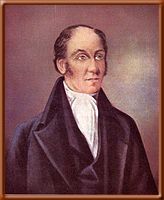
Timothy Hackworth (22 December 1786 – 7 July 1850) was an English steam locomotive engineer who lived in Shildon, County Durham, England and was the first locomotive superintendent of the Stockton and Darlington Railway.
Timothy Hackworth was born in Wylam in 1786, five years after his fellow railway pioneer George Stephenson had been born in the same village. Hackworth was the eldest son of John Hackworth who occupied the position of foreman blacksmith at Wylam Colliery until his death in 1804; the father had already acquired a considerable reputation as a mechanical worker and boiler maker. At the end of his apprenticeship in 1810 Timothy took over his father's position. Since 1804, the mine owner, Christopher Blackett had been investigating the possibilities of working the mine's short 5-mile (8.0 km) colliery tramroad by steam traction. Blackett set up a four-man working group including himself, William Hedley, the viewer; Timothy Hackworth, the new foreman smith and Jonathan Forster, a "wright". The first step in 1808 was the relaying of the Wylam tramway with cast iron plates, until then a simple timber-way. In 1811, the four-man team began investigating the adhesive properties of smooth wheels using a manually operated carriage propelled by a maximum of four men, and in the same year a single-cylinder locomotive devised by one Waters, reportedly on the Richard Trevithick model, was built and tried for a few months with erratic results.
In the meantime a new dilly, (the term used to designate all locomotives at Wylam), was put in hand and set to work in the autumn of 1812. However even Blackett's new cast iron plateway was found inadequate to sustain the weight of a dilly and the subsequent one built in 1813 was carried on two four-wheeled "power bogies" and it is understood that the first one was similarly rebuilt. On the relaying, around 1830, of the Wylam line with wrought iron edge rails, the two locomotives were reverted to the 4-wheel arrangement, continuing to work until the closing of the line in 1862. What is considered to be the earlier of the two engines, now known as Puffing Billy is conserved at the Science Museum in London; the second Wylam Dilly is in the Royal Scottish Museum in Edinburgh.
Although William Hedley is generally credited with the "design" of the locomotives, there is strong evidence that these issued from the aforementioned joint collaboration in which Christopher Blackett was the driving force with Timothy Hackworth playing a preponderant engineering role. Furthermore, it subsequently fell to Hackworth to maintain the locomotives in running order and improve performance. As time went on, Blackett became increasingly occupied by other outside interests and was often absent, leaving Hedley in charge of the mine; Hackworth found himself in conflictual situations due his Methodist activities and his refusal to work on the Sabbath, until he felt obliged to leave Wylam in 1816.
He was not long in finding other employment at Walbottle Colliery where he took up the same position of foreman blacksmith.
In 1824, Hackworth occupied a temporary position as a "borrowed man" or relief manager at the Forth Street factory of Robert Stephenson and Company, whilst Robert was away in South America and George was occupied with the surveying of new railways, notably the Liverpool and Manchester Railway. Hackworth only stayed until the end of that year, following which he returned to Walbottle occupying his time with contract work until, upon the recommendation of George Stephenson, he was appointed on 13 May 1825 to the position of locomotive superintendent of the Stockton and Darlington Railway, a post he held until May 1840.
Hackworth is believed to have been influential in developing the first Stephenson locomotive for the Stockton and Darlington Railway during his time at the Forth Street factory. That locomotive, then named Active and now known as Locomotion No. 1, was delivered to the railway just before the opening ceremony on 27 September 1825. Three more of the same type (Hope, Black Diamond, Diligence) were delivered in the following months and severe operational difficulties made steam locomotives unappealing, thus Hackworth developed an improved design to negate this. This resulted in the Royal George of 1827, an early 0-6-0 locomotive that among many new features incorporated a correctly aligned steam blastpipe. Hackworth is usually acknowledged as the inventor of this concept.
From 1830 onwards the blastpipe was employed by the Stephensons for their updated Rocket and all subsequent new locomotives. Recent letters acquired by the National Railway Museum would appear to confirm Hackworth as the inventor of the device. Since Trevithick's time, it had been common to direct exhaust steam from the cylinders through the chimney using "eductor pipes" for convenience and noise reduction, and its effect on the fire was noted. Regardless, Hackworth was likely the first engineer to fully account for the blast's role in automatically realising the "perfect equilibrium between steam production and usage" in a firetube boiler and consider the blastpipe a distinct device, focusing on its proportions, nozzle size, positioning and precise alignment.
Hub AI
Timothy Hackworth AI simulator
(@Timothy Hackworth_simulator)
Timothy Hackworth
Timothy Hackworth (22 December 1786 – 7 July 1850) was an English steam locomotive engineer who lived in Shildon, County Durham, England and was the first locomotive superintendent of the Stockton and Darlington Railway.
Timothy Hackworth was born in Wylam in 1786, five years after his fellow railway pioneer George Stephenson had been born in the same village. Hackworth was the eldest son of John Hackworth who occupied the position of foreman blacksmith at Wylam Colliery until his death in 1804; the father had already acquired a considerable reputation as a mechanical worker and boiler maker. At the end of his apprenticeship in 1810 Timothy took over his father's position. Since 1804, the mine owner, Christopher Blackett had been investigating the possibilities of working the mine's short 5-mile (8.0 km) colliery tramroad by steam traction. Blackett set up a four-man working group including himself, William Hedley, the viewer; Timothy Hackworth, the new foreman smith and Jonathan Forster, a "wright". The first step in 1808 was the relaying of the Wylam tramway with cast iron plates, until then a simple timber-way. In 1811, the four-man team began investigating the adhesive properties of smooth wheels using a manually operated carriage propelled by a maximum of four men, and in the same year a single-cylinder locomotive devised by one Waters, reportedly on the Richard Trevithick model, was built and tried for a few months with erratic results.
In the meantime a new dilly, (the term used to designate all locomotives at Wylam), was put in hand and set to work in the autumn of 1812. However even Blackett's new cast iron plateway was found inadequate to sustain the weight of a dilly and the subsequent one built in 1813 was carried on two four-wheeled "power bogies" and it is understood that the first one was similarly rebuilt. On the relaying, around 1830, of the Wylam line with wrought iron edge rails, the two locomotives were reverted to the 4-wheel arrangement, continuing to work until the closing of the line in 1862. What is considered to be the earlier of the two engines, now known as Puffing Billy is conserved at the Science Museum in London; the second Wylam Dilly is in the Royal Scottish Museum in Edinburgh.
Although William Hedley is generally credited with the "design" of the locomotives, there is strong evidence that these issued from the aforementioned joint collaboration in which Christopher Blackett was the driving force with Timothy Hackworth playing a preponderant engineering role. Furthermore, it subsequently fell to Hackworth to maintain the locomotives in running order and improve performance. As time went on, Blackett became increasingly occupied by other outside interests and was often absent, leaving Hedley in charge of the mine; Hackworth found himself in conflictual situations due his Methodist activities and his refusal to work on the Sabbath, until he felt obliged to leave Wylam in 1816.
He was not long in finding other employment at Walbottle Colliery where he took up the same position of foreman blacksmith.
In 1824, Hackworth occupied a temporary position as a "borrowed man" or relief manager at the Forth Street factory of Robert Stephenson and Company, whilst Robert was away in South America and George was occupied with the surveying of new railways, notably the Liverpool and Manchester Railway. Hackworth only stayed until the end of that year, following which he returned to Walbottle occupying his time with contract work until, upon the recommendation of George Stephenson, he was appointed on 13 May 1825 to the position of locomotive superintendent of the Stockton and Darlington Railway, a post he held until May 1840.
Hackworth is believed to have been influential in developing the first Stephenson locomotive for the Stockton and Darlington Railway during his time at the Forth Street factory. That locomotive, then named Active and now known as Locomotion No. 1, was delivered to the railway just before the opening ceremony on 27 September 1825. Three more of the same type (Hope, Black Diamond, Diligence) were delivered in the following months and severe operational difficulties made steam locomotives unappealing, thus Hackworth developed an improved design to negate this. This resulted in the Royal George of 1827, an early 0-6-0 locomotive that among many new features incorporated a correctly aligned steam blastpipe. Hackworth is usually acknowledged as the inventor of this concept.
From 1830 onwards the blastpipe was employed by the Stephensons for their updated Rocket and all subsequent new locomotives. Recent letters acquired by the National Railway Museum would appear to confirm Hackworth as the inventor of the device. Since Trevithick's time, it had been common to direct exhaust steam from the cylinders through the chimney using "eductor pipes" for convenience and noise reduction, and its effect on the fire was noted. Regardless, Hackworth was likely the first engineer to fully account for the blast's role in automatically realising the "perfect equilibrium between steam production and usage" in a firetube boiler and consider the blastpipe a distinct device, focusing on its proportions, nozzle size, positioning and precise alignment.
Recent media