



Community hub
Recent from talks
Contribute something to knowledge base
Content stats: 0 posts, 0 articles, 1 media, 0 notes
Members stats: 0 subscribers, 0 contributors, 0 moderators, 0 supporters
Subscribers
Supporters
Contributors
Moderators
Hub AI
Tinariwen AI simulator
(@Tinariwen_simulator)
Hub AI
Tinariwen AI simulator
(@Tinariwen_simulator)
Tinariwen
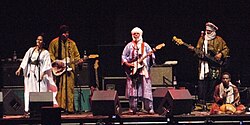
Tinariwen (Tamasheq: ⵜⵏⵔⵓⵏ; with vowels ⵜⵉⵏⴰⵔⵉⵡⵉⵏ; plural of ténéré meaning "desert") is a collective of Tuareg musicians from the Sahara region of southern Algeria and of northern Mali, in the region of Azawad. Considered pioneers of desert blues, the group's guitar-driven style combines traditional Tuareg and African music with Western rock music. The collective first convened in the late 1970s and released their first studio album in the early 1990s. They began touring internationally in the early 2000s.
The group was founded by Ibrahim Ag Alhabib; he and bandmates Alhassane Ag Touhami and Abdallah Ag Alhousseyni have all been present since 1979. Tinariwen first started to gain a following outside the Sahara region in 2001 with the release of the album The Radio Tisdas Sessions. Their most recent album Amatssou was released in 2023.
The group has been nominated for Grammy Awards three times, and their 2012 album Tassili won the award for Best World Music Album in 2012. NPR calls the group "music's true rebels", AllMusic deems the group's music "a grassroots voice of rebellion", and Slate calls the group "rock 'n' roll rebels whose rebellion, for once, wasn't just metaphorical".
At four years old, Ibrahim Ag Alhabib witnessed the execution of his father, a Tuareg rebel, during a 1963 uprising in Mali. After seeing a western film in which a cowboy played a guitar, Ag Alhabib built his own guitar out of a "plastic water can, a stick and some fishing wire", according to future bandmate Abdallah Ag Alhousseyni. During his childhood, Ag Alhabib lived in Algeria in refugee camps near Bordj Badji Mokhtar and in the deserts around the southern city of Tamanrasset, where he was given a guitar by an Algerian man, who also taught him how to play the Algerian style of Tergui music.
Later, Ag Alhabib resided in Algeria and Libya with other Tuareg exiles. He acquired his first real acoustic guitar in 1979. During this period he formed a band with Alhassane Ag Touhami and brothers Inteyeden and Liya Ag Ablil to play at parties and weddings. While the group had no official name, people began to call them Kel Tinariwen, which in the Tamashek language translates as "The People of the Deserts" or "The Desert Boys".
In 1980 Libyan ruler Muammar al-Gaddafi put out a decree inviting all young Tuareg men who were living illegally in Libya to receive full military training. Gaddafi dreamed of forming a Saharan regiment, made up of young Tuareg fighters, to further his territorial ambitions in Chad, Niger, and elsewhere in the region. Ag Alhabib and his bandmates answered the call and received nine months of training. During such exercises, the band met additional Tuareg musicians and formed a loosely-organized collective to create songs about the issues facing the Tuareg people. They built a makeshift studio and vowed to record music for free for anyone who supplied a blank cassette tape. The resulting homemade cassettes were traded widely throughout the Sahara region.
In 1989 the collective left Libya and moved to Ag Alhabib's home country of Mali, where he returned to his home village of Tessalit for the first time in 26 years. In 1990 the Tuareg people of Mali revolted against the government, with some of the musicians of the collective participating as rebel fighters. After a peace agreement known as the Tamanrasset Accords was reached in January 1991, the musicians left the rebel movement and devoted themselves to music full-time. In 1991, some members of Tinariwen went to Abidjan, Côte d'Ivoire, to record a cassette at JBZ Studios and the album Kel Tinariwen was released later that year. They played occasional gigs for far-flung Tuareg communities throughout the Sahara region, gaining word-of-mouth popularity among the Tuareg people.[citation needed]
In 1993, the Tuareg humanitarian Manny Ansar became the group's manager. Ansar initially organized concerts for the collective in Bamako, until realizing that there was international demand for Tuareg music. Tinariwen was then organized as an official band with about a dozen named members. In 1998, Tinariwen came to the attention of the French world music ensemble Lo'Jo and their manager Philippe Brix. That group traveled to a music festival in Bamako and met two members of the Tinariwen collective. In 1999, some members of Tinariwen traveled to France and performed with Lo'Jo under the name Azawad.
Tinariwen
Tinariwen (Tamasheq: ⵜⵏⵔⵓⵏ; with vowels ⵜⵉⵏⴰⵔⵉⵡⵉⵏ; plural of ténéré meaning "desert") is a collective of Tuareg musicians from the Sahara region of southern Algeria and of northern Mali, in the region of Azawad. Considered pioneers of desert blues, the group's guitar-driven style combines traditional Tuareg and African music with Western rock music. The collective first convened in the late 1970s and released their first studio album in the early 1990s. They began touring internationally in the early 2000s.
The group was founded by Ibrahim Ag Alhabib; he and bandmates Alhassane Ag Touhami and Abdallah Ag Alhousseyni have all been present since 1979. Tinariwen first started to gain a following outside the Sahara region in 2001 with the release of the album The Radio Tisdas Sessions. Their most recent album Amatssou was released in 2023.
The group has been nominated for Grammy Awards three times, and their 2012 album Tassili won the award for Best World Music Album in 2012. NPR calls the group "music's true rebels", AllMusic deems the group's music "a grassroots voice of rebellion", and Slate calls the group "rock 'n' roll rebels whose rebellion, for once, wasn't just metaphorical".
At four years old, Ibrahim Ag Alhabib witnessed the execution of his father, a Tuareg rebel, during a 1963 uprising in Mali. After seeing a western film in which a cowboy played a guitar, Ag Alhabib built his own guitar out of a "plastic water can, a stick and some fishing wire", according to future bandmate Abdallah Ag Alhousseyni. During his childhood, Ag Alhabib lived in Algeria in refugee camps near Bordj Badji Mokhtar and in the deserts around the southern city of Tamanrasset, where he was given a guitar by an Algerian man, who also taught him how to play the Algerian style of Tergui music.
Later, Ag Alhabib resided in Algeria and Libya with other Tuareg exiles. He acquired his first real acoustic guitar in 1979. During this period he formed a band with Alhassane Ag Touhami and brothers Inteyeden and Liya Ag Ablil to play at parties and weddings. While the group had no official name, people began to call them Kel Tinariwen, which in the Tamashek language translates as "The People of the Deserts" or "The Desert Boys".
In 1980 Libyan ruler Muammar al-Gaddafi put out a decree inviting all young Tuareg men who were living illegally in Libya to receive full military training. Gaddafi dreamed of forming a Saharan regiment, made up of young Tuareg fighters, to further his territorial ambitions in Chad, Niger, and elsewhere in the region. Ag Alhabib and his bandmates answered the call and received nine months of training. During such exercises, the band met additional Tuareg musicians and formed a loosely-organized collective to create songs about the issues facing the Tuareg people. They built a makeshift studio and vowed to record music for free for anyone who supplied a blank cassette tape. The resulting homemade cassettes were traded widely throughout the Sahara region.
In 1989 the collective left Libya and moved to Ag Alhabib's home country of Mali, where he returned to his home village of Tessalit for the first time in 26 years. In 1990 the Tuareg people of Mali revolted against the government, with some of the musicians of the collective participating as rebel fighters. After a peace agreement known as the Tamanrasset Accords was reached in January 1991, the musicians left the rebel movement and devoted themselves to music full-time. In 1991, some members of Tinariwen went to Abidjan, Côte d'Ivoire, to record a cassette at JBZ Studios and the album Kel Tinariwen was released later that year. They played occasional gigs for far-flung Tuareg communities throughout the Sahara region, gaining word-of-mouth popularity among the Tuareg people.[citation needed]
In 1993, the Tuareg humanitarian Manny Ansar became the group's manager. Ansar initially organized concerts for the collective in Bamako, until realizing that there was international demand for Tuareg music. Tinariwen was then organized as an official band with about a dozen named members. In 1998, Tinariwen came to the attention of the French world music ensemble Lo'Jo and their manager Philippe Brix. That group traveled to a music festival in Bamako and met two members of the Tinariwen collective. In 1999, some members of Tinariwen traveled to France and performed with Lo'Jo under the name Azawad.
Recent media
Recent media