Hubbry Logo
Tit-BitsTit-BitsMain
Open search
Tit-Bits
Community hub
Tit-Bits
logo
8 pages, 0 posts
0 subscribers
Be the first to start a discussion here.
Tit-Bits
Tit-Bits
from Wikipedia

Tit-Bits
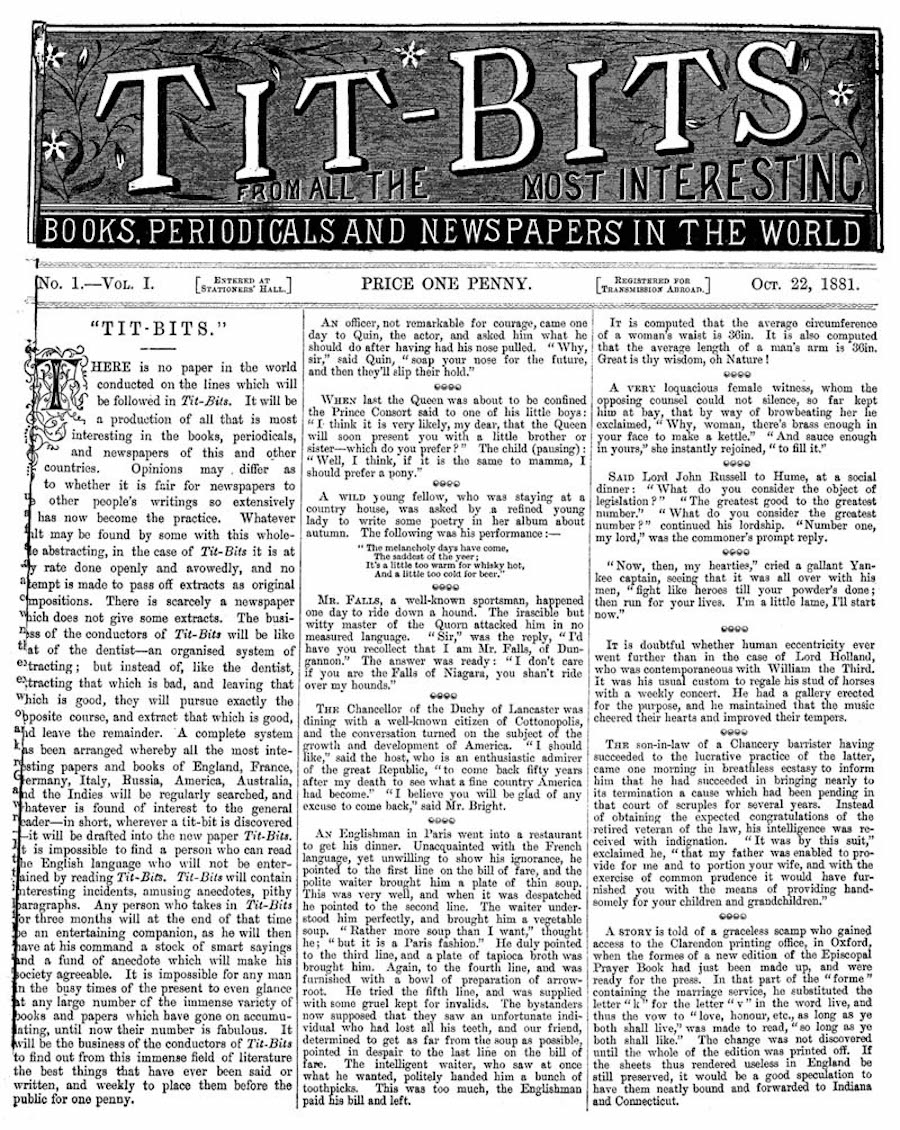
The first issue of Tit-Bits, dated 22 October 1881
FrequencyWeekly
FounderGeorge Newnes
Founded1881
First issue22 October 1881 (1881-10-22)
Final issue18 July 1984 (1984-07-18)
CountryUnited Kingdom
Based inLondon
LanguageEnglish

Tit-Bits from all the interesting Books and Newspapers of the World, more commonly known as Tit-Bits and later as Titbits, was a British weekly magazine founded by George Newnes, a founding figure in popular journalism, on 22 October 1881.[1]

History

[edit]

In 1886, the magazine's headquarters moved from Manchester to London[2] where it paved the way for popular journalism – most significantly, the Daily Mail was founded by Alfred Harmsworth, a contributor to Tit-Bits, and the Daily Express was launched by Arthur Pearson, who worked at Tit-Bits for five years after winning a competition to get a job on the magazine.[3] The London offices were at 12 Burleigh Street, off the Strand.[citation needed]

From the outset, the magazine was a mass-circulation commercial publication on cheap newsprint which soon reached sales of between 400,000 and 600,000. By the turn of the century, it became the first periodical in Britain to sell over one million copies per issue.[4] Each issue presented a diverse range of tit-bits of information in an easy-to-read format, with the emphasis on human interest stories concentrating on drama and sensation.[5] Later issues featured short stories and full-length fiction, including works by authors such as Rider Haggard and Isaac Asimov, plus three very early stories by Christopher Priest.[citation needed]

Virginia Woolf submitted her first article to the paper in 1890, at the age of eight, but it was turned down.[6] The first humorous article by P. G. Wodehouse, "Men Who Missed Their Own Weddings", appeared in Tit-Bits in November 1900.[7] During the First World War Ivor Novello won a Titbits competition to write a song soldiers could sing at the front: he penned Keep the Home Fires Burning.[8]

Pin-ups appeared on the magazine's covers after the Second World War, and by 1955, circulation peaked at 1,150,000. The name changed from "Tit-Bits" in the issue of 28 December 1967 to "Titbits" in January 1968. In 1979 Reveille (a weekly tabloid with a virtually identical demographic) was merged into Titbits, and the magazine was rebranded as Titbits incorporating Reveille. This, however, was dropped in 1981. Following a wage dispute at owner IPC Magazines, publication ceased on 9 June 1984 and its closure was announced at the end of June. At the time, Titbits was selling 200,000 copies per issue.[4] A final issue was published on 18 July 1984[8] under its last editor Paul Hopkins. It was taken over by Associated Newspapers' Weekend. At the time, the Financial Times described Titbits as "the 103-year-old progenitor of Britain's popular press".[8] Weekend itself closed in 1989.

The magazine name survived as a glossy adult monthly, Titbits International.

Imitators

[edit]

The success of Tit-Bits inspired a number of other inexpensive weeklies to ape its format, some short-lived and others, such as Answers becoming major successes in their own right. Within the first six months of its existence, Tit-Bits had inspired twelve imitators, growing to 26 within a year of its debut.[9] Examples of papers said to be imitators include:

  • The Ha'porth[9]
  • Illustrated Bits[10]
  • Rare-Bits[9]
  • Scraps[10]
  • Sketchy Bits, published in London by Charles Shurey[9]
  • Spare Time[10]
  • Tid-Bits, published in the United States[9]

Cultural influence

[edit]

In All Things Considered by G. K. Chesterton, the author contrasts Tit-Bits with The Times, saying: "Let any honest reader... ask himself whether he would really rather be asked in the next two hours to write the front page of The Times, which is full of long leading articles, or the front page of Tit-Bits, which is full of short jokes." Reference to the magazine is also made in James Joyce's Ulysses,[11] George Orwell's Animal Farm, C. P. Snow's The Affair,[12] James Hilton's Lost Horizon, Virginia Woolf's Moments of Being, H. G. Wells' The First Men in the Moon and Kipps, A. J. Cronin's The Stars Look Down and P. G. Wodehouse's Not George Washington. It is also mentioned in Stanley Houghton's play The Dear Departed. Wells also mentioned it in his book Experiment in Autobiography. The magazine is parodied as "Chit Chat" in George Gissing's New Grub Street. In the closing scene of the film Kind Hearts and Coronets (1949), the protagonist Louis Mazzini (Dennis Price) is approached by a journalist (Arthur Lowe) from Tit-Bits.

The magazine was mistakenly referenced alongside Playboy and The Sun's Page 3 in Tom Robinson's 1978 song "Glad to Be Gay". Robinson had misinterpreted the magazine's title and assumed its content to be more salacious.[13][14]

References

[edit]
Revisions and contributorsEdit on WikipediaRead on Wikipedia
from Grokipedia
Tit-Bits was a pioneering British weekly founded by publisher George Newnes on 22 October 1881, renowned for compiling short, entertaining "titbits" of news, anecdotes, stories, and useful information drawn from various sources to appeal to a broad, newly literate working- and middle-class readership. The publication emphasized bright, amusing content designed to both entertain and educate without , quickly achieving mass circulation with sales reaching 400,000 to 600,000 copies per week during its peak years from the to 1910. It continued weekly until its final issue on 18 July 1984, evolving over more than a century to include serialized , interviews, competitions, and later pin-up features while influencing popular and launching careers of writers like Alfred Harmsworth and . Newnes, inspired by a diverting newspaper item about a runaway train in the , self-financed the inaugural issue after failing to secure backing, with 5,000 copies selling out by midday on launch day. Priced at a penny, Tit-Bits targeted the expanding audience created by the , offering digestible reading matter on cheap newsprint that avoided the lurid tones of competitors. By 1891, the magazine generated £30,000 in annual profits for Newnes, underscoring its commercial success and role in the movement that prioritized accessibility and engagement. Throughout its run, Tit-Bits featured contributions from prominent figures, including early articles by between 1892 and 1918—such as short stories, a serialization, an , and essays—and served as a proving ground for emerging talents. Its format of concise, varied pieces influenced literary and cultural commentary, earning praise from , who noted its appeal in crafting "short jokes" over lengthy editorials, and references in works by , , and . Over time, the magazine adapted to changing tastes, incorporating visual elements and merging with titles like in 1979 before concluding in 1984, leaving a legacy as a cornerstone of mass-market periodical publishing.

Founding and Early Years

Origins and Launch

Tit-Bits was founded by George Newnes on 22 October 1881 in , , in response to the rising demand for affordable entertainment and reading material among the newly literate lower-middle class, a development fueled by the that expanded access to basic schooling. Newnes, inspired by a diverting item about a runaway train in the , developed a hobby of compiling scrapbooks filled with intriguing clippings from books, newspapers, and periodicals, including material sourced from American publications. Born in 1851 to a Congregational minister, he had built a foundation in business through apprenticeships in haberdashery and sales, experiences that honed his understanding of consumer preferences and persuasive communication. The magazine debuted as a weekly publication on inexpensive newsprint, priced at one penny to ensure broad accessibility, with its title reflecting the core concept of "tit-bits"—concise, engaging excerpts drawn from diverse sources worldwide. Early issues comprised 16 pages of curated content, including informational snippets, brief anecdotes, practical advice, light humor, reader correspondence, and advertisements, all designed to offer quick, undemanding diversion. This format aligned with the emerging "new journalism" movement, which prioritized sensational, digestible stories to captivate a mass audience amid rising literacy rates. By 1886, Tit-Bits had relocated its headquarters from to , facilitating improved distribution and administrative logistics as the publication established its operational base in the capital.

Initial Content and Reception

Tit-Bits, launched on 22 October 1881 by George Newnes, embodied his vision of providing wholesome, bite-sized for the era's time-strapped readers. The magazine's core content consisted of a compilation of short, entertaining snippets drawn from books, periodicals, and newspapers worldwide, including human interest stories, puzzles, and moral tales designed to uplift and amuse busy urban audiences. These elements were presented in a concise format, emphasizing accessibility over depth, which allowed readers to consume varied topics in brief intervals. Among the first notable features were reader engagement tools such as the "Enquiry Column," where subscribers could submit queries on diverse subjects for editorial responses. This interactive approach fostered , encouraging contributions and correspondence that blurred the lines between publication and audience. The content's focus on light, moralistic, and curiosity-driven material distinguished it from the denser, more analytical fare of contemporary newspapers. The magazine's early reception was overwhelmingly positive among its target demographic, with initial sales of 5,000 copies within two hours of launch, signaling immediate appeal. Circulation rapidly expanded to weekly copies within two years, reflecting in capturing a market underserved by traditional press. It was praised for that provided affordable respite for working-class and lower-middle-class readers in Victorian Britain, filling a niche for quick, edifying reads amid the era's industrial bustle and limited leisure time. However, elites and traditional criticized it as "cheap journalism" for its superficiality and reliance on condensed excerpts, viewing it as a dilution of serious discourse.

Format and Features

Magazine Structure

Tit-Bits was structured as a weekly , initially comprising 16 pages of concise, digestible content designed for quick reading by a broad audience, later expanding to include a 4-page supplement and growing to around 24 pages or more by the early . The core layout featured short articles and anecdotes, often limited to brief paragraphs under 500 words, emphasizing "tit-bits" or snippets extracted and rewritten from books, papers, and other sources to provide entertaining, informative morsels without demanding extended attention. Recurring departments included "Tit-Bits from all the Interesting Books and papers," which formed the backbone by compiling literary excerpts and highlights; an "Answers to Correspondents" offering practical tips on domestic matters, , and ; and dedicated humor pages with jokes and light-hearted stories. Visually, early issues relied on a text-heavy format with bold, eye-catching headlines to draw readers, supplemented by minimal illustrations that highlighted key anecdotes or personalities. As the magazine evolved into the , it incorporated more illustrations and transitioned toward photographs, reflecting broader trends in periodical to enhance visual appeal and realism in human interest stories. Short fiction segments and serialized tales were interspersed among the snippets, maintaining a structure that balanced , amusement, and moral upliftment in its pre-World War II era, with content curated to promote wholesome values through uplifting narratives and practical advice. In the late 1930s, Tit-Bits underwent stylistic adaptations to align with changing reader preferences, adopting newspaper-style layouts with denser, columnar arrangements and introducing pin-up covers featuring in modest attire—one of the first such uses in a mainstream weekly —to inject contemporary allure while retaining core snippet-based content. Departments like the humor-focused "" section persisted, alongside evolving news snippets and reader contributions, ensuring the magazine's format remained accessible and varied across its century-long run. This preserved the original bite-sized ethos but broadened visual and thematic elements to sustain engagement amid shifting cultural norms.

Notable Competitions and Contributions

Tit-Bits engaged its readership through a series of innovative competitions that encouraged submissions of personal essays, puzzles, and anecdotes, often drawing thousands of entries and fostering a sense of community among its audience. One of the earliest and most notorious was the 1889 "Why Am I A Spinster?" contest, which invited single female readers to explain their marital status in 50 words or fewer, offering cash prizes of five shillings to 21 winners whose responses were published for their wit and candor. Notable entries included humorous and pointed replies, such as one winner stating, "Because I have never found a man who would have me," and another quipping, "I am waiting for the man who can make me more comfortable than I am alone," which highlighted the era's social tensions around women's independence and marriage. These contests not only entertained but also boosted circulation by generating word-of-mouth buzz, as readers shared the published responses and anticipated future prizes. The magazine's annual essay and puzzle challenges further exemplified this interactive approach, with recurring calls for reader-submitted riddles, short stories, and problem-solving entries that promised rewards like or , attracting massive participation from working-class contributors. Prizes for photographs and personal s were also common, rewarding vivid snapshots of everyday life or quirky tales that aligned with Tit-Bits' focus on digestible human-interest snippets; for instance, a competition offered a freehold for the best under 3,000 words, turning ordinary readers into published authors and amplifying the magazine's appeal through relatable content. Such features created "Loyal Tit-Bitites," a devoted of subscribers who carried copies on commutes and engaged via dedicated letter columns, where editors responded directly to queries and suggestions, strengthening reader loyalty and driving sustained engagement. Tit-Bits also showcased notable guest contributions that elevated its status, including early fiction by prominent authors that debuted or were serialized within its pages. P.G. Wodehouse's first paid periodical piece, the humorous sketch "Men Who Missed Their Own Weddings," appeared in the November 24, 1900, issue, marking his entry into professional writing. Similarly, H. Rider Haggard's adventure novel The People of the Mist was serialized from December 1893 to August 1894, introducing readers to tales of lost African civilizations and treasure quests. During , the magazine ran a songwriting contest for troops, won by with "Keep the Home Fires Burning" in 1915, which became a morale-boosting anthem and underscored Tit-Bits' role in wartime cultural output. These contributions, alongside reader-driven features, exemplified how Tit-Bits transformed passive consumers into active participants, with winners' stories often inspiring follow-up submissions and perpetuating a cycle of communal storytelling.

Publication History

Expansion and Peak Circulation

Tit-Bits experienced rapid growth following its launch in , with circulation reaching 200,000 copies per week within two years through innovative marketing techniques such as reader competitions and promotional stunts. By the late 1880s, sales had climbed to approximately 350,000 weekly, and by around 1910, the magazine became the first British periodical to exceed one million copies per week, solidifying its position as a mass-market leader. This expansion was fueled by George Newnes' strategy of compiling engaging snippets from newspapers and books, appealing to a newly literate working and lower-middle-class audience in an era of rising education and literacy rates. In the early 20th century, Newnes launched companion publications like The Strand Magazine in 1891, which built on Tit-Bits' format of serialized fiction and illustrated content, further extending the brand's influence. These efforts contributed to steady growth, with circulation hovering between 400,000 and 600,000 copies weekly around 1898. Tit-Bits played a pivotal role in the "new journalism" movement by popularizing the snippet-style format of short, digestible stories and facts, which influenced the structure of daily newspapers and shifted journalism toward more accessible, entertainment-focused reporting. This approach helped establish market dominance among penny weeklies, inspiring imitators and setting standards for mass appeal. Circulation continued to rise, peaking at 1,150,000 copies per week in 1955, a testament to its enduring adaptability amid changing reader preferences.

Ownership Changes and Evolution

Tit-Bits was founded in 1881 by George Newnes and published under his company, George Newnes Ltd., which had been formally established in to manage his growing portfolio of periodicals. Newnes served as the initial editor, emphasizing a moralistic tone with snippets of uplifting stories, serialized , and educational tidbits drawn from various sources to appeal to a working-class readership. In the , the publisher underwent significant corporate evolution through closer ties with C. Arthur Pearson, a former Tit-Bits employee who had built his own sensationalist publications. A joint printing venture, Newnes and Pearson Printing Co., was formed in 1920, followed by a formal working arrangement in 1921; by 1929, Newnes consolidated control by acquiring the remaining shares in Pearson's operations, effectively integrating C. Arthur Pearson Ltd. as an imprint and shifting the editorial focus toward lighter, more entertaining content with sensational elements to boost appeal amid interwar competition. This period marked a departure from Newnes's original didactic style, incorporating more human-interest stories and competitions under Pearson-influenced editors who prioritized drama and reader engagement. The post-World War II era brought further ownership consolidation. In 1959, Odhams Press acquired George Newnes Ltd., including Tit-Bits, as part of broader industry rationalization. By the early 1960s, the Mirror Group Newspapers had taken over Newnes, Odhams Press, and the rival Amalgamated Press, merging them in 1963 to form the International Publishing Corporation (IPC), under which Tit-Bits operated from its London base at Kings Reach Tower. This structure facilitated editorial adaptations, such as the addition of celebrity gossip and pin-up features starting in 1950 to align with changing reader tastes, contributing to a circulation peak that underscored the success of IPC's management. In the 1970s, IPC modernized the magazine by removing the hyphen from the title in 1973 and transitioning to color covers and a tabloid format to refresh its image for a younger audience. A major shift occurred in 1979 when Titbits merged with the similar IPC title Reveille, rebranding as Titbits incorporating Reveille and emphasizing entertainment-oriented content; this was edited by figures like David Hill and Brian Lee in its final years. The publication's evolution culminated in 1984 when it was absorbed into Associated Newspapers' Weekend supplement, ending its independent run under IPC.

Decline and Closure

By the mid-1950s, Tit-Bits had reached its peak circulation of approximately 1.15 million copies weekly, but this figure began a steady decline thereafter, dropping to 904,000 by 1959 and further to around 170,000 by 1984. The primary factors contributing to this erosion included intensifying competition from , which captured audience attention for and news snippets, alongside economic recessions that reduced . Additionally, rising newsprint and production costs in the and strained profitability for general-interest weeklies like Tit-Bits, as the broader magazine industry shifted toward more specialized publications targeting niche audiences. In the late 1970s, efforts to stem the decline through mergers proved unsuccessful and further diluted the magazine's original brand identity. In September 1979, under ownership by IPC Magazines, Tit-Bits merged with the rival tabloid , rebranding as Titbits incorporating Reveille, but this integration failed to reverse falling sales amid competition from daily tabloids such as The Sun, which offered similar bite-sized content on a more frequent basis. Ownership instability at IPC exacerbated these challenges, culminating in a prolonged dispute with staff that halted production. The magazine published its final issue on 18 July 1984, marking the end of 103 years of continuous weekly publication since its launch in 1881. Its assets were absorbed into Associated Newspapers' Weekend magazine, which itself ceased in 1989. Post-closure, physical copies of Tit-Bits are preserved in archival collections such as those held by the , ensuring access for historical research. Issues are preserved digitally in collections such as the and the .

Influence

Imitators

The success of Tit-Bits, launched in 1881 by George Newnes, prompted the rapid emergence of numerous imitators seeking to capitalize on its snippet-style format of condensed news, anecdotes, and human-interest stories. Within the first year, at least 26 such publications appeared, many adopting similar titles and structures to appeal to the growing market of lower-middle-class readers. Among the most notable early imitators was Illustrated Bits, launched in 1885, which differentiated itself by incorporating visual elements like drawings and cartoons alongside textual snippets, aiming to enhance engagement in a competitive . Similarly, Answers to Correspondents (shortened to Answers), founded in 1888 by Alfred Harmsworth—a former Tit-Bits contributor—closely mimicked the original's bite-sized informational style, achieving a weekly circulation of over 700,000 by the early 1900s through reader competitions and serial fiction. Arthur Pearson, another ex-Tit-Bits employee, introduced Pearson's Weekly in 1890, replicating the miscellany approach while emphasizing puzzles and advice columns, which helped it sustain sales amid the rivalry. Tit-Bits responded aggressively to these copycats, underscoring Newnes's efforts to protect the publication's distinctive brand. Many imitators struggled under Tit-Bits' dominance, with several folding quickly due to inferior distribution and reader loyalty to the original, though survivors adapted by integrating photographs or targeting regional audiences to carve out niches. In the longer term, Tit-Bits' influence extended to enduring weeklies like John Bull, launched in 1906 by Horatio Bottomley, which borrowed elements such as prize competitions and populist snippets to build a circulation exceeding one million during World War I. This model also foreshadowed early tabloid formats, where condensed, accessible content became a staple in British popular journalism.

Impact on Journalism and Culture

Tit-Bits played a pivotal role in the development of "" in late Victorian Britain, introducing accessible, factoid-based reporting that prioritized and brevity over traditional in-depth analysis. Founded by George Newnes in 1881, the magazine's format of short, disconnected news snippets, dramatic anecdotes, and reader contests appealed to the lower-middle and working classes, achieving a weekly circulation of around 500,000 copies and setting a model for mass-market periodicals. This approach influenced key figures in the industry, including Alfred Harmsworth (later Lord Northcliffe), who at age 23 launched Answers as a direct rival, adapting Tit-Bits' sensationalist style to drive public engagement. Harmsworth later applied these techniques to the in 1896, transforming daily newspapers by emphasizing amusement and human-interest stories, which eroded the dominance of sober, instructional and forced competitors to follow suit. Similarly, Arthur Pearson, who began his career winning a Tit-Bits competition and later worked on the magazine, drew from its model to found Pearson's Weekly and the in 1900, further embedding snippet-style content in popular dailies. The success of these imitators underscores Tit-Bits' broad appeal in reshaping journalistic practices toward commercial viability and reader interactivity. In popular culture, Tit-Bits became a symbol of mass media's triviality and allure, referenced critically in several literary works. , in his 1908 collection , contrasted the magazine's lighthearted, joke-filled content with the gravitas of , questioning whether an author would prefer writing for the former's broad audience over the latter's elite readership. James Joyce incorporated Tit-Bits into Ulysses (1922), where protagonist reads an old issue while on the in the "Calypso" episode, using it to evoke everyday domesticity and the mundane consumption of popular print. George Orwell referenced the magazine in essays like "Boys' Weeklies" (1940), grouping it with other snippet papers that catered to escapist fantasies, and in (1945), where the pigs subscribe to Tit-Bits alongside and , satirizing the corruption of revolutionary ideals through bourgeois media indulgence. The magazine also appeared in popular music, notably in the Tom Robinson Band's 1978 song "(Sing If You're) Glad to Be Gay," which ironically lists Tit-Bits with and The Sun's as venues for "pictures of naked young women," misinterpreting its content as salacious despite its family-oriented origins. Tit-Bits' broader legacy lies in shaping reader expectations for entertainment-driven print media, fostering a culture of quick, digestible information that influenced the rise of subsequent mass-market publications. By blending facts, fiction, and promotions, it contributed to the genre of condensed magazines, paving the way for American imports like (founded 1922), which echoed its snippet format in abridged articles and trivia to reach wide audiences. This emphasis on accessibility and reflected and reinforced late-Victorian trends in self-improvement and , establishing a template for commercial that prioritized profit alongside cultural engagement. In modern contexts, Tit-Bits holds archival value for studying Victorian media landscapes, with its digitized issues preserved in collections like the British Library's 19th-Century Newspapers, offering insights into reprinting practices and public tastes. Its snippet style finds echoes in digital journalism, where short-form content like listicles and viral memes on platforms such as Twitter remixes historical humor and facts, as seen in projects like the Victorian Meme Machine, which pairs Tit-Bits-era jokes with contemporary visuals to engage online audiences.

References

Add your contribution
Related Hubs
User Avatar
No comments yet.