Hubbry Logo
18831883Main
Open search
1883
Community hub
1883
logo
8 pages, 0 posts
0 subscribers
Be the first to start a discussion here.
1883
1883
from Wikipedia
Not found
Revisions and contributorsEdit on WikipediaRead on Wikipedia
from Grokipedia

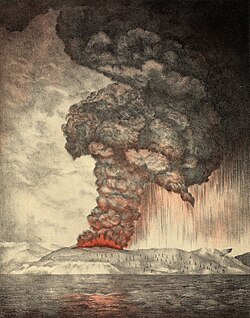
1883 marked a year of profound natural catastrophe and infrastructural triumph, most notably the explosive eruption of the Krakatoa volcano on August 26–27, which obliterated over 70% of the island, generated tsunamis that drowned approximately 36,000 people in nearby regions of Indonesia, and ejected ash that induced a global "volcanic winter" with measurable temperature declines. In the United States, the Brooklyn Bridge opened on May 24 after 14 years of construction, becoming the longest suspension bridge in the world at the time and linking Manhattan and Brooklyn across the East River for the first vehicular and pedestrian crossing. Legislatively, the Pendleton Civil Service Reform Act, signed January 16, introduced merit-based examinations for federal appointments, curtailing the spoils system of political patronage that had dominated U.S. government hiring. The U.S. Supreme Court, in the consolidated Civil Rights Cases decided October 15, ruled 8–1 that Congress lacked authority under the Fourteenth Amendment to regulate private discrimination in public accommodations, effectively nullifying key sections of the Civil Rights Act of 1875 and shifting responsibility to states. Among notable passings were philosopher Karl Marx on March 14, who died in London at age 64 from complications of bronchitis and pleurisy, and composer Richard Wagner on February 13, while births included future Italian dictator Benito Mussolini on July 29 and French fashion designer Coco Chanel on August 19. That same year, German bacteriologist Robert Koch isolated the bacterium Vibrio cholerae responsible for cholera during investigations in Egypt and India, revolutionizing understanding of infectious diseases.

Context

Geopolitical Landscape

In Europe, the geopolitical order in 1883 was dominated by Otto von Bismarck's alliance system, designed to secure 's position after unification and isolate following its defeat in the of 1870–1871. The Triple Alliance, comprising , , and , had been formalized in May 1882 to counter potential French aggression and manage Balkan instabilities, with Bismarck emphasizing defensive mutual support against a Franco-Russian coalition. The Three Emperors' League, renewed in 1881 between , , and , provided a fragile eastern bulwark, though underlying tensions over Balkan nationalism—particularly Romanian aspirations toward and Russian —strained relations between and St. Petersburg. , under the Third Republic, harbored revanchist aims to reclaim Alsace-Lorraine but remained diplomatically isolated, focusing instead on colonial ventures to bolster prestige and resources. Britain adhered to a policy of , prioritizing naval supremacy and colonial defense over continental entanglements, while monitoring Russian advances in amid the rivalry. A key development strengthening the Central European bloc occurred on October 30, 1883, when acceded secretly to the Triple Alliance through a with , assented to by ; this move, driven by King Carol I's Hohenzollern ties and fears of Russian influence, aimed to secure territorial gains against Ottoman holdings while boxing in 's southern frontiers. The , weakened by internal decay and nationalist revolts, faced encroachments from all sides, with administering Bosnia-Herzegovina since 1878 and eyeing . These alliances reflected Bismarck's causal strategy of preventive diplomacy: by encircling potential adversaries, avoided a , though the system's complexity foreshadowed future rigidities. Colonial competition intensified outside Europe, signaling the onset of the and . initiated the First Madagascar Expedition in May 1883, deploying naval forces to subjugate the and establish a after revoking commercial concessions; this action, part of broader Indo-Chinese ambitions, escalated into the Franco-Hova War (1883–1885) and underscored Paris's shift toward overseas empire-building to compensate for European setbacks. , previously colonial-averse under Bismarck, saw early private initiatives in Southwest Africa, where merchant Adolf Lüderitz secured land cessions from Nama chiefs in April 1883, laying groundwork for imperial protection in 1884 amid domestic pressure for "a place in the sun." Britain consolidated control over Egypt following the 1882 , installing a veiled to safeguard the , while clashing with over influence in . In , Qing grappled with European encroachments, including British opium trade legacies and rising Sino-French tensions over Annam (Vietnam), which erupted into war in 1884; Meiji , meanwhile, pursued modernization without major territorial grabs yet. These expansions, fueled by economic motives and national prestige, heightened great-power rivalries, as European states vied for raw materials and markets without formal international arbitration until the of 1884–1885. The United States, adhering to the , focused on hemispheric influence, avoiding Old World alliances while expanding westward and into Pacific islands.

Economic and Industrial Conditions

The global economy in 1883 remained gripped by the Long Depression, a protracted period of deflationary pressures and subdued growth that had persisted since 1873, characterized by falling commodity prices and uneven industrial expansion across Europe and North America. Despite these challenges, technological innovations and infrastructure projects sustained productivity gains in key sectors, with wholesale prices in major economies declining by approximately 1-2% annually amid overproduction in agriculture and raw materials. Industrial output, however, continued to rise modestly, driven by advancements in manufacturing processes and capital investment in machinery, though business failures increased due to credit tightening and reduced demand. In the United States, economic conditions reflected a transition from post-Civil War boom to contraction, with the recession of 1882-1885 manifesting in slowed railroad expansion and related industries after peak construction in , when over 11,500 miles of track were laid. Steel production, heavily reliant on rail demand—accounting for about 90% of output in —faced reduced orders, contributing to idle capacity in ironworks and mills, while edged higher in manufacturing hubs like and . Yet, emblematic industrial achievements persisted, including the completion of the on September 8, 1883, linking the and spurring localized timber and mining activity, and Thomas Edison's expansion of electric lighting to over 330 central stations powering 60,000 lamps by mid-year, heralding electrification's role in urban productivity. European industrial conditions mirrored this pattern of resilience amid stagnation, with Britain's coal and iron sectors experiencing output growth of around 2% but hampered by export slumps to protectionist markets, while Germany's nascent chemical and electrical industries gained traction through firms like . The signing of the Paris Convention for the Protection of Industrial Property on March 20, 1883, by 11 nations standardized patent laws, facilitating cross-border innovation in machinery and processes essential to technologies. Agricultural overproduction exacerbated rural distress, with wheat prices falling to near 1879 lows, prompting debates on trade policies that influenced subsequent tariff reforms.

Events

January–March

On January 4, 1883, the humor and general interest magazine was founded in by publisher John Ames Mitchell, initially as a weekly publication featuring illustrations, , and commentary. On January 10, 1883, fire broke out in the early morning at the Newhall House hotel in Milwaukee, Wisconsin, a six-story wooden structure that collapsed and trapped guests; at least 71 people died, including staff and visitors, marking one of the deadliest hotel fires in U.S. history at the time. On January 16, 1883, U.S. President signed the into law, creating the to oversee merit-based examinations for federal appointments and prohibiting political patronage in the for about 10% of positions initially, with expansions later. On March 3, 1883, the U.S. Congress passed legislation authorizing and funding the construction of four steel warships—the protected cruisers Atlanta, Boston, and Chicago, and the dispatch boat Dolphin—initiating the modernization of the U.S. Navy from wooden vessels to steel construction amid concerns over obsolescence. On March 14, 1883, , the German-born philosopher, economist, and co-author of , died in at age 64 from complications of and , following years of poor health exacerbated by respiratory issues. On March 16, 1883, Susan Hayhurst, aged 63, graduated from the Philadelphia College of Pharmacy, becoming the first woman to receive a pharmaceutical degree from a U.S. institution after completing the required coursework despite initial administrative resistance to female admission. On March 26, 1883, Alva Vanderbilt hosted a grand costume ball at her new mansion in to celebrate its completion and assert social prominence; attended by over 1,200 guests including prominent figures who arrived in themed historical attire, the event cost approximately $250,000 (equivalent to millions today) and featured elaborate decorations, music, and a menu of , solidifying the Vanderbilts' entry into elite society.

April–June

In April, French colonial forces under Lieutenant Colonel Alfred-Amédée Dodds assaulted and defeated Fabous forces at Bamako, facilitating the subsequent occupation of the city on April 12 by troops led by Lieutenant Colonel Borgnis-Desbordes, marking a key advance in France's conquest of the Upper Volta region in West Africa. On April 13, American prospector Alfred Packer was convicted in Lake City, Colorado, of manslaughter for killing and cannibalizing five companions during a snowbound expedition in the San Juan Mountains eight years earlier, though initial sentencing to death was later commuted. The following day, April 14, Léo Delibes' opera Lakmé premiered at the Opéra-Comique in Paris, receiving acclaim for its exotic score and becoming one of the composer's most enduring works. On April 16, Paul Kruger was elected president of the South African Republic (Transvaal), succeeding a triumvirate government and steering Boer resistance against British influence until his death. On May 10, Canadian physician Abraham Groves performed the first documented in on a 12-year-old boy suffering from acute in , predating similar procedures in the United States and advancing surgical treatment for the condition. In mid-May, William F. "Buffalo Bill" Cody staged the inaugural performance of his Wild West show in , featuring reenactments of frontier life, marksmanship, and Native American participation, which popularized romanticized depictions of and toured internationally for decades. Kruger was sworn in as Transvaal president on May 9, pledging policies to consolidate Boer independence amid tensions with Britain. The , spanning the between and , opened to pedestrian traffic on May 24 after 14 years of construction led by engineers John Roebling and his son Washington, accommodating cable suspension design innovations and initially limited to foot passengers due to safety concerns from a prior stampede incident. In June, the USS Trenton, berthed at the New York Navy Yard, received the first electric lights installed aboard a U.S. warship on June 7, introducing incandescent illumination to improve operational efficiency and safety at sea. On June 2, Chicago's initiated service, representing an early implementation of urban elevated rail transit to alleviate street congestion, though the system's full Loop integration occurred later.

July–September

On July 3, the steamer SS capsized during its launch at the Denny shipyard on the River Clyde in , , killing 124 of the approximately 200 shipyard workers aboard; the vessel rolled over due to uneven anchoring and the strong river current, sinking rapidly in deep water. The quarter's dominant event was the cataclysmic eruption of volcano in the Sunda Strait between and , . Activity escalated from mid-August, culminating in massive explosions on August 26–27 that registered a of 6, destroying over two-thirds of the island and ejecting roughly 10 cubic miles of . The blasts generated tsunamis reaching heights of up to 40 meters, which devastated coastal settlements and caused more than 36,000 deaths, primarily by drowning in and . The eruption produced the loudest sound in , audible up to 3,000 miles away, with pressure waves circumnavigating the globe several times; atmospheric effects included a that lowered global temperatures by about 1.2°C for the following year. On September 8, the achieved completion with the ceremonial driving of a near Gold Creek, , linking the to the and spanning approximately 6,800 miles of track to promote trade, immigration, and resource extraction in .

October–December

On 4, the inaugural journey of the luxury train service departed from Paris' Gare de l', traveling through , , and to reach , , on the Danube River, marking the beginning of direct rail links between and the . The service, operated by the , covered approximately 2,000 kilometers in about 80 hours, relying on multiple national railways and ferries for the final leg. On October 16, in the consolidated , the U.S. ruled 8-1 that the was unconstitutional insofar as it applied to private individuals and businesses, holding that the Fourteenth Amendment prohibited only denying equal protection, not in public accommodations like inns, theaters, and railroads. The decision, authored by Justice , limited federal authority to enforce civil rights against private , effectively nullifying key protections for in the post-Reconstruction era. Dissenting Justice argued that the ruling undermined the amendment's intent to secure equality regardless of state involvement. On November 3, notorious stagecoach robber Black Bart (Charles E. Boles) committed his final holdup on a stage near , in Calaveras County, where he wounded the driver and dropped a laundry-marked handkerchief that later aided his identification and arrest. Boles, who had conducted 28 unarmed robberies since 1875 without firing a shot, was captured in on November 21 and sentenced to six years in San Quentin Prison. On , known as the "Day of Two Noons," North American railroads synchronized to a system of four continental zones—Eastern, Central, , and Pacific—replacing over 100 local solar times to resolve scheduling chaos from rapid rail expansion. Proposed by the General Time Convention and , the change occurred at noon local time, after which clocks advanced or retarded as needed within each zone, facilitating precise timetables across 4,000 stations. Adoption was voluntary but widespread, with U.S. Congress formalizing it in the of 1918. In the of the , French forces under Admiral Camille Gautier captured the citadel of on December 16, securing Annam as a French amid resistance from and local mandarins. The victory, following naval engagements, expanded but escalated tensions leading to broader conflict in 1884.

Date Unknown

invests his life savings of $372 to open the first grocery store at 66 Pearl Street in , , introducing a model emphasizing low prices and fresh goods without an exact opening date recorded. Antoni Gaudí assumes leadership of the Sagrada Família cathedral project in following Francisco de Paula del Villar's resignation, shifting the design toward Gaudí's distinctive organic style without a specified date for the transition. New York inventor Charles Fritts develops the first practical by applying a thin layer of gold to , achieving about 1% efficiency and laying groundwork for photovoltaic technology, though the precise timing remains undocumented.

Births

January–March

On January 4, 1883, the humor and general interest magazine Life was founded in New York City by publisher John Ames Mitchell, initially as a weekly publication featuring illustrations, satire, and commentary. On January 10, 1883, fire broke out in the early morning at the Newhall House hotel in Milwaukee, Wisconsin, a six-story wooden structure that collapsed and trapped guests; at least 71 people died, including staff and visitors, marking one of the deadliest hotel fires in U.S. history at the time. On January 16, 1883, U.S. President signed the into law, creating the to oversee merit-based examinations for federal appointments and prohibiting political patronage in the for about 10% of positions initially, with expansions later. On March 3, 1883, the U.S. Congress passed legislation authorizing and funding the construction of four steel warships—the protected cruisers Atlanta, Boston, and Chicago, and the dispatch boat Dolphin—initiating the modernization of the U.S. Navy from wooden vessels to steel construction amid concerns over obsolescence. On March 14, 1883, , the German-born philosopher, economist, and co-author of , died in at age 64 from complications of and , following years of poor health exacerbated by respiratory issues. On March 16, 1883, Susan Hayhurst, aged 63, graduated from the Philadelphia College of Pharmacy, becoming the first woman to receive a pharmaceutical degree from a U.S. institution after completing the required coursework despite initial administrative resistance to female admission. On March 26, 1883, Alva Vanderbilt hosted a grand costume ball at her new mansion in to celebrate its completion and assert social prominence; attended by over 1,200 guests including prominent figures who arrived in themed historical attire, the event cost approximately $250,000 (equivalent to millions today) and featured elaborate decorations, music, and a menu of , solidifying the Vanderbilts' entry into elite society.

April–June

In April, French colonial forces under Lieutenant Colonel Alfred-Amédée Dodds assaulted and defeated Fabous forces at Bamako, facilitating the subsequent occupation of the city on April 12 by troops led by Lieutenant Colonel Borgnis-Desbordes, marking a key advance in France's conquest of the Upper Volta region in West Africa. On April 13, American prospector Alfred Packer was convicted in Lake City, Colorado, of manslaughter for killing and cannibalizing five companions during a snowbound expedition in the San Juan Mountains eight years earlier, though initial sentencing to death was later commuted. The following day, April 14, Léo Delibes' opera Lakmé premiered at the Opéra-Comique in Paris, receiving acclaim for its exotic score and becoming one of the composer's most enduring works. On April 16, Paul Kruger was elected president of the South African Republic (Transvaal), succeeding a triumvirate government and steering Boer resistance against British influence until his death. On May 10, Canadian physician Abraham Groves performed the first documented in on a 12-year-old boy suffering from acute in , predating similar procedures in the United States and advancing surgical treatment for the condition. In mid-May, William F. "Buffalo Bill" Cody staged the inaugural performance of his Wild West show in , featuring reenactments of frontier life, marksmanship, and Native American participation, which popularized romanticized depictions of and toured internationally for decades. Kruger was sworn in as Transvaal president on May 9, pledging policies to consolidate Boer independence amid tensions with Britain. The , spanning the between and , opened to pedestrian traffic on May 24 after 14 years of construction led by engineers John Roebling and his son Washington, accommodating cable suspension design innovations and initially limited to foot passengers due to safety concerns from a prior stampede incident. In June, the USS Trenton, berthed at the New York Navy Yard, received the first electric lights installed aboard a U.S. warship on June 7, introducing incandescent illumination to improve operational efficiency and safety at sea. On June 2, Chicago's initiated service, representing an early implementation of urban elevated rail transit to alleviate street congestion, though the system's full Loop integration occurred later.

July–September

On July 3, the steamer SS capsized during its launch at the Denny shipyard on the River Clyde in , , killing 124 of the approximately 200 shipyard workers aboard; the vessel rolled over due to uneven anchoring and the strong river current, sinking rapidly in deep water. The quarter's dominant event was the cataclysmic eruption of volcano in the Sunda Strait between and , . Activity escalated from mid-August, culminating in massive explosions on August 26–27 that registered a of 6, destroying over two-thirds of the island and ejecting roughly 10 cubic miles of . The blasts generated tsunamis reaching heights of up to 40 meters, which devastated coastal settlements and caused more than 36,000 deaths, primarily by drowning in and . The eruption produced the loudest sound in , audible up to 3,000 miles away, with pressure waves circumnavigating the globe several times; atmospheric effects included a that lowered global temperatures by about 1.2°C for the following year. On September 8, the achieved completion with the ceremonial driving of a near Gold Creek, , linking the to the and spanning approximately 6,800 miles of track to promote trade, immigration, and resource extraction in .

October–December

On 4, the inaugural journey of the luxury train service departed from ' Gare de l'Est, traveling through , , and to reach , , on the Danube River, marking the beginning of direct rail links between and the . The service, operated by the , covered approximately 2,000 kilometers in about 80 hours, relying on multiple national railways and ferries for the final leg. On October 16, in the consolidated , the U.S. ruled 8-1 that the was unconstitutional insofar as it applied to private individuals and businesses, holding that the Fourteenth Amendment prohibited only denying equal protection, not in public accommodations like inns, theaters, and railroads. The decision, authored by Justice , limited federal authority to enforce civil rights against private , effectively nullifying key protections for in the post-Reconstruction era. Dissenting Justice argued that the ruling undermined the amendment's intent to secure equality regardless of state involvement. On November 3, notorious stagecoach robber Black Bart (Charles E. Boles) committed his final holdup on a stage near , in Calaveras County, where he wounded the driver and dropped a laundry-marked handkerchief that later aided his identification and arrest. Boles, who had conducted 28 unarmed robberies since 1875 without firing a shot, was captured in on November 21 and sentenced to six years in San Quentin Prison. On November 18, known as the "Day of Two Noons," North American railroads synchronized to a system of four continental standard time zones—Eastern, Central, Mountain, and Pacific—replacing over 100 local solar times to resolve scheduling chaos from rapid rail expansion. Proposed by the General Time Convention and Canadian Pacific Railway, the change occurred at noon local time, after which clocks advanced or retarded as needed within each zone, facilitating precise timetables across 4,000 stations. Adoption was voluntary but widespread, with U.S. Congress formalizing it in the Standard Time Act of 1918. In the of the , French forces under Admiral Camille Gautier captured the citadel of on December 16, securing Annam as a French amid resistance from Qing and local mandarins. The victory, following naval engagements, expanded but escalated tensions leading to broader conflict in 1884.

Deaths

January–June

On January 10, a fire at the Newhall House Hotel in Milwaukee, Wisconsin, resulted in at least 76 deaths, marking one of the deadliest hotel fires in U.S. history at the time; the blaze originated in the elevator shaft and rapidly engulfed the six-story wooden structure, exacerbated by inadequate fire escapes and locked doors. The was signed into law by President on January 16, introducing merit-based selection through competitive examinations for federal positions, aiming to reduce political following the of President by a disgruntled office seeker. In March, the U.S. Congress authorized the construction of the first steel vessels for the on , signaling a shift toward modernizing the fleet with durable, ironclad designs amid growing naval competition. Alfred Packer was convicted of manslaughter on April 13 in for after surviving a snowstorm by consuming the flesh of his companions, a case that highlighted the perils of expeditions and became a notorious episode in American criminal history. Buffalo Bill's Wild West show premiered on May 17 in Omaha, Nebraska, featuring sharpshooting, rodeo performances, and reenactments of frontier life, which popularized romanticized depictions of the American West and drew large audiences across the U.S. and Europe. The Brooklyn Bridge, spanning the East River between Manhattan and Brooklyn, officially opened to traffic on May 24, engineered by the Roebling family over 14 years at a cost of about $15 million, representing a pioneering use of steel-wire suspension and becoming the longest suspension bridge in the world at 1,595 feet main span. On June 2, Chicago's system, known as the "L," began operations, facilitating and urban expansion in the growing metropolis. The occurred on June 16 in , , where a among children awaiting prizes at a theater event led to 183 deaths, primarily from suffocation, prompting new safety regulations for public venues including outward-opening doors.

July–December

On July 3, the Clyde-built steamer SS capsized and sank during its launch at the Denny shipyard in , , killing 181 of the estimated 200–250 people on board, primarily spectators. On July 4, William F. "Buffalo Bill" Cody organized the first public performance of his Wild West show in , featuring sharpshooting, roping, and reenactments of frontier life that popularized American . The eruption of (also known as Krakatau) in the between and , , began building in May but reached its climax on August 26–27 with four massive explosions equivalent to 200 megatons of TNT, registering a of 6. The blasts were heard up to 4,800 kilometers away, generated s reaching 40 meters in height that devastated coastal communities in the region, and caused approximately 36,417 confirmed deaths, primarily from drowning. Over two-thirds of the island collapsed into the sea, forming a , while pyroclastic flows and ash fallout affected areas as far as 2,500 kilometers away. The eruption injected massive amounts of into the , leading to a global temperature drop of about 0.6°C the following year and vivid, blood-red sunsets observable worldwide from September through December due to aerosol scattering of sunlight. waves from the explosions circled the multiple times, recorded by barographs, marking it as one of the most instrumentally documented volcanic events prior to modern . In the United States, stagecoach robber Black Bart (Charles E. Boles) committed his final heist on July 25 near , but was arrested on November 3 after a laundry mark on a handkerchief linked him to the crime, ending his eight-year career of 28 non-violent robberies. The Southern Pacific Railroad completed its coast-to-coast route from New Orleans to in September, establishing a second American connection.
Previous yearNext year

References

Add your contribution
Related Hubs
User Avatar
No comments yet.