Hubbry Logo
ToghrulToghrulMain
Open search
Toghrul
Community hub
Toghrul
logo
8 pages, 0 posts
0 subscribers
Be the first to start a discussion here.
Toghrul
Toghrul
from Wikipedia

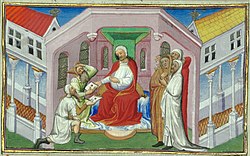
Toghrul (Mongolian: Тоорил хан Tooril han; Chinese: 脫里), also known as Wang Khan or Ong Khan (Ван хан Wan han; Chinese: 王汗; pinyin: Wáng Hán; died 1203), was a khan of the Keraites. He was the blood brother (anda) of the Mongol chief Yesugei and served as an important early patron and ally to Yesugei's son Temüjin, later known as Genghis Khan. The main source on his life is the Secret History of the Mongols.

Key Information

Name

[edit]

"Wang Khan" was the name given to Toghrul by the Jurchen-led Jin dynasty of China; Wang means king or prince. During the 13th century, Toghrul was one of several Asian leaders who was identified with the legend of Prester John,[2] but also King David, a brother to John.[3] Although the Keraites converted to Nestorianism, a sect of Christianity, early in the 11th century[4] there is no credible proof that Toghrul was himself Christian[5] as Mongolian sources say nothing about his religion.[6]

Early life

[edit]

He was born around 1130, to Nestorian family of Keraites. His father was Cyriacus Buyruk Khan, the leader of Keraites.[7] Toghrul had a very difficult youth. The Merkits captured him during his childhood and he was reduced to slavery. It is possible that he left the Merkit after being freed by a ransom or simply escaped. However, according to the Secret History, he was again abducted at the age of thirteen by the Tatars, who also took his own mother. When Toghrul returned to the Keraites later, his father was near death. Toghrul took his place and commanded the Keraites around 1165.

Reign

[edit]

In order to eliminate potential rivals, he started by killing his brothers between 1165 and 1171.[7] One of them, namely Erke Qara managed to escape and fled to the Naimans, who were a neighboring tribe to the west of the Keraites. The two other brothers, Buqa-Timur and Tai-Timur Taïshi were executed. However, Toghrul's success was brief because his uncle only known with the title Gurkhan overthrew him.[8] Toghrul fled with his daughter and a handful of faithful. He tried to get the help of the Merkits to overthrow Gurkhan in turn, but their leader, Toqto'a Beki, refused despite the fact that Toghrul offered him his daughter because the Keraites were very numerous. Being unsuccessful, Toghrul went to see the father of Temüjin, Yesugei. He chose to help Toghrul because he had previously fought a battle with the Keraites against the Tatars. The Keraites were surprised when Yesugei attacked without having time to prepare. Despite the fact that the Keraites were much more numerous, their forces were dispersed throughout Central Mongolia. Toghrul resumed the command of the Keraites, and Gurkhan fled.

Relationship with Temüjin

[edit]

Toghrul was, like Jamukha, blood-brother of Temüjin. He led the coalition against Merkits when Temüjin's wife Börte was abducted in 1183,[9] joined by his brother Jakha Gambhu, Jamukha and Temüjin. Two of the tribal chiefs, Dair Usun and Toqto'a fled the camp, probably informed by people who had seen the army move. The coalition easily won the fight that followed and about 300 Merkit perished. The chiefs distributed the booty among themselves and gave the Merkit wives to the warriors. The children became slaves. Börte was found later in the evening. Toghrul returned to the Kerait camp with his men, proud of an easy victory.

Temüjin, intending to attack the Tatar Confederation who had long caused him problems, including the murder of his father, asked for help from Toghrul in 1194; he willingly accepted, still satisfied with the victory he had had before. Toghrul's grandfather Marcus Buyruk Khan had also been assassinated by the Tatar, which gave him a similar reason to fight them. He joined Temüjin with a few thousand Keraites. The Jurkhin, a Mongolic tribe, were also invited, but declined the offer because they were somewhat hostile with the Borjigin tribe. They eventually found allies in Wanyan Xiang (完顏襄), minister of Emperor Zhangzong of the Jurchen-led Jin dynasty of China. The Tatars were considered by the Jurchens to be harmful and the opportunity was perfect to exterminate them. When the combined forces of Toghrul and Genghis Khan attacked the Tatars, they were caught in a vice as the Jurchen warriors behind them easily encircled the enemy tribe. The men were slaughtered, the women were taken as concubines and the children were adopted or became servants and slaves. Some thousands of Tatar who had resisted and then escaped entrenched themselves. This was the time when he was given the name Wang Khan (Chinese: 王汗; lit. 'King Khan').

Later that year he was overthrown by Erke Qara, whom he had not been able to assassinate and returned with the Naiman army. Many Keraites who were dissatisfied with the command of Toghrul probably also helped to drive Toghrul out. He fled to Yelü Zhilugu[10] without even going to seek the help of Temüjin. He stayed there a year according to the Secret History. It was after leaving the Qara-Khitai that he finally decided to join Genghis Khan. According to Rashid al-Din, he would have reached Genghis Khan's encampment by 1196. Toghrul became his guest for about two years.[11]

Second reign

[edit]

Living in exile, Toghrul was aided by Temüjin, who undertook an attack to the Merkits for a second time and gave a large part of the booty to Toghrul, who gifted it to different Kerait chiefs to consolidate allies with his tribe of origin. Temüjin then allegedly attacked a Kerait clan, the Tumen Tubegen, and a large part of the survivors became Toghrul's followers. The Keraites returned fully to Toghrul around 1198. The Naimans remained neutral and offered no help to Erke Qara because the Naiman people were then divided between two kings. Buyruq khan took the southern part and Tayang khan inherited the northern part of the Naiman lands. Erke Qara fled for the second time, this time to Buyruq khan. To reward the Keraites who had remained faithful to him, Toghrul ordered them to plunder the weakened Merkits for the third time. Important Merkits, including two sons of Toqto'a-beki, were captured while another was murdered. Meanwhile, Toghrul's brother, Jakha Gambhu became blood brothers with Temüjin.

Relationship with Naimans

[edit]

Around 1199, Toghrul wanted to finish once and for all with the Naimans and the dispute between the two kings of this tribe was a useful chance to attack. If he attacked one of the brothers, it was almost certain that the other would do nothing and he could destroy them one after the other without having to confront the two tribes together, which could have formed a formidable alliance. He succeeded in bringing together Temüjin and Jamukha, chief of the tribe of the Jadaran, and forced them to become allies again, for they had hitherto become enemies. They did so, but with a distrust of one another. When the forces of coalition came together to fight Buyruq's army, they quickly realized that the Naiman lands were conducive to a long pursuit. Indeed, Toghrul had a hard time chasing his enemies because they had plenty of ground to escape. After a hike of a few hundred kilometers, Toghrul realized that he could never catch them and came back. Buyruq's general Kökse Sabraq attacked Toghrul, who moved away from Temüjin, defeated Toghrul's son Senggüm, capturing his son and wife in process. However they were beaten back thanks to aid from Temüjin.

In 1200, Toghrul aided Temüjin, who was attacked by an alliance formed by the Taichiud, commanded by Targhutai Kiriltuk, an old enemy of Temüjin, and Merkit led by Toqto'a Beki, who had recently recovered his son on the banks of the Onon River.

Relationship with Jamukha

[edit]

In 1201, Jamukha had resumed hostilities against Temüjin. An impressive coalition of Mongol tribes of Taichiud, Ikires, Qorolas, Salji'ut, Dörbet, Suldus, Qatagin, Besud, Merkit, Oirat and finally Tatars recognized Jamukha as "Khan Universal" (Gurkhan). Toghrul decided to back Temüjin in order to oppose growing power of Jamukha. Toghrul, Jakha Gambu and Temüjin went into the Kerulen Valley with 15000 men. When they saw the enemy, they climbed the mountains because they were shorthanded against the enemy. It was also when Buyruq khan joined Jamukha. Toghrul and Temüjin fought a defensive battle which was very difficult and perilous. Torrential rain made the rolling hills and mountains men fell from the top to finish in crevices and ravines. After the enemy had withdrawn his forces, Toghrul left to return to Tula river with his warriors. Temüjin took advantage of the flight of his enemies to finish several on horseback. Targhutai was reportedly wounded to death as a result of the fight.

Jamukha had fared badly during the first attack and Buyruq khan took command of the armies in 1202. Temüjin took the initiative to make a massacre among the Tatar, which dramatically reduced their numbers. Genghis and Toghrul returned to the mountains, but this time in the southern portion and faced the newly-commanding Kuchuguden's men, among them were Merkit, South Naiman, Oirats and tribes following Jamukha. Six tribes had left Jamukha and there were only four. Again, steep slopes, trees and various natural obstacles greatly slowed down the enemies of Toghrul and Temüjin and the fight gradually grew favorable.

Death

[edit]

Toghrul was more than 70 years old by 1203 and did not have the same reflexes as in his youth. His son Ilga Senggüm took command of the Kerait armies and Toghrul became a figurehead. Ambitious Ilga joined forces with Jamukha, Altan and Qutchar, who persuaded him to eliminate Temüjin . Ilga attempted to assassinate him, failed, and then confronted the hordes of Temüjin in a fierce battle in which he was wounded. Toghrul was present and assumed command, but he was more or less unable to fight himself given his advanced age and withdrew his men from the fight. Some of Keraites joined the forces with Temüjin during and after the battle. After this battle, the Battle of the Burning Sands, Temüjin received the help of the Qonggirats who had confronted him during the first battle of Kerulen and then fled to Jamukha. Toghrul and Ilga, however, were still more numerous. Temüjin sent ambassadors to demand peace, as he wished to renew his friendship with Toghrul. Ilga, now choosing for his father, rejected the request. Other tribes joined Temüjin during that year. He was then in possession of eleven tribes, which formed a third of the whole population of Mongolia. As the enemy increased in number, Jamukha, Qutchar and Altan conspired against Toghrul, but eventually left the Kerait to take refuge with the Naimans of the North. The Tayitchi'ut, Dorbed, Qatagin and Salji'ut followed them.

He died after Temüjin attacked the Keraites by surprise. 8,000 Mongol horsemen faced Keraites for three days but eventually Kerait surrendered. Toghrul fled to Tayang Khan but was killed by a Naiman soldier named Qori Sübeči who did not recognize him. The majority of the Keraites allied themselves with Temüjin. Toghrul's head was later noticed by Tayang, who was panicked and then stepped on it, crushing it.[12]

Family

[edit]

He was married to a Khitan woman and had at least two sons – Ilga Senggüm and Uyku. According to Jami' al-Tawarikh, Doquz Khatun was a daughter of Uyku.[13]

Legacy

[edit]

Starting from 15th century, Torghut nobles claimed descent from Toghrul.

References

[edit]
Revisions and contributorsEdit on WikipediaRead on Wikipedia
from Grokipedia
Toghrul (c. 1130–1203), also known as Ong Khan or Wang Khan, was the khan of the , a powerful Turco-Mongol tribal confederation in 12th-century . He ascended to leadership in the 1160s after defeating rival claimant Tai Temur Taichi, consolidating control over the who were noted for their Nestorian Christian faith and semi-nomadic lifestyle across the Mongolian . As the anda (sworn ) of Yesügei, father of Temüjin (later ), Toghrul provided crucial early patronage and to the young Mongol leader, aiding campaigns against the Merkits in 1179, in 1198, and in 1203. In 1196, the Jin dynasty granted him the honorific title "Wang Khan" in recognition of his support against common foes, elevating his status among rulers. Their , however, eroded amid disputes over proposals and influence, with Toghrul's son Senggüm reportedly plotting against Temüjin, leading to open conflict. Toghrul's defining downfall came in 1203 when Temüjin's forces decisively defeated the Keraites at the Battle of Khalakhaljid Sands, scattering their army and absorbing remnants into the emerging Mongol empire. Fleeing westward, Toghrul sought refuge among the Naimans but was killed by their border guards who failed to recognize him, marking the end of Keraites independence and underscoring the ruthless consolidation of power under Genghis Khan. This event highlighted Toghrul's role as both a mentor whose early support enabled Mongol unification and a cautionary figure whose miscalculations precipitated his tribe's subjugation.

Background

Name and Titles

Toghrul, a Turkic name deriving from "toğrul," denoting a falcon or bird of prey in , served as the personal identifier for the Keraites ruler amid the diverse linguistic milieu of the Central Asian s. This etymology underscores the martial connotations associated with , where names evoking predatory birds symbolized prowess and dominion. The title Wang Khan, conferred by the Jurchen Jin dynasty in 1196, marked Toghrul's recognition as a paramount leader, with "Wang" translating to "king" or "prince" in Chinese, thus rendering the epithet as "King Khan." This honorific, often rendered as "Khan of Khans" in interpretive translations, functioned diplomatically to affirm his authority without imposing substantive subordination, thereby augmenting his stature in intertribal negotiations and frontier relations. In indigenous Mongolian nomenclature, he bore Ong Khan, a variant integrating steppe vernacular for "folk" or "multitude" with "khan," connoting oversight of a broad confederation. Primary sources like the Secret History of the Mongols consistently pair his given name with the Wang Khan title, as "Toghrul Wang Khan," highlighting the fusion of personal and bestowed honors in historical recollection.

Keraites Khanate Context

The Keraites formed one of the five major Turco-Mongol tribal confederations, or khanates, that vied for dominance in the of during the , encompassing territories along the modern frontiers of western , northern , and southern . This area, including valleys between the Orkhon and Cherlen rivers east of the Naiman territories, provided fertile lands suited to their nomadism, where tribes sustained themselves through sheep, , and especially essential for mobility and mounted warfare. Their society emphasized equestrian skills and tribal alliances, reflecting the broader dynamics of steppe confederations that balanced internal kinship ties with expansionist raids. Emerging prominently from the 10th to 11th centuries as a nomadic group in , the traced their early expansions to conquests under leaders who subdued neighboring tribes, establishing a power base amid the fragmented polities of the Zubu confederacy that controlled much of . By the mid-12th century, under khans like Markus Buyruk, they had consolidated influence in central , incorporating diverse Mongol and Turkic elements while maintaining a distinct identity marked by Nestorian Christian practices adopted around 1007–1008 through missionary contacts. Their economic foundation in and not only fueled military campaigns but also positioned them along key trade corridors linking the to sedentary empires. Strategically, the khanate acted as a western bulwark in the 12th-century steppe geopolitics, buffering against eastern threats from tribes allied initially with the Jurchen Jin dynasty and serving as a counterweight to southern incursions from the Jin, whose shifting patronage—from Tatars to after 1161—underscored their pivotal role in regional balances of power. Toghrul assumed of a khanate around the 1170s–1180s that, despite nominal unity, harbored fractious clans stemming from prior successions and rivalries, such as those following Markus Buyruk's rule. This internal volatility, common to steppe confederations reliant on charismatic khans and anda (blood-brother) pacts, highlighted the Keraites' precarious yet formidable position amid the era's tribal flux.

Early Life and Rise

Origins and Family

Toghrul was born circa 1130 in the territory of the , a nomadic inhabiting the region between the Orkhon and rivers in central . The , speakers of a Turkic-Mongolic and adherents of Nestorian since the , formed a powerful tribal entity under dynastic khans. His father, Buyruk Khan (baptismally Cyriacus), held the title of khan and commanded the tribe's military and political structure, providing Toghrul with hereditary legitimacy for future leadership. Toghrul's early years occurred amid the volatile steppe environment, where nomadic elites trained from youth in equestrian skills, archery, and survival tactics essential for tribal raids and defense. The Secret History of the Mongols, compiled around 1240 for the Mongol court and thus potentially biased toward glorifying Genghis Khan's allies-turned-rivals, offers scant details on his personal upbringing but describes the Keraite society's emphasis on anda (sworn brotherhood) pacts and intertribal conflicts that shaped leadership emergence. Following Buyruk Khan's death—likely from internal rivalries or assassination, as inferred from patterns in Keraite succession—Toghrul faced exile and hardship, fostering resilience through alliances with neighboring tribes like the Naimans before reclaiming authority. No records indicate formal education; instead, practical immersion in pastoralism and warfare formed his foundational influences. Familial dynamics included siblings such as Yula-Mangus and Tai-Timur, who shared in the clan's noble status, though sources vary on their roles. The scarcity of contemporary written records, relying heavily on later Mongol chronicles, underscores the oral tradition's dominance in pre-conquest , with potential distortions from victor-centric narratives.

Ascension to Power

Toghrul assumed leadership of the in the late , navigating a succession complicated by his father's division of authority among his sons, which sparked rivalries with his brothers. He overcame these internal challenges through persistent military engagements, gradually unifying the clan's fractious sub-tribes under centralized rule by the 1180s. A pivotal diplomatic achievement came in 1196, when the Jurchen Jin dynasty bestowed upon him the title Wang Khan—meaning "king khan"—as documented in the official Jinshi history, lending external legitimacy to his authority and bolstering his position among neighboring nomadic groups. This consolidation of power enabled Toghrul to assert dominance over extensive pastoral territories in the Mongolian steppe, establishing tribute mechanisms from vassal tribes and laying the groundwork for Keraites expansion without initial dependence on external Mongol support.

Primary Reign and Alliances

Ties to Yesugei

Toghrul, ruler of the Keraites, and Yesugei, chief of the Borjigin clan, formalized their alliance through an anda pact, a ritualized blood brotherhood typical of steppe nomadic societies that pledged mutual aid in warfare and defense. This bond, likely established during their early adulthood amid the fragmented tribal landscape of 12th-century Mongolia, positioned the Keraites' superior military and numerical strength—estimated at tens of thousands of households—as a bulwark for the smaller Borjigin group against existential threats. Early interactions between the two leaders centered on coordinated efforts against common adversaries, particularly the , who posed a persistent danger through raids and dominance in eastern Mongol territories. Yesugei conducted successful campaigns capturing Tatar leaders, such as Temujin Uge, which aligned with Toghrul's interests in curbing Tatar expansion to safeguard Keraite grazing lands and trade routes; Toghrul's seniority, owing to his earlier ascension around the 1170s and the ' established khanate, cast him as the guiding partner in these pragmatic ventures, emphasizing resource sharing over ritualistic loyalty. The 's endurance stemmed from shared geopolitical pressures rather than interpersonal sentiment, enabling defensive pooling of herds, warriors, and intelligence in a region where isolation invited subjugation. Following Yesugei's death circa 1171 from poisoning after a Tatar feast, the pact's framework persisted as a , underscoring its utility in stabilizing Borjigin-Keraite ties amid ongoing rivalries.

Joint Campaigns

In circa 1196, Toghrul and Temüjin collaborated in a military campaign against the as auxiliaries to the Jin dynasty's forces, which sought to suppress Tatar rebellions on the . This effort marked a significant assertion of Kerait and Mongol influence, leveraging the alliance to combat a common enemy historically allied with the Jin but now in revolt. The participation avenged lingering grievances, including the poisoning of Temüjin's father by Tatar agents around 1171, through the subjugation of Tatar clans. The campaign employed characteristic steppe tactics, including highly mobile charges and feigned retreats to draw enemies into ambushes, though primary accounts like the Secret History of the Mongols provide limited granular details on specific engagements. Allied forces under Toghrul and Temüjin contributed to decisive defeats of Tatar contingents, disrupting their control over eastern Mongolian territories and enabling the extraction of tribute and captives, which bolstered Kerait herds and manpower. No precise casualty figures are recorded in surviving chronicles, but the victories fragmented Tatar resistance, preventing coordinated threats for several years. These successes elevated Toghrul's prestige as a key anti-Tatar leader, culminating in the Jin bestowal of the title "Wang Khan" (King Khan) upon him in recognition of his role, solidifying Kerait authority amid shifting power dynamics. The collaboration expanded Toghrul's territorial sway indirectly through weakened rivals, fostering temporary stability and resource gains such as livestock and slaves from defeated foes, as inferred from patterns in contemporaneous nomadic warfare.

Patronage of Temüjin

Following the death of around 1171, Temüjin's family faced abandonment by allied tribes and internal strife, prompting the young leader to seek refuge among the under Toghrul's rule in the late 1170s or early 1180s. Toghrul, honoring his prior bond with , provided shelter and initial military assistance to help Temüjin regroup his followers and stabilize his position amid threats from rival Mongol factions. A pivotal instance of Toghrul's patronage occurred around 1184 when Temüjin's wife Börte was abducted by the Merkits in retaliation for earlier Mongol raids. Temüjin appealed directly to Toghrul for aid, who agreed to mobilize forces alongside Temüjin's ally Jamukha, assembling a coalition that successfully raided Merkit territory and rescued Börte after several months in captivity. This joint operation, detailed in The Secret History of the Mongols, not only restored Temüjin's household but also demonstrated Toghrul's commitment to bolstering a promising subordinate against common steppe adversaries like the Merkits. Toghrul further endorsed Temüjin's emerging authority by recognizing his leadership claims during early qurultais in the 1180s and 1190s, where Temüjin consolidated power over his clan and began attracting followers. This support served Toghrul's interests by creating a reliable Mongol buffer against eastern threats such as the and , fostering mutual exchanges of intelligence, troops, and raiding opportunities in the competitive nomadic landscape.

Conflicts and Shifting Alliances

Influence of Rivals

, Temüjin's erstwhile anda (sworn brother) and chief rival among the , exerted pressure on Toghrul by framing Temüjin as a burgeoning threat to Kerait supremacy, leveraging their shared opposition to further erode the longstanding alliance. Following his defeat at the Battle of Dalan Baljut in 1201, sought coalitions against Temüjin, eventually drawing Toghrul into alignment around 1203 through promises of mutual gain, including the potential subjugation of Mongol tribes under joint authority. These overtures capitalized on steppe-wide anxieties over Temüjin's consolidation of power, as his victories against tribes like the Merkits and signaled a shift from fragmented nomadic feuds to centralized dominance, alarming traditional khans who viewed him as an upstart challenging entrenched hierarchies. Toghrul's receptivity stemmed partly from overconfidence rooted in his prior triumphs, such as restoring his rule with Yesügei's aid in the 1170s and joint campaigns that had elevated his status, blinding him to the risks of alienating a now-formidable protégé. The Secret History of the Mongols portrays this realignment as a perfidious act fueled by ambition and envy, with rivals exploiting Toghrul's vulnerabilities to incite preemptive action against perceived betrayal. Composed in the Mongol court under Temüjin's successors, the text prioritizes narrative legitimacy for the conquerors, potentially amplifying Toghrul's culpability while downplaying his strategic rationale. Some analyses interpret the episode instead as a rational defensive maneuver by an aging ruler safeguarding his realm against a disruptive force intent on transcending vassalage.

Relations with Naimans and Jamukha

In 1199, Toghrul, in alliance with Temüjin, launched a campaign against the to exploit their internal divisions following the death of Khan Inanch and the succession dispute between his sons Buyiruk and Tayang. This joint effort resulted in the defeat of Naiman forces, weakening their position in western . By 1203, after his forces were routed by Temüjin amid escalating tensions, Toghrul fled westward with his son Senggum toward Naiman territory under Tayang Khan, seeking asylum. Disguised as common herders to evade pursuit, Toghrul was nonetheless identified and slain by a Naiman named Qori Sübeči near the , who failed to recognize his true identity; Senggum met a similar fate shortly thereafter. This incident underscored the precarious nature of Toghrul's bid for refuge among former adversaries, as Tayang had initially extended tentative welcome but Naiman guards acted decisively against the intruders. Toghrul's interactions with evolved from early cooperation to a fraught anti-Temüjin partnership. Initially, around the 1180s–1190s, the two supported Temüjin's campaigns against shared foes like the Merkits, contributing warriors to rescue Temüjin's wife . However, as Temüjin's influence expanded, Toghrul—resenting perceived slights over marriage proposals and patronage—aligned with , his fellow traditionalist aristocrat, in 1203 to challenge Temüjin's dominance. Their coalition, bolstered by tribes like the Tayichiud and , clashed with Temüjin's forces but fractured due to leadership disputes between Toghrul and over command and spoils, compounded by defections to Temüjin; escaped, while Toghrul's position collapsed.

Breakdown with Temüjin

The alliance between Toghrul and Temüjin deteriorated primarily due to a refused marriage proposal intended to solidify ties. Temüjin proposed marrying his eldest son to Toghrul's daughter, a customary means of forging bonds among steppe leaders, but Toghrul declined, advised by his son Senggum who viewed the union as a ploy by Temüjin to seize control of the Kerait confederation. Senggum's jealousy stemmed from Temüjin's increasing influence and close rapport with Toghrul, leading him to advocate against the alliance and even plot Temüjin's , though these schemes were thwarted. External pressures exacerbated the rift, as , Temüjin's former anda and rival, along with Naiman envoys, lobbied Toghrul by depicting Temüjin as ungrateful and ambitious, intent on subverting Kerait authority rather than remaining a loyal subordinate. These portrayals aligned with Toghrul's of Temüjin as a junior partner whose growing successes threatened the established hierarchy. By circa 1203, tensions escalated into open hostility when Toghrul authorized raids on tribes allied with Temüjin, signaling a declaration of war and an insistence on reasserting dominance over the . Toghrul's miscalculation lay in underestimating the cohesion Temüjin had achieved among disparate Mongol groups through merit-based loyalty and shared campaigns, mistaking Temüjin's deference for perpetual amid evolving power dynamics. This breakdown reflected fundamental asymmetries in expectations: Toghrul anticipated continued of a dependent, while Temüjin pursued parity through proven valor and strategic autonomy.

Fall, Death, and Aftermath

Final Campaigns and Defeat

In 1203, Toghrul, having allied with the ruler Tayang Khan, mobilized a coalition force comprising and to confront Temüjin's expanding . This aimed to preempt Temüjin's perceived threat, launching preemptive strikes that initially overwhelmed Mongol positions, including a notable setback for Temüjin at Qalaqaljid Sands, compelling his forces into a strategic withdrawal toward the Baljuna River region. Logistical strains plagued the coalition, as their extended supply lines across the proved vulnerable to disruption, while overconfidence following early gains led to dispersed formations. Temüjin capitalized on the retreat by rallying his core followers through oaths of mutual , restoring cohesion amid adversity, before counterattacking with hallmark Mongol maneuvers. Employing feigned retreats, his units simulated disorderly flight to draw pursuers into ambushes, followed by rapid encirclements that exploited the enemy's fragmented pursuit. These tactics, rooted in high mobility and coordinated volleys, fragmented the coalition's lines, turning initial Mongol vulnerabilities into decisive advantages. Compounding these tactical errors, internal divisions eroded Keraite resolve; widespread , fueled by Toghrul's faltering and reports of Temüjin's clemency offers, prompted mass defections mid-campaign, including key clans shifting . Mongol superiority in —manifest in strict and merit-based command—contrasted sharply with the coalition's reliance on tribal loyalties prone to fracture under pressure. The resultant near the vicinity shattered Toghrul's army, scattering remnants and culminating in the collapse of his military power.

Execution and Immediate Consequences

![Depiction of Toghrul (Wang Khan)][float-right] In 1203, following a decisive defeat by Temüjin's forces during the campaign against the , Toghrul fled westward seeking refuge with the , traditional allies. Unrecognized by Naiman sentinels amid the chaos of his disguise and flight, he was slain by their arrows before reaching safety under Tayang Khan. This inadvertent killing, rather than direct execution, ended Toghrul's resistance, as primary accounts like The Secret History of the Mongols describe his desperate escape and fatal misidentification. The immediate aftermath saw the rapid collapse of organized Kereit opposition, with surviving warriors and clans submitting tribute or integrating into Temüjin's burgeoning Mongol confederation. Kereit remnants, lacking centralized leadership post-Toghrul, offered minimal sustained resistance, underscoring the fragility of authority tied to individual khans rather than institutional structures. This absorption bolstered Temüjin's military capacity, incorporating skilled Kereit horsemen and resources essential for subsequent conquests. By late 1203, the Kereit heartlands were under Mongol control, marking a pivotal consolidation of power.

Family and Succession

Key Relatives

Toghrul's principal son was Senggüm, who played a role in intra-alliance tensions and was betrothed to Fujin Beki, a daughter of Temüjin. Another son, Abaqu, fathered , a Nestorian Christian who later became a prominent figure in the Mongol court through her marriage to Hulagu Khan. Toghrul also had at least one daughter offered for a marriage alliance with Temüjin's eldest son , reflecting steppe customs of using familial ties for political consolidation, though the betrothal ultimately collapsed. Toghrul's younger brother, Jagambo (also rendered Jakha Gambhu), produced three daughters who integrated deeply into Temüjin's lineage: Bekutemish wed , Siurkukteni () wed , and Abika wed Temüjin himself. In his ascent, Toghrul overcame rivals among his brothers to claim the Keraite leadership, aided by , and earlier deposed his uncle Gur-Khan to solidify authority. These kin networks underscored the Keraite clan's extensive marital interconnections across tribes, per accounts in the Secret History of the Mongols and contemporary chronicles.

Successors and Clan Fate

Following Toghrul's execution by Naiman forces in 1203 after his defeat by Genghis Khan's armies, the faced a profound leadership vacuum, as no capable heir or nephew consolidated power to resist Mongol subjugation. Potential successors among Toghrul's kin were either eliminated during the campaigns or compelled to submit, preventing any organized revival of Keraite . The bulk of the Keraite population and nobility integrated into Genghis Khan's nascent empire, with warriors dispersed into the niru'un—the decimal military units of arban (10s), jaghun (100s), (1,000s), and tümen (10,000s)—to dilute tribal loyalties and enhance Mongol cohesion. This incorporation extended to administrative roles, as select leveraged prior alliances to gain favor, though resistance pockets, such as a reported revolt in , were swiftly crushed. This shift occurred through missionary activities involving Uighur Christian elites, who had adopted the faith earlier via Syriac clergy along Central Asian trade networks, and direct outreach by East Syrian (Nestorian) priests seeking alliances with nomadic groups. The adoption was confined largely to the , driven by instrumental benefits such as enhanced diplomatic ties and commercial access across Eurasian routes controlled by Christian merchants and polities, rather than widespread doctrinal conviction among the populace. Toghrul (c. 1130–1203 CE), who ruled the Keraites as Ong Khan from roughly 1170 onward, exhibited only nominal association with Nestorianism, with contemporary accounts like the Secret History of the Mongols portraying him invoking traditional Tengrist (shamanistic) rituals and omens in decision-making, indicating Christianity's secondary role to indigenous beliefs. No primary sources depict Toghrul as devoutly pious or engaging in personal religious observances aligned with Nestorian liturgy, suggesting his tolerance stemmed from pragmatic governance over tribal elites who had converted a century prior, without extending to coercive endorsement or personal immersion. Archaeological corroboration for Nestorian presence among the includes regional finds such as kayraks (gravestones) inscribed with Syriac script, Nestorian crosses, and phrases from sites in the Altai and Orkhon valleys, dating to the 10th–12th centuries and reflecting elite burial practices blending Christian symbols with steppe motifs. Artifacts like cross-embossed metalwork and stone stelae from Keraites-associated territories further attest to superficial integration, but lack indicators of institutionalized churches or mass conversion artifacts under Toghrul's era. Notably, no epigraphic or textual evidence records proselytizing initiatives or missionary expansions led by Toghrul, underscoring the faith's stasis as a cultural accessory rather than a dynamic force during his reign. The legend of , a purported Christian priest-king ruling a vast Eastern realm with immense wealth and military might poised to aid against , emerged in mid-12th-century through forged letters circulating from around 1145, initially addressed to Byzantine Manuel I Comnenus and later to Western rulers. These documents described as descending from the Three , commanding 72 tributary kings, and possessing marvels like a mirror revealing distant plots, fueling Crusader-era hopes for an Eastern ally amid setbacks in the . The ' adoption of Nestorian around 1000 CE, via missionaries from the , provided a plausible kernel for such tales, as rumors of Christian nomads in reached via traders and papal envoys, though no contemporary accounts tied the myth directly to specific Keraite leaders. By the late 13th century, European chroniclers retrospectively associated Prester John with Toghrul, the Ong Khan of the Keraites, whose dominance over steppe confederations from the 1170s to 1203 and nominal Nestorian affiliation aligned superficially with the legend's motifs of a powerful Christian monarch. Marco Polo, in his Travels composed around 1298, explicitly identified "Prester John" as the title bestowed by Nestorian clergy on Toghrul, portraying him as a formidable ruler whose defeat by Temüjin in 1203 echoed mythic narratives of familial betrayal, such as a son slaying his father. This linkage gained traction in Western historiography, with some accounts conflating Toghrul's Jin-bestowed title "Wang Khan" (rendered as "Ung" or "Ong") phonetically with "John," amplifying the identification amid reports of Mongol-era Christian communities. However, this connection lacks empirical substantiation and reflects anachronistic European projections rather than historical reality, as the letters predated Toghrul's rise by decades and described an ahistorical utopia incompatible with . No records indicate direct contact between Toghrul's realm and European courts, and his alliances—pragmatic pacts with Temüjin against rivals like the —prioritized territorial consolidation over theological solidarity with distant Latin , underscoring that Central Asian rulers navigated power vacuums through kinship and warfare, not messianic . The myth's inflation served Western morale during the but distorted Toghrul's documented role as a tribal khan vulnerable to , with his 1203 execution by Temüjin's forces contradicting the invincible sovereign . Scholarly consensus views the association as a composite, blending vague Nestorian reports with aspirational fiction, devoid of causal evidence for Toghrul embodying the priest-king.

Legacy and Assessment

Role in Mongol Unification

Toghrul, as ruler of the , provided crucial early patronage to Temüjin following the death of Temüjin's father Yesügei, with whom Toghrul shared a bond of anda (blood brotherhood), enabling Temüjin's survival and initial consolidation of power among Mongol tribes. This alliance offered Temüjin military support and legitimacy, stabilizing his position against immediate threats like the Merkits, whom they jointly defeated in campaigns during the late 12th century. In the early 1200s, Toghrul and Temüjin collaborated on expeditions against the , exploiting clan feuds to launch rear attacks that contributed to their subjugation around 1202, after which the Jin dynasty rewarded Toghrul with the title Wang Khan. These joint efforts helped Temüjin expand his influence eastward, incorporating defeated foes and fostering precedents for integrated tribal forces that later informed the Mongol decimal military organization based on units of 10, 100, 1,000, and 10,000. By 1203, tensions escalated due to Toghrul's son Senggum's envy of Temüjin's rising dominance, leading Toghrul to ally with Temüjin's rival against him, rupturing their longstanding partnership. Temüjin decisively defeated the that year, scattering their forces and forcing Toghrul to flee, an event that eliminated a major confederation in the eastern steppes and accelerated Mongol centralization by absorbing Keraite manpower—estimated in the tens of thousands—into Temüjin's unified structure. While Toghrul's initial alliances delayed fragmentation among eastern nomads and enabled Temüjin's buildup, his eventual resistance postponed full unification but ultimately hastened it, as the Keraite defeat by 1203 paved the way for Temüjin's proclamation as in 1206, marking the coalescence of Mongol tribes under centralized authority.

Achievements and Criticisms

Toghrul consolidated and expanded territory across central during his rule from the 1160s to 1203, leveraging control over fertile pastures and trade routes to amass wealth and followers capable of fielding 20,000 warriors, as demonstrated in his 1179 campaign aiding Temüjin against the Merkits. His military acumen shone in joint victories, including the defeat of the Alakai Bulak in 1201 alongside Temüjin and conquests of eastern Mongol tribes after 1199, which bolstered Keraite dominance in the steppes. Diplomatically, Toghrul fostered key alliances, such as the 1179 Triple Alliance with Temüjin and To'oril of the Tayichi'ud, and supported Temüjin's elevation to khan in 1189, promoting temporary confederative stability amid tribal rivalries. Critics, drawing from Mongol chronicles like the Secret History of the Mongols, fault Toghrul for ruthless power grabs, such as assassinating rival Tai Temür to seize the throne in the 1160s, and for overreliance on traditional kinship ties that blinded him to emerging threats. His breakdown of the anda oath with Temüjin—marked by suspicions incited by his wife and son, leading to aborted ambushes and open war in 1203—exemplifies alliance mismanagement, resulting in Keraite defeat and absorption into the Mongol polity. These sources, composed from Genghis Khan's victorious perspective, depict Toghrul as arrogant and ungrateful, yet a realist interpretation posits his actions as pragmatic defense against a subordinate's ascendancy, prioritizing clan survival over outdated pacts in fluid steppe power dynamics.

Depictions in Historical Sources

The Secret History of the Mongols, compiled around 1240 for the Mongol imperial court, serves as the core primary source for Toghrul's biography, chronicling his role as an early patron to Temüjin (later Genghis Khan) through anda ties inherited from Yesügei, joint campaigns against the Merkits and Tatars in the 1180s–1190s, and eventual rupture marked by Toghrul's alleged schemes to betray Temüjin via deceptive marital overtures and alignment with Jamukha, culminating in the Keraite rout at the Battle of Khalakhaljid Sands in 1203 and Toghrul's flight and death soon after. This account, while invaluable for sequencing steppe events and internal dynamics like the jealousy of Toghrul's son Senggüm, exhibits clear propagandistic bias as a post-unification narrative designed to exalt Temüjin's destiny and delegitimize defeated rivals, often employing hyperbolic language to frame Toghrul's ambitions as envious perfidy rather than standard nomadic realpolitik. Persian chronicles, such as Rashid al-Din's Jāmiʿ al-tavārīkh (completed circa 1307–1316 under Ilkhanid auspices), draw on Mongol oral traditions and official records to depict Toghrul more dispassionately as a key figure in pre-imperial alliances, noting his aid to Temüjin against shared foes and the strategic conferral of the "Wang Khan" title by the Jin dynasty around 1196 in exchange for anti-Tatar military support, which facilitated cross-verification of campaign timelines absent in purely Mongol texts. These sources, though filtered through Persianate historiography favoring the broader Mongol imperial arc, emphasize Toghrul's Jurchen-oriented diplomacy over personal betrayals, offering a less vilified lens that highlights pragmatic frontier pacts rather than moral failing. Similarly, Jin dynasty annals record Toghrul's ennoblement and collaborative raids, prioritizing his utility as a buffer against northern threats like the Tatars without delving into intra-Mongol feuds, thus enabling corroboration of dates like the 1196 Tatar subjugation. Modern critiques the 's episodic dramatization as skewed toward hagiographic ends, advocating with Persian and Chinese materials to reconstruct Toghrul as a adept but ultimately outmaneuvered khan whose decisions reflected preservation amid volatile power shifts, rather than archetypal treachery. Scholars further caution against overreliance on any single corpus, noting how the 's anonymity and courtly origins introduce retrospective justifications, while Persian accounts, despite their own Ilkhanid slant, provide essential counterbalance for assessing alliance credibilities and chronological anchors. This epistemic approach underscores the need to discount unsubstantiated embellishments, such as inflated portrayals of Toghrul's initial dominance, in favor of convergent evidence from multiple archival traditions.

References

Add your contribution
Related Hubs
User Avatar
No comments yet.