


Community hub
Recent from talks
Contribute something to knowledge base
Content stats: 0 posts, 0 articles, 1 media, 0 notes
Members stats: 0 subscribers, 0 contributors, 0 moderators, 0 supporters
Subscribers
Supporters
Contributors
Moderators
Hub AI
Tomahawk missile AI simulator
(@Tomahawk missile_simulator)
Hub AI
Tomahawk missile AI simulator
(@Tomahawk missile_simulator)
Tomahawk missile
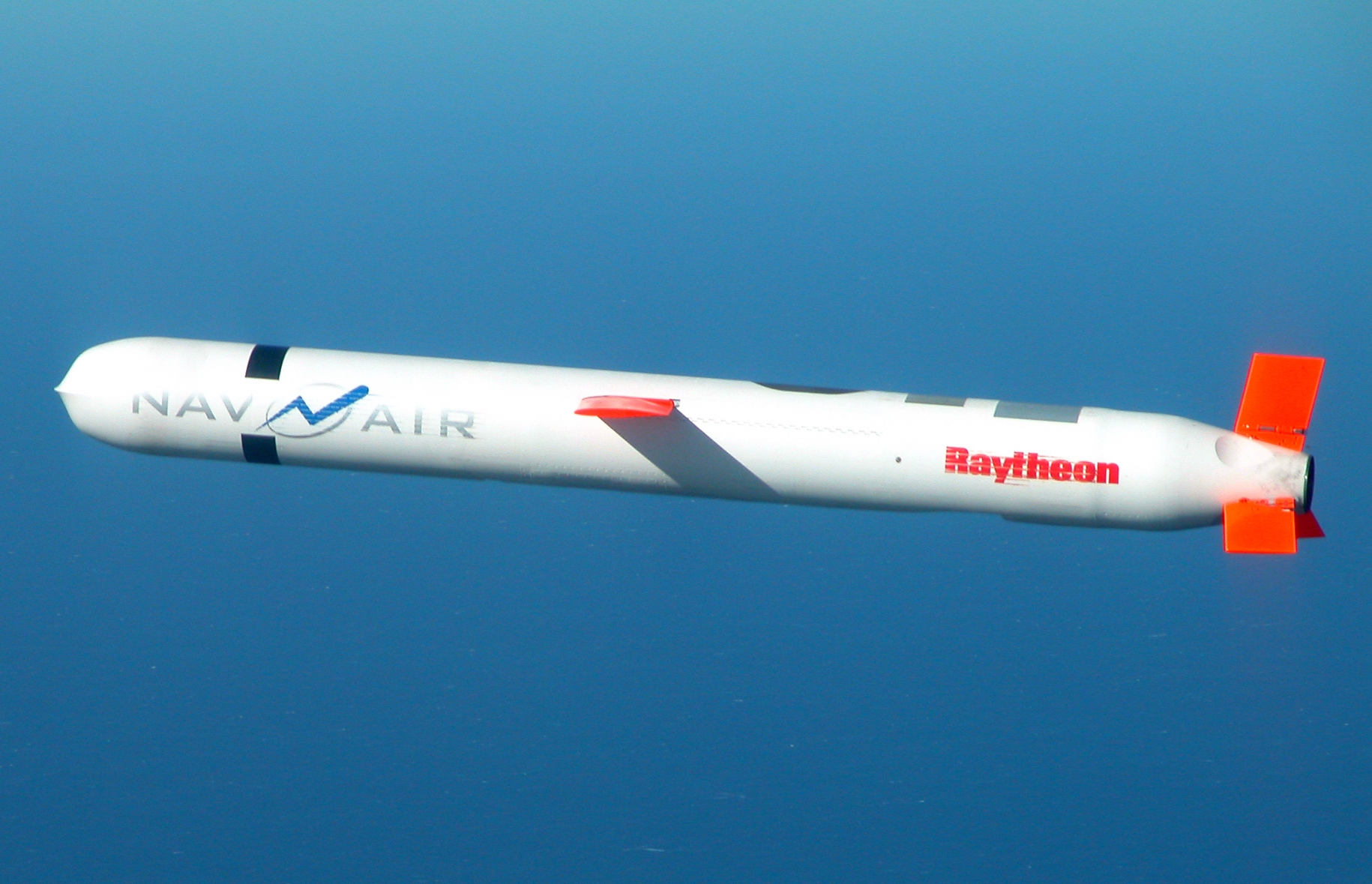
The BGM-109 Tomahawk Land Attack Missile (TLAM) is an American long-range, all-weather, jet-powered, subsonic cruise missile that is used by the United States Navy, Royal Australian Navy, Royal Netherlands Navy and Royal Navy in ship and submarine-based land-attack operations.
Developed at the Applied Physics Laboratory of Johns Hopkins University under James H. Walker near Laurel, Maryland, the Tomahawk emerged in the 1970s as a modular cruise missile first manufactured by General Dynamics. Early tests of the missile took place between 1983 and 1993, during which time 23 cruise missiles were tested over northern Canada under the "Canada–U.S. Test and Evaluation Program". The goal of the program was to simulate the climate and terrain similar to that of the northern Soviet Union, and to allow the North American Aerospace Defence Command (NORAD) to develop an anti-cruise capability. The Tomahawk aimed to fulfill the need for a medium- to long-range, low-altitude missile with diverse capabilities. Its modular design allows for compatibility with a range of warheads, including high-explosive, submunitions, and bunker-busters. The Tomahawk can use a variety of guidance systems, including GPS, inertial navigation, and terrain contour matching. Over a dozen variants and upgraded versions have been developed since the original design, including air-, sub-, and ground-launched configurations with both conventional and nuclear armaments. The Tomahawk's manufacturing history has seen several transitions. General Dynamics served as the sole supplier in the 1970s. From 1992 until 1994, McDonnell Douglas was the sole supplier of Tomahawks, producing Block II and Block III versions and remanufacturing many Tomahawks to Block III specifications. In 1994, Hughes Aircraft, having purchased General Dynamics' missile division in 1992, outbid McDonnell Douglas to become the sole supplier of Tomahawks. A joint venture between Hughes and Raytheon manufactured the missile from 1995 until Raytheon's acquisition of Hughes in 1997, solidifying their position as the sole supplier. In 2016, the US Department of Defense purchased 149 Tomahawk Block IV missiles for $202.3 million. As of 2024[update], Raytheon remains the sole manufacturer of non-nuclear, sea-launched Tomahawk variants.
The variants and multiple upgrades to the missile include:
BGM-109G Gryphon Ground Launched Cruise Missiles (GLCM) and their truck-like launch vehicles were employed at bases in Europe; they were withdrawn from service to comply with the 1987 Intermediate-Range Nuclear Forces Treaty. Many of the anti-ship versions were converted into TLAMs at the end of the Cold War. The Block III TLAMs that entered service in 1993 can fly farther using their new turbofan engines and use Global Positioning System (GPS) receivers to strike more precisely. Block III TLAM-Cs retain the Digital Scene Matching Area Correlation (DSMAC) II navigation system, allowing three kinds of navigation: GPS-only, which allow for rapid mission planning, with some reduced accuracy, DSMAC-only, which take longer to plan but terminal accuracy is somewhat better; and GPS-aided missions that combine DSMAC II and GPS navigation for greatest accuracy. Block IV TLAMs have an improved turbofan engine that allows them to get better fuel economy and change speeds in flight. The Block IV TLAMs can loiter better and have electro-optical sensors that allow real-time battle damage assessment. The Block IVs can be given a new target in flight and can transmit an image, via satcom, immediately before impact to help determine whether the missile is on target and the likely damage from the attack.
A major improvement to the Tomahawk is network-centric warfare-capabilities, using data from multiple sensors (aircraft, UAVs, satellites, foot soldiers, tanks, ships) to find its target. It will also be able to send data from its sensors to these platforms.
Tomahawk Block II variants were all tested during January 1981 to October 1983. Deployed in 1984, some of the improvements included: an improved booster rocket, cruise missile radar altimeter, and navigation through the Digital Scene Matching Area Corellator (DSMAC).[citation needed] DSMAC was a highly accurate rudimentary AI which allowed early low power computers to navigate and precisely target objectives using cameras on board the missile. With its ability to visually identify and aim directly at a target, it was more accurate than weapons using estimated GPS coordinates. Due to the very limited computer power of the day, DSMAC did not directly evaluate the maps, but instead would compute contrast maps and then combine multiple maps into a buffer, then compare the average of those combined images to determine if it was similar to the data in its small memory system. The data for the flight path was very low resolution in order to free up memory to be used for high resolution data about the target area. The guidance data was computed by a mainframe computer which took spy satellite photos and estimated what the terrain would appear like during low level flight. Since this data would not match the real terrain exactly, and since terrain changes seasonally and with changes in light quality, DSMAC would filter out differences between maps and use the remaining similar sections in order to find its location regardless of changes in how the ground appeared. It also had an extremely bright strobe light it could use to illuminate the ground for fractions of a second in order to find its position at night, and was able to take the difference in ground appearance into account.
Tomahawk Block III introduced in 1993 added time-of-arrival control and improved accuracy for Digital Scene Matching Area Correlator (DSMAC) and jam-resistant GPS, smaller, lighter WDU-36 warhead, engine improvements and extended missile's range.
Tactical Tomahawk Weapons Control System (TTWCS) takes advantage of a loitering feature in the missile's flight path and allows commanders to redirect the missile to an alternative target, if required. It can be reprogrammed in-flight to attack predesignated targets with GPS coordinates stored in its memory or to any other GPS coordinates. Also, the missile can send data about its status back to the commander. It entered service with the US Navy in late 2004. The Tactical Tomahawk Weapons Control System (TTWCS) added the capability for limited mission planning on board the firing unit (FRU).
Tomahawk missile
The BGM-109 Tomahawk Land Attack Missile (TLAM) is an American long-range, all-weather, jet-powered, subsonic cruise missile that is used by the United States Navy, Royal Australian Navy, Royal Netherlands Navy and Royal Navy in ship and submarine-based land-attack operations.
Developed at the Applied Physics Laboratory of Johns Hopkins University under James H. Walker near Laurel, Maryland, the Tomahawk emerged in the 1970s as a modular cruise missile first manufactured by General Dynamics. Early tests of the missile took place between 1983 and 1993, during which time 23 cruise missiles were tested over northern Canada under the "Canada–U.S. Test and Evaluation Program". The goal of the program was to simulate the climate and terrain similar to that of the northern Soviet Union, and to allow the North American Aerospace Defence Command (NORAD) to develop an anti-cruise capability. The Tomahawk aimed to fulfill the need for a medium- to long-range, low-altitude missile with diverse capabilities. Its modular design allows for compatibility with a range of warheads, including high-explosive, submunitions, and bunker-busters. The Tomahawk can use a variety of guidance systems, including GPS, inertial navigation, and terrain contour matching. Over a dozen variants and upgraded versions have been developed since the original design, including air-, sub-, and ground-launched configurations with both conventional and nuclear armaments. The Tomahawk's manufacturing history has seen several transitions. General Dynamics served as the sole supplier in the 1970s. From 1992 until 1994, McDonnell Douglas was the sole supplier of Tomahawks, producing Block II and Block III versions and remanufacturing many Tomahawks to Block III specifications. In 1994, Hughes Aircraft, having purchased General Dynamics' missile division in 1992, outbid McDonnell Douglas to become the sole supplier of Tomahawks. A joint venture between Hughes and Raytheon manufactured the missile from 1995 until Raytheon's acquisition of Hughes in 1997, solidifying their position as the sole supplier. In 2016, the US Department of Defense purchased 149 Tomahawk Block IV missiles for $202.3 million. As of 2024[update], Raytheon remains the sole manufacturer of non-nuclear, sea-launched Tomahawk variants.
The variants and multiple upgrades to the missile include:
BGM-109G Gryphon Ground Launched Cruise Missiles (GLCM) and their truck-like launch vehicles were employed at bases in Europe; they were withdrawn from service to comply with the 1987 Intermediate-Range Nuclear Forces Treaty. Many of the anti-ship versions were converted into TLAMs at the end of the Cold War. The Block III TLAMs that entered service in 1993 can fly farther using their new turbofan engines and use Global Positioning System (GPS) receivers to strike more precisely. Block III TLAM-Cs retain the Digital Scene Matching Area Correlation (DSMAC) II navigation system, allowing three kinds of navigation: GPS-only, which allow for rapid mission planning, with some reduced accuracy, DSMAC-only, which take longer to plan but terminal accuracy is somewhat better; and GPS-aided missions that combine DSMAC II and GPS navigation for greatest accuracy. Block IV TLAMs have an improved turbofan engine that allows them to get better fuel economy and change speeds in flight. The Block IV TLAMs can loiter better and have electro-optical sensors that allow real-time battle damage assessment. The Block IVs can be given a new target in flight and can transmit an image, via satcom, immediately before impact to help determine whether the missile is on target and the likely damage from the attack.
A major improvement to the Tomahawk is network-centric warfare-capabilities, using data from multiple sensors (aircraft, UAVs, satellites, foot soldiers, tanks, ships) to find its target. It will also be able to send data from its sensors to these platforms.
Tomahawk Block II variants were all tested during January 1981 to October 1983. Deployed in 1984, some of the improvements included: an improved booster rocket, cruise missile radar altimeter, and navigation through the Digital Scene Matching Area Corellator (DSMAC).[citation needed] DSMAC was a highly accurate rudimentary AI which allowed early low power computers to navigate and precisely target objectives using cameras on board the missile. With its ability to visually identify and aim directly at a target, it was more accurate than weapons using estimated GPS coordinates. Due to the very limited computer power of the day, DSMAC did not directly evaluate the maps, but instead would compute contrast maps and then combine multiple maps into a buffer, then compare the average of those combined images to determine if it was similar to the data in its small memory system. The data for the flight path was very low resolution in order to free up memory to be used for high resolution data about the target area. The guidance data was computed by a mainframe computer which took spy satellite photos and estimated what the terrain would appear like during low level flight. Since this data would not match the real terrain exactly, and since terrain changes seasonally and with changes in light quality, DSMAC would filter out differences between maps and use the remaining similar sections in order to find its location regardless of changes in how the ground appeared. It also had an extremely bright strobe light it could use to illuminate the ground for fractions of a second in order to find its position at night, and was able to take the difference in ground appearance into account.
Tomahawk Block III introduced in 1993 added time-of-arrival control and improved accuracy for Digital Scene Matching Area Correlator (DSMAC) and jam-resistant GPS, smaller, lighter WDU-36 warhead, engine improvements and extended missile's range.
Tactical Tomahawk Weapons Control System (TTWCS) takes advantage of a loitering feature in the missile's flight path and allows commanders to redirect the missile to an alternative target, if required. It can be reprogrammed in-flight to attack predesignated targets with GPS coordinates stored in its memory or to any other GPS coordinates. Also, the missile can send data about its status back to the commander. It entered service with the US Navy in late 2004. The Tactical Tomahawk Weapons Control System (TTWCS) added the capability for limited mission planning on board the firing unit (FRU).
Recent media
Recent media