Hubbry Logo
TomatitoTomatitoMain
Open search
Tomatito
Community hub
Tomatito
logo
8 pages, 0 posts
0 subscribers
Be the first to start a discussion here.
Tomatito
Tomatito
from Wikipedia

Key Information

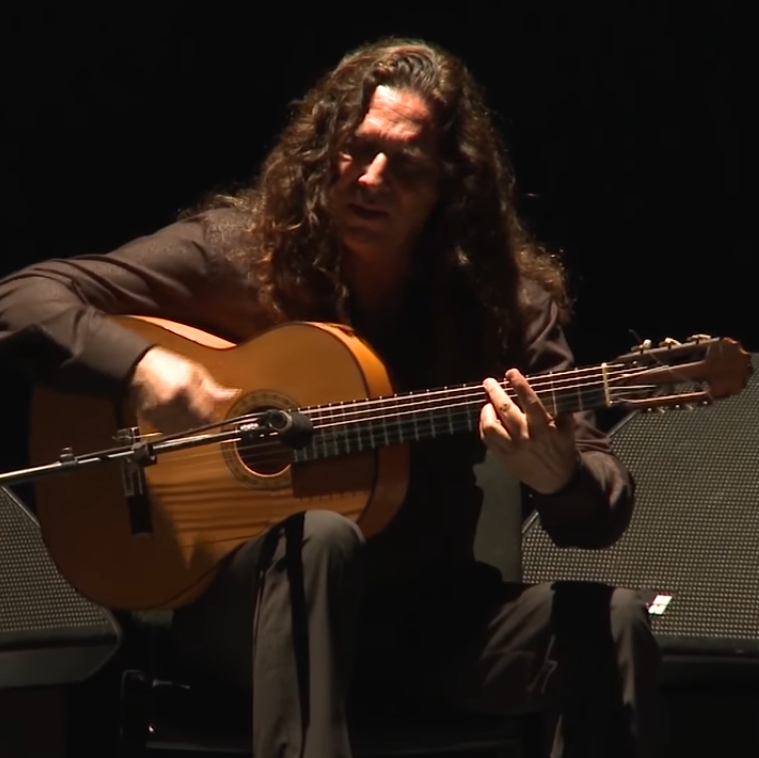
José Fernández Torres (born Fondón, 1958), known professionally as Tomatito, is a Spanish roma flamenco guitarist and composer. Having started his career accompanying famed flamenco singer Camarón de la Isla (with Paco de Lucía), he has made a number of collaborative albums and six solo albums, two of which have won Latin Grammy Awards.[1]

Biography

[edit]

Beginnings, Camarón de la Isla

[edit]

Jose Fernández Torres grew up in a musical family, which included two guitar playing uncles: Niño Miguel, a flamenco guitarist, and Antonio, a professional guitarist.

Tomatito, who had been playing clubs in Andalucía, became a flamenco sensation when he was discovered by guitarist Paco de Lucía. He accompanied legendary flamenco singer Camarón de la Isla for two decades. With Paco and Camarón he recorded four albums, and had a 1979 hit called "La Leyenda del Tiempo". Their album Paris 87 won a Latin Grammy for best flamenco album in 2000. Their partnership continued until Camarón's death in 1992.[2]

Later career

[edit]

Tomatito's music blends traditional flamenco and jazz. On some albums, such as Barrio Negro, he experimented with Afro-Cuban and Brazilian Music. He has also worked with flamenco singers Duquende and Potito and pianist Chano Domínguez, among others. A collaboration with pianist Michel Camilo produced the albums Spain (2000), which won a Latin Grammy,[2] and Spain Again (2006).

Tomatito has produced six solo albums. His 2005 album Aguadulce won a Latin Grammy for best flamenco album, and in 2010 he won his second solo Latin Grammy for Sonanta Suite.[3]

His music for the film Vengo, directed by Tony Gatlif, won the César Award for Best Music Written for a Film in 2001.

On March 11, 2019, he was awarded by the Premio Flamenco Radio of Canal Sur.[4]

Style and instruments

[edit]

Tomatito incorporates elements of jazz in his style of flamenco; both, he says, "emerged as a response to discrimination, a cry of suffering, or the joy of liberation". Half of what he plays is improvised, he said. He frequently employs the Phrygian mode, and his favorite tuning is D, A, D, G, B♭, D.[2]

He plays guitars made by Manuel Reyes, and uses (and endorses) strings by Savarez.[2]

Discography

[edit]

Solo albums

[edit]

Singles

[edit]
  • 2012: "Mi Santa" Ft Romeo

With Camarón de la Isla and Paco de Lucía

[edit]
  • 1981: "Como El Agua"
  • 1983: "Calle Real"
  • 1984: "Vivire"
  • 1992: "Potro de Rabia y Miel"

With Camarón de la Isla

[edit]
  • 1979: "La Leyenda del Tiempo"
  • 1986: "Te lo Dice Camarón"
  • 1987: "Flamenco Vivo"
  • 1989: "Soy Gitano"
  • 1994: "Camarón Nuestro"
  • 1999: Paris 1987

References

[edit]
[edit]
Revisions and contributorsEdit on WikipediaRead on Wikipedia
from Grokipedia
José Fernández Torres (born 28 August 1958), known professionally as Tomatito, is a Spanish flamenco and of Romani heritage, renowned for his innovative fusion of traditional flamenco with and other genres. Born in Almería, , he emerged as a in the flamenco scene, becoming one of the most influential guitarists of his generation through his emotive technique and collaborations with legendary artists. With a career spanning over six decades, Tomatito has released numerous solo albums, including Guitarra Gitana (1996), Aguadulce (2005), and Sonanta Suite Flamenco (2010), and earned six , solidifying his status as a pivotal figure in contemporary flamenco music. His notable collaborations include the jazz-flamenco fusion album Spain (2000) with pianist , and a recent release Spain Forever Again (2024), nominated for a 2025 Grammy Award for Best Album. He has also composed for films, including the soundtrack for Tony Gatlif's Vengo (2000), which won the César Award for Best Music Written for a Film in 2001 (shared). Tomatito continues to perform worldwide and mentor new flamenco artists.

Early life

Family background

José Fernández Torres, known professionally as Tomatito, was born on August 28, 1958, in the Pescadería neighborhood of Almería, Spain, a region deeply rooted in Andalusian flamenco traditions. Tomatito hails from a Gitano (Roma) family with strong ties to flamenco music, raised in an environment where the art form was a central part of daily life in Almería's vibrant musical community. His father, José Fernández Castro, nicknamed "El Tomate," was a renowned flamenco guitarist and clarinetist in the city's Municipal Band, while his uncle Niño Miguel (Miguel Vega de la Cruz), also known from the family tradition, pursued a career as a professional flamenco guitarist. Their grandfather, Miguel Fernández Cortés, another "El Tomate," was a staple at early 20th-century flamenco gatherings, embedding multi-generational performance traditions within the family's Gitano heritage across local Andalusian circles. The immediate family further reinforced this musical legacy, with Tomatito's upbringing immersed in flamenco sounds from his relatives. Continuing the tradition, his son, José del Tomate (José Fernández Fernández), has emerged as a prominent flamenco guitarist, often collaborating internationally with his father, and his daughter, Mari Ángeles Fernández, is a noted flamenco singer who performs alongside family members.

Musical beginnings

Tomatito, born José Fernández Torres in , , in 1958, grew up immersed in a flamenco-rich environment that sparked his early interest in the guitar. Largely self-taught and never formally trained in reading music, he began experimenting with the instrument around the age of five or six, using guitars belonging to his family members, who were accomplished flamenco musicians themselves. This hands-on approach allowed him to develop an intuitive feel for the art form from a tender age, playing extensively throughout his childhood in the Pescadería neighborhood. His initial musical influences stemmed directly from his —his father and grandfather, both nicknamed "El Tomate," were skilled guitarists—and the vibrant regional scenes of 1960s , where traditional gatherings and local performances exposed him to the genre's rhythmic and expressive depths. By age ten, Tomatito had already debuted as an accompanist at the El Taranto in , marking his entry into public performance, though he continued honing his skills through informal appearances in Andalusian clubs and fiestas around age twelve. Seeking greater exposure in the world, Tomatito's family relocated to in 1970 when he was twelve, opening doors to a more dynamic artistic scene. It was after this move that he met the legendary singer , an interaction that propelled him into professional circles and foreshadowed their enduring collaboration.

Career

Collaboration with Camarón de la Isla

Tomatito first met in 1973 at the age of 15 in , where he was recommended as a for an unexpected performance after impressing audiences by imitating de Lucía's style at local venues. This encounter marked the beginning of their professional relationship, with Tomatito stepping in as Camarón's primary accompanist as de Lucía's commitments grew, around 1974. Their partnership endured for 18 years, spanning extensive tours across , Europe, and international venues such as the and New York concerts, until Camarón's death in 1992 at age 41. Tomatito's guitar work provided a dynamic foundation for Camarón's revolutionary approach to , blending traditional cante with and rock elements to create a more accessible, fusion-oriented sound that challenged purist conventions. Key joint recordings highlighted their synergy, starting with La Leyenda del Tiempo (1979), Camarón's groundbreaking album where Tomatito's rhythmic and melodic contributions helped pioneer flamenco's modern evolution. This was followed by Calle Real (1983), a live album capturing their intense stage chemistry in , and Soy Gitano (1989), where Tomatito joined Camarón and for orchestral arrangements with the Royal Philharmonic Orchestra. A posthumously released live recording, Paris 1987 (recorded 1987, issued 1999), further documented their powerful duo performances abroad. The duo shared a profound artistic and personal bond, with Tomatito later describing Camarón as his idol and expressing that he would have continued accompanying him indefinitely had he lived, underscoring the singer's pivotal role in shaping his career and flamenco's trajectory.

Solo career and later collaborations

Following the death of Camarón de la Isla in 1992, Tomatito shifted his focus to a solo career, building on his earlier independent release Rosas del Amor from 1987, which he recorded while still accompanying the singer. From 1993 onward, he established himself as a solo performer through extensive international tours and festival appearances, including opening for Frank Sinatra's tour that year and performing alongside Elton John in subsequent projects. This period marked his evolution toward greater artistic autonomy, incorporating flamenco with jazz and other influences while maintaining rigorous global performance schedules across Europe, the Americas, and beyond. Tomatito's solo trajectory featured notable early collaborations with , his former mentor, in fusion-oriented projects that bridged traditional and broader musical explorations. He also partnered with flamenco vocalists such as Duquende and Potito, as well as jazz pianist Chano Domínguez, fostering innovative cross-genre dialogues in live settings and recordings. A cornerstone of his later work has been his longstanding collaboration with pianist , beginning with their 2000 album Spain and continuing through Spain Again (2006), Spain Forever (2016), and Spain Forever Again (2024), which blended with improvisation to critical acclaim. In addition to musical partnerships, Tomatito contributed to film soundtracks, most prominently composing and performing for Tony Gatlif's 2000 drama Vengo, where his guitar work, including the track "Fusion Flamenco Soufi" co-written with Sheikh Ahmad Al Tuni, underscored the film's exploration of gypsy culture in . His international presence extended to landmark performances, such as his 1991 appearance with Camarón at the , later released as a live recording. Tours remained a vital component, including performances at major festivals like Flamenco on Fire in 2025 and at Barcelona's in October 2025. Recent years have seen Tomatito release archival live material from his collaborations, including the 2024 album Oviedo, San Mateo 1991 with , alongside the fresh Spain Forever Again with Camilo. As of 2025, he continues worldwide festival circuits, often sharing stages with his son José del Tomate, ensuring the flamenco legacy's vitality through intergenerational performances.

Musical style and equipment

Style and influences

Tomatito's guitar style is firmly anchored in flamenco puro, the pure, traditional form of flamenco characterized by its raw emotional intensity and adherence to established rhythmic and melodic structures, yet he skillfully blends these roots with jazz, Latin, and contemporary elements to pioneer aspects of flamenco nuevo. This fusion allows for a versatile expression, where the guitar serves both as a rhythmic backbone and a melodic voice capable of whimsy and power. His approach emphasizes emotional depth through the Phrygian mode, often played por arriba (in E Phrygian), which imparts a haunting, Andalusian flavor, while maintaining the intricate rhythmic complexity of compás—the cyclical patterns that underpin flamenco palos like soleá and bulerías. Key influences on Tomatito's playing stem from his familial heritage as a third-generation ; his father, "El Tomate," and grandfather, Miguel "Tomate," instilled a deep-seated Gypsy sensibility and technical foundation from an early age in . The vocal innovations of , his longtime collaborator, profoundly shaped Tomatito's style during their 18-year partnership, pushing him to adapt his guitar work to Camarón's boundary-breaking interpretations that fused traditional cante with modern sensibilities. Additionally, Paco de Lucía's precision and virtuosity served as a benchmark, evident in Tomatito's refined phrasing, while Michel Camilo's rhythmic and harmonic ideas influenced his explorations beyond pure , as seen in their joint albums where both genres respond to themes of struggle and liberation, including their 2024 release Spain Forever Again. Tomatito's signature techniques highlight his mastery and creativity: explosive rasgueado strumming delivers the percussive drive essential to flamenco's energy, complemented by the independent pulgar (thumb) technique for agile bass lines and melodic independence, and inventive falsetas—short improvisational phrases—that allow spontaneous expression within the compás. Over time, his role evolved from dedicated accompanist, honing subtlety in supporting vocals, to a commanding soloist who integrates global sounds, such as Latin jazz infusions, in albums like Spain (2000), expanding flamenco's palette without diluting its core essence.

Instruments and technique

Tomatito primarily plays custom guitars crafted by Manuel Reyes, known for their blanca style featuring back and sides, which provide the bright, percussive tone essential to flamenco music. These instruments are tailored to his specifications, emphasizing responsiveness and projection suited to both solo and accompaniment roles. He maintains an extensive personal collection of guitars at home, selecting Reyes models as his preferred choice for performances. For strings, Tomatito endorses and uses the Savarez Tomatito signature set from the Alliance series, which combines clear trebles, a carbon third string, and silver-plated copper-wound basses on a multifilament core to deliver a bright, durable tone with precise response and enhanced projection. This setup supports the dynamic demands of , offering clarity for intricate passages while maintaining the percussive snap characteristic of the genre. Tomatito's technique showcases advanced mastery of core methods, including picado—rapid with index and middle fingers for speed and evenness—and alzapúa, a thumb-index pattern that alternates strumming and for rhythmic drive and melodic flow. His left-hand work features sophisticated ornamentation such as ligados (hammer-ons and pull-offs), enabling fluid phrasing and expressive runs that integrate seamlessly with the music's emotional intensity. These elements contribute to his distinctive sound, blending precision with rhythmic vitality. In recordings and live settings, Tomatito prioritizes unplugged authenticity, employing amplifiers only sparingly to preserve the natural resonance of the , often relying on high-quality for larger venues to capture the instrument's raw timbre without electronic alteration.

Discography

Solo albums

Tomatito's solo discography spans over three decades, showcasing his evolution as a guitarist from traditional roots to innovative fusions while maintaining a focus on his primary in composition and . His albums emphasize intricate guitar work, often accompanied by select vocalists and percussionists, highlighting his heritage and technical mastery. Key releases include studio efforts that explore pure forms as well as experimental blends, with production typically handled by Tomatito alongside collaborators like Flamenco Vivo or established engineers. His debut solo album, Rosas del Amor, released in 1987 by Hispavox, marked Tomatito's transition from accompanist to bandleader, featuring passionate tangos and bulerías dedicated to influences from his early career. Produced by Flamenco Vivo, it includes tracks like the title song, blending rhythmic drive with emotional depth. In 1991, Barrio Negro followed on Nuevos Medios, a raw exploration of flamenco nuevo with seven tracks emphasizing soleá and rumba elements, self-produced to capture street-level intensity. The album's title track evokes urban gypsy life, underscoring Tomatito's narrative style through guitar solos. Guitarra Gitana, issued in 1996 by Nuevos Medios, achieved commercial success as the top-selling album that year, filled with and tangos featuring guests like Remedios Amaya on vocals. Produced with contributions from Raimundo Amador on guitar, it celebrates gypsy traditions while incorporating modern production techniques. The 2001 release Paseo de los Castaños on Universal Music presented a more orchestral approach, recorded in studios with tracks like "Alquimia" showcasing soleá por . Self-produced by Tomatito, it reflects a mature phase, balancing purity with subtle inflections, and peaked in Spanish charts. Aguadulce, released in 2004 by Universal, represented a deliberate return to pure after exploratory works, featuring authentic soleás, , and tangos with minimal accompaniment. Tomatito described it as a "vuelta a casa," self-produced to emphasize raw guitar expression and collaborations with vocalists like . In 2010, Sonanta Suite on blended with classical orchestration, performed with the Orquesta Nacional de España under Josep Pons. Recorded live in , it includes tarantas and alegrías reimagined symphonically, marking Tomatito's bold fusion experiment co-produced with the orchestra's team. Soy Flamenco, issued in 2013 by Universal, reaffirmed Tomatito's core identity through ten tracks of , soleás, and rumbas, self-produced to highlight unadorned guitar virtuosity. The title track encapsulates his lifelong dedication to the , with no notable chart performance but strong critical acclaim for its authenticity. De Verdad, a with José Mercé on Universal Music , explored forms with vocal and guitar interplay, produced collaboratively to emphasize emotional depth. It features tracks blending their styles, receiving praise for its authenticity.

Collaborative albums

Tomatito's collaborative albums primarily feature his guitar work alongside prominent flamenco vocalists and musicians, showcasing fusions of traditional with other genres. His longstanding partnership with produced several landmark recordings that blended raw emotional cante with intricate guitar accompaniment. One of the earliest collaborations was on 's La Leyenda del Tiempo, released in 1979 by , where Tomatito contributed alongside Raimundo Amador, marking a revolutionary shift toward modern flamenco influences like rock and . This was followed by Como el Agua in 1981, issued by (an subsidiary), featuring Tomatito's guitar on tracks such as the titular tangos, emphasizing Camarón's poignant delivery supported by dual guitars from Tomatito and . In 1983, Calle Real, also on /, highlighted Tomatito's rhythmic drive in and tangos, co-credited with Camarón and , capturing their live energy in studio form. The 1989 album Soy Gitano, released by , included Tomatito's guitar on pieces like the tangos title track, arranged with orchestral elements from the Royal Philharmonic Orchestra and contributions from , reflecting Camarón's final major studio effort before his death. A posthumous live release, París 1987 (1999, Universal), documented a 1987 at the d'Hiver, featuring intimate duets between Camarón's voice and Tomatito's sole guitar accompaniment in styles like tarantos and . Additional live archival releases include Montreux 1991 (2018, Universal), capturing a 1991 festival performance with Camarón, and Oviedo, San Mateo 1991 (2024, Universal), documenting another live collaboration from that year. Tomatito's series with jazz pianist Michel Camilo exemplifies flamenco-jazz fusion, beginning with Spain in 2000 on Telarc/Verve, where their interplay on tracks like "Bésame Mucho" and Chick Corea's title composition earned critical acclaim for blending improvisational jazz with flamenco rasgueado. The duo continued with Spain Again (2006, Telarc), incorporating Latin rhythms and flamenco palos in a more expansive ensemble setting. Spain Forever (2016, Impulse!/Universal) paid homage to influences like Egberto Gismonti, with tracks such as "Our Spanish Love Song" highlighting their matured synergy. The latest, Spain Forever Again (2024, Resilience Music), Grammy-nominated, further explores their dialogue through reinterpreted standards and originals, maintaining the flamenco-jazz essence. Other notable joint works include the 1993 album Y la Guitarra de Tomatito with singer Duquende on Nuevos Medios, a pure recording focused on cante accompanied by Tomatito's guitar across soleás and siguiriyas. Tomatito also featured Potito on his 2005 album Aguadulce (Dro East West), with the singer's contributions to like "Potito por Bulerías," adding vocal intensity to Tomatito's compositions. Additionally, Tomatito composed and performed on the 2000 soundtrack for Tony Gatlif's film Vengo (Warner Music ), including tracks like "A Mi Niña " and the fusion piece " Soufi" with Sheikh Al Tuni, integrating with Sufi elements to underscore the film's themes of gypsy heritage.

Awards and honors

Grammy and Latin Grammy Awards

Tomatito has received six Latin Grammy Awards, highlighting his contributions to flamenco and Latin jazz music. His first two wins came in 2000 at the inaugural Latin Grammy Awards: Best Flamenco Album for the collaborative live album Paris 87 with Camarón de la Isla, and Best Latin Jazz Album for the collaborative album Spain with pianist Michel Camilo, which fused flamenco guitar with jazz improvisation. These marked early recognition of his ability to bridge traditional flamenco with other genres. In 2005, Tomatito earned a Latin Grammy for Best Flamenco Album with Aguadulce, a work that showcased his innovative approach to flamenco rhythms and melodies during the 6th Annual Latin Grammy Awards. He followed this with another Best Flamenco Album win in 2010 for Sonanta Suite at the 11th Annual Latin Grammy Awards, further establishing his solo prowess in the genre. Tomatito secured another Best Flamenco Album win in 2013 for Soy Flamenco during the 14th Annual ceremony. In 2017, he won Best Instrumental Album for Spain Forever with Michel Camilo at the 18th Annual Latin Grammy Awards. Beyond his wins, Tomatito has been nominated for additional awards, including Best Latin Jazz Album in 2007 for Spain Again with at the 8th Annual . In 2025, he received a Grammy nomination for Best Latin Jazz Album for Spain Forever Again, again in collaboration with Camilo, at the 67th Annual , though it did not result in a win. These accolades underscore Tomatito's impact in blending flamenco traditions with jazz influences, as evidenced by his wins in both specialized categories and his ongoing collaborations that expand the boundaries of each genre. As of 2025, his six Latin Grammy wins reflect a career dedicated to innovative fusion while honoring flamenco's roots.

Other recognitions

In 1997, Tomatito was awarded the Medalla de Andalucía by the regional government for his outstanding contributions to Andalusian culture through flamenco guitar. In 2001, his musical composition for the film Vengo, directed by , earned the César Award for Best Original Music, shared with collaborators Ahmad Al Tuni, La Caita, and Gatlif, recognizing the score's integration of elements. Tomatito received the Premio Nacional de la Guitarra from the Cátedra de Flamencología de Jerez in 2010, honoring his lifetime achievements in mastery. The 2019 Premio Flamenco Radio, presented by Canal Sur Radio, acknowledged Tomatito's profound impact on flamenco, highlighted by his performances at the Bienal de Flamenco de Sevilla and collaborations like the album De verdad with José Mercé. Additionally, Tomatito serves as an ambassador for Savarez strings, co-developing the signature T50R Tomatito series designed specifically for flamenco guitar's percussive and expressive demands.

References

Add your contribution
Related Hubs
User Avatar
No comments yet.