Hubbry Logo
Tower RockTower RockMain
Open search
Tower Rock
Community hub
Tower Rock
logo
8 pages, 0 posts
0 subscribers
Be the first to start a discussion here.
Tower Rock
Tower Rock
from Wikipedia

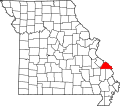
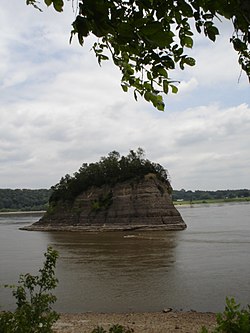
Tower Rock, also known as Grand Tower, is a rock formation and landmark island in the Mississippi River, in Brazeau Township, Perry County, Missouri, near the town of Wittenberg, Missouri, and across the river from Grand Tower, Illinois. It was listed on the National Register of Historic Places in 1970.[1]

Key Information

Tower Rock has also been dubbed with many names over the centuries: Cap de Roche, Cap St. Croix la Tour, La Roche de la Croix, Rock of St. Cosme, Castle Rock, and Devil's Tower.[2][3]

The earliest mention by Europeans of this island is by French missionary Jacques Marquette in 1673:

...we found ourselves at a river called ouaboukigou, The mouth of which is at the 36th degree of latitude. Before reaching it, we passed by a Place that is dreaded by the Savages, because they believe that a manitou is there, — that is to say, a demon, — that devours travelers; and The savages, who wished to divert us from our undertaking, warned us against it. This is the demon: there is a small cove, surrounded by rocks 20 feet high, into which The whole Current of the river rushes; and, being pushed back against the waters following It, and checked by an Island near by, the Current is Compelled to pass through a narrow Channel. This is not done without a violent Struggle between all these waters, which force one another back, or without a great din, which inspires terror in the savages....

Another early mention of the rock was by French-Canadian seminarian priests, Fathers Montigny, Davion, and St. Cosme, who planted a cross on the rock in 1698.[4]

A ridge directly across the river from the island is named Devil's Backbone.

The earliest European inhabitants on the island were a band of river pirates, who settled here after being driven off Spanish soil west of the Mississippi River, using the location as a pirate ambush spot. This outlaw haven was destroyed in 1803 by the United States Army dragoons, most likely sent from the army post upriver at Fort Kaskaskia.

Meriwether Lewis mentions the island in his journals, stating that rivermen who passed the rock would celebrate in a way similar to sailors crossing the equator, by raising a drink of spirits.

Lutherans from Germany considered this island their Plymouth Rock, because they landed near here after seeking a place where they could practice religious freedom.

Although the rock is normally inaccessible by foot, Mike Keeley, then manager of the 32-acre (13 ha) Tower Rock National Historic Site for the Missouri Department of Conservation, said in 2003 that there is usually a time every year when people can walk out to it due to low water conditions.[5] Due to severe drought in October 2022, it was reported that "you can walk over to Tower Rock and not get your feet wet or muddy".[6]

References

[edit]
[edit]
Revisions and contributorsEdit on WikipediaRead on Wikipedia
from Grokipedia
Tower Rock, also known as the Grand Tower, is a prominent formation and island landmark in the , located in Brazeau Township, , near the community of Grand Tower. Rising about 60 feet above the average river level, it is an erosional remnant of Devonian-period limestone dating back approximately 400 million years, surrounded by upland oak-pine forests and mixed hardwoods on the adjacent 32-acre Tower Rock Natural Area. The site offers scenic overlooks, hiking trails, and opportunities for and , though access to the rock itself typically requires a , except during periods of exceptionally low river levels when it becomes walkable from the shoreline. Historically, Tower Rock has been a significant navigational and cultural feature along the . First documented by French explorer Father in 1673 during his voyage down the river, it was later observed and described in detail by and on November 26, 1803, as part of their expedition, with Lewis noting its commanding views in his journal. The formation was legendary among river boatmen for the dangerous whirlpool it created during floods, marking a perilous , and it was well-known to Native American tribes long before European arrival. In the post-Civil War era, the U.S. Army Corps of Engineers proposed its removal to improve navigation, but President issued an on March 4, 1871, sparing it from destruction and preserving its integrity. Designated as a Missouri Natural Area and managed by the Missouri Department of Conservation since 1972, Tower Rock holds dual geologic and historic importance, listed on the in 1970 for its historic significance. The site's protection extends to its diverse , including , , , and trees on the itself, supporting local and providing a window into the region's prehistoric river dynamics. In recent years, prolonged droughts have exposed surrounding sandbars, allowing pedestrian access for the first time in decades—such as in 2023 and 2024—highlighting the impacts of climate variability on this enduring icon.

Geography and Geology

Location and Physical Description

Tower Rock is situated at 37°37′54″N 89°30′53″W in Brazeau Township, , directly opposite the town of Grand Tower, , along the . This prominent landmark forms an isolated in the river that is part of the 32-acre Tower Rock Natural Area. The site is managed by the Missouri Department of Conservation, which oversees its preservation as a protected natural area. Physically, Tower Rock rises about 60 feet above the average level, reaching an of roughly 344 feet. Its structure features jagged, broken sides shaped by relentless erosion, contributing to a striking, raw, and wild beauty that has long captivated observers. As a mid- island, Tower Rock is typically encircled by turbulent whirlpools and fast currents, rendering it a hazardous yet iconic feature of the . These dynamic waters isolate the formation, emphasizing its dramatic presence amid the surrounding and forested bluffs.

Geological Formation and Erosion

Tower Rock consists primarily of Bailey limestone, a resistant rock type deposited during the Period approximately 400 million years ago in a shallow marine environment. This formation occurred as part of widespread sedimentary deposition across the region that would later become the Ozark Plateau, where carbonate platforms accumulated on ancient seabeds. The limestone's durability stems from its high content, which contrasts with overlying and adjacent layers of less resistant materials. The tower's current form is an erosional remnant shaped by the River's long-term channel migration and incision over millennia. Surrounding softer sedimentary rocks, including shales and sandstones, have been preferentially worn away by the river's flow, , and sediment abrasion, isolating the harder core. This differential process accelerated during the Pleistocene Epoch due to the uplift of the Ozark Dome, which elevated the regional landscape and allowed the river to deepen its trench through the bedrock, leaving prominent pinnacles like Tower Rock behind. Structurally, Tower Rock rises sharply from the riverbed, with its base at or near the and the approximately 60 feet above the average river stage. The sides exhibit jagged, irregular profiles resulting from ongoing fluvial erosion, while the flat top supports sparse vegetation adapted to the exposed conditions. As part of the eastern edge of the Ozark Plateau, the formation reflects broader dynamics and meandering river patterns that continue to influence its stability, though the tower itself stands as a testament to the plateau's resistant strata.

History

Pre-Columbian and Early European Encounters

Local tribes, including the Peoria and other Confederacy groups, regarded Tower Rock as a site imbued with spiritual danger, primarily due to the powerful whirlpools at its base that were believed to harbor malevolent spirits capable of claiming lives. These warned early French explorers of the perilous waters surrounding the formation, advising them to proceed with caution or avoid the area altogether during river voyages. Such views stemmed from longstanding oral traditions associating the rock and its turbulent currents with forces that demanded respect and avoidance. The first documented European encounter with Tower Rock occurred during the 1673 expedition down the led by French Jesuit missionary and explorer . In his journal, Marquette described the landmark as a prominent high rock or cliff near a village of the Peouarea ( on the western shore, noting its striking elevation amid the surrounding landscape. He referred to it in the context of the treacherous river conditions, including the whirlpools, which aligned with the local Native American cautions they had received earlier in their journey. This sighting marked Tower Rock as "Cap de Roche" (Rock ) in subsequent French accounts, highlighting its role as a notable navigational feature. During the French colonial period, Tower Rock gained further religious significance when, in 1699, a group of missionary priests—Fathers François de Montigny, Antoine Davion, and Jean-François de Saint-Cosme—erected a large cross atop the formation during their downstream journey to evangelize Native American communities in the lower Mississippi Valley. This act symbolized Christian dominion over the site, intended to counteract the demonic associations tied to the whirlpools as described in indigenous lore and earlier explorer reports. The priests' journals recount the placement of the cross as a deliberate gesture to sanctify the dangerous landmark, transforming it into a makeshift religious beacon for passing travelers. Early folklore emerging from these encounters contributed to alternative names like "Devil's Tower," reflecting the blend of Native spiritual warnings and European interpretations of peril. Prior to 1800, documentation of Tower Rock remained limited, primarily appearing in French missionary journals and rudimentary maps as a critical navigation hazard on the . These sources emphasized the rock's role in creating hazardous currents and eddies, advising pilots to steer clear during low water levels when the formation posed an even greater risk to canoes and early flatboats. French cartographic records from the late 17th and 18th centuries, such as those derived from Marquette and Jolliet's expedition, depicted it as a isolated promontory, underscoring its isolation and the sparse human activity around it amid the broader colonial expansion.

19th-Century Exploration and Settlement

During the of 1803–1806, Tower Rock served as a significant landmark on the . On November 25, 1803, as the expedition ascended the river, noted the rock's commanding presence in his journal, describing it as a "singular rock" marking a hazardous passage with a at its base. That evening, Lewis climbed the formation and measured its height at 92 feet using a rope, while sketched and mapped the surrounding area, including Tower Rock and nearby features like the Sugar Loaf, to aid navigation toward the confluence. This documentation highlighted the rock's role as a transitional point in their upstream journey. In the same year, following the , U.S. Army dragoons intervened to establish federal authority over the region, expelling river pirates who had established a hideout in nearby caves along the near Tower Rock. These outlaws, driven from Spanish territory west of the river, had used the site's treacherous waters and secluded bluffs for ambushes on passing vessels until troops from Fort routed them in 1803. This action cleared the area of illicit activity and secured the waterway for legitimate commerce. Early 19th-century settlement in the vicinity was influenced by Tower Rock's prominence as a navigational and geographic reference. German Lutheran immigrants, led by figures like Martin Stephan, began arriving in Perry County around 1839, establishing farms and communities that developed into the town of Wittenberg, Missouri, just upstream from the rock. The formation's visibility aided in land surveys and territorial delineations following U.S. acquisition of the area, serving as a fixed point for mapping the shifting . The growth of river traffic after the further underscored Tower Rock's importance. As steamboat navigation expanded on the —beginning with vessels like the New Orleans in 1811— the rock became a key reference for pilots avoiding its and rocky shallows, with flatboatmen and later steamers using it as a rite-of-passage landmark similar to equatorial crossings for sailors. By the , increased commerce past the site reflected broader in the upper river valley.

Role in River Navigation and Piracy

Tower Rock presented significant navigational challenges on the due to its position in a narrow channel flanked by strong currents and whirlpools, making it one of the most hazardous landmarks for early boatmen. The rock's location constricted the river, creating turbulent waters that could dash vessels against its jagged sides or draw them into deadly eddies, particularly during high water stages. During the on November 25, 1803, described an "immense and dangerous" whirlpool forming below the rock, noting the perilous passage through the narrow chute to avoid it. Flatboats and keelboats traveling the river from to New Orleans often required manual poling or cordelling—hauling from shore—to navigate past the rock, a grueling process that exposed crews to further risks from the swift flow and limited maneuverability. This for rivermen symbolized mastery over the river's dangers, akin to sailors crossing the , as successfully passing Tower Rock marked a boatman's skill and endurance in the flatboat trade that fueled early American commerce along the . Historical accounts record accidents where boats were crushed or lost near the rock, underscoring its role in pilot training during the steamboat era from the 1810s to the 1850s, where apprentices learned to read the currents and position vessels safely through the bottleneck. The rock served as a critical reference point for pilots, its distinctive visible for miles and aiding in orientation amid shifting sandbars and floods. In the late 18th and early 19th centuries, the area's navigational perils also attracted river pirates who exploited the constricted channel to ambush flatboats laden with goods, using Tower Rock and nearby bluffs like as hideouts for robbing and vessels. Bands of outlaws centered operations around Grand Tower, preying on the lucrative downstream trade in , , and whiskey, which heightened economic stakes for merchants and prompted calls for protection. Piracy intensified after the , with reports of systematic raids disrupting commerce until military intervention curbed the threat. By 1803, amid the , U.S. Army Captain Amos Stoddard, commanding artillery at nearby , led a detachment of dragoons that raided pirate strongholds near Tower Rock, expelling the outlaws and securing the river route for legal trade. This action protected the economy, enabling safer transport to New Orleans and facilitating the transition to steamboat navigation, where pilots honed skills around the rock's hazards until diminished its risks. Tower Rock's navigational prominence waned in the late with U.S. Army Corps of Engineers improvements, including dikes and revetments installed post-Civil War, which tamed the whirlpools and widened the channel, reducing accidents and rendering the rock more a historical landmark than an active peril. By the 1850s, locks and dams further stabilized the , shifting focus from perilous passages to controlled commerce and minimizing the site's role in piracy or pilot rites.

Cultural Significance

Folklore, Legends, and Native American Associations

Tower Rock holds significant cultural importance in Native American traditions, particularly among the Illinois Confederation tribes, such as the and Peoria, who inhabited the valley in the 17th and 18th centuries. Local indigenous groups viewed the formation as a site guarded by malevolent spirits dwelling in the surrounding whirlpools, which they believed served as portals or warnings to travelers. These tribes warned early European explorers, including Marquette and in 1673, of demons lurking in the treacherous currents at the rock's base, advising them to avoid the area to prevent being devoured. In response, Marquette and Jolliet erected a cross atop the pillar to exorcise the perceived evil forces, blending indigenous lore with . European folklore surrounding Tower Rock, often referred to as the "Devil's Tower" in 18th-century accounts, amplified these supernatural associations, attributing the perilous eddies to demonic influences that claimed lives along the river. Rivermen in the early treated passage near the rock as a , similar to sailors crossing the , involving rituals such as oaths or ceremonial duckings to appease river spirits; documented this tradition in his November 25, 1803, journal entry during the ascent of the . By the 19th century, local embellishments enriched the lore with tales of tragedy and hidden perils. A prominent legend recounts the 1839 wedding of John Randolph Davis and Penelope Pike atop Tower Rock, officiated by Rev. Josiah Maxwell; the party's return boat capsized in a whirlpool, drowning all but one survivor and inspiring ghostly apparitions in subsequent stories, including a 1859 sighting of the spectral wedding party during a memorial gathering. River piracy added another layer, with accounts of outlaws using the rock's secluded coves as hideouts for ambushes and rumored buried treasures, fueling superstitions of haunted echoes from lost souls. These narratives influenced broader river lore, echoing in Mark Twain's depictions of the Mississippi's mysterious hazards and rite-of-passage customs among pilots. In contemporary times, these elements persist through tourism promotions and oral histories preserved by local historical societies, emphasizing Tower Rock's role as a site of enduring indigenous reverence and cautionary tales for river navigation. Modern retellings in Perry County guides highlight the demon whirlpool warnings and ghostly as cultural touchstones, attracting visitors while underscoring the formation's symbolic warnings against the river's dangers.

Depictions in Art and Literature

Tower Rock has been a prominent subject in 19th-century , notably captured in Karl Bodmer's 1832 engraving titled Tower-Rock, View on the (Vignette IX), created during Prince Maximilian of Wied's expedition along the . Bodmer's detailed illustration depicts the rock's isolated, cylindrical profile rising dramatically from the river amid forested bluffs and passing steamboats, emphasizing its majestic and hazardous presence as a navigational bathed in evening light. This work, part of the atlas accompanying Maximilian's travelogue Reise in das innere Nord-America (1839–1841), highlights the rock's role in the river's scenic and perilous character, based on Bodmer's on-site field sketches conducted en route to . In 19th-century literature, Tower Rock—often referred to as Grand Tower—appears in travelogues and histories as a symbol of the Mississippi's wild beauty and dangers. Louis Houck's A History of Missouri (1908) describes it as a towering limestone pillar advancing into the river to form whirlpools and narrows that created violent currents, dreaded by early explorers and Native Americans who viewed it as a demon-haunted site where sacrifices were made; Houck notes French missionary Father St. Cosme erecting a cross there in 1699 during his voyage. Mark Twain, in Life on the Mississippi (1883), portrays it as "a piece of nature's fanciful handiwork" and "one of the most picturesque features of the scenery of that region," a squat, isolated pillar inspiring the nearby town of Grand Tower and evoking the river's transformative power through personal reminiscences of piloting past its hazards. These accounts influenced regional writers by framing Tower Rock as an emblem of the Mississippi's untamed allure, blending geological awe with historical peril. Early surveyors contributed sketches that documented Tower Rock's strategic importance for mapping and navigation. William Clark's 1803 journal entries and maps from the include notations of the rock as a key landmark during their descent of the , describing it as a prominent, isolated formation amid the river's bends, though surviving sketches are rudimentary field drawings rather than polished artworks. These efforts laid groundwork for later U.S. government surveys, such as those by the Corps of Engineers in the mid-19th century, which produced technical illustrations emphasizing the rock's role in river channel dynamics. Twentieth-century photographs often underscore Tower Rock's isolation and endurance against the river's fluctuations. Images from the Missouri State Historical Society, such as aerial views from the mid-1900s, capture the rock encircled by high water, highlighting its solitary stance amid vast, forested shorelines and emphasizing its inaccessibility except by . These black-and-white photographs, taken during routine surveys, portray the formation's rugged, eroded surfaces and the surrounding bluffs, serving as visual records of its unchanged prominence in a modernizing . In contemporary media, Tower Rock gained renewed attention during severe droughts, with CNN reporting in 2022 and 2023 on how record-low Mississippi River levels exposed the formation, allowing rare pedestrian access and framing it as a "once-in-a-lifetime" sight amid climate-driven water crises. A 2022 article detailed visitors walking to the rock for the first time in decades, underscoring its typical isolation while linking the event to broader environmental impacts like shipping disruptions. The 2023 coverage similarly highlighted near-zero water levels near Cape Girardeau, Missouri, portraying the rock's emergence as a stark visual of drought's severity in the Midwest.

Immigration and Symbolic Importance

During the 1830s and 1840s, German Lutheran immigrants from Saxony, fleeing religious persecution under Prussian King Frederick William III, viewed Tower Rock as a profound symbol of arrival and renewal upon reaching the Mississippi River. Approximately 700 Saxons, led initially by Martin Stephan, landed near Wittenberg in Perry County, Missouri, in 1839 after a grueling transatlantic voyage and river journey from New Orleans; they likened the prominent limestone formation to the Pilgrims' Plymouth Rock, marking their "first landmark in the new homeland" and a beacon of religious freedom. This symbolism influenced settlement patterns, drawing Saxon Lutherans to establish tight-knit communities in Perry County centered on , church, and . Immigrants founded villages such as , , Frohna, Dresden, and Seelitz, purchasing over 4,475 acres of undeveloped land by April 1839 to create self-sustaining farms and institutions; churches like Trinity Lutheran in and St. Paul in were built as anchors, with community names and structures often referencing their German heritage and the river landmark that guided them. Tower Rock embodied broader themes of frontier perseverance in immigrant accounts, representing triumphs over natural and personal hardships. Diaries and letters, such as those from Christiane Loeber, describe the rock's imposing presence amid perilous river travel, storms, and illness, yet emphasize resilience: "we have not really suffered want" despite cold winters and afflictions, framing the formation as a testament to enduring faith and adaptation in the American wilderness. In the , Tower Rock's legacy integrated into Perry County's cultural identity through preservation efforts and commemorative events. The Perry County Lutheran Historical Society, founded to document Saxon immigration, maintains the Lutheran Heritage Center and Museum in , featuring exhibits on the rock's role in 1839 arrivals and hosting presentations that highlight its enduring symbolism; annual events like the Saxon Lutheran Memorial Fall Festival, held since the , celebrate immigrant perseverance with reenactments, music, and tours that reinforce local ties to the landmark. As of 2024, the museum highlighted Tower Rock in new exhibits on history.

Preservation and Modern Access

Designation as Natural Area and Historic Site

Tower Rock was added to the on February 26, 1970, under reference number 70000344, recognizing its significance as a associated with key events in American and . The nomination highlights its role as a hazardous navigational feature on the , noted by early explorers such as in 1673 for the perilous at its base, which influenced river travel and safety practices. This designation qualifies under National Register Criterion A, emphasizing its contribution to broad patterns of U.S. through associations with exploration, settlement, and cultural landmarks, as well as Criterion C for its embodiment of distinctive natural characteristics as an architectural and natural . In 1972, the Missouri Department of Conservation designated Tower Rock as a Natural Area on November 15, encompassing 32 acres primarily along the bank of the to protect its ecological and scenic values. The area features upland oak-pine forests and mixed hardwoods, including shortleaf pine-oak and beech-yellow poplar-oak communities, which are preserved to maintain and the site's natural integrity. Acquired by the Conservation Department in 1973, management practices focus on minimal intervention, such as prescribed burns to control forest succession and invasive species suppression, while prohibiting any development beyond existing basic infrastructure like a short hiking trail and scenic overlook to ensure the unaltered state of the landscape. This protection underscores the site's value as a rare erosional remnant and riparian corridor, supporting species of conservation concern and providing uninterrupted views of the geologic formation rising 60 feet above the river.

Contemporary Challenges and Visitor Access

Access to Tower Rock Natural Area is primarily by boat, as the formation is isolated in the , with trails available on the adjacent riverbank for exploration of the surrounding riparian forest and bluffs. The area features a short, easy 0.2-mile trail leading to scenic overlooks, but visitors must park at the designated lot off County Road 460, approximately 1.5 miles south of , . Recent droughts have significantly altered access patterns, exposing a temporary land bridge that allows pedestrian approach to the rock itself when Mississippi River levels at the Chester gauge drop below 1.5 feet. This phenomenon occurred during severe droughts in 2022, 2023, 2024, and 2025—the fourth consecutive year of such low flows—enabling rare foot access without boating, though the riverbed remains uneven and potentially hazardous. These prolonged low levels are attributed to extreme drought conditions exacerbated by climate change, including reduced precipitation and warmer temperatures across the Mississippi River Basin, which have led to record-low river stages in multiple years. Preservation efforts face ongoing challenges from fluctuating river levels, including accelerated along the riparian corridor, which the Missouri Department of Conservation (MDC) addresses through vegetation management to stabilize soils. Low water periods have increased visitor numbers, prompting temporary restrictions such as the 2023 closure of County Road 460 due to pipeline construction, which coincided with heightened foot traffic and aimed to mitigate potential damage to sensitive habitats. Visitor guidelines emphasize safety and : the area operates as day-use only from 4 a.m. to 10 p.m., with no permitted; interpretive signs provide information on the site's , , and . MDC urges visitors to avoid littering, disturbing vegetation, or blocking access roads, while heeding warnings about swift currents—even at low levels—unstable terrain, active railroad tracks nearby, and the need to keep pets leashed. Special use permits are required for groups of 10 or more to ensure minimal impact on the natural features.

References

Add your contribution
Related Hubs
User Avatar
No comments yet.