



Community hub
Recent from talks
Knowledge base stats:
Talk channels stats:
Members stats:
Transcritical cycle
A transcritical cycle is a closed thermodynamic cycle where the working fluid goes through both subcritical and supercritical states. In particular, for power cycles the working fluid is kept in the liquid region during the compression phase and in vapour and/or supercritical conditions during the expansion phase. The ultrasupercritical steam Rankine cycle represents a widespread transcritical cycle in the electricity generation field from fossil fuels, where water is used as working fluid. Other typical applications of transcritical cycles to the purpose of power generation are represented by organic Rankine cycles, which are especially suitable to exploit low temperature heat sources, such as geothermal energy, heat recovery applications or waste to energy plants. With respect to subcritical cycles, the transcritical cycle exploits by definition higher pressure ratios, a feature that ultimately yields higher efficiencies for the majority of the working fluids. Considering then also supercritical cycles as a valid alternative to the transcritical ones, the latter cycles are capable of achieving higher specific works due to the limited relative importance of the work of compression work. This evidences the extreme potential of transcritical cycles to the purpose of producing the most power (measurable in terms of the cycle specific work) with the least expenditure (measurable in terms of spent energy to compress the working fluid).
While in single level supercritical cycles both pressure levels are above the critical pressure of the working fluid, in transcritical cycles one pressure level is above the critical pressure and the other is below. In the refrigeration field carbon dioxide, CO2, is increasingly considered of interest as refrigerant.
In transcritical cycles, the pressure of the working fluid at the outlet of the pump is higher than the critical pressure, while the inlet conditions are close to the saturated liquid pressure at the given minimum temperature.
During the heating phase, which is typically considered an isobaric process, the working fluid overcomes the critical temperature, moving thus from the liquid to the supercritical phase without the occurrence of any evaporation process, a significant difference between subcritical and transcritical cycles. Due to this significant difference in the heating phase, the heat injection into the cycle is significantly more efficient from a second law perspective, since the average temperature difference between the hot source and the working fluid is reduced.
As a consequence, the maximum temperatures reached by the cold source can be higher at fixed hot source characteristics. Therefore, the expansion process can be accomplished exploiting higher pressure ratios, which yields higher power production. Modern ultrasupercritical Rankine cycles can reach maximum temperatures up to 620°C exploiting the optimized heat introduction process.
As in any power cycle, the most important indicator of its performance is the thermal efficiency. The thermal efficiency of a transcritical cycle is computed as:
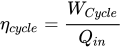
where is the thermal input of the cycle, provided by either combustion or with a heat exchanger, and is the power produced by the cycle.


Hub AI
Transcritical cycle AI simulator
(@Transcritical cycle_simulator)
Transcritical cycle
A transcritical cycle is a closed thermodynamic cycle where the working fluid goes through both subcritical and supercritical states. In particular, for power cycles the working fluid is kept in the liquid region during the compression phase and in vapour and/or supercritical conditions during the expansion phase. The ultrasupercritical steam Rankine cycle represents a widespread transcritical cycle in the electricity generation field from fossil fuels, where water is used as working fluid. Other typical applications of transcritical cycles to the purpose of power generation are represented by organic Rankine cycles, which are especially suitable to exploit low temperature heat sources, such as geothermal energy, heat recovery applications or waste to energy plants. With respect to subcritical cycles, the transcritical cycle exploits by definition higher pressure ratios, a feature that ultimately yields higher efficiencies for the majority of the working fluids. Considering then also supercritical cycles as a valid alternative to the transcritical ones, the latter cycles are capable of achieving higher specific works due to the limited relative importance of the work of compression work. This evidences the extreme potential of transcritical cycles to the purpose of producing the most power (measurable in terms of the cycle specific work) with the least expenditure (measurable in terms of spent energy to compress the working fluid).
While in single level supercritical cycles both pressure levels are above the critical pressure of the working fluid, in transcritical cycles one pressure level is above the critical pressure and the other is below. In the refrigeration field carbon dioxide, CO2, is increasingly considered of interest as refrigerant.
In transcritical cycles, the pressure of the working fluid at the outlet of the pump is higher than the critical pressure, while the inlet conditions are close to the saturated liquid pressure at the given minimum temperature.
During the heating phase, which is typically considered an isobaric process, the working fluid overcomes the critical temperature, moving thus from the liquid to the supercritical phase without the occurrence of any evaporation process, a significant difference between subcritical and transcritical cycles. Due to this significant difference in the heating phase, the heat injection into the cycle is significantly more efficient from a second law perspective, since the average temperature difference between the hot source and the working fluid is reduced.
As a consequence, the maximum temperatures reached by the cold source can be higher at fixed hot source characteristics. Therefore, the expansion process can be accomplished exploiting higher pressure ratios, which yields higher power production. Modern ultrasupercritical Rankine cycles can reach maximum temperatures up to 620°C exploiting the optimized heat introduction process.
As in any power cycle, the most important indicator of its performance is the thermal efficiency. The thermal efficiency of a transcritical cycle is computed as:
where is the thermal input of the cycle, provided by either combustion or with a heat exchanger, and is the power produced by the cycle.