Hubbry Logo
Griffith's experimentGriffith's experimentMain
Open search
Griffith's experiment
Community hub
Griffith's experiment
logo
8 pages, 0 posts
0 subscribers
Be the first to start a discussion here.
Griffith's experiment
from Wikipedia
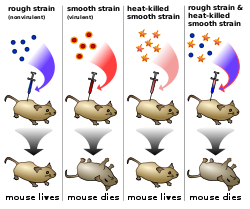
Griffith's experiment discovering the "transforming principle" in Streptococcus pneumoniae (pneumococcal) bacteria.

Griffith's experiment,[1] performed by Frederick Griffith and reported in 1928,[2] was the first experiment suggesting that bacteria are capable of transferring genetic information through a process known as transformation.[3][4] Griffith's findings were followed by research in the late 1930s and early 40s that isolated DNA as the material that communicated this genetic information.

Pneumonia was a serious cause of death in the wake of the post-WWI Spanish influenza pandemic, and Griffith was studying the possibility of creating a vaccine. Griffith used two strains of pneumococcus (Streptococcus pneumoniae) bacteria which infect mice – a type III-S (smooth) which was virulent, and a type II-R (rough) strain which was nonvirulent. The III-S strain synthesized a polysaccharide capsule that protected itself from the host's immune system, resulting in the death of the host, while the II-R strain did not have that protective capsule and was defeated by the host's immune system. A German bacteriologist, Fred Neufeld, had discovered the three pneumococcal types (Types I, II, and III) and discovered the quellung reaction to identify them in vitro.[5] Until Griffith's experiment, bacteriologists believed that the types were fixed and unchangeable, from one generation to another.

In this experiment, bacteria from the III-S strain were killed by heat, and their remains were added to II-R strain bacteria. While neither alone harmed the mice, the combination was able to kill its host. Griffith was also able to isolate both live II-R and live III-S strains of pneumococcus from the blood of these dead mice. Griffith concluded that the type II-R had been "transformed" into the lethal III-S strain by a "transforming principle" that was somehow part of the dead III-S strain bacteria.

Scientific advances since then have revealed that the "transforming principle" Griffith observed was the DNA of the III-s strain bacteria. While the bacteria had been killed, the DNA had survived the heating process and was taken up by the II-R strain bacteria. The III-S strain DNA contains the genes that form the smooth protective polysaccharide capsule. Equipped with this gene, the former II-R strain bacteria were now protected from the host's immune system and could kill the host. The exact nature of the transforming principle (DNA) was verified in the experiments done by Avery, McLeod and McCarty and by Hershey and Chase.

Notes

[edit]

References

[edit]

Further reading

[edit]
Revisions and contributorsEdit on WikipediaRead on Wikipedia
from Grokipedia
Griffith's experiment, conducted in 1928 by British medical microbiologist Frederick Griffith, was a pivotal study demonstrating bacterial transformation using strains of Streptococcus pneumoniae, the bacterium responsible for pneumonia in humans. Griffith identified two key forms of the bacterium: the virulent smooth (S) strain, characterized by a polysaccharide capsule that enables it to evade host immunity and cause lethal infections in mice, and the avirulent rough (R) strain, lacking this capsule and thus harmless. In the core experiment, Griffith injected mice with either live R bacteria (resulting in survival), heat-killed S bacteria (also survival), or a mixture of heat-killed S and live R bacteria, from which the mice unexpectedly died, yielding viable S-type bacteria of the original serotype recovered from their bloodstream. This outcome revealed a "transforming principle" in the heat-killed S extract capable of permanently altering the genetic and phenotypic properties of the live R bacteria, converting them into virulent S forms. The experiment's methods involved heating virulent S strains (such as Type I or II) at 60°C for 2–3 hours to ensure while preserving the transforming agent, then combining them with live R strains of a different type (e.g., Type II R with Type I S). Griffith's controls confirmed that neither component alone caused mortality, isolating the transformation effect to the interaction between the components. Published in the Journal of Hygiene, the findings challenged prevailing views on bacterial stability and suggested a heritable factor transferable between cells, though Griffith did not identify its chemical nature. Griffith's work arose from epidemiological observations of pneumococcal type changes in pneumonia patients, aiming to clarify virulence fluctuations rather than multiple infections. Its significance lies in providing the first evidence of horizontal gene transfer in bacteria, paving the way for later discoveries, including Oswald Avery, Colin MacLeod, and Maclyn McCarty's 1944 confirmation that deoxyribonucleic acid (DNA) was the transforming principle. This breakthrough revolutionized molecular genetics, establishing DNA as the molecule of heredity and influencing fields from biotechnology to synthetic biology, such as the engineering of minimal genomes. Despite Griffith's untimely death in 1941 during the London Blitz, his experiment remains a foundational milestone in understanding genetic transformation and microbial evolution.

Historical and Scientific Background

Bacterial Pneumonia and Streptococcus pneumoniae

Streptococcus pneumoniae is a gram-positive, lancet-shaped, facultative anaerobic bacterium that primarily causes , a form of acute infection characterized by consolidation of an entire lobe of the . This pathogen is responsible for the majority of community-acquired , leading to severe respiratory illness through invasion of the lower . Common symptoms include sudden onset of high fever, chills, productive cough, and exacerbated by breathing, with the often appearing rusty or blood-tinged due to the presence of red blood cells. These manifestations reflect the inflammatory response to bacterial proliferation in the alveoli, potentially progressing to systemic complications if untreated. The virulence of S. pneumoniae is largely attributed to its polysaccharide capsule, which envelops the bacterium in smooth (S) strains and enables evasion of phagocytosis by host macrophages and neutrophils. This capsular layer inhibits opsonization and complement-mediated clearance, allowing encapsulated strains to cause lethal infections in susceptible hosts, such as mice, where intravenous injection of as few as 10^5 S-strain bacteria results in rapid mortality. In contrast, rough (R) strains, which lack the capsule due to spontaneous mutations, form non-mucoid colonies and are avirulent, failing to establish infection even at high doses because they are readily phagocytosed. Observations of these colony morphology variants emerged in the early , highlighting the capsule's essential role in . In the early , pneumonia ranked as one of the leading causes of death worldwide, claiming hundreds of thousands of lives annually and often surpassing as a killer, particularly among the young and elderly. Its prevalence surged following outbreaks, as viral damage to the facilitated secondary bacterial superinfections; for instance, during the 1918 pandemic, accounted for over 90% of fatalities in autopsy-reviewed cases, contributing to an estimated 50 million global deaths. This era's high mortality underscored the urgent need for therapeutic advances, including vaccine strategies targeting pneumococcal strains. S. pneumoniae was independently isolated in the 1880s by in , from the saliva of a patient, and by George Sternberg in the United States, who demonstrated its pathogenicity in rabbits. Subsequent microbiological studies revealed strain variability based on capsular antigens, with Alphonse Dochez and Louise Gillespie establishing a in that distinct types (initially Types I, II, and III) through immunity reactions in animal models. This typing framework was pivotal for understanding epidemiological patterns and informed early development efforts, including those by , who investigated pneumococcal serotypes to combat virulent strains.

Prior Studies on Bacterial Virulence

Prior to Griffith's 1928 experiment, research on bacterial virulence, particularly in (pneumococcus), focused on identifying factors responsible for its pathogenicity in . Early studies established that virulence was closely linked to the presence of a capsule, which protected the bacteria from . Non-encapsulated variants, termed rough (R) forms, were avirulent and unable to cause disease, while encapsulated smooth (S) forms were highly virulent. These observations laid the groundwork for investigations into stable bacterial characteristics and potential transforming agents. In 1909, Friedrich Neufeld and colleagues at the identified three distinct pneumococcal serotypes through protection experiments in mice, demonstrating that antisera raised against one type conferred immunity only to homologous strains, not to others. This type-specific immunity was further visualized in 1902 via Neufeld's , where type-specific antisera caused observable capsular swelling in corresponding pneumococcal strains under a , confirming the immunological specificity of capsular . These findings highlighted the existence of multiple stable serotypes, each with unique properties tied to their capsules. During the 1910s, Rufus Cole and Alphonse R. Dochez at the Rockefeller Institute advanced pneumococcal typing for therapeutic production, classifying strains into four major types (I–IV) based on serological reactivity and their prevalence in human cases. Their 1917 monograph detailed how type-specific antisera could neutralize homologous bacteria in animal models, but emphasized challenges in maintaining type stability during serial passages, as some cultures spontaneously lost or shifted forms. This work underscored the heritable nature of pneumococcal types, as stability was preserved through animal passage but not always . The concept of pneumococcal "types" as stable, heritable traits emerged from immunological cross-protection studies, where no protection was observed between types, indicating genetically fixed differences rather than environmental variations. Dochez and Oswald Avery's work demonstrated a soluble specific substance (SSS)—a capsular —in filtrates of pneumococcal cultures, which precipitated with type-specific antisera and was detectable in infected animal fluids, providing evidence for extracellular components. These pre-1928 efforts collectively set the stage for exploring how traits could be altered or transferred between .

Experimental Design

Griffith's Objectives and Hypothesis

, a British serving as a medical officer at the Pathological Laboratory of the Ministry of Health in , dedicated much of his career to the and of caused by . His research emphasized the development of effective vaccines and therapeutic antisera to combat this prevalent and often fatal disease, particularly in the post-World War I era when contributed significantly to mortality rates. Building on earlier serological typing work by Alphonse Dochez and colleagues, which had identified distinct pneumococcal types based on capsule antigens, Griffith sought to refine these classifications for practical applications in . Griffith's primary objective in his 1928 study was to investigate the stability of pneumococcal types and determine whether they could change or revert under laboratory conditions, as this knowledge was essential for producing multivalent capable of protecting against multiple strains. He aimed to address inconsistencies in type distributions observed in clinical samples from patients, where multiple types sometimes appeared in the same individual, potentially complicating antiserum production and vaccine efficacy. By exploring these dynamics, Griffith hoped to explain apparent "type conversions" noted in cultured and enhance strategies for inducing protective immunity without relying solely on live virulent strains. Central to his approach was the hypothesis that type-specific factors from heat-killed virulent (smooth, S-form) pneumococci could be taken up by live avirulent (rough, R-form) strains, enabling the R strains to acquire the capsular characteristics and virulence of the S type, thus explaining observed type changes in infections. Griffith posited that attenuated R strains, which lacked the full capsular substance, might "rebuild" their type characteristics and virulence by incorporating substances from heated S cultures of the same or different types, a process he viewed as more plausible than assuming multiple independent infections. This idea stemmed from his observations of variable stability in R strains and the need for reliable methods to generate immunogenic material for vaccines. The experiment, conducted in 1928 and published in the Journal of Hygiene, represented a targeted effort to test these concepts in a controlled setting using mouse models.

Materials and Methods

Griffith employed strains of Streptococcus pneumoniae (pneumococcus) in his experiments, including the virulent smooth (S) forms of Types I and II, isolated from human cases of lobar pneumonia via sputum or lung samples, and avirulent rough (R) variants derived in the laboratory from S strains through cultivation in homologous immune serum or on solid media. Experiments included mixtures of heat-killed S from one type with live R from another (e.g., Type I S with Type II R) to test for type-specific transformation. These strains were selected to investigate bacterial stability and potential applications in vaccine development against pneumonia. To prepare heat-killed S bacteria, Griffith grew virulent S cultures in glucose or blood , centrifuged the suspensions, and heated them in sealed tubes at 60°C for durations ranging from 15 minutes to 3 hours, ensuring complete sterilization while aiming to preserve transforming antigens; alternatively, steaming at 100°C for 12-20 minutes was used in some preparations, with sterility confirmed by the absence of viable growth on . White mice (Mus musculus) served as the animal model for assessing bacterial and transformation, with inoculations administered subcutaneously at doses of 0.5-1 mL containing bacterial suspensions equivalent to 0.2-1.0 mL of original broth culture for live strains or larger deposits up to 110 mL in aggregated form for heat-killed. Strains were maintained and propagated in blood broth or glucose broth, with typing and verification performed on chocolate blood agar plates, where S colonies appeared smooth and glistening due to capsules, while R colonies were rough and matte; agglutination tests using type-specific antisera (e.g., for Type II) confirmed strain identity through observable clumping reactions.

Conducting the Experiment

Procedure Details

Griffith's experiment involved four controlled groups of mice to test the interactions between virulent and avirulent strains of Streptococcus pneumoniae. The first group received injections of live rough (R) strain bacteria alone, which formed non-capsulated, rough colonies and were avirulent. The second group was injected with heat-killed smooth (S) strain bacteria alone, which typically produced encapsulated, smooth colonies and were virulent in their live form. The third group received a mixture of live R strain and heat-killed S strain bacteria of different serotypes (e.g., Type II R with Type I S), consisting of live R strain bacteria and a concentrated deposit from heat-killed S strain bacteria. The fourth group served as a positive control, receiving live S strain bacteria alone to confirm their expected lethality. Bacterial preparation began with culturing both R and S strains in nutrient broth, such as chocolate agar broth, to obtain sufficient quantities for inoculation. The S strain was then heat-killed by heating at 60°C for 30 minutes to several hours, ensuring no viable cells remained while preserving potential transforming agents; viability was verified by the absence of growth in subcultures. Immediately prior to injection, the components were mixed to form the experimental combination, minimizing any degradation of components. Inoculations were administered via subcutaneous injection into groups of mice, typically using doses of approximately 0.5 mL to 1 mL per mouse, depending on the bacterial concentration. Following injection, the mice were monitored for 24 to 48 hours for signs of , including , respiratory distress, and mortality, with observations extending up to 10 days if needed to confirm outcomes. As a control measure, deceased mice underwent autopsy, during which heart blood and other tissues were harvested and cultured to identify and type the bacteria present, confirming the strain responsible for any observed effects through morphological and serological analysis.

Live and Heat-Killed Bacteria Inoculations

In Griffith's experiment, the live rough (R) strain of Streptococcus pneumoniae was utilized as a non-encapsulated, avirulent variant incapable of causing infection in healthy mice. This strain, derived from attenuated cultures grown in immune serum or on solid media, formed rough colonies and lacked the polysaccharide capsule essential for virulence, making it suitable for testing potential interactions that could alter its properties, such as transformation to a virulent form. The heat-killed smooth (S) strain, in contrast, consisted of virulent, encapsulated that had been rendered non-viable through treatment, resulting in the loss of reproductive capacity while preserving key structural and immunogenic components. Cultures of the S strain were grown in , concentrated by , and heated at 60°C for 1 to 3 hours to ensure sterility, as confirmed by subsequent incubation and plating tests showing no viable pneumococci. This process denatured proteins and eliminated infectivity but retained the capsule antigens and soluble factors, including the "specific S substance," which were hypothesized to confer or influence bacterial behavior. The rationale for combining live R bacteria with heat-killed S bacteria was to simulate a vaccination-like scenario, where the harmless live avirulent strain acted as a carrier, potentially absorbing or utilizing the immunogenic components from the dead virulent strain to probe for biological interactions, such as reversion to virulence. This mixture was administered to mice as one of several experimental groups to investigate whether the retained antigens in the heat-killed S could induce changes in the R strain, beyond mere passive protection. Notably, the 60°C heat-killing method was selected because it effectively killed the bacteria while leaving the transforming principle—later identified as DNA—intact, allowing for unexpected genetic transfer.

Results and Interpretation

Key Observations

Griffith conducted experiments using mice inoculated with different preparations of strains, specifically the non-virulent rough (R) strain and the virulent smooth (S) strain of different types, such as Type II R and heat-killed Type I S. In the control group receiving only live R strain , all mice survived with no signs of , and no smooth (S)-type bacteria were recovered from their or organs, ruling out spontaneous reversion or contamination. Mice inoculated solely with heat-killed S strain bacteria also all survived, showing no septicemia, and autopsies yielded no viable S bacteria, confirming the effectiveness of the heat-killing process at 60°C. In the experimental group injected with a of live R strain and heat-killed S strain bacteria, the mice developed septicemia and died; autopsies of the deceased mice revealed encapsulated S pneumococci of the type matching the heat-killed strain in their blood, which were isolated and confirmed virulent through , forming smooth colonies and causing death upon reinoculation into fresh mice. As expected, the positive control group receiving live S strain resulted in all mice dying rapidly from , with large numbers of virulent S-type recovered from their .

Discovery of Transformation

The phenomenon observed in Griffith's experiment constituted the stable, heritable conversion of avirulent rough (R) strain into the virulent smooth (S) strain type upon exposure to an extract from heat-killed S . This process, later termed bacterial transformation, resulted in R acquiring the morphological, serological, and pathogenic characteristics of the S type, enabling them to cause fatal infections in mice. Griffith interpreted these findings as evidence of a "" derived from the dead S cells that induced a permanent type change in the living R cells, rather than a transient or reversible alteration. He emphasized that the recovered bacteria exhibited fully virulent S properties, distinct from any simple reversion to the original form or the formation of hybrid variants. This transforming was capable of conferring type-specific traits, as demonstrated when R bacteria of one type (e.g., Type II) were converted to another (e.g., Type I) matching the heat-killed S strain used. Supporting the heritable nature of this change, subcultures derived from the transformed isolated from infected tissues consistently produced virulent S colonies across multiple generations, maintaining their capsulated morphology and lethality without reverting to the R form. These observations indicated genetic stability, as the transformed strains could be propagated indefinitely in culture while retaining full S . Although the term "transformation" was coined in subsequent studies, Griffith described the altered in his 1928 report as undergoing a specific , occasionally referring to potential "intermediate" forms but ultimately concluding they represented true S pneumococci rather than reversions or partial changes.

Impact and Legacy

Immediate Scientific Implications

Griffith's 1928 experiment challenged the prevailing bacteriological consensus that pneumococcal serotypes were fixed and immutable across generations, demonstrating instead that avirulent rough () strains could acquire and type-specificity from heat-killed smooth (S) strains through a process of transformation, implying dynamic genetic exchange between . This finding suggested bacterial were not static entities but capable of heritable changes in antigenic properties, prompting reevaluation of epidemiological patterns in pneumococcal infections. The discovery faced initial skepticism within the , primarily due to the absence of a clear mechanism explaining how the transforming agent operated, with prominent researchers like questioning its reproducibility and biological plausibility amid concerns over experimental controls. However, validation came swiftly through replications: Martin Dawson and Richard Sia achieved transformation in 1931, while James Alloway's 1932 work using sterile, cell-free extracts from heat-killed pneumococci confirmed the phenomenon without live donor cells, solidifying its acceptance and attributing the effect to a soluble "." In practical terms, Griffith's results advanced understanding of type-specific immunity in pneumococcal , underscoring the need for targeting multiple serotypes to counter variability in expression. Polyvalent pneumococcal in the 1930s, such as those incorporating capsular from predominant types, improved serological protection against outbreaks. By the early , Griffith's work was frequently cited in bacterial studies, influencing a paradigm shift away from Lamarckian notions of environmentally induced, non-heritable adaptations toward recognition of stable, transferable heritable factors in microbial variation. For instance, Dawson and Sia's experiments built directly on Griffith's observations to explore transformation's genetic basis, redirecting research toward particulate inheritance models in .

Influence on Genetic Research

Griffith's 1928 experiment provided the foundational evidence for bacterial transformation, a process where genetic material from one bacterium could alter the traits of another, which directly inspired subsequent efforts to identify the chemical nature of this "transforming principle." In 1944, Oswald Avery, Colin MacLeod, and Maclyn McCarty built upon Griffith's model by purifying the transforming substance from heat-killed virulent pneumococci and demonstrating through enzymatic degradation experiments that it was deoxyribonucleic acid (DNA), not protein, responsible for inducing heritable changes in non-virulent strains. This breakthrough shifted the scientific consensus toward DNA as the carrier of genetic information, overturning prevailing views that proteins were the primary hereditary molecules. The identification of DNA as the transforming agent paved the way for further confirmation in viral systems. In 1952, Alfred Hershey and Martha Chase conducted experiments with bacteriophages, labeling viral DNA with radioactive and proteins with sulfur, to show that only the DNA entered host to direct , solidifying DNA's role as the genetic material over proteins. This work, inspired by the bacterial transformation paradigm established by Griffith and refined by Avery and colleagues, provided irrefutable evidence that DNA is the molecule of heredity across different organisms. Griffith's demonstration of transformation also laid the groundwork for technology, enabling the deliberate insertion of foreign genes into host cells—a technique central to modern for producing insulin, vaccines, and genetically modified organisms. Beyond these molecular milestones, Griffith's findings illuminated non-sexual mechanisms of transfer in , influencing research on (HGT), where genetic material moves between organisms without reproduction. This process, first evidenced by Griffith's observation of trait acquisition in live exposed to extracts from dead ones, has since been recognized as a key driver of bacterial , resistance, and microbial . Studies on HGT in diverse bacterial continue to draw from this early model, highlighting transformation as one of three primary HGT pathways alongside conjugation and transduction. Tragically, Frederick Griffith did not live to witness the full vindication of his discovery, as he perished in 1941 during an air raid in the London Blitz amid World War II, three years before Avery's team confirmed DNA's role and unaware of the molecular revolution his work would ignite. Nonetheless, his experiment is universally credited as the inaugural demonstration of genetic transformation, catalyzing the birth of molecular genetics and transforming our understanding of heredity.

References

Add your contribution
Related Hubs
User Avatar
No comments yet.