Hubbry Logo
RNA worldRNA worldMain
Open search
RNA world
Community hub
RNA world
logo
8 pages, 0 posts
0 subscribers
Be the first to start a discussion here.
RNA world
RNA world
from Wikipedia
Not found
Revisions and contributorsEdit on WikipediaRead on Wikipedia
from Grokipedia
The RNA world hypothesis posits that early life on Earth evolved from a stage where RNA molecules served dual roles as both genetic material, storing and transmitting information via self-replication, and as catalysts, performing biochemical reactions akin to enzymes, prior to the emergence of DNA and proteins. This model suggests that RNA's versatility allowed it to bootstrap the development of more complex cellular machinery, with genetic continuity maintained through RNA replication driven by Watson-Crick base-pairing. The concept traces its roots to the 1960s, when researchers including , , and Leslie Orgel independently proposed that or a similar could have predated proteins in primordial biochemistry. The term "RNA world" was coined by in 1986, building on these ideas to describe a prebiotic era dominated by . A pivotal advancement came in 1982–1983 with the discovery of ribozymes—RNA molecules with catalytic activity—by , who identified self-splicing introns in , and Sidney Altman, who characterized the RNA component of RNase P as an enzyme. This breakthrough, for which Cech and Altman shared the 1989 , provided direct evidence that could function catalytically, challenging the protein-centric view of enzymology. Supporting evidence includes the central role of RNA in modern , such as the ribosome's peptidyl transferase center, which is a responsible for protein synthesis. Laboratory experiments have demonstrated capable of replicating other RNA strands, as shown by Bartel and Szostak in 1993, and continuous evolution of self-replicating RNA systems by Lincoln and Joyce in 2009; more recently, in 2024, researchers at the Salk Institute developed high-fidelity enabling molecular-scale Darwinian . Prebiotic chemistry studies further bolster the hypothesis, with demonstrations of synthesis and non-enzymatic RNA polymerization under simulated conditions. Despite its prominence, the RNA world faces challenges, including the instability of RNA in prebiotic environments and the difficulty of achieving robust, error-free replication without protein assistance. Recent models propose hybrid scenarios, such as an RNA-DNA world transition involving reverse transcriptase-like ribozymes to incorporate DNA for greater stability. Ongoing research continues to refine the hypothesis through advances in synthetic biology and astrobiology, aiming to reconstruct plausible pathways for life's origins.

Historical Development

Origins of the Hypothesis

The origins of the RNA world hypothesis can be traced to mid-20th-century speculations about RNA's potential dual functionality as both a carrier of genetic information and a biochemical catalyst, predating the modern synthesis of the idea. In 1962, Alexander Rich proposed that early life forms might have relied on RNA molecules capable of serving both informational and enzymatic roles, suggesting that primitive genetic systems could have operated without proteins or DNA. This insight was influenced by emerging understandings of RNA's structural versatility and its central position in cellular processes, positioning RNA as a plausible precursor to more complex biopolymers. The discovery of (tRNA) in the late 1950s further fueled these ideas by revealing RNA's active role in protein synthesis beyond mere templating. tRNA, identified as an adaptor molecule that links to codons, underscored RNA's intermediary function in translating genetic information into proteins, prompting questions about whether RNA alone could have sustained primitive replication and catalysis. These developments were amplified through informal discussions in the RNA Tie Club, a group of 20 scientists formed by in 1954 to decipher the , where members like and exchanged ideas on RNA's structural and functional primacy in early biology. The club's deliberations in the 1950s and 1960s highlighted RNA's potential as a foundational molecule, laying groundwork for hypotheses about its prebiotic dominance. By the late 1960s, independent proposals by Carl Woese, Francis Crick, and Leslie Orgel explicitly framed RNA as the precursor to both DNA and proteins in evolutionary history. In his 1967 book, Woese argued that early protocells likely had RNA-based genomes, with individual genes as separate RNA strands that replicated and evolved without protein involvement. Complementing this, Crick and Orgel's 1968 companion papers advanced the "RNA replication hypothesis," positing that self-replicating RNA molecules could have initiated genetic continuity, gradually incorporating proteins and later DNA as evolutionary advantages emerged. These formulations crystallized RNA's proposed primacy in the origin of life, bridging theoretical speculation with the era's biochemical insights.

Key Milestones and Discoveries

In 1986, coined the term "RNA world" in a article, proposing a prebiotic era where RNA served as both genetic material and catalyst, building on prior speculations to frame the hypothesis more cohesively. The discovery of self-splicing introns in the precursor of thermophila in 1982 by and colleagues marked a pivotal breakthrough, demonstrating that RNA could catalyze its own splicing without protein assistance, challenging the prevailing view that only proteins function as enzymes. This finding, detailed in the seminal paper by Kruger et al., revealed the intron's autocatalytic excision and circularization, providing the first evidence of RNA's enzymatic potential. For this work, Cech shared the 1989 with . In 1983, Sidney Altman and his team identified the RNA component of ribonuclease P (RNase P) as the catalytic subunit, capable of cleaving transfer RNA precursors in the absence of its protein moiety, thus establishing the second natural ribozyme. Published by Guerrier-Takada et al., this discovery showed that the M1 RNA subunit alone could perform the endonucleolytic reaction under high-magnesium conditions, confirming RNA's role as a true enzyme. Altman shared the 1989 Nobel Prize in Chemistry for this contribution. During the 1990s, advances in evolution enabled the generation of artificial ribozymes, with Gerald Joyce and Jack Szostak's laboratories isolating RNA ligases from random-sequence pools, as reported in Bartel and Szostak's 1993 study, which demonstrated template-independent ligation activities up to 100 times faster than natural counterparts. Building on this, Ekland et al. in evolved structurally complex ligase ribozymes that incorporated multiple catalytic domains, laying groundwork for functions. By the late 1990s, these efforts extended to rudimentary ribozymes, such as those derived by Lehman and Joyce in 1999, which catalyzed template-directed with up to 20 nucleotides added per reaction. The 2009 Nobel Prize in Chemistry, awarded to Venkatraman Ramakrishnan, , and Ada E. Yonath, recognized their crystallographic structures of the , which at resolutions down to 2.5 Å revealed the peptidyl transferase center as an RNA-based catalyst devoid of protein contributions to the core reaction mechanism. These structures, including Steitz's 2000 model of the large subunit and subsequent refinements, confirmed that residues position substrates for formation, solidifying RNA's ancient enzymatic role in protein synthesis. Recent milestones include the 2020 development of an evolved class I ribozyme by Tjhung et al. in Gerald F. Joyce's laboratory, capable of accurately transcribing complex RNA templates up to 100 long, including functional and aptamers, with fidelity approaching 95% and enabling of its ancestor sequence. Further progress by 2024 saw the cryo-EM structure of an advanced polymerase at 5 Å resolution, elucidating its architecture and supporting RNA-templated as a plausible prebiotic mechanism. These achievements highlight ongoing efforts to reconstruct RNA world replication systems.

Core Concepts of the RNA World

RNA as a Catalyst

Ribozymes are molecules that function as enzymes, catalyzing specific biochemical reactions much like protein enzymes. The discovery of ribozymes revolutionized understanding of 's potential roles in early life, demonstrating that can perform essential for self-sustaining replication in an RNA world scenario. Prominent natural examples include self-splicing s, where catalyzes its own excision from precursor transcripts. In the group I from Tetrahymena thermophila ribosomal , the folds into a complex structure that promotes two reactions: first, the 3'-OH of an internal guide sequence attacks the 5'-splice site, cleaving the ; second, the 3'-OH of the upstream attacks the 3'-splice site to join the s and circularize the . Another key example is RNase P, a ribonucleoprotein complex in bacteria that processes (tRNA) precursors by cleaving the 5' leader sequence. The subunit of RNase P acts as the catalyst, recognizing the tRNA structure and performing endonucleolytic cleavage, with the protein enhancing efficiency but not essential for activity . The peptidyl transferase center (PTC) in the ribosome's large subunit represents a critical , catalyzing formation during protein synthesis by facilitating nucleophilic attack of the aminoacyl-tRNA's α-amino group on the peptidyl-tRNA's ester linkage. Experiments depleting ribosomal proteins showed retained PTC activity, confirming the rRNA's catalytic role. Ribozymes rely on RNA's unique chemical properties for catalysis, particularly the 2'-hydroxyl (2'-OH) group on the ribose sugar, which is absent in DNA and enables greater reactivity. This 2'-OH can be deprotonated to form a nucleophile or position substrates for attack on phosphodiester bonds, as seen in self-cleaving ribozymes where it initiates transesterification by attacking the adjacent 3'-phosphodiester linkage. In contrast to DNA's stable deoxyribose lacking this group, RNA's 2'-OH facilitates both structural flexibility and direct participation in reaction mechanisms, such as general acid-base catalysis or substrate alignment in the Tetrahymena intron. Many ribozymes require metal ion cofactors, especially Mg²⁺, to achieve proper folding and catalytic activity. Mg²⁺ ions neutralize the backbone's negative charges, stabilizing RNA tertiary structures necessary for formation, as in the where specific Mg²⁺ binding sites coordinate the cofactor and align substrates. In , Mg²⁺ often acts as a Lewis acid, activating nucleophiles or polarizing bonds; for instance, in RNase P, Mg²⁺ facilitates the 2'-OH attack on the scissile by coordinating water or hydroxyl groups. Optimal Mg²⁺ concentrations vary, but typically millimolar levels (e.g., 5-10 mM) support folding and turnover without inhibition. In vitro selection techniques have generated diverse ribozymes, expanding evidence for RNA's catalytic versatility. Using SELEX (systematic evolution of ligands by exponential enrichment), random RNA pools are iteratively selected for ligation activity, yielding ribozymes that join RNA fragments via 3'-5' or 2'-5' phosphodiester bonds, mimicking prebiotic . Cleavage ribozymes have been evolved to site-specifically hydrolyze RNA, with variants achieving rates up to 1 min⁻¹ under physiological conditions, demonstrating potential for RNA processing in an RNA world. ribozymes, selected for template-directed addition, catalyze multiple incorporation cycles, with one variant achieving processivity of up to 20 , supporting RNA replication hypotheses. Recent advances, such as ribozyme-mediated RNA synthesis in simulated environments as of 2023, further highlight RNA's evolvability, as their activities can be optimized through .

RNA as Genetic Material

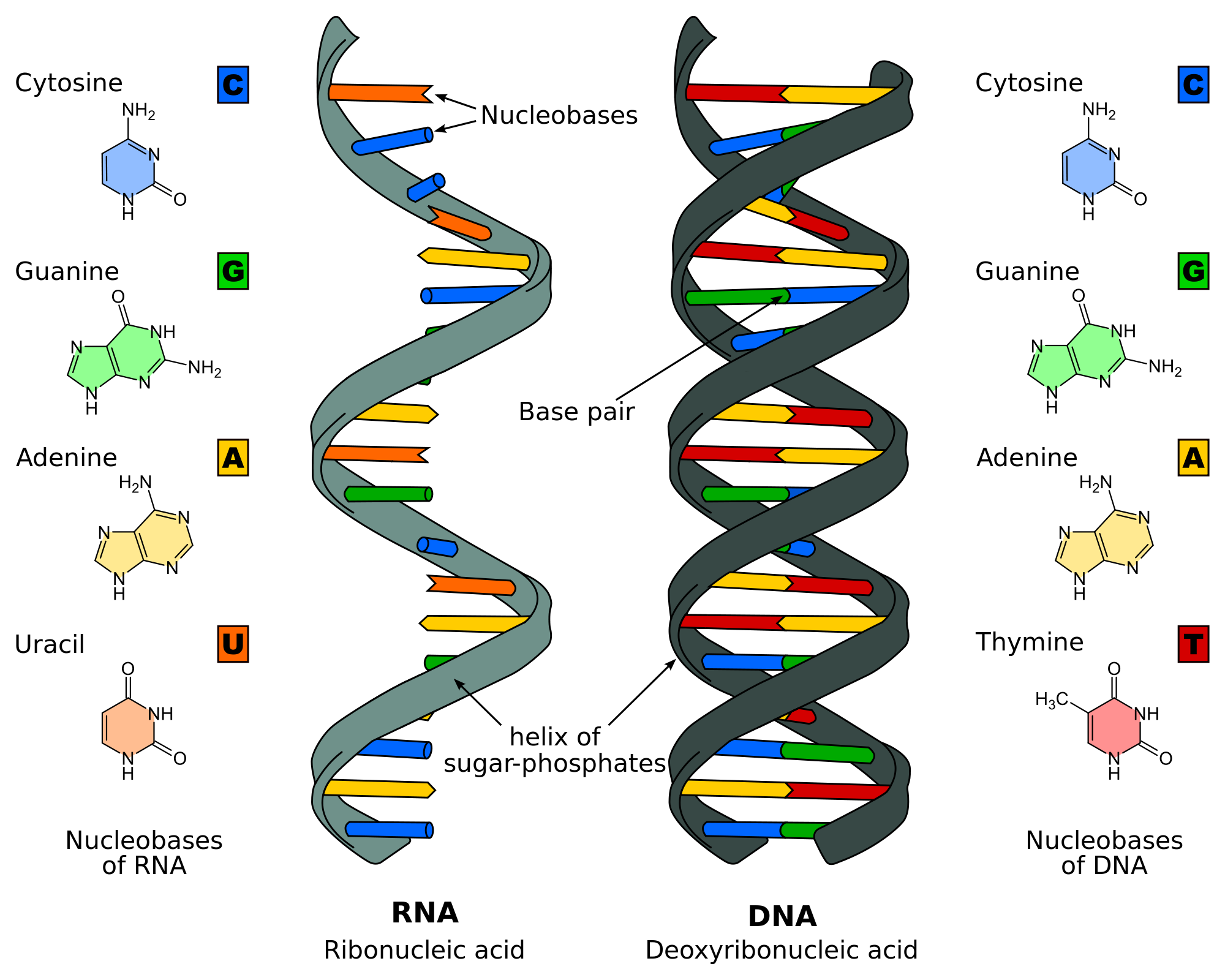
In the RNA world hypothesis, RNA served as the primary genetic material, capable of storing heritable information and enabling its transmission through template-directed replication via Watson-Crick base-pairing. Unlike DNA, which forms a stable double helix, RNA is typically single-stranded, allowing it to fold into complex secondary structures such as hairpins and loops while still facilitating base-pairing with complementary strands during replication. This flexibility was essential in a prebiotic environment lacking protein enzymes, where RNA molecules could act as both information carriers and, potentially, rudimentary replicases. Structurally, RNA differs from DNA in key ways that influenced its role in early life. RNA incorporates uracil instead of thymine as one of its bases, pairing with , which may have been simpler to synthesize prebiotically since uracil formation avoids the additional step required for . Its sugar backbone consists of rather than , introducing a hydroxyl group at the 2' position that enhances reactivity but also contributes to chemical instability, particularly under alkaline conditions or hydrolytic attack, making RNA more prone to degradation than DNA. Additionally, RNA's single-stranded nature contrasts with DNA's double helix, providing less inherent protection against damage but enabling dynamic interactions necessary for in the absence of sophisticated repair mechanisms. A major limitation of RNA as genetic material lies in its replication fidelity, which is inherently error-prone due to the lack of proofreading capabilities in early ribozyme-based systems. This restricts viable genome lengths to short polymers to avoid error catastrophe, where mutations overwhelm functional sequences. Modern RNA viruses provide compelling evidence that RNA can function as a stable genetic material within cellular contexts, supporting the plausibility of an RNA-based precursor to DNA life. Examples include viruses like and , which carry single-stranded RNA genomes that replicate via RNA-dependent RNA polymerases, demonstrating RNA's capacity for information storage and propagation without DNA intermediaries. These viral systems, though dependent on host machinery, illustrate how RNA genomes persist and evolve, echoing the proposed dynamics of the primordial RNA world.

RNA in Gene Regulation

In the RNA world hypothesis, RNA molecules are posited to have played crucial roles not only in information storage and catalysis but also in regulating gene expression through non-coding RNAs that provided feedback mechanisms for controlling replication and resource allocation in primordial replicators. Riboswitches, structured RNA domains within messenger-like RNAs, exemplify this by directly sensing environmental metabolites or ions and modulating transcription or translation without requiring protein intermediaries, a capability that likely enabled adaptive responses in an RNA-dominated biosphere. These elements, such as the thiamine pyrophosphate (TPP) riboswitch, bind cofactors derived from RNA precursors, suggesting their ancient origins as sensors in early metabolic networks. Antisense RNAs further illustrate RNA's regulatory prowess, functioning through direct RNA-RNA base-pairing interactions to attenuate or target RNAs, thereby preventing over-replication and maintaining balance in primitive genetic systems. In hypothetical early replicators, these antisense molecules could form duplexes with sense strands, inhibiting replication or promoting degradation, which would have been essential for population-level control in RNA-based protocells lacking complex protein machinery. Such mechanisms mirror modern bacterial systems where antisense transcripts regulate or genes, hinting at conserved strategies from the RNA era. Modern small non-coding RNAs, including microRNAs (miRNAs) and small interfering RNAs (siRNAs), are viewed as evolutionary relics of RNA world regulation, where they likely evolved from ancient pathways to fine-tune post-transcriptionally. miRNAs, typically 21-25 long, bind imperfectly to target mRNAs to repress or promote decay, while siRNAs enable precise silencing via perfect complementarity, both processes rooted in RNA-RNA interactions that may have originated as defenses against aberrant replication in primordial RNA pools. These pathways, conserved across eukaryotes and some prokaryotes, underscore RNA's versatility in creating layered control hierarchies. Hypothetical primordial regulatory networks, composed of interconnected riboswitches, antisense RNAs, and proto-small RNAs, are proposed to have enabled the of in proto-cells by integrating sensing, , and feedback loops, allowing selective advantages for replicators in fluctuating prebiotic environments. In this model, RNA-RNA interactions formed dynamic circuits that coordinated replication rates with nutrient availability, fostering the transition toward more elaborate genetic systems. Such networks would have provided a scaffold for the of multicomponent , bridging simple autocatalytic cycles to the sophisticated control seen in contemporary .

Evidence Supporting the Hypothesis

Biochemical and Experimental Support

Laboratory experiments have demonstrated that molecules can undergo Darwinian in vitro, supporting the feasibility of an RNA-based replicative system in . In a seminal 1967 study, Sol Spiegelman and colleagues incubated Qβ viral with its replicase in a , allowing serial transfer of the replication products. Over generations, the evolved to shorter variants, with the dominant "Spiegelman's monster" reducing from ~4200 to 218 while retaining replicase binding sites, illustrating rapid of through and selection, albeit dependent on a protein replicase for replication. This experiment provided early that can self-replicate and evolve autonomously, a core requirement for the RNA world hypothesis. Subsequent in vitro studies, such as those evolving ribozymes, further showed RNA's capacity for functional diversification under selective pressure. Recent modeling (2024) demonstrates RNA monomer accumulation and polymerization in thermal gradients mimicking pores, supporting prebiotic RNA formation. Additionally, as of 2025, experiments show spontaneous thioester-driven linkage of to RNA under prebiotic conditions, bridging RNA world to early protein integration. The structure of the ribosome offers compelling biochemical evidence for RNA's ancient role as a catalyst in protein synthesis, consistent with its primacy in the RNA world. High-resolution crystal structures reveal that the peptidyl transferase center (PTC), responsible for forming peptide bonds, is composed entirely of (rRNA), with no nearby proteins contributing to . In the large ribosomal subunit, the 23S rRNA's A-site and residues position substrates for nucleophilic attack, confirming the as a . This RNA-centric catalytic core, surrounded by peripheral proteins that likely evolved later for stabilization, suggests the originated as an RNA machine before protein integration enhanced efficiency. Such findings align with the hypothesis that preceded modern systems. Computational models have explored RNA folding dynamics and replication kinetics, providing quantitative support for the viability of -based replication in prebiotic conditions. Simulations of RNA secondary structure formation indicate that short can achieve stable folds conducive to catalytic activity within plausible environmental parameters, such as varying temperatures and concentrations. Kinetic models of non-enzymatic template-directed replication demonstrate that error-prone copying can sustain populations if replication rates exceed decay, with fidelity thresholds around 1-2% error per enabling evolutionary progress. For instance, agent-based models simulating RNA replicase evolution show that parasitic shorter RNAs can be outcompeted by longer, functional variants under spatial constraints, mirroring observations and bolstering the plausibility of sustained RNA proliferation. These computations highlight that RNA world viability hinges on balancing replication speed against mutation rates, achievable in dilute, fluctuating prebiotic soups. Isotopic labeling studies have traced RNA precursors to extraterrestrial and hydrothermal origins, suggesting abiotic availability for early RNA synthesis. In the Murchison carbonaceous meteorite, compound-specific carbon isotope analyses (δ¹³C values of +37‰ to +45‰) confirm indigenous purines (adenine, guanine) and pyrimidines (uracil, cytosine) as non-terrestrial, formed via formamide-based reactions in the parent body. These nucleobases, alongside detected ribose sugars with extraterrestrial isotopic signatures (δ¹³C +8‰ to +43‰), indicate meteoritic delivery of RNA building blocks to . Laboratory simulations of alkaline hydrothermal vents using isotopically labeled nucleotides (e.g., ¹⁴C- or ¹⁵N-tagged) demonstrate formation of short RNA oligomers (up to 4-mers) on iron-sulfur surfaces, driven by wet-dry cycles and gradients. Such experiments, mimicking vent conditions ( 9-11, 40-90°C), underscore vents as potential sites for RNA precursor accumulation and polymerization.

Natural Biological Analogues

The ribosome's peptidyl transferase center (PTC), composed entirely of (rRNA), catalyzes formation during protein synthesis, serving as a vestigial example of RNA's ancient catalytic capabilities in the RNA world. This RNA-based activity, conserved across all domains of life, involves a core of approximately 180 that positions aminoacyl- and peptidyl-tRNA substrates for nucleophilic attack, with key residues like A2451 and U2585 facilitating the reaction without direct protein involvement. Structural studies reveal the PTC's pseudosymmetric architecture, suggesting it evolved from a dimeric proto-ribosome predating the , where RNA alone drove early of . Experimental reconstruction of minimal PTC constructs has demonstrated efficient formation, reinforcing its role as a "fossil" of primordial . Retroviruses exemplify RNA-to-DNA transitions through reverse transcription, a process that mirrors a hypothesized evolutionary shift from RNA-based genomes to DNA storage in the RNA world. In retroviruses such as HIV-1, reverse transcriptase (RT) enzyme converts the single-stranded viral RNA genome into double-stranded DNA using a tRNA primer, followed by integration into the host genome via integrase. This mechanism, involving RNase H-mediated degradation of RNA-DNA hybrids and strand transfers, parallels ancient ribonucleotide reduction and DNA polymerization events that may have enabled stable genetic inheritance beyond RNA's instability. Long terminal repeats (LTRs) flanking the resulting proviral DNA further stabilize the integrated sequence, providing indirect evidence for how RNA progenitors could have given rise to DNA-dominated systems over a billion years ago. Group I and Group II introns represent self-splicing ribozymes that persist as molecular relics of RNA-mediated RNA processing in modern cells, underscoring the RNA world's legacy in splicing mechanisms. Group I introns, found in eukaryotic nuclear rRNA genes, excise themselves via two transesterification steps using an exogenous guanosine cofactor, as exemplified by the Tetrahymena thermophila pre-rRNA intron, which requires no proteins for in vitro splicing. Similarly, Group II introns, prevalent in bacterial and organellar genomes, form lariat structures through a bulged adenosine nucleophile in domain VI, catalyzing self-excision and mobility via retrohoming into DNA targets, often with magnesium-dependent active sites. These introns' structural and chemical similarities to spliceosomal components suggest they are evolutionary precursors, where RNA alone orchestrated intron removal in a pre-protein era. In thermophilic organisms, particularly thriving at temperatures above 80°C, exhibits expanded functional roles through enhanced stabilization and regulatory mechanisms, analogous to adaptive strategies in an -dominated early . Hyperthermophilic like Sulfolobus solfataricus employ extensive post-transcriptional modifications, such as pseudouridylation and 2'-O-methylation, to bolster secondary structures against thermal denaturation, enabling persistent catalytic and informational functions. These organisms also feature diverse non-coding RNAs (ncRNAs) that regulate via riboswitches and small RNAs, expanding 's regulatory repertoire under extreme conditions akin to those postulated for prebiotic worlds. selections have further revealed thermotolerant ribozymes in halo-thermophilic environments, capable of ligation and cleavage at high temperatures, supporting 's viability as a primordial catalyst in hot origins-of-life scenarios.

Challenges and Criticisms

Chemical and Stability Issues

One major chemical challenge in the RNA world hypothesis is the inherent susceptibility of RNA to hydrolysis, primarily due to the presence of the 2'-hydroxyl (2'-OH) group on its ribose sugar. This group enables an intramolecular nucleophilic attack on the phosphodiester backbone, leading to transesterification and subsequent strand cleavage, a process that is negligible in DNA lacking the 2'-OH. Hydrolysis rates accelerate significantly under alkaline conditions (pH > 7), where the 2'-OH is deprotonated and more reactive, rendering RNA unstable in basic prebiotic environments like certain hydrothermal vents. This chemical lability results in a much shorter half-life for RNA compared to DNA under similar conditions. For instance, the half-life of the 3'-phosphoester bond in RNA at neutral pH and physiological temperatures is on the order of hours to days, whereas DNA bonds remain stable for years or longer due to the absence of the 2'-OH-mediated degradation pathway. Ultraviolet (UV) radiation, prevalent on the early Earth without an ozone layer, further exacerbates RNA degradation by inducing photohydration and dimerization, particularly in pyrimidine residues, compounding the hydrolytic instability. Replication in an RNA world would also face an error catastrophe due to high rates from imprecise template-directed synthesis, limiting viable sizes. Without enzymatic , error rates of approximately 10% per would cap maintainable lengths at around 10 to avoid , far below the complexity needed for advanced functions. Eigen's quasispecies model underscores this threshold, where exceeding it leads to loss of genetic information across the population. In prebiotic aqueous solutions, these issues are amplified without protective mechanisms, as RNA strands degrade rapidly through and environmental stressors like fluctuating and metal ions. Compartmentalization into protocells, such as vesicles, would be essential to concentrate and shield RNA from dilution and bulk-phase , though such structures themselves pose assembly challenges in open water.

Informational and Evolutionary Limitations

One major informational limitation of the RNA world hypothesis stems from the low fidelity of RNA-templated replication, which can lead to the accumulation of deleterious mutations akin to . In asexual replicating systems like those posited for early populations, high mutation rates prevent the maintenance of mutation-free lineages, causing a progressive decline in fitness as errors accumulate irreversibly without recombination to purge them. This process, observed in RNA viruses as analogues, demonstrates how error-prone replication erodes genetic quality over generations, potentially stalling the evolution of complex RNA-based systems. RNA's limited coding capacity further constrains its role in supporting diverse proto-genes, due to its four-nucleotide alphabet and inherent error rates that restrict length and informational density. Unlike DNA's more stable two-base-pair , RNA's single-stranded and higher —estimated at 10-17% per in non-enzymatic replication and ~3% in early ribozyme-catalyzed replication—limit viable genome sizes to short , insufficient for encoding the catalytic diversity needed for open-ended . Recent studies as of 2023 continue to report high error rates of around 17% in non-enzymatic RNA copying, underscoring the difficulty in maintaining informational integrity. This bottleneck, formalized in Eigen's , implies that RNA replicators below a critical cannot sustain heritable , favoring short, low-specificity molecules over complex ones. Evolutionary dead-ends arise from the difficulty in developing error-correcting mechanisms within a purely RNA-based system, as advanced typically requires protein enzymes absent in the prebiotic RNA world. Models like the hypercycle, intended to amplify replication fidelity through cooperative RNA networks, prove unstable due to parasitic mutants and shortcut replicators that exploit the system without contributing, leading to collapse rather than progressive refinement. Without compartmentalization or protein-assisted repair—features not easily evolved from RNA alone—high rates erode informational integrity, hindering the transition to more robust genetic systems. Criticisms from researchers like Harold Bernhardt highlight the RNA world's plausibility issues for sustaining open-ended , arguing that its high error thresholds and limited catalytic repertoire make it an improbable bridge to modern despite lacking better alternatives. Bernhardt notes that 's functional constraints, including the need for improbably long sequences (e.g., ~190 for a minimal replicase), combined with mutagenic replication, undermine the hypothesis's for generating life's complexity.

Prebiotic Origins of RNA

Formation of RNA Building Blocks

The formation of RNA building blocks, specifically the nucleotides composed of nucleobases, sugar, and phosphate, requires prebiotic pathways from simple molecules like (HCN), , and inorganic phosphates. Early experiments simulating primordial conditions, akin to the Miller-Urey apparatus, demonstrated the abiotic synthesis of but also extended to nucleobases. In 1960, Juan Oró reported the synthesis of from solutions under heating, yielding up to 0.5% adenine through HCN oligomerization, a process plausible in a rich in and . Guanine synthesis proved more elusive initially, but in 2016, Sidney Becker and colleagues at Ludwig Maximilian University described a prebiotic pathway starting from formamidopyrimidines—derived from , HCN, and derivatives—leading to both and precursors in yields exceeding 50% under mild aqueous conditions, addressing prior challenges in simultaneous production. The sugar component, , poses significant challenges due to its instability and low selectivity in abiotic syntheses. The , first observed by Alexander Butlerov in , involves the base-catalyzed condensation of to produce a mixture of sugars, including ribose, but typically yields less than 1% ribose amid a complex tarry mixture of aldotetroses to aldohexoses. This reaction's prebiotic relevance is supported by its occurrence in neutral to alkaline aqueous solutions at moderate temperatures (around 60°C), yet ribose degrades rapidly via retroaldol reactions, limiting accumulation without stabilizing agents like , which can enhance ribose selectivity to 5-10% by complexation. Phosphorylation of nucleosides to form nucleotides requires activating phosphate groups, often via polyphosphates or mineral catalysis. Cyclic polyphosphates, such as trimetaphosphate, can phosphorylate nucleosides in aqueous solutions at neutral pH, yielding up to 30% nucleotides under heating to 65°C, as these high-energy compounds hydrolyze to provide activated phosphorus. Minerals like hydroxyapatite (Ca5(PO4)3OH) facilitate phosphorylation by mobilizing insoluble phosphates through surface adsorption and dehydration cycles, enabling up to 20% conversion of adenosine to its monophosphate in wet-dry simulations. Recent advances in the 2010s and 2020s have integrated these steps into one-pot reactions; for instance, in 2019, Stefan Becker et al. utilized concentrated urea solutions (up to 7 M) in a "warm little pond" scenario to mobilize phosphates from apatite-like minerals and phosphorylate purine nucleosides, achieving nucleotide yields of 10-20% alongside base and sugar formation. These cycles highlight cyanamide's role in energy transfer and urea's solvent properties, bridging disparate building block syntheses.

Pathways for Early RNA Synthesis

One proposed mechanism for prebiotic RNA polymerization involves the catalysis by clay, a phyllosilicate mineral formed from , which facilitates the oligomerization of activated into RNA-like polymers up to 50 long in aqueous solutions. This process relies on the clay's layered structure adsorbing , promoting regioselective 3',5'- formation while minimizing side reactions, as demonstrated in experiments using 5'-phosphorimidazolides of and . enhances yields by concentrating reactants and providing a surface for , mimicking environments near hydrothermal vents or volcanic sites. Wet-dry cycles in geothermal pools or hot springs represent another pathway, where alternating hydration and dehydration phases drive condensation reactions between nucleotide monomers, overcoming the unfavorable of in dilute aqueous solutions. During drying, concentrated solutions form anhydrides or activated intermediates that link upon rehydration, yielding RNA oligomers up to 100-200 , particularly effective at mild alkaline with 2',3'-cyclic as precursors. These cycles, simulated in settings, also promote the parallel synthesis of and non-canonical , suggesting a geochemical setup in fluctuating freshwater pools on . Recent studies as of 2024 have further demonstrated that wet-dry cycles can produce oligomers exceeding 100 in length, enhancing the plausibility of non-enzymatic RNA formation. Lipid vesicles or membranes can serve as templates for RNA oligomerization by encapsulating and concentrating mononucleotides, facilitating non-enzymatic polymerization through hydrophobic interactions that align monomers for bond formation. In prebiotic simulations, amphiphilic derived from meteoritic or volcanic sources form multilamellar structures that increase local concentrations, yielding RNA-like polymers from unactivated mononucleotides during wet-dry or thermal cycling. Similarly, acts as a mineral-like template in frozen environments, where eutectic phases concentrate solutes and pores in ice crystals guide nucleotide alignment, enabling replication and polymerization at sub-zero temperatures without enzymes. Despite these advances, challenges persist, including low yields (often below 10% for long oligomers) due to competing with synthesis and the formation of racemic mixtures from chiral monomers, which produce heterogeneous backbones that inhibit template-directed extension. To address these, activated like 5'-phosphorimidazolides have been employed, as they form more stable intermediates resistant to , achieving up to 50% yields in clay- or template-assisted reactions while maintaining regiospecificity. These activations, potentially generated via prebiotic , help surmount energetic barriers in racemic conditions by favoring productive linkages over aberrant ones. Ongoing dynamical models as of 2025 link these processes to the of functional replicators, bridging prebiotic chemistry to early evolutionary steps.

Transition to DNA and Protein-Based Life

Evolution from RNA to DNA Genomes

The transition from RNA-based genomes to DNA in the RNA world is hypothesized to have been driven by the superior chemical and informational properties of DNA, which provided selective advantages under evolving environmental conditions. DNA's deoxyribose sugar lacks the 2'-hydroxyl group present in RNA's ribose, rendering it far more resistant to hydrolysis and base-catalyzed cleavage, thus enhancing long-term stability for genetic storage. Additionally, DNA's typical double-helical structure facilitates error repair mechanisms, such as homologous recombination, which are less feasible with single-stranded RNA. The substitution of thymine for uracil in DNA further aids in damage detection, as spontaneous deamination of cytosine produces uracil—a mismatch readily excised by repair enzymes—preventing mutations that would accumulate in an RNA-only system using uracil. A key proposed mechanism for this genomic shift involves reverse transcription, where primordial RNA-based reverse transcriptases—likely ribozymes—synthesized strands from RNA templates, leading to RNA-DNA hybrids and eventually double-stranded DNA genomes. This process may have been facilitated by early retroelements, akin to modern retroviruses, which could integrate DNA copies into RNA genomes, gradually replacing unstable RNA with more durable DNA under selective pressure for larger, more complex genetic information storage. Recent models describe a hybrid RNA-DNA world, where DNA sequences begin to encode heritable memory through Darwinian , providing a stepwise pathway from RNA dominance. experiments have demonstrated that RNA polymerase ribozymes can function as reverse transcriptases, incorporating deoxyribonucleotides to produce DNA up to dozens of bases long, supporting the plausibility of this pathway in a prebiotic or early RNA world context. The RNA world is estimated to have existed around 4 billion years ago, with the transition to DNA genomes occurring prior to the oldest fossil evidence of life at approximately 3.5–3.8 billion years ago, possibly accelerated by environmental changes. Evidence for this evolutionary relic persists in modern biology through reverse transcriptase enzymes found in retroviruses and retrotransposons, which are ancient molecular fossils suggesting their origins trace back to the RNA-to-DNA transition. These enzymes maintain the capacity to convert RNA to DNA, underscoring their potential role in the primordial shift toward DNA-based heredity.

Integration of Proteins and Ribozymes

In the RNA world hypothesis, the incorporation of proteins began with the emergence of simple mechanisms templated by molecules, marking a pivotal shift toward hybrid ribonucleoprotein (RNP) systems. Early ribozymes likely facilitated the ligation of into short peptides, with experimental evidence supporting the existence of proto-ribosomes—minimal constructs capable of catalyzing formation. For instance, selections have yielded ribozymes that link activated to specific RNA anticodons, mimicking primordial tRNA-like molecules and enabling non-enzymatic of peptides up to 20-50 residues long. These proto-ribosomal systems, composed primarily of , demonstrate how could have directly encoded and synthesized primitive proteins without modern ribosomal proteins, providing a bridge from purely RNA-based to more efficient hybrid machinery. The integration of proteins and ribozymes proceeded through coevolutionary processes, where each component enhanced the functionality of the other, fostering the stability and efficiency of early replicators. Ribozymes played a role in aiding by acting as chaperones, with certain RNA motifs binding unfolded peptides to prevent aggregation and promote correct secondary structures, as observed in modern chaperna (chaperone RNA) systems that echo ancient dual-function RNAs. Conversely, peptides and early proteins stabilized RNA structures by shielding catalytic cores from degradation and enhancing folding kinetics; short arginine-rich peptides, for example, have been shown to increase ribozyme activity up to threefold through electrostatic interactions. This mutual reinforcement likely accelerated the evolution of complex RNP assemblies, where proteins gradually assumed catalytic roles while RNAs retained informational primacy. Some hypotheses suggest that Chargaff's second parity rule, which describes the approximate equality of complementary bases (A≈T, G≈C) within single DNA strands, may originate from pre-DNA RNA templates, with deviations in protein-coding regions correlating with transcription and translation directions potentially reflecting ancient bidirectional encoding patterns. This pattern, observed across bacterial and eukaryotic genomes, has been proposed to indicate an early equilibrium in RNA systems before the dominance of unidirectional protein synthesis. Transition models posit that the RNA world gradually gave way to RNP complexes as peptides evolved into functional proteins, forming stable ribonucleoprotein particles that integrated RNA's informational role with protein's catalytic versatility. In these models, early RNPs such as proto-ribosomes evolved by incorporating peripheral proteins that enhanced fidelity and speed of translation, while central RNA cores performed peptidyl transfer. This stepwise replacement of RNA functions by proteins in RNP scaffolds—evidenced by the conservation of rRNA active sites in modern ribosomes—facilitated the emergence of the RNA-protein world, setting the stage for further genomic innovations like DNA adoption.

Modern Implications and Analogues

Viroids and Other RNA-Only Entities

Viroids represent a class of acellular pathogens composed solely of RNA, lacking any protein coat or DNA component, which positions them as intriguing modern analogs to the hypothetical RNA world where genetic information and catalysis were RNA-based. These entities infect plants and replicate using host machinery, illustrating a form of RNA autonomy that echoes primordial self-replicating systems. Discovered in 1971 by plant pathologist Theodor O. Diener at the USDA Agricultural Research Service, viroids were first identified as the causative agent of potato spindle tuber disease, a condition previously misattributed to a virus due to its small size and infectious nature. Diener's work revealed that the pathogen was an unencapsidated RNA molecule far smaller than any known virus, marking a significant expansion in understanding minimal infectious agents. Structurally, viroids consist of small, circular, single-stranded RNA (ssRNA) molecules that are non-coding, meaning they do not translate into proteins, and typically range from 246 to 434 in length. This circular conformation confers resistance to exonucleases and enhances stability, allowing the RNA to form extensive rod-like secondary structures through intramolecular base pairing. The (PSTVd), the prototype viroid, exemplifies this with its approximately 359 and ability to induce symptoms such as , spindle-shaped tubers, and yield losses up to 65% in potatoes. Other examples include the citrus exocortis viroid and coconut cadang-cadang viroid, which similarly affect specific hosts and cause economic damage in . Viroids replicate without encoding any proteins, hijacking the host's nuclear RNA polymerase II—typically involved in mRNA transcription from DNA—to instead synthesize viroid RNA via a rolling-circle mechanism. This process generates multimeric RNA intermediates that are cleaved and ligated by host or viroid-derived ribozymes to yield monomeric circular forms, demonstrating RNA's capacity for self-propagation in a protein-free context. No translation occurs, as the RNA lacks open reading frames, underscoring viroids' reliance on host factors for all enzymatic needs while maintaining infectious autonomy. Recent research has expanded the known diversity of viroid-like entities beyond plants. For instance, infectious circular non-coding RNAs resembling viroids have been identified in fungi, such as those causing symptoms in mushrooms, reported between 2022 and 2024. These discoveries, including viroid-like agents in species like and other fungi, suggest broader evolutionary persistence of RNA-only replicators and provide additional modern analogs to RNA world components. In the context of the RNA world hypothesis, viroids serve as potential "living fossils," providing for autonomous RNA replication and processing in contemporary biology. Their minimalistic design—small size, circularity, and ribozyme-mediated maturation—mirrors expected features of early RNA replicons that could have predated DNA and proteins, offering a glimpse into how RNA alone might have sustained primitive life processes. This perspective is supported by viroids' evolutionary persistence and ability to exploit host polymerases, suggesting they may descend from ancient RNA entities adapted to modern cellular environments. In the RNA world hypothesis, RNA recombination served as a primitive mechanism for genetic exchange within quasispecies populations, where diverse RNA variants coexisted and interacted through template switching during replication, facilitating the repair of damaged genomes and the generation of . This process, akin to copy-choice recombination observed in modern RNA viruses, allowed RNA replicases to switch templates mid-synthesis, exchanging segments between related RNA molecules and promoting collective adaptation in error-prone environments. Hypothetical models propose that RNA-based precursors emerged via template switching, where replication errors led to strand invasion and resolution, enabling allelic recombination and increased variability in lineages. In this scenario, damaged ssRNA templates triggered switching to homologous strands from co-replicating variants, mimicking meiotic crossing-over and providing a selective advantage for diversity generation without requiring complex cellular machinery. Evidence from contemporary RNA viruses underscores the prevalence of such recombination, with high rates observed across diverse families; for instance, in picornaviruses and coronaviruses, recombination frequencies are on the order of 10^{-5} to 10^{-6} per nucleotide per replication cycle, driving rapid evolution and host adaptation. These rates, far higher than in DNA organisms, reflect the inherent instability of RNA genomes and support the notion that recombination was a core feature of early RNA populations, enhancing survival amid mutational pressures. The transition from RNA to DNA genomes likely stabilized these sexual mechanisms in early eukaryotes, as double-stranded DNA reduced hydrolysis sensitivity and enabled more precise recombinational repair, evolving into meiotic processes that integrated lateral transfer with obligatory sexual cycles. expansion during this phase, driven by endosymbiosis and relaxed selection on transfer modes, favored over transient RNA-like fusions, establishing durable diploid intermediates and recombination hotspots. This shift preserved RNA world-derived template-switching elements, as seen in eukaryotic synthesis-dependent strand annealing pathways.

Alternative Hypotheses

Protein-Peptide World Models

Protein-peptide world models propose that the earliest stages of life on were dominated by proteins or peptides serving as catalysts and structural components, prior to the emergence of functional molecules. These hypotheses contrast with the RNA world by suggesting that polymers provided the initial replicative and catalytic capabilities, potentially resolving challenges in prebiotic synthesis such as the instability of in aqueous environments. In these scenarios, peptides could have facilitated the formation of more complex systems, eventually enabling the incorporation of nucleic acids. A prominent example is Sidney Fox's proteinoid model, developed in the 1950s and 1960s, which demonstrates that dry heating of at temperatures around 180°C produces random copolymers called proteinoids. These proteinoids, when rehydrated in water, spontaneously assemble into microspheres approximately 1-2 micrometers in diameter, exhibiting properties akin to primitive cell membranes, including selective permeability and catalytic activity for reactions like . Fox argued that such microspheres represent proto-enzymes capable of under prebiotic conditions, providing a stable foundation for early metabolism without relying on nucleic acids. Building on this, RNA-peptide coevolution hypotheses posit that short peptides coexisted with and assisted early molecules, enhancing RNA replication and synthesis before RNA achieved dominance. Experimental shows that peptides can catalyze the non-enzymatic ligation of RNA oligomers, improving polymerization efficiency under prebiotic conditions, as demonstrated by systems where histidine-containing dipeptides catalyze formation. This coevolutionary framework suggests an intermediate stage where peptides stabilized RNA against and facilitated its evolution into ribozymes, addressing the RNA world's reliance on solely nucleic acid-based . These models directly tackle key criticisms of the RNA world, particularly the chemical instability of RNA and the difficulty of achieving sufficient concentrations for without protein assistance. Proteins and peptides offer greater hydrolytic stability in primordial soups, enabling sustained and compartmentalization that nucleic acids alone struggle to provide. For instance, peptide-stabilized systems can maintain functional integrity across pH and temperature fluctuations typical of environments, circumventing RNA degradation issues. Key proponents include , whose experimental work laid the groundwork for protein-first ideas, and Günter Wächtershäuser, who in his iron-sulfur world hypothesis (1988 onward) envisioned peptides bound to surfaces as primordial catalysts driving carbon fixation and metabolic cycles. A. G. Cairns-Smith contributed to alternative views by proposing that inorganic replicators, such as clay , could template formation, leading to a pre-RNA phase where organic polymers like proteins took over replication functions. These ideas collectively emphasize peptides' role in bridging abiotic chemistry to biotic evolution, prioritizing protein stability over RNA's informational primacy.

Metabolism-First Scenarios

Metabolism-first scenarios propose that self-sustaining chemical networks, capable of producing and maintaining complex organic molecules, emerged prior to the of genetic polymers like , providing a scaffold from which replicative systems could later develop. These hypotheses emphasize geochemical environments, such as surfaces or hydrothermal systems, where abiotic reactions could form proto-metabolic cycles driven by gradients and without requiring informational macromolecules. In this framework, would arise subsequently, potentially utilizing the products of these early metabolisms as precursors for synthesis, bridging non-genetic chemistry to the RNA world. A prominent example is the iron-sulfur world hypothesis, proposed by Günter Wächtershäuser, which posits that proto-metabolism originated on the surfaces of iron-sulfide minerals like (FeS₂) in volcanic or hydrothermal settings. Here, reducing volcanic gases such as H₂ and H₂S react with CO₂ under mild aqueous conditions, catalyzed by the mineral surfaces, to generate simple organic compounds like and pyruvate through surface-bound reactions. These processes form autocatalytic cycles that mimic aspects of modern anaerobic , such as the reduction of CO₂ to energy-rich thioesters, without the need for enzymes or genetic templates, establishing a chemoautotrophic origin for life. Wächtershäuser's model suggests that these surface metabolisms provided a fixed, two-dimensional reaction space that concentrated reactants and facilitated the emergence of increasingly complex chemistries. Another key metabolism-first model involves the reverse (TCA) cycle operating in submarine alkaline hydrothermal vents, where geochemical gradients drive carbon fixation and . In these environments, H₂-rich fluids from alkaline vents mix with CO₂-laden at moderate temperatures (around 40–90°C), enabling metal-sulfide minerals to catalyze the reductive TCA cycle, producing precursors like oxaloacetate and α-ketoglutarate from CO₂. This cycle is self-sustaining and autocatalytic, as intermediates regenerate catalysts, forming a core that could have predated cellular compartmentalization. Proponents argue that such vent systems provided both energy (via proton gradients) and raw materials for early biochemistry, aligning with isotopic evidence of ancient carbon fixation pathways in microbial fossils dating back over 3.5 billion years. The integration of these metabolic networks with RNA emergence is hypothesized to occur through metabolites serving as building blocks or templates for formation. For instance, glycolytic and TCA cycle intermediates, such as α-ketoglutarate and derivatives, can react abiotically in vent-like conditions to yield sugars and purine/ bases, which then combine into via by mineral-bound polyphosphates. Laboratory experiments demonstrate that such metabolic products facilitate the non-enzymatic synthesis of RNA precursors, suggesting that proto-metabolic cycles concentrated and stabilized these components, enabling the transition to polymer-based replication without invoking pre-existing RNA. This stepwise emergence avoids the "chicken-and-egg" problem of the RNA world by positing as the initial driver of molecular complexity. Supporting evidence for metabolism-first scenarios comes from simulations of autocatalytic sets, which demonstrate self-sustaining reaction networks independent of RNA or proteins. For example, experiments using iron-nickel sulfides in H₂-CO₂ atmospheres have produced small autocatalytic cycles involving thioesters and organic acids, mirroring reverse TCA steps and sustaining themselves over multiple turnovers without external genetic input. Similarly, geochemical simulations in alkaline vent proxies have shown the spontaneous formation of interconnected reaction networks from simple inorganic precursors, achieving closure and stability akin to primitive metabolisms. These results indicate that autocatalytic sets can emerge readily under prebiotic conditions, providing a plausible non-genetic route to life's chemical foundations, with network sizes scaling from dozens to hundreds of reactions in controlled settings.

Broader Implications

For Origin of Life Research

The RNA world hypothesis has profoundly influenced experimental approaches in origin of life research by guiding efforts to recreate self-replicating systems in the laboratory through techniques. Researchers have evolved ribozymes capable of accurately copying functional RNA strands, such as hammerhead ribozymes, over multiple generations, demonstrating molecular-scale Darwinian evolution. These experiments test full replication cycles by selecting for variants with improved fidelity, where higher-fidelity polymerases maintain functional sequences and evolve fitter RNA molecules, while lower-fidelity versions lose activity, mimicking early life's selective pressures. Such selections from random RNA libraries illustrate how RNA could have transitioned from simple oligomers to complex, evolvable systems without protein assistance. In , the hypothesis informs searches for prebiotic organics and environments potentially conducive to RNA-like chemistry, such as the subsurface oceans of Europa and ancient aqueous settings on Mars. NASA's Mars Sample Return campaign and rover missions like Perseverance employ instruments, including gas chromatography-mass spectrometry and , to detect organic molecules that could relate to early biochemical pathways. Similarly, proposed Europa missions focus on analyzing plume ejecta and surface ices for signs of , including organics relevant to prebiotic synthesis. Despite these advances, significant gaps persist, notably the absence of a confirmed prebiotic capable of robust, continuous from realistic feedstocks like activated mononucleotides. duplexes often form stable complexes that hinder strand dissociation and cycling, limiting open-ended evolution in prebiotic simulations. Ongoing efforts address this by engineering improved ribozymes, such as variants of the R18 polymerase, to copy complex templates and incorporate non-equilibrium conditions like thermal gradients to facilitate encapsulation and replication. In the 2020s, has accelerated RNA world investigations by modeling RNA folding dynamics essential to early catalytic and replicative functions. Tools like AlphaFold-inspired predictors generate initial 3D structures from sequences, refined via processes such as SCOPER, which incorporate ion placements and validate against experimental data like for atomic-level accuracy. These models elucidate how RNA stability and complexity could have emerged in primordial environments, informing scenarios of evolution and prebiotic assembly.

Influence on Evolutionary Biology

The RNA world hypothesis has profoundly shaped evolutionary biology by highlighting the persistence of RNA-based elements in modern cellular machinery, particularly transfer RNAs (tRNAs) and ribosomal RNAs (rRNAs), which serve as conserved relics across all domains of life. These molecules form the core of the translation apparatus, with rRNAs comprising the catalytic peptidyl transferase center of the ribosome and tRNAs facilitating codon-anticodon recognition, mechanisms that trace back to ancient RNA catalysis. For instance, the ribosome's rRNA components, such as 16S, 23S, and 5S in bacteria and archaea, account for about two-thirds of its mass and retain enzymatic activity reminiscent of ribozymes from an RNA-dominated era. This universal conservation underscores RNA's foundational role in protein synthesis, suggesting that the transition from RNA to DNA-protein systems preserved these elements due to their irreplaceable efficiency in decoding genetic information. A key evolutionary legacy of the RNA world is its influence on the origins of the genetic code, exemplified by the "frozen accident" theory proposed by Francis Crick in 1968, which posits that the code's near-universality and restriction to 20 standard amino acids resulted from an early, arbitrary fixation during RNA-peptide interactions that later became immutable. In the RNA world context, initial tRNA-amino acid associations likely arose through stereochemical affinities or simple charging by ribozymes, evolving into a code stabilized by the coevolution of tRNAs and aminoacyl-tRNA synthetases, preventing further alterations despite potential codon expansions. This theory explains the code's stability over billions of years, with minor exceptions like selenocysteine indicating rare post-freezing adaptations, and challenges earlier ideas by integrating RNA's catalytic primacy with the selective pressures of early translation. Modern analyses further suggest the 20-amino-acid set was not purely accidental but near-optimal for protein folding and solubility, emerging from an initial repertoire of about 10 simpler amino acids during the RNA era around 4 billion years ago. The RNA world hypothesis also informs reconstructions of the Last Universal Common Ancestor (LUCA), proposing it as an RNA-based entity with a genome and catalytic machinery reliant on RNA, prior to the widespread adoption of DNA. Evidence from ribozyme fossils, such as self-cleaving twister ribozymes, and the ubiquity of RNA-dependent RNA polymerases supports LUCA possessing an RNA replicase system, enabling horizontal gene transfer via vesicles and facilitating the diversification of early life forms. This RNA-centric view of LUCA aligns with phylogenetic analyses of rRNA sequences, which reveal deep conservation and imply a protocell-like ancestor where RNA handled both information storage and metabolism before protein dominance. The RNA world hypothesis continues to influence discussions on major evolutionary transitions, though its specific roles remain debated.

References

Add your contribution
Related Hubs
User Avatar
No comments yet.