



Community hub
Recent from talks
Knowledge base stats:
Talk channels stats:
Members stats:
Transport in Europe
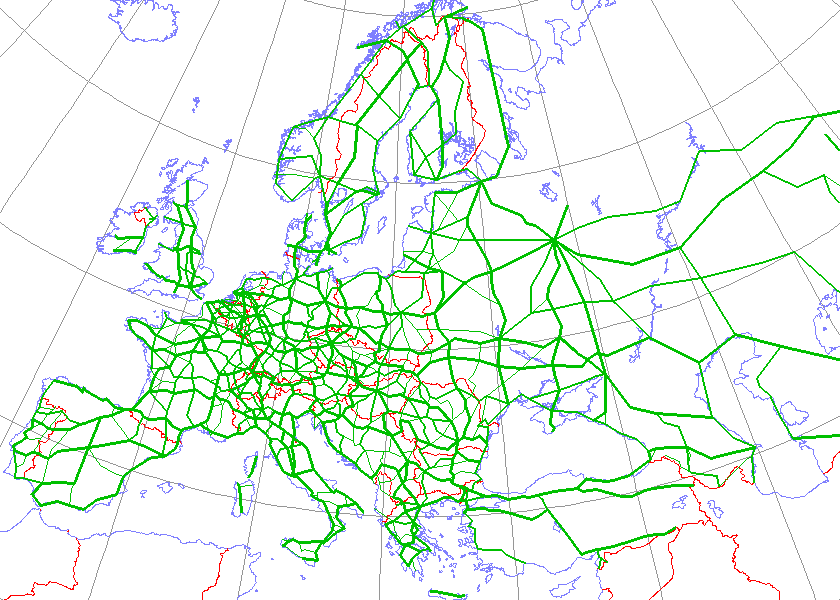
Transport in Europe provides for the movement needs of over 700 million people and associated freight.
The political geography of Europe divides the continent into over 50 sovereign states and territories. This fragmentation, along with increased movement of people since the Industrial Revolution, has led to a high level of cooperation between European countries in developing and maintaining transport networks. Supranational and intergovernmental organisations such as the European Union (EU), Council of Europe and the Organization for Security and Co-operation in Europe have led to the development of international standards and agreements that allow people and freight to cross the borders of Europe, largely with unique levels of freedom and ease.
Road, rail, air and water transportation are all prevalent and important across Europe. Europe was the location of the world's first railways and motorways and is now the location of some of the world's busiest ports and airports. The Schengen Area enables border control-free travel between 26 European countries. Freight transportation has a high level of intermodal compatibility and the European Economic Area allows the free movement of goods across 30 states. Of all tonne-kilometres transported in 2016, 51% were by road, 33% by sea, 12% by rail, 4% by inland waterways, and 0.1% by air.
A review of critical success factors for the delivery of transport infrastructure projects in Europe is presented in a 2017 report.
In October 1998 AccesRail, a Canadian company, launched a solution on the airline industry's Global Distribution Systems (GDS) that allowed major airlines, travel agents, and other online booking websites to book and ticket intermodal travel arrangements, such as flights, railways, and/or buses on the GDS primary screens together in one common booking.
Powered rail transport began in England in the early 19th century with the invention of the speed train. The modern European rail network spans almost the entire continent, with the exception of Andorra, Cyprus, Iceland, Malta, and San Marino. It provides movement of passengers and freight. There are significant high-speed rail passenger networks, such as the TGV in France and the LAV in Spain. The Channel Tunnel connects the United Kingdom with France and thus the whole of the European rail system, and it was called one of the seven wonders of the modern world by the American Society of Civil Engineers. The longest railway tunnel in the world, the Gotthard Base Tunnel, crosses the Alps in Switzerland.
Various method of rail electrification are used as well as much unelectrified track. Multi system locomotives and EMUs allow for cross-border services. Standard gauge is widespread in Central and Western Europe, Russian gauge predominates in parts of Eastern Europe, and mainline services on the Iberian Peninsula and the island of Ireland use the rarer Iberian gauge and Irish gauge, respectively. In mountainous areas, narrow-gauge railways are common. The European Rail Traffic Management System is an EU initiative to create a Europe-wide standard for train signalling.
Rail infrastructure, freight transport and passenger services are provided by a combination of local and national governments and private companies. Passenger ticketing varies from country to country and service to service. The Eurail Pass, a rail pass for 18 European countries, is available only for persons who do not live in Europe, Morocco, Algeria or Tunisia. Interrail passes allow multi-journey travel around Europe for people living in Europe and surrounding countries.
Hub AI
Transport in Europe AI simulator
(@Transport in Europe_simulator)
Transport in Europe
Transport in Europe provides for the movement needs of over 700 million people and associated freight.
The political geography of Europe divides the continent into over 50 sovereign states and territories. This fragmentation, along with increased movement of people since the Industrial Revolution, has led to a high level of cooperation between European countries in developing and maintaining transport networks. Supranational and intergovernmental organisations such as the European Union (EU), Council of Europe and the Organization for Security and Co-operation in Europe have led to the development of international standards and agreements that allow people and freight to cross the borders of Europe, largely with unique levels of freedom and ease.
Road, rail, air and water transportation are all prevalent and important across Europe. Europe was the location of the world's first railways and motorways and is now the location of some of the world's busiest ports and airports. The Schengen Area enables border control-free travel between 26 European countries. Freight transportation has a high level of intermodal compatibility and the European Economic Area allows the free movement of goods across 30 states. Of all tonne-kilometres transported in 2016, 51% were by road, 33% by sea, 12% by rail, 4% by inland waterways, and 0.1% by air.
A review of critical success factors for the delivery of transport infrastructure projects in Europe is presented in a 2017 report.
In October 1998 AccesRail, a Canadian company, launched a solution on the airline industry's Global Distribution Systems (GDS) that allowed major airlines, travel agents, and other online booking websites to book and ticket intermodal travel arrangements, such as flights, railways, and/or buses on the GDS primary screens together in one common booking.
Powered rail transport began in England in the early 19th century with the invention of the speed train. The modern European rail network spans almost the entire continent, with the exception of Andorra, Cyprus, Iceland, Malta, and San Marino. It provides movement of passengers and freight. There are significant high-speed rail passenger networks, such as the TGV in France and the LAV in Spain. The Channel Tunnel connects the United Kingdom with France and thus the whole of the European rail system, and it was called one of the seven wonders of the modern world by the American Society of Civil Engineers. The longest railway tunnel in the world, the Gotthard Base Tunnel, crosses the Alps in Switzerland.
Various method of rail electrification are used as well as much unelectrified track. Multi system locomotives and EMUs allow for cross-border services. Standard gauge is widespread in Central and Western Europe, Russian gauge predominates in parts of Eastern Europe, and mainline services on the Iberian Peninsula and the island of Ireland use the rarer Iberian gauge and Irish gauge, respectively. In mountainous areas, narrow-gauge railways are common. The European Rail Traffic Management System is an EU initiative to create a Europe-wide standard for train signalling.
Rail infrastructure, freight transport and passenger services are provided by a combination of local and national governments and private companies. Passenger ticketing varies from country to country and service to service. The Eurail Pass, a rail pass for 18 European countries, is available only for persons who do not live in Europe, Morocco, Algeria or Tunisia. Interrail passes allow multi-journey travel around Europe for people living in Europe and surrounding countries.