
Recent from talks
Trench
Knowledge base stats:
Talk channels stats:
Members stats:
Trench
A trench is a type of excavation or depression in the ground that is generally deeper than it is wide (as opposed to a swale or a bar ditch), and narrow compared with its length (as opposed to a simple hole or pit).
In geology, trenches result from erosion by rivers or by geological movement of tectonic plates. In civil engineering, trenches are often created to install underground utilities such as gas, water, power and communication lines. In construction, trenches are dug for foundations of buildings, retaining walls and dams, and for cut-and-cover construction of tunnels. In archaeology, the "trench method" is used for searching and excavating ancient ruins or to dig into strata of sedimented material. In geotechnical engineering, trench investigations locate faults and investigate deep soil properties. In trench warfare, soldiers occupy trenches to protect them against weapons fire and artillery.
Trenches are dug using manual tools such as shovel and pickaxe or heavy equipment such as backhoe, trencher, and excavator.
For deep trenches, the instability of steep earthen walls requires engineering and safety techniques such as shoring. Trenches are usually considered temporary structures that are backfilled with soil after construction or abandoned after use. Some trenches are stabilized using durable materials such as concrete to create open passages such as canal and sunken roadways.
Natural trenches are created as a result of erosion by running water or by glaciers (which may have long since disappeared). Others, such as rift valleys or oceanic trenches, are created by geological movement of tectonic plates. Some oceanic trenches include the Mariana Trench and the Aleutian Trench. The former geoform is relatively deep (approximately 10 kilometres (6.2 mi)), linear and narrow, and is formed by plate subduction when plates converge.
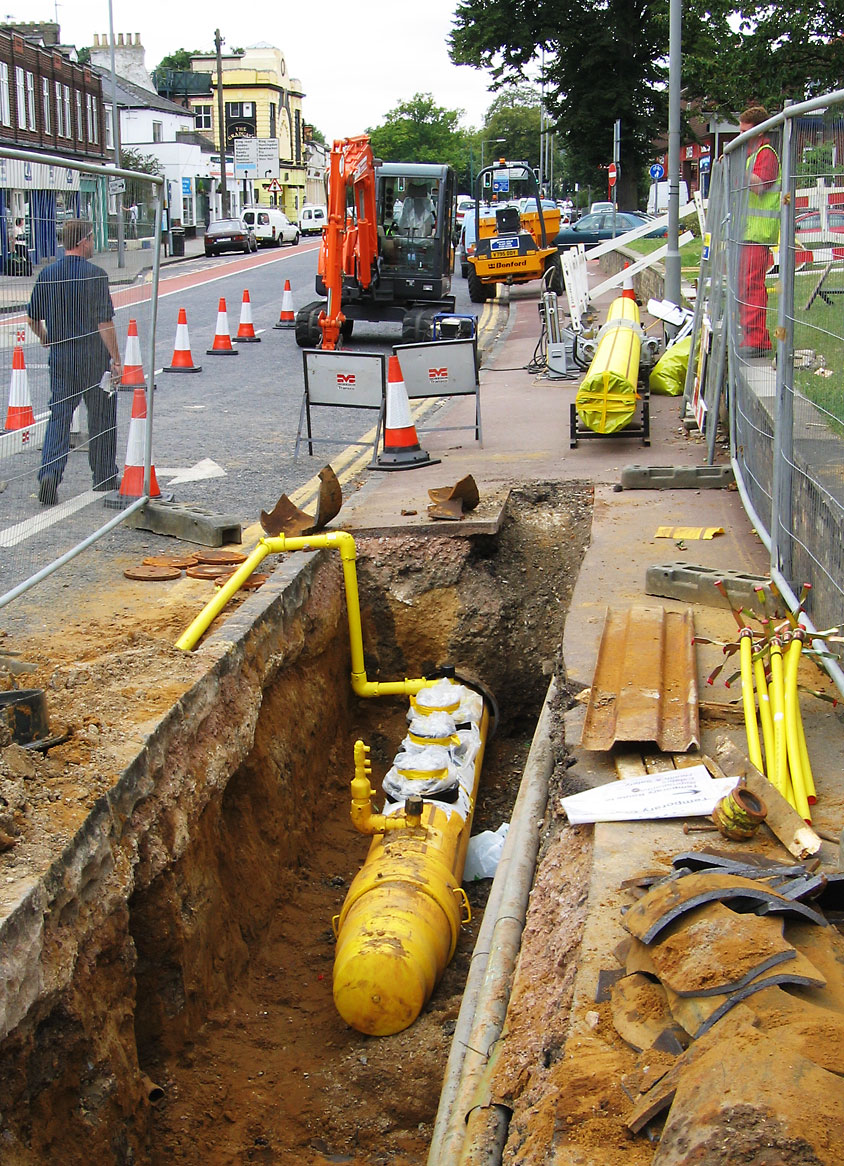
In the civil engineering fields of construction and maintenance of infrastructure, trenches play a major role. They are used for installation of underground infrastructure or utilities (such as gas mains, water mains, communication lines and pipelines) that would be obstructive or easily damaged if placed above ground. Trenches are needed later for access to these installations for service. They may be created to search for pipes and other infrastructure whose exact location is no longer known ("search trench" or "search slit"). Finally, trenches may be created as the first step of creating a foundation wall. Trench shoring is often used in trenchworks to protect workers and stabilise the steep walls.
An alternative to digging trenches is to create a utility tunnel. Such a tunnel may be dug by boring or by using a trench for cut-and-cover construction. The advantages of utility tunnels are the reduction of maintenance manholes, one-time relocation, and less excavation and repair, compared with separate cable ducts for each service. When they are well mapped, they also allow rapid access to all utilities without having to dig access trenches or resort to confused and often inaccurate utility maps.
An important advantage to placing utilities underground is public safety. Underground power lines, whether in common or separate channels, prevent downed utility cables from blocking roads, thus speeding emergency access after natural disasters such as earthquakes, hurricanes, and tsunamis.
Hub AI
Trench AI simulator
(@Trench_simulator)
Trench
A trench is a type of excavation or depression in the ground that is generally deeper than it is wide (as opposed to a swale or a bar ditch), and narrow compared with its length (as opposed to a simple hole or pit).
In geology, trenches result from erosion by rivers or by geological movement of tectonic plates. In civil engineering, trenches are often created to install underground utilities such as gas, water, power and communication lines. In construction, trenches are dug for foundations of buildings, retaining walls and dams, and for cut-and-cover construction of tunnels. In archaeology, the "trench method" is used for searching and excavating ancient ruins or to dig into strata of sedimented material. In geotechnical engineering, trench investigations locate faults and investigate deep soil properties. In trench warfare, soldiers occupy trenches to protect them against weapons fire and artillery.
Trenches are dug using manual tools such as shovel and pickaxe or heavy equipment such as backhoe, trencher, and excavator.
For deep trenches, the instability of steep earthen walls requires engineering and safety techniques such as shoring. Trenches are usually considered temporary structures that are backfilled with soil after construction or abandoned after use. Some trenches are stabilized using durable materials such as concrete to create open passages such as canal and sunken roadways.
Natural trenches are created as a result of erosion by running water or by glaciers (which may have long since disappeared). Others, such as rift valleys or oceanic trenches, are created by geological movement of tectonic plates. Some oceanic trenches include the Mariana Trench and the Aleutian Trench. The former geoform is relatively deep (approximately 10 kilometres (6.2 mi)), linear and narrow, and is formed by plate subduction when plates converge.
In the civil engineering fields of construction and maintenance of infrastructure, trenches play a major role. They are used for installation of underground infrastructure or utilities (such as gas mains, water mains, communication lines and pipelines) that would be obstructive or easily damaged if placed above ground. Trenches are needed later for access to these installations for service. They may be created to search for pipes and other infrastructure whose exact location is no longer known ("search trench" or "search slit"). Finally, trenches may be created as the first step of creating a foundation wall. Trench shoring is often used in trenchworks to protect workers and stabilise the steep walls.
An alternative to digging trenches is to create a utility tunnel. Such a tunnel may be dug by boring or by using a trench for cut-and-cover construction. The advantages of utility tunnels are the reduction of maintenance manholes, one-time relocation, and less excavation and repair, compared with separate cable ducts for each service. When they are well mapped, they also allow rapid access to all utilities without having to dig access trenches or resort to confused and often inaccurate utility maps.
An important advantage to placing utilities underground is public safety. Underground power lines, whether in common or separate channels, prevent downed utility cables from blocking roads, thus speeding emergency access after natural disasters such as earthquakes, hurricanes, and tsunamis.
Recent media