
Recent from talks
Triadica sebifera
Knowledge base stats:
Talk channels stats:
Members stats:
Triadica sebifera
Triadica sebifera is a tree native to eastern Asia (Chinese 乌桕, wū jiù). It is commonly called Chinese tallow, Chinese tallowtree, Florida aspen, chicken tree, gray popcorn tree, or candleberry tree.
The seeds (as well as from those of Triadica cochinchinensis) are the sources of stillingia oil, a drying oil used in paints and varnishes. The fatty coat of the seeds, used for candle and soap making, is known as stillingia tallow; hence its common name. It is relevant to biodiesel production because it is the third most productive vegetable oil producing crop in the world, after algae and oil palm.[citation needed] The leaves are used as herbal medicine to treat boils. The plant sap and leaves are reputed to be toxic, and decaying leaves from the plant are toxic to other species of plants. The species is classified as a noxious invader in the southern U.S.
This species and T. cochinchinensis were formerly classified in the genus Stillingia, as Stillingia sebifera and Stillingia discolor (hence the name still used for the oil and tallow). The specific epithet sebifera is derived from Latin sebum (meaning "tallow") and fero (meaning "to bear"), thus "tallow-bearing". At some time before 1950, this tree was reclassified into the genus Sapium as Sapium sebiferum, and many papers about the oil still refer to the tree by this name. In 2002 or so it was reclassified again into the genus Triadica with its present name.
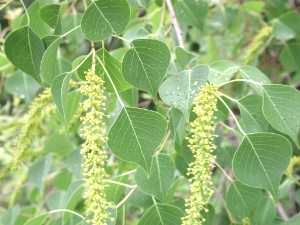
The simple, deciduous leaves of this tree are alternate, broad rhombic to ovate in shape and have smooth edges, heart shaped and sometimes with an extended tail often resembling the bo tree, Ficus religiosa. The leaves are bright green in color and slightly paler underneath. They become bright yellows, oranges, purples and reds in the autumn. The tree is monoecious, producing male and female flowers on the same plant.
The waxy green leaves set off the clusters of greenish-yellow and white flowers at bloom time. The flowers occur in terminal spike-like inflorescences up to 20 cm long. Light green in color, these flowers are very conspicuous in the spring. Each pistillate (female) flower is solitary and has a three-lobed ovary, three styles, and no petals. They are located on short branches at the base of the spike. The staminate (male) flowers occur in clusters at the upper nodes of the inflorescence.
Fruits are three-lobed, three-valved capsules. As the capsules mature, their color changes from green to a brown-black. The capsule walls fall away and release three globose seeds, about 12 mm in diameter and weighing about 0.15 g, with a white, tallow-containing covering. Seeds usually hang on the plants for several weeks. In North America, the flowers typically mature from April to June and the fruit ripens from September to October.
Triadica sebifera is native to China, probably originally in the Zhejiang area, and it was described in the Tang pharmacopoeia Xinxiu bencao. Cultivation of the tree may have begun in the 7th century during the Tang dynasty in the Yangtze Delta region, and from there it spread westward and southward. The trees reached the Philippines, Taiwan, northern Vietnam and Hainan by the 17th century. It was also introduced to Japan during the Edo period. By the 18th century, it had spread to India, the Caribbean islands, and South Carolina and Georgia in the United States through the East India Company. It is also found in Sudan, and southern France.
The tree was said to have been introduced to the US by Benjamin Franklin, who mentioned having obtained some seeds in a letter dated October 1772, but it may have actually been introduced to South Carolina, Georgia and Florida in early 1773 by John Bradby Blake who had access to the seeds earlier in late 1770 or early 1771. The tree has become naturalized from North Carolina southward along the Atlantic seaboard and the entire Gulf Coast, where it grows profusely along ditchbanks and dikes. It grows especially well in open fields and abandoned farmland coastal prairie regions featuring disturbed ground—such as abandoned farmland, spoil banks, roadsides, and storm-damaged forests—and along the edges of the Western Gulf coastal grasslands biome, sometimes forming monocultures. The Chinese Tallow Tree is listed as an invasive species in South Carolina.
Hub AI
Triadica sebifera AI simulator
(@Triadica sebifera_simulator)
Triadica sebifera
Triadica sebifera is a tree native to eastern Asia (Chinese 乌桕, wū jiù). It is commonly called Chinese tallow, Chinese tallowtree, Florida aspen, chicken tree, gray popcorn tree, or candleberry tree.
The seeds (as well as from those of Triadica cochinchinensis) are the sources of stillingia oil, a drying oil used in paints and varnishes. The fatty coat of the seeds, used for candle and soap making, is known as stillingia tallow; hence its common name. It is relevant to biodiesel production because it is the third most productive vegetable oil producing crop in the world, after algae and oil palm.[citation needed] The leaves are used as herbal medicine to treat boils. The plant sap and leaves are reputed to be toxic, and decaying leaves from the plant are toxic to other species of plants. The species is classified as a noxious invader in the southern U.S.
This species and T. cochinchinensis were formerly classified in the genus Stillingia, as Stillingia sebifera and Stillingia discolor (hence the name still used for the oil and tallow). The specific epithet sebifera is derived from Latin sebum (meaning "tallow") and fero (meaning "to bear"), thus "tallow-bearing". At some time before 1950, this tree was reclassified into the genus Sapium as Sapium sebiferum, and many papers about the oil still refer to the tree by this name. In 2002 or so it was reclassified again into the genus Triadica with its present name.
The simple, deciduous leaves of this tree are alternate, broad rhombic to ovate in shape and have smooth edges, heart shaped and sometimes with an extended tail often resembling the bo tree, Ficus religiosa. The leaves are bright green in color and slightly paler underneath. They become bright yellows, oranges, purples and reds in the autumn. The tree is monoecious, producing male and female flowers on the same plant.
The waxy green leaves set off the clusters of greenish-yellow and white flowers at bloom time. The flowers occur in terminal spike-like inflorescences up to 20 cm long. Light green in color, these flowers are very conspicuous in the spring. Each pistillate (female) flower is solitary and has a three-lobed ovary, three styles, and no petals. They are located on short branches at the base of the spike. The staminate (male) flowers occur in clusters at the upper nodes of the inflorescence.
Fruits are three-lobed, three-valved capsules. As the capsules mature, their color changes from green to a brown-black. The capsule walls fall away and release three globose seeds, about 12 mm in diameter and weighing about 0.15 g, with a white, tallow-containing covering. Seeds usually hang on the plants for several weeks. In North America, the flowers typically mature from April to June and the fruit ripens from September to October.
Triadica sebifera is native to China, probably originally in the Zhejiang area, and it was described in the Tang pharmacopoeia Xinxiu bencao. Cultivation of the tree may have begun in the 7th century during the Tang dynasty in the Yangtze Delta region, and from there it spread westward and southward. The trees reached the Philippines, Taiwan, northern Vietnam and Hainan by the 17th century. It was also introduced to Japan during the Edo period. By the 18th century, it had spread to India, the Caribbean islands, and South Carolina and Georgia in the United States through the East India Company. It is also found in Sudan, and southern France.
The tree was said to have been introduced to the US by Benjamin Franklin, who mentioned having obtained some seeds in a letter dated October 1772, but it may have actually been introduced to South Carolina, Georgia and Florida in early 1773 by John Bradby Blake who had access to the seeds earlier in late 1770 or early 1771. The tree has become naturalized from North Carolina southward along the Atlantic seaboard and the entire Gulf Coast, where it grows profusely along ditchbanks and dikes. It grows especially well in open fields and abandoned farmland coastal prairie regions featuring disturbed ground—such as abandoned farmland, spoil banks, roadsides, and storm-damaged forests—and along the edges of the Western Gulf coastal grasslands biome, sometimes forming monocultures. The Chinese Tallow Tree is listed as an invasive species in South Carolina.
Recent media