Hubbry Logo
TributyrinTributyrinMain
Open search
Tributyrin
Community hub
Tributyrin
logo
8 pages, 0 posts
0 subscribers
Be the first to start a discussion here.
Tributyrin
Tributyrin
from Wikipedia
Tributyrin
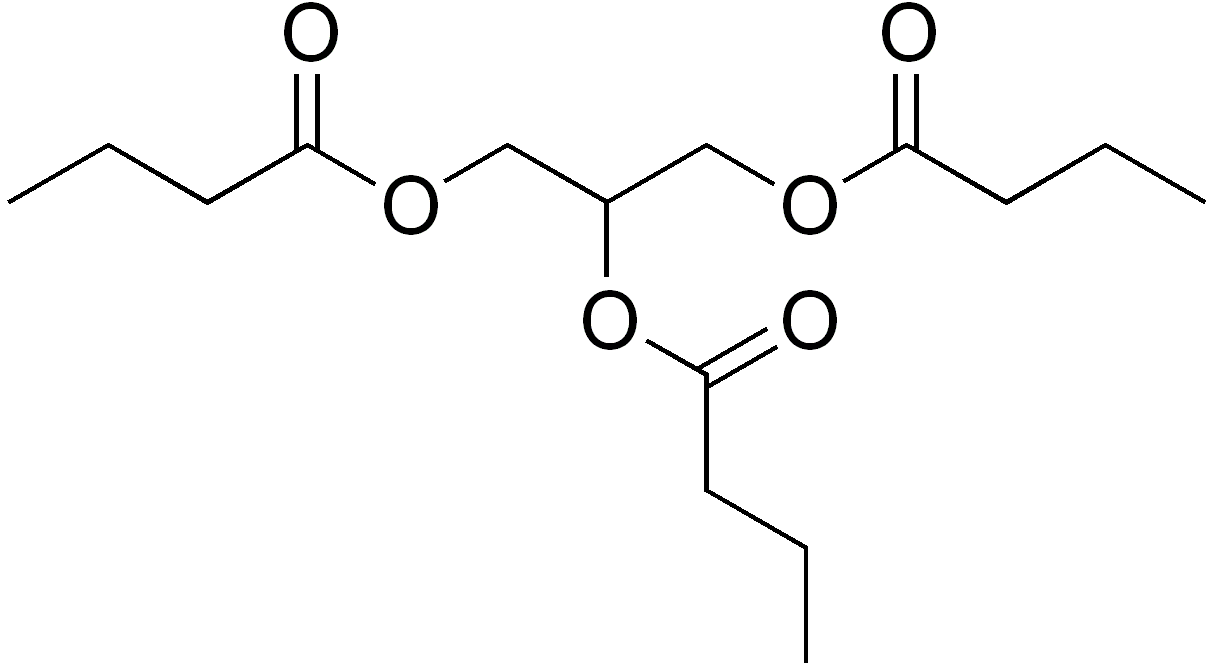
Skeletal formula of butyrin
Ball-and-stick model of the butyrin molecule
Names
Systematic IUPAC name
Propane-1,2,3-triyl tributanoate
Other names
Tributyrin
Identifiers
3D model (JSmol)
ChEBI
ChemSpider
ECHA InfoCard 100.000.410 Edit this at Wikidata
KEGG
UNII
  • InChI=1S/C15H26O6/c1-4-7-13(16)19-10-12(21-15(18)9-6-3)11-20-14(17)8-5-2/h12H,4-11H2,1-3H3
    Key: UYXTWWCETRIEDR-UHFFFAOYSA-N
  • CCCC(=O)OCC(COC(=O)CCC)OC(=O)CCC
Properties
C15H26O6
Molar mass 302.367 g·mol−1
Appearance Oily liquid with bitter taste‍[1]
Density 1.032 g/cm3[1]
Melting point −75 °C (−103 °F; 198 K)[1]
Boiling point 305 to 310 °C (581 to 590 °F; 578 to 583 K)[1]
Insoluble‍[1]
Hazards
Safety data sheet (SDS) Tributyrin MSDS, Fischer Scientific
Except where otherwise noted, data are given for materials in their standard state (at 25 °C [77 °F], 100 kPa).
☒N verify (what is checkY☒N ?)

Tributyrin is a triglyceride naturally present in butter. It is an ester composed of butyric acid and glycerol.‍[1] Among other things, it is used as an ingredient in making margarine. It is present in butter and can be described as a liquid fat with an acrid taste.

Tributyrin is also used in microbiological laboratories to identify the bacterium Moraxella catarrhalis.‍[2]

Tributyrin is a stable and rapidly absorbed prodrug of butyric acid which enhances antiproliferative effects of dihydroxycholecalciferol in human colon cancer cells.‍[3]

See also

[edit]

References

[edit]
Revisions and contributorsEdit on WikipediaRead on Wikipedia
from Grokipedia
Tributyrin, also known as glyceryl tributyrate or butyrin, is a naturally occurring composed of one molecule esterified with three molecules of , with the C₁₅H₂₆O₆ and a molecular weight of 302.36 g/mol. It appears as a clear, colorless to yellow liquid at , with a of -75 °C, a of 305 °C, and a of 1.0335 g/cm³, and it is insoluble in water but soluble in alcohol and ether. Found in products such as , where it contributes to the characteristic flavor, tributyrin serves as a stable for , a short-chain that is released through enzymatic in the . As a , tributyrin offers improved and compared to free , enabling systemic delivery of butyrate, which acts as a histone deacetylase (HDAC) inhibitor with potential , antiproliferative, and gut health-promoting effects. In , it has been investigated in clinical trials for conditions including solid tumors, , , optic neuropathies, and hematopoietic cell transplantation, where it activates caspase-3 to induce in cancer cells and supports mitochondrial function. Beyond therapeutics, tributyrin functions as a agent in foods like baked goods, beverages, and dairy products, approved by regulatory bodies for safe use in limited concentrations. In and , tributyrin supplementation enhances growth performance, feed efficiency, intestinal barrier integrity, antioxidant capacity, and immune responses in and crustaceans, particularly when counteracting the inflammatory effects of plant-based diets. Hydrolyzed by pancreatic lipases, it provides butyrate directly to intestinal cells, modulating and reducing without the volatility or odor associated with free . While generally of low toxicity via ingestion, tributyrin is combustible and incompatible with strong oxidizers, requiring careful handling in industrial applications.

Chemistry

Molecular structure

Tributyrin is a composed of esterified with three molecules of butanoic acid, a short-chain saturated denoted as C4:0. Its chemical formula is C15H26O6, and its systematic IUPAC name is 1,3-bis(butanoyloxy)propan-2-yl butanoate, also known as glyceryl tributyrate or 1,2,3-propanetriyl tributanoate. The molecular structure features a central glycerol backbone, where the three hydroxyl groups of are linked via ester bonds to the carboxyl groups of three butanoic acid molecules (CH3CH2CH2COOH). This results in a triacylglycerol with the general form:

CH<sub>3</sub>CH<sub>2</sub>CH<sub>2</sub>COO-CH<sub>2</sub> | CH<sub>3</sub>CH<sub>2</sub>CH<sub>2</sub>COO-CH | CH<sub>3</sub>CH<sub>2</sub>CH<sub>2</sub>COO-CH<sub>2</sub>

CH<sub>3</sub>CH<sub>2</sub>CH<sub>2</sub>COO-CH<sub>2</sub> | CH<sub>3</sub>CH<sub>2</sub>CH<sub>2</sub>COO-CH | CH<sub>3</sub>CH<sub>2</sub>CH<sub>2</sub>COO-CH<sub>2</sub>

This symmetric arrangement distinguishes tributyrin as the fully esterified form, unlike monobutyrin (one ester bond) or dibutyrin (two ester bonds), which retain free hydroxyl groups on the moiety and thus exhibit partial esterification. The molecular weight of tributyrin is 302.37 g/mol.

Physical properties

Tributyrin is a clear, colorless to pale yellow oily liquid at . It exhibits a mild described as cheesy, waxy, creamy, and fatty. The compound has a of -75 °C. Its boiling point is approximately 305 °C at . Tributyrin possesses a of about 1.03 g/cm³ at 20 °C. It is insoluble in (with around 133 mg/L at 37 °C) but readily soluble in organic solvents including , , and . As a short-chain , tributyrin's oily consistency arises from its structure.

Chemical properties and reactivity

Tributyrin demonstrates relative under neutral conditions and at ambient temperatures, making it suitable for storage and handling without significant decomposition. This stability is attributed to its structure, which resists spontaneous breakdown in the absence of catalysts or extreme shifts. Unlike free , tributyrin is non-volatile with minimal , avoiding issues associated with the volatility of its products. The compound undergoes in acidic or basic environments, cleaving the bonds to yield and . This reaction is typical of triglycerides and can be performed chemically under laboratory conditions, such as acid-catalyzed using solid acid catalysts or base-catalyzed . The general equation for the is: (\ceCH3CH2CH2COO)3\ceC3H5+3\ceH2O3\ceCH3CH2CH2COOH+\ceC3H8O3(\ce{CH3CH2CH2COO})3\ce{C3H5} + 3\ce{H2O} \rightarrow 3\ce{CH3CH2CH2COOH} + \ce{C3H8O3} Tributyrin exhibits greater susceptibility to in alkaline media compared to acidic conditions. In terms of reactivity, tributyrin is particularly susceptible to enzymatic by lipases, which preferentially target its short-chain ester linkages. This property underpins its role as a for butyrate, enabling controlled and slow release of the active through gradual rather than immediate liberation.

Occurrence and production

Natural occurrence

Tributyrin occurs naturally as a minor in fats, primarily in where it comprises about 3-4% of the total fat content, representing the main esterified form of in these products. This concentration makes the richest dietary source of tributyrin among common foods. Trace amounts of tributyrin are also present in , cheeses, and fermented products, typically at lower levels than in due to processing and dilution effects. In animals, tributyrin is biosynthesized in the mammary glands through the esterification of , which is generated via microbial of carbohydrates in the of herbivores. Typical tributyrin levels in fat vary between 2-5% of total , influenced by factors such as animal diet and stage. As a natural precursor to butyrate, tributyrin contributes to the short-chain fatty acid profile in these natural sources.

Industrial synthesis

Tributyrin is primarily produced on an industrial scale through the esterification of glycerol with butyric acid in the presence of acid catalysts, such as sulfuric acid or p-toluenesulfonic acid. This process involves heating the reactants to 100-150°C under reflux conditions, often with azeotropic removal of water using toluene to drive the equilibrium toward ester formation. The reaction proceeds as follows: C3H8O3+3CH3(CH2)2COOH(CH3(CH2)2COO)3C3H5+3H2O\mathrm{C_3H_8O_3 + 3 CH_3(CH_2)_2COOH \rightarrow (CH_3(CH_2)_2COO)_3C_3H_5 + 3 H_2O} Typical molar ratios of glycerol to butyric acid range from 1:3 to 1:6, with catalyst concentrations of 1-5 wt%, yielding high-purity tributyrin after neutralization, washing, and distillation. Enzymatic synthesis using immobilized lipases, like Novozyme 435, offers a milder alternative at 40-60°C and ambient pressure, achieving conversions up to 97% with reduced byproduct formation and higher selectivity for pharmaceutical-grade product. These methods are particularly valued for their environmental benefits and ability to produce tributyrin with minimal energy input. Industrial processes routinely achieve tributyrin purity exceeding 97% through , enabling its use in food additives and pharmaceutical formulations. Commercial production has been scaling to meet demands in and nutraceuticals, with key manufacturers employing continuous flow reactors for efficiency.

Biological and pharmacological aspects

Metabolism and bioavailability

Tributyrin exhibits favorable absorption characteristics owing to its lipophilic nature, enabling passive across the epithelial lining of the . Unlike free butyrate, which undergoes rapid uptake and in the proximal gut, tributyrin's esterified structure confers resistance to immediate breakdown, allowing a portion to progress distally while still permitting efficient absorption. This positions tributyrin as an effective for sustained butyrate delivery throughout the . In the gut lumen, tributyrin undergoes hydrolysis primarily by pancreatic and microbial lipases, which cleave its three ester bonds to release butyrate and glycerol in a controlled manner. The process can be summarized by the equation: Tributyrin (glyceryl tributyrate)lipases3×butyric acid+glycerol\text{Tributyrin (glyceryl tributyrate)} \xrightarrow{\text{lipases}} 3 \times \text{butyric acid} + \text{glycerol}
Add your contribution
Related Hubs
User Avatar
No comments yet.