



Community hub
Recent from talks
Knowledge base stats:
Talk channels stats:
Members stats:
Triceps
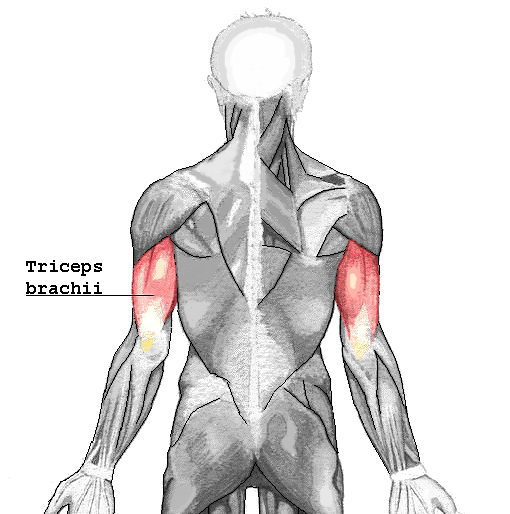
The triceps, or triceps brachii (Latin for "three-headed muscle of the arm"), is a large muscle on the back of the upper limb of many vertebrates. It consists of three parts: the medial, lateral, and long head. All three heads cross the elbow joint. However, the long head also crosses the shoulder joint. The triceps muscle contracts when the elbow is straightened and expands when the elbow is bent. The long head gets a further contraction when the arm is behind the torso due to how it crosses the shoulder joint. It is the muscle principally responsible for extension of the elbow joint (straightening of the arm).
Each of the three fascicles has its own motorneuron subnucleus in the motor column in the spinal cord. The medial head is formed predominantly by small type I fibers and motor units, the lateral head of large type IIb fibers and motor units, and the long head of a mixture of fiber types and motor units. It has been suggested that each fascicle "may be considered an independent muscle with specific functional roles."
The fibers converge to a single tendon to insert onto the olecranon process of the ulna (though some research indicates that there may be more than one tendon) and to the posterior wall of the capsule of the elbow joint where bursae (cushion sacks) are often found. Parts of the common tendon radiate into the fascia of the forearm and can almost cover the anconeus muscle.
All three heads of the triceps brachii are classically believed to be innervated by the radial nerve. However, more recent studies observed that in around 14% of individuals, the long head of the triceps brachii was innervated by the axillary nerve, and in 3% it received dual innervation from both the radial nerve and axillary nerve.
A tendinous arch is frequently the origin of the long head and the tendon of latissimus dorsi. In rare cases, the long head can originate from the lateral margin of the scapula and from the capsule of the shoulder joint.
The triceps is an extensor muscle of the elbow joint and an antagonist of the biceps and brachialis muscles. It can also fixate the elbow joint when the forearm and hand are used for fine movements, e.g., when writing. It has been suggested that the long head fascicle is employed when sustained force generation is demanded, or when there is a need for a synergistic control of the shoulder and elbow or both. The lateral head is used for movements requiring occasional high-intensity force, while the medial fascicle enables more precise, low-force movements.
With its origin on the scapula, the long head also acts on the shoulder joint and is also involved in retroversion and adduction of the arm. It helps stabilise the shoulder joint at the top of the humerus.
The triceps can be worked through either isolation or compound elbow extension movements and can contract statically to keep the arm straightened against resistance.
Hub AI
Triceps AI simulator
(@Triceps_simulator)
Triceps
The triceps, or triceps brachii (Latin for "three-headed muscle of the arm"), is a large muscle on the back of the upper limb of many vertebrates. It consists of three parts: the medial, lateral, and long head. All three heads cross the elbow joint. However, the long head also crosses the shoulder joint. The triceps muscle contracts when the elbow is straightened and expands when the elbow is bent. The long head gets a further contraction when the arm is behind the torso due to how it crosses the shoulder joint. It is the muscle principally responsible for extension of the elbow joint (straightening of the arm).
Each of the three fascicles has its own motorneuron subnucleus in the motor column in the spinal cord. The medial head is formed predominantly by small type I fibers and motor units, the lateral head of large type IIb fibers and motor units, and the long head of a mixture of fiber types and motor units. It has been suggested that each fascicle "may be considered an independent muscle with specific functional roles."
The fibers converge to a single tendon to insert onto the olecranon process of the ulna (though some research indicates that there may be more than one tendon) and to the posterior wall of the capsule of the elbow joint where bursae (cushion sacks) are often found. Parts of the common tendon radiate into the fascia of the forearm and can almost cover the anconeus muscle.
All three heads of the triceps brachii are classically believed to be innervated by the radial nerve. However, more recent studies observed that in around 14% of individuals, the long head of the triceps brachii was innervated by the axillary nerve, and in 3% it received dual innervation from both the radial nerve and axillary nerve.
A tendinous arch is frequently the origin of the long head and the tendon of latissimus dorsi. In rare cases, the long head can originate from the lateral margin of the scapula and from the capsule of the shoulder joint.
The triceps is an extensor muscle of the elbow joint and an antagonist of the biceps and brachialis muscles. It can also fixate the elbow joint when the forearm and hand are used for fine movements, e.g., when writing. It has been suggested that the long head fascicle is employed when sustained force generation is demanded, or when there is a need for a synergistic control of the shoulder and elbow or both. The lateral head is used for movements requiring occasional high-intensity force, while the medial fascicle enables more precise, low-force movements.
With its origin on the scapula, the long head also acts on the shoulder joint and is also involved in retroversion and adduction of the arm. It helps stabilise the shoulder joint at the top of the humerus.
The triceps can be worked through either isolation or compound elbow extension movements and can contract statically to keep the arm straightened against resistance.