Hubbry Logo
Radial nerveRadial nerveMain
Open search
Radial nerve
Community hub
Radial nerve
logo
8 pages, 0 posts
0 subscribers
Be the first to start a discussion here.
Radial nerve
Radial nerve
from Wikipedia
Radial nerve
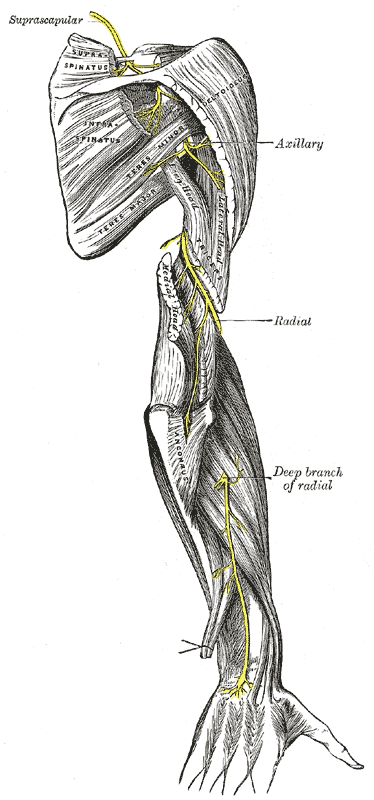
The suprascapular, axillary, and radial nerves
Details
FromPosterior cord
ToPosterior interosseous nerve
InnervatesPosterior compartment of the arm, posterior compartment of the forearm
Identifiers
Latinnervus radialis
MeSHD011826
TA98A14.2.03.049
TA26431
FMA37069
Anatomical terms of neuroanatomy

The radial nerve is a nerve in the human body that supplies the posterior portion of the upper limb. It innervates the medial and lateral heads of the triceps brachii muscle of the arm, as well as all 12 muscles in the posterior osteofascial compartment of the forearm and the associated joints and overlying skin.

It originates from the brachial plexus, carrying fibers from the posterior roots of spinal nerves C5, C6, C7, C8 and T1.[1]

The radial nerve and its branches provide motor innervation to the dorsal arm muscles (the triceps brachii and the anconeus) and the extrinsic extensors of the wrists and hands; it also provides cutaneous sensory innervation to most of the back of the hand, except for the back of the little finger and adjacent half of the ring finger (which are innervated by the ulnar nerve).

The radial nerve divides into a deep branch, which becomes the posterior interosseous nerve, and a superficial branch, which goes on to innervate the dorsum (back) of the hand.

This nerve was historically referred to as the musculospiral nerve.[2]

Structure

[edit]
Radial nerve of the right axilla, posterior view

The radial nerve originates as a terminal branch of the posterior cord of the brachial plexus.[1] It goes through the arm, first in the posterior compartment of the arm, and later in the anterior compartment of the arm, and continues in the posterior compartment of the forearm.

Arm

[edit]

The radial nerve originates from the posterior cord of the brachial plexus with root values of C5 to C8 and T1. From the brachial plexus, it travels behind the third part of the axillary artery (part of the axillary artery distal to the pectoralis minor). In the arm, it runs behind the brachial artery and then enters the lower triangular space to reach the radial sulcus on the back of the humerus.[1] It travels downwards together with profunda brachii artery, between the lateral and medial heads of triceps brachii until it reaches the lateral side the arm at 5 cm below the deltoid tuberosity where it pierces the lateral intermuscular septum to reach the anterior compartment of the arm. Then, it descends down to cross the lateral epicondyle of the humerus where the nerve terminates by branching itself into superficial and deep branch which continues into cubital fossa and then into the forearm.[3]

The radial nerve gives out muscular branches to supply the long head, medial head, and lateral head of triceps brachii muscles before and during its course in the radial sulcus. After it emerges out from the radial sulcus, it supplies the brachialis, brachioradialis and extensor carpi radialis longus.[3]

Above the radial sulcus, the radial nerve gives off posterior cutaneous nerve of the arm which supplies the skin at the back of the arm. In the radial sulcus, it gives off lower lateral cutaneous nerve of the arm and posterior cutaneous nerve of the forearm. The radial nerve also gives articular branches to supply the elbow joint.[3]

Forearm and hand

[edit]

In the forearm, it is divided into a superficial branch (primarily sensory) and a deep branch (primarily motor).[4]

Variation

[edit]

It is commonly believed that the radial nerve provides motor innervation to the long head of the triceps. However, a study conducted in 2004 found that axillary nerve innervated the long head of the triceps in twenty cadavers without any supply from the radial nerve.[7]

Function

[edit]

The following are branches of the radial nerve (including the superficial branch of the radial nerve and the deep branch of the radial nerve/posterior interosseous nerve).

Cutaneous

[edit]
Cutaneous innervation of the right upper extremity. Areas innervated by the radial nerve are colored in pink.

Cutaneous innervation by the radial nerve is provided by the following nerve branches:

The superficial branch of the radial nerve provides sensory innervation to much of the back of the hand, including the web of skin between the thumb and index finger.

Motor

[edit]
Muscles of the posterior forearm. All the labelled muscles (that is, all the visible muscles except the ones on the dorsal hand and one at top left) are innervated by the radial nerve, and represent all muscles innervated by the radial nerve except for the supinator.

Muscular branches of the radial nerve:

Deep branch of the radial nerve:

Posterior interosseous nerve (a continuation of the deep branch after the supinator):

The radial nerve (and its deep branch) provides motor innervation to the muscles in the posterior compartment of the arm and forearm, which are mostly extensors.

Clinical significance

[edit]

Injury

[edit]

Injury to the radial nerve at different levels causes different syndromes with varying motor and sensory deficits.

At the axilla

  • Common mechanisms of injury: Saturday night palsy,[1] crutch palsy, lesions[8]
  • Motor deficit:
  • Sensory deficit: Loss of sensation[9] in lateral arm, posterior forearm, the radial half of dorsum of hand, and dorsal aspect of radial 3+12 digits, excluding their nail beds.

At mid-arm

  • Common mechanism of injury: Mid-shaft humeral fracture
  • Motor deficit:
    • Weakness of supination, and loss of extension of hand and fingers.
    • Presence of wrist drop, due to inability to extend the hand and fingers.[9][10]
  • Sensory deficit: Loss of sensation in posterior forearm, the radial half of dorsum of hand, and dorsal aspect of radial 3+12 digits, excluding their nail beds.

Just below the elbow

  • Common mechanism of injury: Neck of radius fracture, elbow dislocation or fracture, tight cast, rheumatoid nodules, injections due to tennis elbow, injuring the deep branch of the radial nerve that pierces the radial head, causing posterior interosseous nerve syndrome
  • Motor deficit:
  • Sensory deficit: None, as sensation is supplied by the superficial radial nerve
    Radial nerve

Within the distal forearm:

History

[edit]

Additional images

[edit]

See also

[edit]

References

[edit]
[edit]
Revisions and contributorsEdit on WikipediaRead on Wikipedia
from Grokipedia
The radial nerve is a large terminal branch of the of the , originating from the ventral rami of spinal nerves C5 to T1, and serves as the primary nerve supplying motor and sensory innervation to the posterior compartments of the , forearm, and hand. It emerges in the posterior to the , travels through the , bounded superiorly by the teres major, inferiorly by the long head of the triceps brachii, and laterally by the , and then descends in the along the posterior aspect of the , where it is vulnerable to compression from fractures. Piercing the approximately 10 to 12 cm proximal to the , the nerve enters the anterior compartment of the and bifurcates at the level of the into a deep branch (continuing as the ) and a superficial branch. In terms of motor function, the radial nerve innervates the triceps brachii (via branches in the and ), anconeus, , and all extensors in the posterior , including the extensor carpi radialis and brevis, extensor digitorum, extensor digiti minimi, extensor carpi ulnaris, supinator, abductor pollicis , extensor pollicis brevis and , and extensor indicis. These muscles enable extension at the , , and fingers, as well as supination of the and abduction of the thumb. Sensory functions are provided through its posterior cutaneous nerves of the arm and , the lower lateral cutaneous nerve of the arm, and the superficial branch, which supplies sensation to the skin over the posterior arm, posterior , and the dorsal aspect of the lateral hand including the first 3.5 digits (proximal to the distal interphalangeal joints). Clinically, the radial nerve is prone to injury from humeral shaft fractures (leading to due to of extensors), prolonged pressure in the (" night palsy"), or compression in the radial tunnel or at the (causing syndrome with weakness but preserved sensation). Superficial branch entrapment, known as or Wartenberg's syndrome, results in pain and paresthesia over the dorsal radial hand without motor deficits. Surgical considerations include its superficial position in the distal , making it susceptible during procedures like or tendon repairs, and its role in nerve transfers for reconstruction.

Anatomy

Origin and proximal course

The radial nerve originates as the largest terminal branch of the posterior cord of the brachial plexus, which is formed by the union of the posterior divisions from the superior, middle, and inferior trunks derived from spinal nerve roots C5 through T1. Although contributions arise from all these roots, the primary input to the radial nerve comes from C6 to C8, with C5 and T1 providing lesser involvement. The posterior cord itself emerges in the axilla and sequentially gives off branches including the upper and lower subscapular nerves (the latter innervating the subscapularis and teres major muscles) and the thoracodorsal nerve before dividing at the inferior border of the subscapularis muscle into the axillary nerve superiorly and the radial nerve inferiorly. This division marks the formal origin of the radial nerve as a distinct structure within the axilla, where it lies posterior to the axillary artery and vein. In the proximal course, the radial nerve exits the posteriorly through the —a space bounded medially by the long head of the brachii, superiorly by the teres major, and laterally by the —accompanied by the profunda brachii artery (also known as the deep ). It then descends in the posterior compartment of the , traveling between the long and medial heads of the brachii muscle, providing a motor branch to the long head of the brachii as well as the posterior of the , which supplies sensory innervation to the skin over the posterior aspect of the mid-. This segment of the nerve remains in close relation to the and the accompanying profunda brachii artery until reaching the spiral groove. The blood supply to the initial segments of the radial nerve arises from vasa nervorum derived from branches of the in the and the profunda brachii artery in the proximal , ensuring nutrient delivery along its early trajectory. These vascular contributions are critical for maintaining the nerve's integrity in this region, where it is relatively fixed and vulnerable to compressive forces.

Course in the arm

After emerging from the axilla via the triangular interval, the radial nerve enters the posterior compartment of the arm, descending between the long and medial heads of the triceps brachii muscle. It then courses laterally along the posterior surface of the humerus within the spiral groove (also known as the radial groove), accompanied by the profunda brachii artery, and gives off muscular branches to the lateral and medial heads of the triceps brachii. In this position, the nerve is in direct contact with the bone, making it vulnerable to compression from midshaft humeral fractures or external pressure, such as from prolonged leaning on the arm or use of crutches. As it traverses the spiral groove, the radial nerve also emits several cutaneous branches, including the lower lateral of the (supplying the skin over the lower lateral ), the posterior of the (innervating the posterior skin of the ), and the posterior of the (which pierces the lateral intermuscular to reach the posterior skin). Additionally, it provides a muscular branch to the near the distal end of the groove. Distally, approximately 10-14 cm proximal to the , the pierces the lateral intermuscular to transition into the anterior compartment of the . In the anterior compartment, the radial nerve lies anterior to the , positioned between the medially and the muscle laterally, while adhering closely to the lateral aspect of the . It provides motor innervation to the muscle in this region. This segment marks the nerve's preparation for bifurcation near the , but its course here remains within the arm's boundaries, maintaining proximity to the bone and adjacent musculature.

Course in the forearm

In the forearm, the radial nerve divides into its two major terminal branches at the level of the , anterior to the , between the brachialis and muscles. This bifurcation occurs after the nerve emerges from the lateral intermuscular septum in the distal arm. The superficial branch, primarily sensory, descends distally in the deep to the muscle, maintaining a position along the radial side of the . It gradually becomes more superficial, emerging from beneath the tendon of the in the distal third of the , approximately 5 to 8 cm proximal to the , before crossing the to reach the dorsum of the hand. The deep branch, predominantly motor, winds laterally around the neck of the radius and pierces the through the fibrous , a tendinous arch formed by the proximal edge of the supinator's superficial head. Upon entering the supinator, it becomes the and courses distally through the , initially deep to the supinator and later lying beneath the extensor digitorum and extensor carpi ulnaris muscles, adjacent to the interosseous membrane. This deep branch is particularly vulnerable to injury during radial head fractures due to its close relation to the radial head and . Prior to its division in the , the radial nerve gives off the posterior cutaneous nerve of the , which arises in the spiral groove of the and descends to supply the skin of the posterior after piercing the lateral head of the . The lower lateral cutaneous nerve of the arm originates in the spiral groove and supplies the skin of the lower lateral arm.

Branches and distribution

The radial nerve bifurcates in the into a superficial sensory and a deep motor , known as the (PIN), with the superficial continuing distally along the to reach the hand. The radial nerve proper gives motor branches to the extensor carpi radialis longus, extensor carpi radialis brevis, and before bifurcation. The superficial divides into dorsal digital nerves that supply sensation to the skin over the dorsum of the thumb, , , and radial half of the ring finger, while sparing the ulnar half of the ring finger and the entire . This distribution covers the dorsal wrist, the , and the proximal phalanges of the affected digits, providing no motor innervation to intrinsic hand muscles. The superficial branch courses subcutaneously across the on the radial aspect of the wrist, where it lies in close relation to the extensor pollicis longus tendon and is at risk of compression or injury in De Quervain's tenosynovitis. The PIN, after emerging from the in the proximal forearm, gives rise to motor branches that innervate key extensors of the wrist and digits. It supplies the supinator (via the deep branch before full transformation to PIN), extensor digitorum, extensor digiti minimi, extensor carpi ulnaris, abductor pollicis longus, extensor pollicis longus, extensor pollicis brevis, and extensor indicis in the distal forearm. The PIN provides no sensory distribution to the skin of the hand and no innervation to intrinsic hand muscles.

Anatomical variations

The radial nerve typically arises as the terminal branch of the of the in the , but variations in its origin occur infrequently, with an accessory branch arising from the middle trunk in less than 0.1% of cases and from the inferior trunk or medial cord in 0.1% to 0.3% of cases, respectively. A high bifurcation of the radial nerve into its superficial and deep branches can occur proximally in the or mid-arm rather than the usual site at the , with studies reporting such early divisions in up to 44% of dissected specimens in certain populations. Intra-individual variations in the bifurcation point are common, with a difference of 18 mm from the lateral between left and right limbs, potentially altering the nerve's vulnerability during surgical approaches. Variations in the course and branching of the , a major deep branch of the radial nerve, include its entry into the either through the muscle belly (in 50% of cases) or beneath the distal edge of the superficial head (in the other 50%), which may represent an earlier piercing relative to the standard path at the . Regarding relations to the , both nerves occasionally share contributions from the , with cadaveric dissections revealing trifurcation of the leading to anomalous branching where the receives fibers that could influence deltoid innervation, as documented in studies from the early 2000s. Such shared roots or variant innervations have been noted in approximately 5% of cases for the long head of the , extending to potential deltoid involvement via anomalies. Developmental anomalies of the radial nerve are rare but include duplication of the superficial branch, observed in isolated cadaveric cases where one duplicated branch courses aberrantly between variant muscle bellies, such as a two-bellied , potentially linked to broader dysplasias affecting nerve formation during embryogenesis. Complete absence of the superficial branch is exceptionally uncommon and typically associated with congenital malformations, though specific incidence data remain limited due to rarity. Ethnic and geographic differences influence radial nerve , with studies on Asian populations, particularly Chinese cadavers, showing a more proximal course of the nerve relative to the (147 mm to the upper margin of the spiral groove versus 124 mm in Caucasians) and a more distal position relative to the medial (111 mm versus 131 mm), suggesting higher rates of altered branching or positioning in Asian cohorts, up to 15% in some regional dissections. These anatomical variations carry clinical implications, particularly an elevated risk of iatrogenic injury during humeral fracture fixation or axillary procedures if unrecognized, as proximal bifurcations or aberrant courses can place the nerve outside expected safe zones, leading to neuropraxia in 15-25% of high-risk surgeries.

Function

Motor innervation

The radial nerve serves as the primary motor nerve for the extensor muscles of the upper limb, facilitating elbow extension, wrist extension, finger extension, and forearm supination. It originates from the posterior cord of the brachial plexus (C5-T1) and supplies efferent fibers to the posterior compartment muscles, counterbalancing the flexor actions predominantly mediated by the median and ulnar nerves. This innervation enables coordinated movements essential for reaching, grasping, and manipulating objects in opposition to flexion-dominated activities. In the , the radial nerve innervates the brachii muscle, including its long, lateral, and medial heads, which collectively extend the . It also supplies the , a small extensor that assists in elbow extension and stabilizes the during movement. The branch to the long head arises proximal to the spiral groove in the , while branches to the lateral and medial heads and the anconeus arise within the spiral groove, ensuring robust elbow control. In the forearm, the radial nerve continues to provide motor supply to several key extensors via its main trunk and the (PIN). The muscle receives innervation for elbow flexion, particularly effective when the forearm is in a neutral position. The extensor carpi radialis longus and brevis muscles are supplied for wrist extension and radial deviation (abduction). Additionally, the is innervated by the deep branch (PIN) to enable forearm supination, rotating the against the . Distally, the PIN innervates the extensor muscles of the fingers and , originating from the but acting on the hand. These include the extensor digitorum for extension of the four medial fingers, the extensor digiti minimi for extension of the , and the extensor carpi ulnaris for wrist extension and ulnar deviation (adduction). For the , innervation extends to the abductor pollicis longus for abduction at the , the extensor pollicis brevis for extension at the , the extensor pollicis longus for extension of the distal phalanx, and the extensor indicis for independent extension of the . Notably, the radial nerve does not innervate any intrinsic hand muscles, such as those in the thenar or hypothenar eminences, which are supplied by the and ulnar nerves. Physiologically, the radial nerve's motor role establishes it as the dominant extensor pathway in the , promoting balanced opposition to the flexor synergy of the and ulnar nerves for precise hand and function during daily activities.

Sensory innervation

The sensory innervation of the radial nerve is provided by its cutaneous branches, which supply sensation to specific regions of the skin on the posterior and lateral aspects of the . These branches arise at various points along the nerve's course in the and , delivering afferent signals primarily from the skin surface. The posterior cutaneous nerve of the arm branches from the radial nerve in the and innervates the over the posterior aspect of the and the region around the . This branch provides sensation to a relatively small area on the back of the upper , contributing to the overall posterior coverage. The lower lateral cutaneous nerve of the arm emerges from the radial nerve within the spiral groove and supplies the skin on the lateral aspect of the arm, extending from the mid-arm distally to the elbow. This innervation covers the inferolateral skin below the deltoid insertion, ensuring sensory input from this transitional zone between the arm and elbow. Further distally, the posterior cutaneous nerve of the arises in the spiral groove and travels to innervate the skin along the posterior surface of the , from the to the . It supplies a longitudinal strip down the middle of the posterior , providing sensation to this extensor-facing region. The superficial branch of the radial nerve, which becomes the terminal sensory continuation after the motor deep branch diverges near the , innervates the dorsal aspect of the hand. Specifically, it supplies the skin over the dorsal surface of , , , and the radial half of up to the proximal two-thirds, while sparing the finger tips (which are innervated by the ) and the ulnar side of the hand. This distribution covers the lateral and central dorsal hand, including the proximally. The sensory modalities conveyed by these radial nerve cutaneous branches include touch, pain, and temperature sensation from the overlying skin. Unlike deeper afferents, these branches do not transmit from joints or muscles, which is handled by other neural pathways such as those from the and ulnar nerves or direct joint capsules. There are overlap zones in the sensory territories, with minor redundancy between the superficial radial nerve and the on the dorsal hand, particularly near the thumb web where only a small exclusive patch is attributed solely to the radial nerve. Overlap is more extensive with the on the medial aspect of the hand, where the radial distribution avoids the ulnar-innervated medial regions entirely.

Clinical Significance

Injury mechanisms

Radial nerve injuries primarily arise from traumatic, compressive, and iatrogenic mechanisms, often occurring at specific anatomical sites along the nerve's course from the to the . These injuries are categorized by level: high lesions in the or proximal affect the and all distal functions; mid-level injuries at the spiral groove spare the but impair wrist and finger extension; and low-level injuries at the or typically spare the while affecting the (PIN) branches. Traumatic injuries are the most frequent , accounting for up to 70% of radial neuropathies, with humeral shaft fractures being the predominant cause due to the nerve's vulnerable position in the spiral groove. The incidence of radial nerve in closed humeral shaft fractures ranges from 7% to 17%, rising higher in high-energy or Holstein-Lewis spiral fractures of the distal third. Radial head dislocations and wounds also commonly injure the nerve, particularly at the where traction or direct laceration occurs during , or through ballistic trauma causing transection or neuropraxia in up to significant portions of cases. Compression injuries result from prolonged external pressure at entrapment sites, leading to neuropraxia without structural damage. Saturday night palsy involves compression at the spiral groove from arm draping over a firm surface, often after intoxication, while palsy occurs in the due to improper padding causing direct pressure. Posterior interosseous syndrome typically arises at the in the , where repetitive forearm pronation or fibrous bands compress the PIN. These compressive neuropathies represent the fourth most common mononeuropathy, with an annual incidence of approximately 2.97 per 100,000 in men. Iatrogenic injuries stem from medical interventions, including surgical procedures around the or , prolonged use, or venipuncture near the . During humeral fixation, radial nerve damage occurs in 4% to 20% of cases depending on surgical approach, often from retractors, drills, or improper limb positioning. Venipuncture risks are heightened at the due to the superficial radial nerve's proximity to the in 72% of individuals, while can cause compression at the mid-arm if applied excessively. Risk factors for these injuries include anatomical variations that narrow potential spaces, such as a fibrous arch from the lateral head or anomalous accessory muscles like a variant creating a tight . High bifurcation of the radial nerve proximal to the usual site increases vulnerability during trauma or . Occupational factors, like repetitive elbow extension or vibration exposure, may predispose to chronic compression at the .

Symptoms and presentation

Radial nerve dysfunction typically manifests as a combination of motor , sensory disturbances, and , with the specific symptoms varying based on the level of . High lesions at the result in profound motor deficits, including loss of elbow extension due to involvement, from extensor muscle paralysis, and inability to extend the fingers and thumb, alongside sensory loss over the posterior arm, , and dorsal hand including the first dorsal web space. In contrast, mid-arm lesions at the spiral groove spare elbow extension but produce , weakened finger and thumb extension at the metacarpophalangeal joints, and sensory deficits distal to the mid-arm, affecting the posterior and dorsal hand. Low lesions in the , particularly involving the (PIN), preserve wrist extension but cause finger and thumb drop, with weakness in metacarpophalangeal extension while maintaining interphalangeal extension via intrinsic muscles; is minimal or absent in pure PIN syndromes, limited to the dorsal hand in superficial radial nerve involvement. Associated signs include a positive elicited by percussion over compression sites such as the radial tunnel, indicating irritability; acute trauma may present with fasciculations due to , while chronic cases show in the extensors of the and hand. Differential diagnosis distinguishes radial nerve injury from C7 radiculopathy, which spares function and often involves with broader dermatomal sensory changes, and from , which can mimic but includes systemic symptoms like and alongside multifocal neuropathy.

Diagnosis

Diagnosis of radial nerve injury begins with a thorough clinical examination to assess motor and sensory deficits suggestive of the condition. Key tests include evaluating wrist extension against resistance, which reveals weakness or inability to extend the wrist (), indicating involvement proximal to the branches innervating the extensor muscles. Similarly, testing and extension at the metacarpophalangeal joints assesses the integrity of the , a deep of the radial nerve. Sensory mapping involves checking on the dorsum of the first web space and the radial aspect of the , where deficits confirm sensory involvement. Electrophysiological studies provide objective confirmation and localization of the injury. (NCV) tests measure slowed conduction across compression sites, such as the spiral groove, distinguishing demyelination from axonal damage. (EMG) detects potentials in radial-innervated muscles like the extensors of the and fingers, with abnormalities appearing as early as 2-3 weeks post-injury and aiding in assessment. These studies are particularly useful for serial monitoring to track recovery, as over 90% of radial nerve palsies resolve within 3-4 months. Imaging modalities complement clinical and electrophysiological findings by visualizing structural causes of compression or trauma. X-rays are essential for identifying fractures, such as humeral shaft fractures, that may entrap the nerve at the spiral groove. (MRI) excels in detecting soft-tissue compressions, such as masses in the or at the , showing nerve enlargement, T2 hyperintensity, or loss of fascicular architecture. offers dynamic assessment of entrapments, revealing focal nerve thickening, decreased , or discontinuity, and is particularly valuable for real-time evaluation at sites like the radial tunnel. Provocative tests help localize specific entrapments, such as the extension lag sign, which indicates involvement by demonstrating inability to extend the while others extend normally. For , targeted testing excludes conditions like or ; for instance, preserved function points away from lesions, while EMG/NCV patterns differentiate radial-specific injury from broader plexopathies.

Treatment and prognosis

Treatment of radial nerve injuries primarily involves conservative management for mild cases, such as neuropraxia from compression, with surgical options reserved for more severe damage like or . Conservative approaches focus on protecting the and promoting recovery through immobilization and rehabilitation. A dynamic cock-up splint is commonly used to support wrist extension in cases of , maintaining the in a neutral or slightly extended position to prevent contractures and facilitate functional use of the hand. emphasizes range-of-motion exercises, strengthening of unaffected muscles, and electrical to enhance regeneration and muscle function. Nonsteroidal anti-inflammatory drugs (NSAIDs) are often prescribed to manage and reduce associated with the injury. For inflammatory entrapment neuropathies, such as , pharmacological interventions include injections to alleviate swelling and pressure on the nerve, which can provide symptomatic and potentially avoid in select cases. Analgesics, including gabapentinoids for , may also be utilized to improve patient comfort during recovery. Surgical interventions are indicated when conservative measures fail, typically after 3 months of no improvement, or in cases of complete transection. is performed to free the nerve from compressive scar tissue or adhesions, while nerve grafting using autologous is employed for defects following lacerations, particularly if exceeds 3 months, to bridge gaps and restore continuity. For irreparable high radial nerve palsies with prolonged , tendon transfers are a standard reconstructive option; the pronator teres is frequently transferred to the extensor carpi radialis brevis to restore wrist extension, often combined with flexor carpi radialis to extensor digitorum communis for finger extension. Prognosis varies by injury severity and timeliness of intervention. In neuropraxic injuries like , over 90% of cases achieve full recovery within 3-4 months through observation and conservative care alone. For axonotmetic injuries associated with humeral shaft fractures, functional recovery occurs in approximately 94% of presenting cases and 89% of postoperative cases with appropriate management. Poorer outcomes are seen in , where surgical reconstruction is needed if no recovery is evident by 3 months, though overall success rates for nerve grafting in gaps under 5 cm can reach 70-80% with good motor reinnervation. Factors influencing prognosis include patient age, injury level, and distance to target muscles, with younger patients and proximal injuries faring better due to shorter reinnervation times. Recent advances in the 2020s include the use of nerve conduits made from tubes, often combined with (PRP) or mesenchymal stem cell-derived exosomes, for repairing small gaps (<5 cm) in radial nerve injuries. These bioengineered scaffolds promote axonal regeneration by providing a supportive microenvironment and reducing scar formation, showing promising results in preclinical and early clinical studies for improved functional outcomes compared to traditional autografts.

History and Etymology

Early anatomical descriptions

The earliest anatomical observations of nerves date to ancient , where Herophilus of (c. 335–280 BCE) conducted systematic dissections and distinguished sensory and motor nerves, including those supplying the arm and potentially contributing to an understanding of extensor functions, though without isolating the radial nerve specifically. In the medieval period, (Ibn Sina, 980–1037 CE) advanced nerve descriptions in his , noting general patterns of posterior arm innervation derived from Greek sources like , while emphasizing the role of nerves in voluntary muscle control across the limbs. The marked a pivotal shift toward precise depictions through direct dissection. , in De Humani Corporis Fabrica (), provided early anatomical drawings of the muscles, including the supinator, distinguishing its trajectory and association with extensor muscles. This work corrected Galenic errors and established foundational views of posterior . Building on Vesalius, Bartholomeo Eustachius in Opuscula Anatomica (1564) offered the earliest accurate illustration of the radial nerve's relationship to the supinator muscle's heads at the , emphasizing its vulnerability during rotation. By the , surgical anatomists refined these observations in practical contexts. William Hunter (1718–1783), through his lectures and dissections, detailed the radial nerve's exposure in the spiral groove of the , underscoring its susceptibility to from fractures or compression during procedures. A key limitation of these early descriptions was the grouping of peripheral nerves without delineating precise spinal root origins, as the full structure of the brachial plexus remained incompletely understood until later contributions.

Modern nomenclature and studies

In the 19th century, advancements in anatomical nomenclature laid the foundation for standardized terminology of the radial nerve. The term "radial" reflects the nerve's intimate relation to the radius bone along the forearm, derived from the Latin radius, meaning "spoke" or "ray," evoking the bone's spoke-like projection in the wheel of the forearm's rotational mechanics. The deep motor branch, known as the posterior interosseous nerve, received its designation based on its posterior position relative to the interosseous membrane and its course through the posterior compartment of the forearm, distinguishing it from the superficial sensory branch. By the late , efforts to unify anatomical terms culminated in the Nomina Anatomica (BNA) of 1895, chaired by Wilhelm His, which officially adopted nervus radialis for the main trunk and mapped its origins within the from roots C5-T1, providing a systematic classification that influenced subsequent international standards. The mid-20th century introduced electrophysiologic techniques that revolutionized the study and diagnosis of radial nerve pathology. In the 1940s, pioneers including Weddell, Hodes, Feindel, and others developed (NCV) and (EMG) methods, enabling quantitative assessment of radial nerve function; these tools demonstrated slowed conduction in radial cases, confirming or injury sites with velocities often reduced below 50 m/s in affected segments. Post-2000 research has leveraged imaging and regenerative approaches to deepen understanding of radial nerve entrapments and repairs. High-resolution MRI neurography, advanced in studies around , has improved visualization of compressions at the , where the passes. In regenerative therapies, processed nerve allografts have emerged as alternatives to autografts for bridging gaps in radial nerve injuries.

References

Add your contribution
Related Hubs
User Avatar
No comments yet.