
Recent from talks
Tridentine Mass
Knowledge base stats:
Talk channels stats:
Members stats:
Tridentine Mass
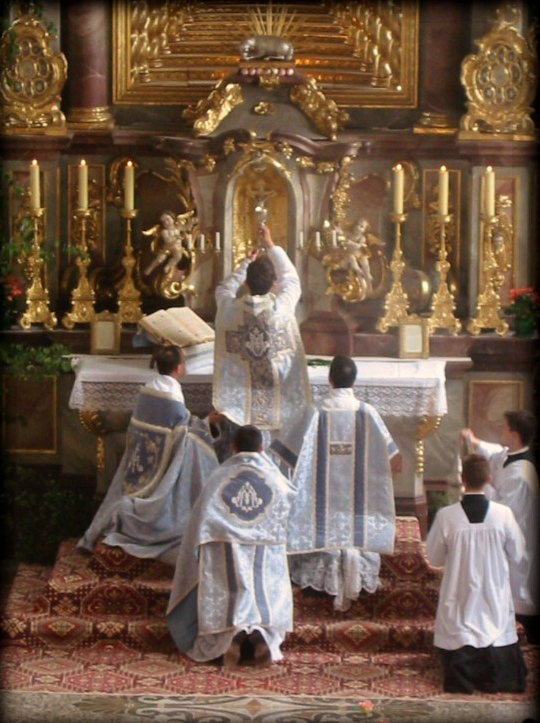
The Tridentine Mass, also known as the Extraordinary Form of the Roman Rite, the usus antiquior (Latin for 'more ancient use'), the Vetus Ordo ('Old Order'), the Traditional Latin Mass (TLM), or the Traditional Rite, is the form of Mass found in the Roman Missal of the Catholic Church codified in 1570 and published thereafter with amendments up to 1962. Celebrated almost exclusively in Ecclesiastical Latin, it was the most widely used Eucharistic liturgy in the world from its issuance in 1570 until its replacement by the Mass of Paul VI promulgated in 1969 (with the revised Roman Missal appearing in 1970).
"Tridentine" is derived from the Latin Tridentinus, lit. 'relating to the city of Trent', where the Council of Trent was held at the height of the Counter-Reformation. In response to a decision of that council, Pope Pius V promulgated the 1570 Roman Missal, making it mandatory throughout the Latin Church, except in places and religious orders with rites or uses from before 1370.
Permissions for celebrating the Tridentine Mass have been adjusted by successive popes, and most recently restricted by Pope Francis's motu proprio Traditionis custodes in 2021. This has been controversial among traditionalist Catholics.
The term "Tridentine Mass" applies to celebrations in accordance with the successive editions of the Roman Missal whose title attribute them to the Council of Trent (Missale Romanum ex decreto Sacrosancti Concilii Tridentini restitutum) and to the pope or popes who made the revision represented in the edition in question. The first of these editions is that of 1570, in which the mention of the Council of Trent is followed by a reference to Pope Pius V (Pii V Pont. Max. iussu editum). The last, that of 1962, mentions the popes only generically (Missale Romanum ex decreto SS. Concilii Tridentini restitutum Summorum Pontificum cura recognitum). Editions later than that of 1962 mention the Second Vatican Council instead of the Council of Trent, as in the 2002 edition: Missale Romanum ex decreto Sacrosancti Oecumenici Concilii Vaticani II instauratum auctoritati Pauli Pp. VI promulgatum Ioannis Pauli Pp. II cura recognitum.
Sometimes the term "Tridentine Mass" is applied restrictively to Masses in which the final 1962 edition of the Tridentine Roman Missal is used, the only edition still authorized, under certain conditions, as an extraordinary form of the Roman Rite Mass.
Some speak of this form of Mass as "the Latin Mass". This too is a restrictive use of a term whose proper sense is wider. The Second Vatican Council Mass also has its normative text, from which vernacular translations are made, in Latin, and, except at Masses scheduled by the ecclesiastical authorities to take place in the language of the people, it can everywhere be celebrated in Latin.
A few speak of the Tridentine Mass in general or of its 1962 form as the "Gregorian Rite". The term "Tridentine Rite" is also sometimes met with, but Pope Benedict XVI declared it inappropriate to speak of the 1962 Roman Missal and that published by later popes as if they were two rites: rather, he wrote, it is a matter of "a twofold use of one and the same" Roman Rite. Hugh Somerville-Knapman, O.S.B., says that they should be separate rites, as the Mass promulgated at the Council of Trent was already the pre-existing liturgy of the Diocese of Rome and has direct continuity with the Mass practiced by the apostles, whereas the changes made in implementing the Mass of Paul VI are so great that it no longer resembles any Catholic liturgy practiced prior to the 20th century.[failed verification]
Other names for the edition promulgated by Pope John XXIII in 1962 (the last to bear the indication ex decreto Sacrosancti Concilii Tridentini restitutum) are the Extraordinary Form, or the usus antiquior ("more ancient usage" in Latin ).
Hub AI
Tridentine Mass AI simulator
(@Tridentine Mass_simulator)
Tridentine Mass
The Tridentine Mass, also known as the Extraordinary Form of the Roman Rite, the usus antiquior (Latin for 'more ancient use'), the Vetus Ordo ('Old Order'), the Traditional Latin Mass (TLM), or the Traditional Rite, is the form of Mass found in the Roman Missal of the Catholic Church codified in 1570 and published thereafter with amendments up to 1962. Celebrated almost exclusively in Ecclesiastical Latin, it was the most widely used Eucharistic liturgy in the world from its issuance in 1570 until its replacement by the Mass of Paul VI promulgated in 1969 (with the revised Roman Missal appearing in 1970).
"Tridentine" is derived from the Latin Tridentinus, lit. 'relating to the city of Trent', where the Council of Trent was held at the height of the Counter-Reformation. In response to a decision of that council, Pope Pius V promulgated the 1570 Roman Missal, making it mandatory throughout the Latin Church, except in places and religious orders with rites or uses from before 1370.
Permissions for celebrating the Tridentine Mass have been adjusted by successive popes, and most recently restricted by Pope Francis's motu proprio Traditionis custodes in 2021. This has been controversial among traditionalist Catholics.
The term "Tridentine Mass" applies to celebrations in accordance with the successive editions of the Roman Missal whose title attribute them to the Council of Trent (Missale Romanum ex decreto Sacrosancti Concilii Tridentini restitutum) and to the pope or popes who made the revision represented in the edition in question. The first of these editions is that of 1570, in which the mention of the Council of Trent is followed by a reference to Pope Pius V (Pii V Pont. Max. iussu editum). The last, that of 1962, mentions the popes only generically (Missale Romanum ex decreto SS. Concilii Tridentini restitutum Summorum Pontificum cura recognitum). Editions later than that of 1962 mention the Second Vatican Council instead of the Council of Trent, as in the 2002 edition: Missale Romanum ex decreto Sacrosancti Oecumenici Concilii Vaticani II instauratum auctoritati Pauli Pp. VI promulgatum Ioannis Pauli Pp. II cura recognitum.
Sometimes the term "Tridentine Mass" is applied restrictively to Masses in which the final 1962 edition of the Tridentine Roman Missal is used, the only edition still authorized, under certain conditions, as an extraordinary form of the Roman Rite Mass.
Some speak of this form of Mass as "the Latin Mass". This too is a restrictive use of a term whose proper sense is wider. The Second Vatican Council Mass also has its normative text, from which vernacular translations are made, in Latin, and, except at Masses scheduled by the ecclesiastical authorities to take place in the language of the people, it can everywhere be celebrated in Latin.
A few speak of the Tridentine Mass in general or of its 1962 form as the "Gregorian Rite". The term "Tridentine Rite" is also sometimes met with, but Pope Benedict XVI declared it inappropriate to speak of the 1962 Roman Missal and that published by later popes as if they were two rites: rather, he wrote, it is a matter of "a twofold use of one and the same" Roman Rite. Hugh Somerville-Knapman, O.S.B., says that they should be separate rites, as the Mass promulgated at the Council of Trent was already the pre-existing liturgy of the Diocese of Rome and has direct continuity with the Mass practiced by the apostles, whereas the changes made in implementing the Mass of Paul VI are so great that it no longer resembles any Catholic liturgy practiced prior to the 20th century.[failed verification]
Other names for the edition promulgated by Pope John XXIII in 1962 (the last to bear the indication ex decreto Sacrosancti Concilii Tridentini restitutum) are the Extraordinary Form, or the usus antiquior ("more ancient usage" in Latin ).
Recent media