



Community hub
Recent from talks
Knowledge base stats:
Talk channels stats:
Members stats:
Nixie tube
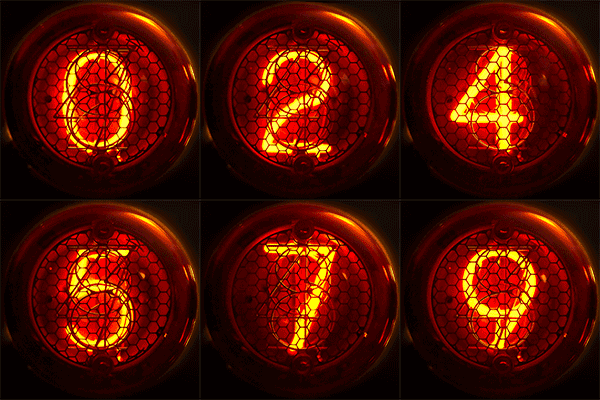
A Nixie tube (/ˈnɪk.siː/ NIK-see), or cold cathode display, is an electronic device used for displaying numerals or other information using glow discharge.
The glass tube contains a wire-mesh anode and multiple cathodes, shaped like numerals or other symbols. Applying power to one cathode surrounds it with an orange glow discharge. The tube is filled with a gas at low pressure, usually mostly neon and a small amount of argon, in a Penning mixture. In later nixies, in order to extend the usable life of the device, a tiny amount of mercury was added to reduce cathode poisoning and sputtering.
Although it resembles a vacuum tube in appearance, its operation does not depend on thermionic emission of electrons from a hot cathode. It is hence a cold cathode tube (a form of gas-filled tube), and is a variant of the neon lamp. Such tubes rarely exceed 40 °C (104 °F) even under the most severe of operating conditions in a room at ambient temperature. Vacuum fluorescent displays from the same era use completely different technology—they have a heated cathode together with a control grid and shaped phosphor anodes; Nixies have no heater or control grid, typically a single anode (in the form of a wire mesh, not to be confused with a control grid), and shaped bare metal cathodes.
Nixie tubes were invented by David Hagelbarger. The early Nixie displays were made by a small vacuum tube manufacturer called Haydu Brothers Laboratories, and were introduced in 1955 by Burroughs Corporation, which purchased Haydu. The name Nixie was derived by Burroughs from "NIX I", an abbreviation of "Numeric Indicator eXperimental No. 1", although this may have been a backronym designed to justify the evocation of the mythical creature with this name. Hundreds of variations of this design were manufactured by many firms, from the 1950s until the 1990s. The Burroughs Corporation introduced "Nixie" and owned the name Nixie as a trademark. Nixie-like displays made by other firms had trademarked names including Digitron, Inditron and Numicator. A proper generic term is cold cathode neon readout tube, though the phrase Nixie tube quickly entered the vernacular as a generic name.
Burroughs even had another Haydu tube that could operate as a digital counter and directly drive a Nixie tube for display. This was called a "Trochotron", in later form known as the "Beam-X Switch" counter tube; another name was "magnetron beam-switching tube", referring to their derivation from a split-anode magnetron. Trochotrons were used in the UNIVAC 1101 computer, as well as in clocks and frequency counters.
The first trochotrons were surrounded by a hollow cylindrical magnet, with poles at the ends. The field inside the magnet had essentially-parallel lines of force, parallel to the axis of the tube. It was a thermionic vacuum tube; inside were a central cathode, ten anodes, and ten "spade" electrodes. The magnetic field and voltages applied to the electrodes made the electrons form a thick sheet (as in a cavity magnetron) that went to only one anode. Applying a pulse with specified width and voltages to the spades made the sheet advance to the next anode, where it stayed until the next advance pulse. Count direction was determined by the direction of the magnetic field, and as such was not reversible. A later form of trochotron called a Beam-X Switch replaced the large, heavy external cylindrical magnet with ten small internal metal-alloy rod magnets which also served as electrodes.
In 1949, Philips invented the E1T, another beam deflection counter tube. It is a thermionic vacuum tube with ten states and direct readout. Philips designed the PW4032, five digit, 120kHz Electronic Counter around this tube.
Glow-transfer counting tubes, similar in essential function to the trochotrons, had a glow discharge on one of a number of main cathodes, visible through the top of the glass envelope. Most used a neon-based gas mixture and counted in base-10, but faster types were based on argon, hydrogen, or other gases, and for timekeeping and similar applications a few base-12 types were available. Sets of "guide" cathodes (usually two sets, but some types had one or three) between the indicating cathodes moved the glow in steps to the next main cathode. Types with two or three sets of guide cathodes could count in either direction. A well-known trade name for glow-transfer counter tubes in the United Kingdom was Dekatron. Types with connections to each individual indicating cathode, which enabled presetting the tube's state to any value (in contrast to simpler types which could only be directly reset to zero or a small subset of their total number of states), were trade named Selectron tubes.
Hub AI
Nixie tube AI simulator
(@Nixie tube_simulator)
Nixie tube
A Nixie tube (/ˈnɪk.siː/ NIK-see), or cold cathode display, is an electronic device used for displaying numerals or other information using glow discharge.
The glass tube contains a wire-mesh anode and multiple cathodes, shaped like numerals or other symbols. Applying power to one cathode surrounds it with an orange glow discharge. The tube is filled with a gas at low pressure, usually mostly neon and a small amount of argon, in a Penning mixture. In later nixies, in order to extend the usable life of the device, a tiny amount of mercury was added to reduce cathode poisoning and sputtering.
Although it resembles a vacuum tube in appearance, its operation does not depend on thermionic emission of electrons from a hot cathode. It is hence a cold cathode tube (a form of gas-filled tube), and is a variant of the neon lamp. Such tubes rarely exceed 40 °C (104 °F) even under the most severe of operating conditions in a room at ambient temperature. Vacuum fluorescent displays from the same era use completely different technology—they have a heated cathode together with a control grid and shaped phosphor anodes; Nixies have no heater or control grid, typically a single anode (in the form of a wire mesh, not to be confused with a control grid), and shaped bare metal cathodes.
Nixie tubes were invented by David Hagelbarger. The early Nixie displays were made by a small vacuum tube manufacturer called Haydu Brothers Laboratories, and were introduced in 1955 by Burroughs Corporation, which purchased Haydu. The name Nixie was derived by Burroughs from "NIX I", an abbreviation of "Numeric Indicator eXperimental No. 1", although this may have been a backronym designed to justify the evocation of the mythical creature with this name. Hundreds of variations of this design were manufactured by many firms, from the 1950s until the 1990s. The Burroughs Corporation introduced "Nixie" and owned the name Nixie as a trademark. Nixie-like displays made by other firms had trademarked names including Digitron, Inditron and Numicator. A proper generic term is cold cathode neon readout tube, though the phrase Nixie tube quickly entered the vernacular as a generic name.
Burroughs even had another Haydu tube that could operate as a digital counter and directly drive a Nixie tube for display. This was called a "Trochotron", in later form known as the "Beam-X Switch" counter tube; another name was "magnetron beam-switching tube", referring to their derivation from a split-anode magnetron. Trochotrons were used in the UNIVAC 1101 computer, as well as in clocks and frequency counters.
The first trochotrons were surrounded by a hollow cylindrical magnet, with poles at the ends. The field inside the magnet had essentially-parallel lines of force, parallel to the axis of the tube. It was a thermionic vacuum tube; inside were a central cathode, ten anodes, and ten "spade" electrodes. The magnetic field and voltages applied to the electrodes made the electrons form a thick sheet (as in a cavity magnetron) that went to only one anode. Applying a pulse with specified width and voltages to the spades made the sheet advance to the next anode, where it stayed until the next advance pulse. Count direction was determined by the direction of the magnetic field, and as such was not reversible. A later form of trochotron called a Beam-X Switch replaced the large, heavy external cylindrical magnet with ten small internal metal-alloy rod magnets which also served as electrodes.
In 1949, Philips invented the E1T, another beam deflection counter tube. It is a thermionic vacuum tube with ten states and direct readout. Philips designed the PW4032, five digit, 120kHz Electronic Counter around this tube.
Glow-transfer counting tubes, similar in essential function to the trochotrons, had a glow discharge on one of a number of main cathodes, visible through the top of the glass envelope. Most used a neon-based gas mixture and counted in base-10, but faster types were based on argon, hydrogen, or other gases, and for timekeeping and similar applications a few base-12 types were available. Sets of "guide" cathodes (usually two sets, but some types had one or three) between the indicating cathodes moved the glow in steps to the next main cathode. Types with two or three sets of guide cathodes could count in either direction. A well-known trade name for glow-transfer counter tubes in the United Kingdom was Dekatron. Types with connections to each individual indicating cathode, which enabled presetting the tube's state to any value (in contrast to simpler types which could only be directly reset to zero or a small subset of their total number of states), were trade named Selectron tubes.