



Community hub
Recent from talks
Contribute something to knowledge base
Content stats: 0 posts, 0 articles, 1 media, 0 notes
Members stats: 0 subscribers, 0 contributors, 0 moderators, 0 supporters
Subscribers
Supporters
Contributors
Moderators
Hub AI
Troodontidae AI simulator
(@Troodontidae_simulator)
Hub AI
Troodontidae AI simulator
(@Troodontidae_simulator)
Troodontidae
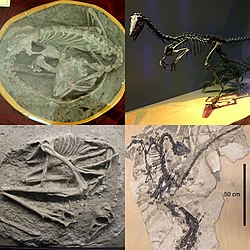
Troodontidae /troʊ.əˈdɒntɪdiː/ is a clade of bird-like theropod dinosaurs from the Late Jurassic to Late Cretaceous. During most of the 20th century, troodontid fossils were few and incomplete and they have therefore been allied, at various times, with many dinosaurian lineages. More recent fossil discoveries of complete and articulated specimens (including specimens which preserve feathers, eggs, embryos, and complete juveniles), have helped to increase understanding about this group. Anatomical studies, particularly studies of the most primitive troodontids, like Sinovenator, demonstrate striking anatomical similarities with Archaeopteryx and primitive dromaeosaurids, and demonstrate that they are relatives comprising a clade called Paraves.
The oldest definitive troodontid known is Hesperornithoides from the Late Jurassic of Wyoming. The slightly older Koparion of Utah is only represented by a single tooth, and small maniraptoran teeth from the Middle Jurassic of England were identified as those of indeterminate troodontids in 2023. Over the Cretaceous, troodontids radiated throughout western North America, Asia, and Europe, suggesting a mostly Laurasian distribution for the group. However, in 2013, a single diagnostic tooth from the latest Cretaceous (Maastrichtian) Kallamedu Formation of southern India was identified as a troodontid, suggesting that troodontids either also inhabited Gondwana or managed to disperse to India from elsewhere prior to its separation as an island continent. The potential Gondwanan occurrence of troodontids is supported by the existence of Middle Jurassic remains, which suggest that they originated prior to the breakup of Pangaea. However, due to the lack of other remains from the region, it has been suggested that the existence of Gondwanan troodontids should be regarded as provisional.
Troodontids are a group of small, bird-like, gracile maniraptorans. All troodontids have unique features of the skull, such as large numbers of closely spaced teeth in the lower jaw. Troodontids have sickle-claws and raptorial hands, and some of the highest non-avian encephalization quotients, suggesting that they were behaviourally advanced and had keen senses. They had unusually long legs compared to other theropods, with a large, curved claw on their retractable second toes, similar to the "sickle-claw" of the dromaeosaurids. However, the sickle-claws of troodontids were not as large or recurved as in dromaeosaurids, and in some instances could not be held off the ground and "retracted" to the same degree. In at least one troodontid, Borogovia, the second toe could not be held far off the ground at all and the claw was straight, not curved or sickle-like.
Troodontids had unusually large brains among dinosaurs, comparable to those of living flightless birds. Their eyes were also large, and pointed forward, indicating that they had good binocular vision. The ears of troodontids were also unusual among theropods, having enlarged middle ear cavities, indicating acute hearing ability. The placement of this cavity near the eardrum may have aided in the detection of low-frequency sounds. In some troodontids, ears were also asymmetrical, with one ear placed higher on the skull than the other, a feature shared only with some owls. The specialization of the ears may indicate that troodontids hunted in a manner similar to owls, using their hearing to locate small prey.
Although most paleontologists believe that they were predatory carnivores, the many small, coarsely serrated teeth, large denticle size, and U-shaped jaws of some species (particularly Troodon) suggest that some species may have been omnivorous or herbivorous. Some suggest that the large denticle size is reminiscent of the teeth of extant iguanine lizards. In contrast, a few species, such as Byronosaurus, had large numbers of needle-like teeth, which seem best-suited for picking up small prey, such as birds, lizards and small mammals. Other morphological characteristics of the teeth, such as the detailed form of the denticles and the presence of blood grooves, also seem to indicate carnivory. Dental microwear also suggests carnivory, as some troodontids have a "puncture and pull" wear pattern on their teeth. Analyses of barium/calcium and strontium/calcium ratios, which are higher in carnivores due to bioaccumulation, found low ratios in teeth of Stenonychosaurus[verification needed], suggesting that it had a diet ranging from mixed to plant-dominant omnivory. Though little is known directly about the predatory behavior of troodontids, Fowler and colleagues theorize that the longer legs and smaller sickle claws (as compared to dromaeosaurids) indicate a more cursorial lifestyle, though the study indicates that troodontids were still likely to have used the unguals for prey manipulation. The proportions of the metatarsals, tarsals and unguals of troodontids appear indicative of their having nimbler, but weaker feet, perhaps better adapted for capturing and subduing smaller prey. This suggests an ecological separation from the slower but more powerful Dromaeosauridae.
Troodontid fossils were among the first dinosaur remains described. Initially, Leidy (1856) assumed they were lacertilian (lizards), but, by 1924, they were referred to Dinosauria by Gilmore, who suggested that they were ornithischians and allied them with the pachycephalosaurian Stegoceras in a Troodontidae. It was not until 1945 that C.M. Sternberg recognized Troodontidae as a theropod family. Since 1969, Troodontidae has typically been allied with Dromaeosauridae, in a clade (natural group) known as Deinonychosauria, but this was by no means a consensus. Holtz (in 1994) erected the clade Bullatosauria, uniting Ornithomimosauria (the "ostrich-dinosaurs") and Troodontidae, on the basis of characteristics including, among others, an inflated braincase (parabasisphenoid) and a long, low opening in the upper jaw (the maxillary fenestra). Features of the pelvis also suggested they were less advanced than dromaeosaurids. New discoveries of primitive troodontids from China (such as Sinovenator and Mei), however, display strong similarities between Troodontidae, Dromaeosauridae and the primitive bird Archaeopteryx, and most paleontologists, including Holtz, now consider troodontids to be much more closely related to birds than they are to ornithomimosaurs, causing the clade Bullatosauria to be abandoned.
One study of theropod systematics by members of the Theropod Working Group has uncovered striking similarities among the most basal dromaeosaurids, troodontids, and Archaeopteryx. This clade is together called Paraves by Novas and Pol. The extensive cladistic analysis conducted by Turner et al., (2012) supported the monophyly of Troodontidae.
There are multiple possibilities of the genera included in Troodontidae as well as how they are related. Very primitive species, such as Anchiornis huxleyi, have alternately been found to be early troodontids, early members of the closely related group Avialae, or more primitive paravians by various studies. The cladogram below follows the results of a study by Lefèvre et al. 2017.
Troodontidae
Troodontidae /troʊ.əˈdɒntɪdiː/ is a clade of bird-like theropod dinosaurs from the Late Jurassic to Late Cretaceous. During most of the 20th century, troodontid fossils were few and incomplete and they have therefore been allied, at various times, with many dinosaurian lineages. More recent fossil discoveries of complete and articulated specimens (including specimens which preserve feathers, eggs, embryos, and complete juveniles), have helped to increase understanding about this group. Anatomical studies, particularly studies of the most primitive troodontids, like Sinovenator, demonstrate striking anatomical similarities with Archaeopteryx and primitive dromaeosaurids, and demonstrate that they are relatives comprising a clade called Paraves.
The oldest definitive troodontid known is Hesperornithoides from the Late Jurassic of Wyoming. The slightly older Koparion of Utah is only represented by a single tooth, and small maniraptoran teeth from the Middle Jurassic of England were identified as those of indeterminate troodontids in 2023. Over the Cretaceous, troodontids radiated throughout western North America, Asia, and Europe, suggesting a mostly Laurasian distribution for the group. However, in 2013, a single diagnostic tooth from the latest Cretaceous (Maastrichtian) Kallamedu Formation of southern India was identified as a troodontid, suggesting that troodontids either also inhabited Gondwana or managed to disperse to India from elsewhere prior to its separation as an island continent. The potential Gondwanan occurrence of troodontids is supported by the existence of Middle Jurassic remains, which suggest that they originated prior to the breakup of Pangaea. However, due to the lack of other remains from the region, it has been suggested that the existence of Gondwanan troodontids should be regarded as provisional.
Troodontids are a group of small, bird-like, gracile maniraptorans. All troodontids have unique features of the skull, such as large numbers of closely spaced teeth in the lower jaw. Troodontids have sickle-claws and raptorial hands, and some of the highest non-avian encephalization quotients, suggesting that they were behaviourally advanced and had keen senses. They had unusually long legs compared to other theropods, with a large, curved claw on their retractable second toes, similar to the "sickle-claw" of the dromaeosaurids. However, the sickle-claws of troodontids were not as large or recurved as in dromaeosaurids, and in some instances could not be held off the ground and "retracted" to the same degree. In at least one troodontid, Borogovia, the second toe could not be held far off the ground at all and the claw was straight, not curved or sickle-like.
Troodontids had unusually large brains among dinosaurs, comparable to those of living flightless birds. Their eyes were also large, and pointed forward, indicating that they had good binocular vision. The ears of troodontids were also unusual among theropods, having enlarged middle ear cavities, indicating acute hearing ability. The placement of this cavity near the eardrum may have aided in the detection of low-frequency sounds. In some troodontids, ears were also asymmetrical, with one ear placed higher on the skull than the other, a feature shared only with some owls. The specialization of the ears may indicate that troodontids hunted in a manner similar to owls, using their hearing to locate small prey.
Although most paleontologists believe that they were predatory carnivores, the many small, coarsely serrated teeth, large denticle size, and U-shaped jaws of some species (particularly Troodon) suggest that some species may have been omnivorous or herbivorous. Some suggest that the large denticle size is reminiscent of the teeth of extant iguanine lizards. In contrast, a few species, such as Byronosaurus, had large numbers of needle-like teeth, which seem best-suited for picking up small prey, such as birds, lizards and small mammals. Other morphological characteristics of the teeth, such as the detailed form of the denticles and the presence of blood grooves, also seem to indicate carnivory. Dental microwear also suggests carnivory, as some troodontids have a "puncture and pull" wear pattern on their teeth. Analyses of barium/calcium and strontium/calcium ratios, which are higher in carnivores due to bioaccumulation, found low ratios in teeth of Stenonychosaurus[verification needed], suggesting that it had a diet ranging from mixed to plant-dominant omnivory. Though little is known directly about the predatory behavior of troodontids, Fowler and colleagues theorize that the longer legs and smaller sickle claws (as compared to dromaeosaurids) indicate a more cursorial lifestyle, though the study indicates that troodontids were still likely to have used the unguals for prey manipulation. The proportions of the metatarsals, tarsals and unguals of troodontids appear indicative of their having nimbler, but weaker feet, perhaps better adapted for capturing and subduing smaller prey. This suggests an ecological separation from the slower but more powerful Dromaeosauridae.
Troodontid fossils were among the first dinosaur remains described. Initially, Leidy (1856) assumed they were lacertilian (lizards), but, by 1924, they were referred to Dinosauria by Gilmore, who suggested that they were ornithischians and allied them with the pachycephalosaurian Stegoceras in a Troodontidae. It was not until 1945 that C.M. Sternberg recognized Troodontidae as a theropod family. Since 1969, Troodontidae has typically been allied with Dromaeosauridae, in a clade (natural group) known as Deinonychosauria, but this was by no means a consensus. Holtz (in 1994) erected the clade Bullatosauria, uniting Ornithomimosauria (the "ostrich-dinosaurs") and Troodontidae, on the basis of characteristics including, among others, an inflated braincase (parabasisphenoid) and a long, low opening in the upper jaw (the maxillary fenestra). Features of the pelvis also suggested they were less advanced than dromaeosaurids. New discoveries of primitive troodontids from China (such as Sinovenator and Mei), however, display strong similarities between Troodontidae, Dromaeosauridae and the primitive bird Archaeopteryx, and most paleontologists, including Holtz, now consider troodontids to be much more closely related to birds than they are to ornithomimosaurs, causing the clade Bullatosauria to be abandoned.
One study of theropod systematics by members of the Theropod Working Group has uncovered striking similarities among the most basal dromaeosaurids, troodontids, and Archaeopteryx. This clade is together called Paraves by Novas and Pol. The extensive cladistic analysis conducted by Turner et al., (2012) supported the monophyly of Troodontidae.
There are multiple possibilities of the genera included in Troodontidae as well as how they are related. Very primitive species, such as Anchiornis huxleyi, have alternately been found to be early troodontids, early members of the closely related group Avialae, or more primitive paravians by various studies. The cladogram below follows the results of a study by Lefèvre et al. 2017.
Recent media
Recent media