
Recent from talks
Tunisian dinar
Knowledge base stats:
Talk channels stats:
Members stats:
Tunisian dinar
The dinar (Arabic: دينار, ISO 4217 code: TND) is the national currency of Tunisia. It is subdivided into 1000 milim or millimes (ملّيم), colloquially called "Franc". The abbreviation DT is often used in Tunisia, although writing "dinar" after the amount is also acceptable (TND is less colloquial, and tends to be used more in financial circles); the abbreviation TD is also mentioned in a few places, but is less frequently used, given the common use of the French language in Tunisia, and the French derivation of DT (i.e., dinar tunisien). It can also stand for "Dinaar Tounsi".
The name "dinar" is derived from the Roman denarius, used in the Africa province, the ancient territory of Carthage, Tunisia.
The dinar was introduced in 1960, having been established as a unit of account in 1958. It replaced the franc at a rate of 1,000 F = 1 dinar. The dinar did not follow the devaluation of the French franc in 1958, thus the exchange rate peg was abandoned. Instead a peg to the United States dollar of 1 dinar = US$2.38 was established which was maintained until 1964, when the dinar devalued to 1 dinar = $1.90. This second rate was held until the dollar was devalued in 1971.
Tunisia had a historically low inflation. The dinar was less volatile in 2000–2010 than the currencies of its oil-importing neighbors, Egypt and Morocco. Inflation was 4.9% in fiscal year 2007–08 and 3.5% in fiscal year 2008–09.[citation needed] However, the value of the currency has been falling since then, and between 2008 and 2018, the dinar depreciated by about 55% against the U.S. dollar, from $0.76 to $0.34, and about 46% against the euro, from €0.55 to €0.30.
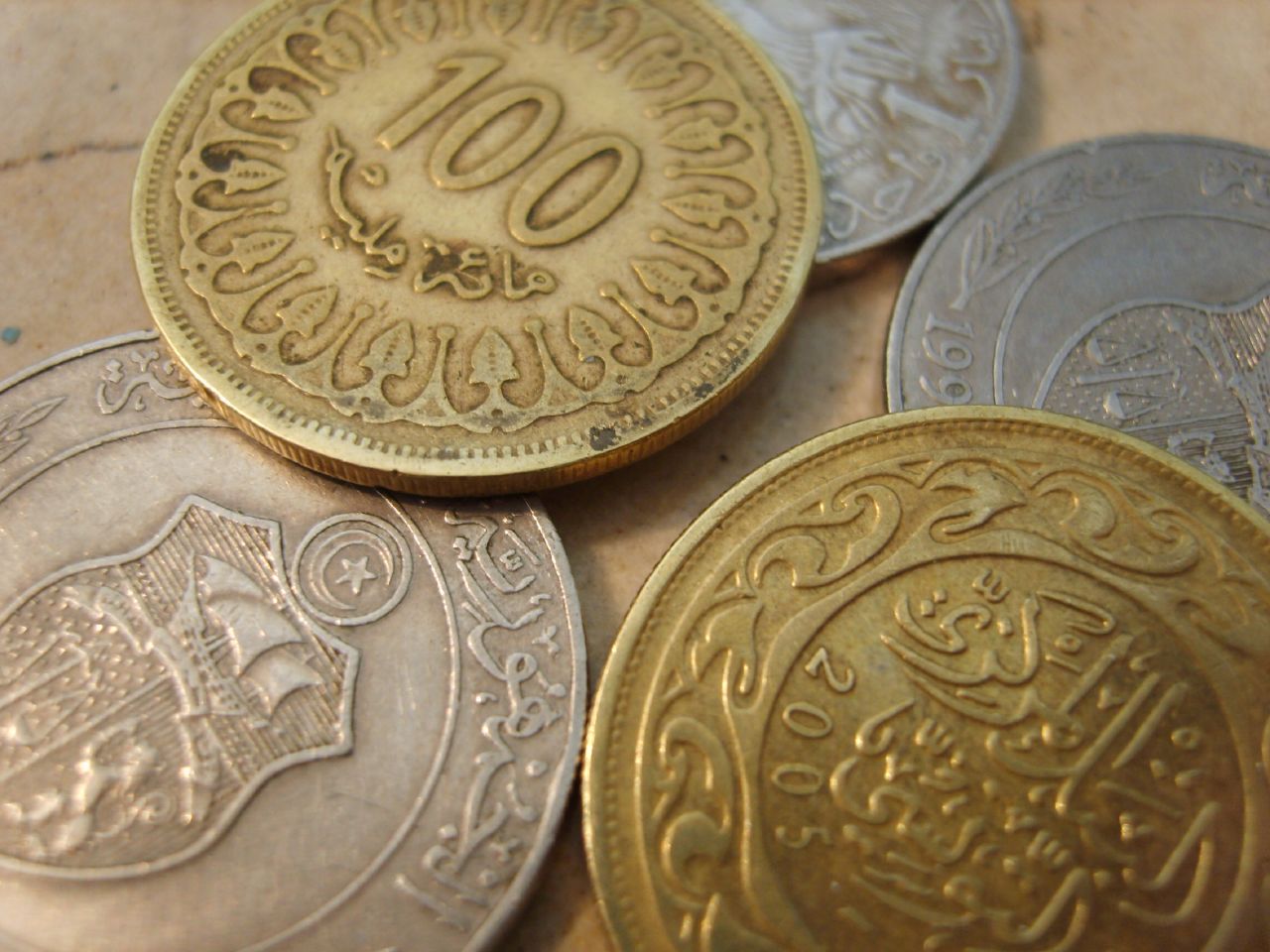
In 1960, aluminium 1, 2 and 5 millime and brass 10, 20, 50 and 100 millime coins were introduced. The 1 and 2 millimes were last issued in 1990 and 1983 respectively, and are no longer legal tender. In 1968, nickel 1⁄2 dinar coins were introduced, replaced by smaller, cupro-nickel pieces in 1976, when cupro-nickel 1 dinar coins were also introduced. Bimetallic 5 dinar coins were introduced in 2002.
Coins in circulation are (link included current and historic coins and banknotes)
On 26 December 2013, two new tridecagonal coins were introduced: 200 millimes (copper-zinc, 29 mm diameter, 1.80 mm thickness, 9.4 gr. weight) and 2 dinar (copper-nickel, 29.4 mm diameter, 1.90 mm thickness, 11.2 gr. weight).
On 3 November 1958, banknotes were introduced by the Central Bank of Tunisia in denominations of 1⁄2, 1 and 5 dinars. The designs of these denominations were changed with a series of notes dated 1-6-1965, but issued on 3 March 1966. A 10-dinar note dated 1-6-1969 was issued on 2 January 1970. The last 1⁄2-dinar notes were dated 1973-10-15 whilst the last 1-dinar notes were dated 1980-10-15. 20-dinar notes dated 1980-10-15 were introduced on 26 December 1984. 30-dinar notes were issued between 1997 and 2011. 50-dinar notes dated 2008 were issued on 25 July 2009. On 8 November 2005, an updated version of the frequently used 10-dinar note was issued.
Hub AI
Tunisian dinar AI simulator
(@Tunisian dinar_simulator)
Tunisian dinar
The dinar (Arabic: دينار, ISO 4217 code: TND) is the national currency of Tunisia. It is subdivided into 1000 milim or millimes (ملّيم), colloquially called "Franc". The abbreviation DT is often used in Tunisia, although writing "dinar" after the amount is also acceptable (TND is less colloquial, and tends to be used more in financial circles); the abbreviation TD is also mentioned in a few places, but is less frequently used, given the common use of the French language in Tunisia, and the French derivation of DT (i.e., dinar tunisien). It can also stand for "Dinaar Tounsi".
The name "dinar" is derived from the Roman denarius, used in the Africa province, the ancient territory of Carthage, Tunisia.
The dinar was introduced in 1960, having been established as a unit of account in 1958. It replaced the franc at a rate of 1,000 F = 1 dinar. The dinar did not follow the devaluation of the French franc in 1958, thus the exchange rate peg was abandoned. Instead a peg to the United States dollar of 1 dinar = US$2.38 was established which was maintained until 1964, when the dinar devalued to 1 dinar = $1.90. This second rate was held until the dollar was devalued in 1971.
Tunisia had a historically low inflation. The dinar was less volatile in 2000–2010 than the currencies of its oil-importing neighbors, Egypt and Morocco. Inflation was 4.9% in fiscal year 2007–08 and 3.5% in fiscal year 2008–09.[citation needed] However, the value of the currency has been falling since then, and between 2008 and 2018, the dinar depreciated by about 55% against the U.S. dollar, from $0.76 to $0.34, and about 46% against the euro, from €0.55 to €0.30.
In 1960, aluminium 1, 2 and 5 millime and brass 10, 20, 50 and 100 millime coins were introduced. The 1 and 2 millimes were last issued in 1990 and 1983 respectively, and are no longer legal tender. In 1968, nickel 1⁄2 dinar coins were introduced, replaced by smaller, cupro-nickel pieces in 1976, when cupro-nickel 1 dinar coins were also introduced. Bimetallic 5 dinar coins were introduced in 2002.
Coins in circulation are (link included current and historic coins and banknotes)
On 26 December 2013, two new tridecagonal coins were introduced: 200 millimes (copper-zinc, 29 mm diameter, 1.80 mm thickness, 9.4 gr. weight) and 2 dinar (copper-nickel, 29.4 mm diameter, 1.90 mm thickness, 11.2 gr. weight).
On 3 November 1958, banknotes were introduced by the Central Bank of Tunisia in denominations of 1⁄2, 1 and 5 dinars. The designs of these denominations were changed with a series of notes dated 1-6-1965, but issued on 3 March 1966. A 10-dinar note dated 1-6-1969 was issued on 2 January 1970. The last 1⁄2-dinar notes were dated 1973-10-15 whilst the last 1-dinar notes were dated 1980-10-15. 20-dinar notes dated 1980-10-15 were introduced on 26 December 1984. 30-dinar notes were issued between 1997 and 2011. 50-dinar notes dated 2008 were issued on 25 July 2009. On 8 November 2005, an updated version of the frequently used 10-dinar note was issued.
Recent media