Hubbry Logo
logo
Tuplet
Community hub

Tuplet

logo
0 subscribers
Read side by side
from Wikipedia

\new RhythmicStaff {
   \clef percussion
   \time 4/4
   \set Score.tempoHideNote = ##t \tempo 4 = 80
   c4 \tuplet 3/2 { c8 c c }
   c4 \tuplet 5/4 { c16 c c c c }
   c4
}
Rhythm with tuplets: a triplet on the second beat and a quintuplet on the fourth

In music, a tuplet (also irrational rhythm or groupings, artificial division or groupings, abnormal divisions, irregular rhythm, gruppetto, extra-metric groupings, or, rarely, contrametric rhythm) is "any rhythm that involves dividing the beat into a different number of equal subdivisions from that usually permitted by the time-signature (e.g., triplets, duplets, etc.)"[1] This is indicated by a number, or sometimes two indicating the fraction involved. The notes involved are also often grouped with a bracket or (in older notation) a slur.

The most common type of tuplet is the triplet.

Terminology

[edit]

The modern term 'tuplet' comes from a rebracketing of compound words like quintu(s)-(u)plet and sextu(s)-(u)plet, and from related mathematical terms such as "tuple", "-uplet" and "-plet", which are used to form terms denoting multiplets (Oxford English Dictionary, entries "multiplet", "-plet, comb. form", "-let, suffix", and "-et, suffix1"). An alternative modern term, "irrational rhythm", was originally borrowed from Greek prosody where it referred to "a syllable having a metrical value not corresponding to its actual time-value, or ... a metrical foot containing such a syllable" (Oxford English Dictionary, entry "irrational"). The term would be incorrect if used in the mathematical sense (because the note-values are rational fractions) or in the more general sense of "unreasonable, utterly illogical, absurd".

Alternative terms found occasionally are "artificial division",[2] "abnormal divisions",[3] "irregular rhythm",[4] and "irregular rhythmic groupings".[5] The term "polyrhythm" (or "polymeter"), sometimes incorrectly used instead of "tuplets", actually refers to the simultaneous use of opposing time signatures.[6]

Besides "triplet", the terms "duplet", "quadruplet", "quintuplet", "sextuplet", "septuplet", and "octuplet" are used frequently. The terms "nonuplet", "decuplet", "undecuplet", "dodecuplet", and "tredecuplet" had been suggested but up until 1925 had not caught on.[7] By 1964 the terms "nonuplet" and "decuplet" were usual, while subdivisions by greater numbers were more commonly described as "group of eleven notes", "group of twelve notes", and so on.[8]

Triplet

[edit]

The most common tuplet[9] is the triplet (German Triole, French triolet, Italian terzina or tripletta, Spanish tresillo). Whereas normally two quarter notes (crotchets) are the same duration as a half note (minim), three triplet quarter notes have that same duration, so the duration of a triplet quarter note is 23 the duration of a standard quarter note.

 \new RhythmicStaff {
   \clef percussion
   \time 2/4
   \set Score.tempoHideNote = ##t \tempo 4 = 100
   c4 c
   \tuplet 3/2 { c4 c c }
}

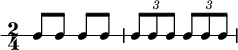
Similarly, three triplet eighth notes (quavers) are equal in duration to one quarter note. If several note values appear under the triplet bracket, they are all affected the same way, reduced to 23 their original duration.

 \new RhythmicStaff {
   \clef percussion
   \time 2/4
   \set Score.tempoHideNote = ##t \tempo 4 = 100
   c8 c c c
   \tuplet 3/2 { c8 c c } \tuplet 3/2 { c8 c c }
}

The triplet indication may also apply to notes of different values, for example a quarter note followed by one eighth note, in which case the quarter note may be regarded as two triplet eighths tied together.[10]

 \new RhythmicStaff {
   \clef percussion
   \time 2/4
   \set Score.tempoHideNote = ##t \tempo 4 = 100
   \tuplet 3/2 { c4 c8 } \tuplet 3/2 { c8 c4 }
}

In some older scores, rhythms like this would be notated as a dotted eighth note and a sixteenth note as a kind of shorthand[11] presumably so that the beaming more clearly shows the beats.

Tuplet notation

[edit]

Notation

[edit]

Tuplets are typically notated either with a bracket or with a number above or below the beam if the notes are beamed together. Sometimes, the tuplet is notated with a ratio (instead of just a number) — with the first number in the ratio indicating the number of notes in the tuplet and the second number indicating the number of normal notes they have the same duration as — or with a ratio and a note value.

 {
\override Score.TimeSignature #'stencil = ##f
\new RhythmicStaff {
   \clef percussion
   \time 5/4
   \set Score.tempoHideNote = ##t \tempo 4 = 100
   \tuplet 3/2 { c8 c c }
   \once \override TupletBracket.bracket-visibility = ##t \tuplet 3/2 { c8 c c }
   \once \override TupletNumber.text = "3:2" \tuplet 3/2 { c8 c c }
   \once \override TupletNumber.text = "3:2♪" \tuplet 3/2 { c8 c c }
} }

Rhythm

[edit]

Simple meter

[edit]

For other tuplets, the number indicates a ratio to the next lower normal value in the prevailing meter (a power of 2 in simple meter). So a quintuplet (quintolet or pentuplet[12]) indicated with the numeral 5 means that five of the indicated note value total the duration normally occupied by four (or, as a division of a dotted note in compound time, three), equivalent to the second higher note value. For example, five quintuplet eighth notes total the same duration as a half note (or, in 3
8
or compound meters such as 6
8
, 9
8
, etc. time, a dotted quarter note).

 \new RhythmicStaff {
   \clef percussion
   \time 2/4
   \set Score.tempoHideNote = ##t \tempo 4 = 100
   c8 c c c
   \tuplet 5/4 { c8 c c c c }
   c2
}

Some numbers are used inconsistently: for example septuplets (septolets or septimoles) usually indicate 7 notes in the duration of 4—or in compound meter 7 for 6—but may sometimes be used to mean 7 notes in the duration of 8.[13] Thus, a septuplet lasting a whole note can be written with either quarter notes (7:4) or eighth notes (7:8).

 \new RhythmicStaff {
   \clef percussion
   \time 4/4
   \set Score.tempoHideNote = ##t \tempo 4 = 100
   \tuplet 7/4 { c4 c c c c c c }
   \tuplet 7/8 { c8 c c c c c c }
}

To avoid ambiguity, composers sometimes write the ratio explicitly instead of just a single number. This is also done for cases like 7:11, where the validity of this practice is established by the complexity of the figure. A French alternative is to write pour ("for") or de ("of") in place of the colon, or above the bracketed "irregular" number.[14] This reflects the French usage of, for example, "six-pour-quatre" as an alternative name for the sextolet.[15][16]

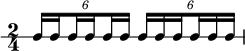
There are disagreements about the sextuplet (pronounced with stress on the first syllable, according to Baker[17])—which is also called sestole, sestolet, sextole, or sextolet.[17][18][19][20][21][22][23] This six-part division may be regarded either as a triplet with each note divided in half (2 + 2 + 2)—therefore with an accent on the first, third, and fifth notes—or else as an ordinary duple pattern with each note subdivided into triplets (3 + 3) and accented on both the first and fourth notes. This is indicated by the beaming in the example below.
 \new RhythmicStaff {
   \clef percussion
   \time 2/4
   \set Score.tempoHideNote = ##t \tempo 4 = 100
   \tuplet 6/4 { c16 \set stemRightBeamCount = #1 c \set stemLeftBeamCount = #1 c \set stemRightBeamCount = #1 c \set stemLeftBeamCount = #1 c c }
   \tuplet 6/4 { c16 c \set stemRightBeamCount = #1 c \set stemLeftBeamCount = #1 c c c }
}

Some authorities treat both groupings as equally valid forms,[24][25][19][26][27] while others dispute this, holding the first type to be the "true" (or "real") sextuplet, and the second type to be properly a "double triplet", which should always be written and named as such.[28][29][30] Some go so far as to call the latter, when written with a numeral 6, a "false" sextuplet.[17][31][32] Still others, on the contrary, define the sextuplet precisely and solely as the double triplet,[21][33] and a few more, while accepting the distinction, contend that the true sextuplet has no internal subdivisions—only the first note of the group should be accented.[34][30][23])

Compound meter

[edit]

In compound meter, even-numbered tuplets can indicate that a note value is changed in relation to the dotted version of the next higher note value. Thus, two duplet eighth notes (most often used in 6
8
meter) take the time normally totaled by three eighth notes, equal to a dotted quarter note. Four quadruplet (or quartole) eighth notes would also equal a dotted quarter note. The duplet eighth note is thus exactly the same duration as a dotted eighth note, but the duplet notation is far more common in compound meters.[35]

 \new RhythmicStaff {
   \clef percussion
   \time 6/8
   \set Score.tempoHideNote = ##t \tempo 4 = 100
   c8 c c c c c
   \tuplet 2/3 { c8 c } c8. c
   \tuplet 4/3 { c8 c c c } c16. c c c
   c2.
}

A duplet in compound time is more often written as 2:3 (a dotted quarter note split into two duplet eighth notes) than 2:1+12 (a dotted quarter note split into two duplet quarter notes), even though the former is inconsistent with a quadruplet also being written as 4:3 (a dotted quarter note split into four quadruplet eighth notes).[36]

Nested tuplets

[edit]

On occasion, tuplets are used "inside" tuplets. These are referred to as nested tuplets.

 \new RhythmicStaff {
   \clef percussion
   \time 2/4
   \set Score.tempoHideNote = ##t \tempo 4 = 68
   \once \override TupletBracket.bracket-visibility = ##t \tuplet 5/4 {c8[ \tuplet 3/2 { c16 c c] } c4 \tuplet 7/4 { c32[ c c c c c c] } } c2
}

Counting

[edit]

Tuplets can produce rhythms such as the hemiola or may be used as polyrhythms when played against the regular duration. They are extrametric rhythmic units. The example below shows sextuplets in quintuplet time.


<< \relative c' {
   \override Staff.StaffSymbol.line-positions = #'(-2 2)
   \clef percussion
   \time 5/4
   \override TupletNumber.text = #tuplet-number::calc-fraction-text
   \tuplet 6/5 { e4 e e e e e } e4
} \\ \relative c' {
   a4 a a a a a
}
>>

Tuplets may be counted, most often at extremely slow tempos, using the least common multiple (LCM) between the original and tuplet divisions. For example, with a 3-against-2 tuplet (triplets) the LCM is 6. Since 6 ÷ 2 = 3 and 6 ÷ 3 = 2 the quarter notes fall every three counts (overlined) and the triplets every two (underlined):

1 2 3 4 5 6

This is fairly easily brought up to tempo, and depending on the music may be counted in tempo, while 7-against-4, having an LCM of 28, may be counted at extremely slow tempos but must be played intuitively ("felt out") at tempo:

1 2 3 4 5 6 7 8 9 10 11 12 13 14 15 16 17 18 19 20 21 22 23 24 25 26 27 28

To play a half-note (minim) triplet accurately in a bar of 4
4
, count eighth-note triplets and tie them together in groups of four


<< \relative c' {
   \override Staff.StaffSymbol.line-positions = #'(-2 2)
   \clef percussion
   \time 4/4
   \tuplet 3/2 { e4.~ e8 e4~ e e8~ e4. } e4
} \\ \relative c' {
   \tuplet 3/2 { a2 a a } a4
}
>>

With a stress on each target note, one would count: 1 – 2 – 3  1 – 2 – 3  1 – 2 – 3  1 – 2 – 3  1 The same principle can be applied to quintuplets, septuplets, and so on.

See also

[edit]

References

[edit]

Further reading

[edit]
[edit]
Revisions and contributorsEdit on WikipediaRead on Wikipedia
from Grokipedia
A tuplet is a rhythmic device in music notation that groups a specified number of notes to be performed in the time normally occupied by a different number, creating subdivisions of a beat that deviate from the standard binary (divisions of two) or ternary (divisions of three) patterns dictated by the meter.[1] This allows composers and performers to introduce rhythmic complexity and variety, such as fitting three notes into the space of two or five into the space of four.[2] The most common tuplet is the triplet, where three equal notes replace two, often notated with a "3" above a bracket or slur connecting the notes, and it is widely used to add syncopation or fluidity.[1] Other tuplets include duplets (two notes in the time of three, common in compound meters), quadruplets (four in the time of three or six), quintuplets (five in four or six), and less frequent ones like sextuplets or septuplets, each indicated by the corresponding numeral.[1] Tuplets can apply to any note value and span beats or measures, but they must maintain equal duration within the group unless otherwise specified.[1] In practice, tuplets enhance expressiveness by challenging conventional pulse, appearing in works by composers like Johann Sebastian Bach, who employed them in inventions and fugues such as the triplet version of Invention No. 1 in C major (BWV 772a),[3] and remaining essential in modern music education for developing rhythmic precision.[2] Their notation ensures clarity in scores, preventing misinterpretation of timing, and they underscore music's mathematical underpinnings through ratios like 3:2 or 5:4.[1]

Fundamentals

Definition

In music theory, a tuplet refers to an irregular grouping of notes that divides a beat or a portion of a measure into a non-standard number of equal parts, contrasting with the conventional divisions of two (binary) or three (ternary) typically prescribed by simple or compound time signatures. This allows composers to deviate from expected rhythmic patterns, such as fitting three equal notes into the space of two.[1][4] Tuplets are conceptually expressed through mathematical ratios, where the numerator represents the number of notes in the group and the denominator indicates the equivalent standard duration they occupy; for example, a triplet is a 3:2 ratio, playing three equal notes in the time normally reserved for two.[5] The triplet serves as the most prevalent example of a tuplet in Western music.[1] Tuplets serve to introduce rhythmic variety and complexity, enabling syncopated effects that emphasize off-beats and facilitating the adaptation of non-Western rhythmic structures, such as additive patterns from African or Indian traditions, into standard Western notation.[4][6] The term "tuplet" is a generalization derived from the suffixes of specific designations like "duplet," "triplet," and "quintuplet," providing a unified label for all such non-standard rhythmic groupings.[7]

Terminology

The term "triplet" for a group of three notes played in the time of two emerged in English musical usage during the early 18th century, aligning with the Classical period's standardization of numerical indications for irregular rhythms.[8] This nomenclature built on earlier rhythmic practices from the Renaissance and Baroque eras, where such divisions were notated but lacked the specific label. The broader term "tuplet," encompassing any irregular subdivision beyond the standard binary or ternary divisions, is a generalization in music notation and theory, deriving from the suffix "-tuplet" analogous to "quintuplet" or "sextuplet." Linguistic variations for triplets reflect national traditions in Western music: in German, it is known as Triole; in French, triolet; and in Italian, terzina or tripletta. These terms distinguish the concept from related but distinct ideas, such as "irrational rhythm," an older designation borrowed from Greek prosody referring to metrically anomalous syllables and applied to non-standard note groupings in music, or "polymeter," which involves simultaneous different meters rather than subdivided beats within a single meter.[9] Specific tuplets beyond triplets bear analogous names based on their note count: a duplet divides the time of three equal notes into two, typically in compound meters (e.g., 2:3 ratio for eighth notes in 6/8); a quadruplet fits four notes into the time of three, common in simple meters (e.g., 4:3 for eighth notes in 3/4); and a quintuplet places five notes in the duration of four or two, depending on context (e.g., 5:4 for sixteenth notes in 4/4 or 5:2 in duple meter).[10][1]/04:_Basics_of_Rhythm/4.05:_Tuplets) In modern pedagogy, particularly through music notation software, the generic "n-tuplet" has gained prominence to denote any such grouping by number n, facilitating precise input and display; for instance, Finale and Sibelius employ "tuplet" tools that allow users to specify ratios like 5:4 via dialogs, standardizing the handling of these elements in digital composition since the late 20th century.[11][12]

The Triplet

Characteristics

A triplet consists of three notes performed in the time normally occupied by two notes of equal value, establishing a core ratio of 3:2 that accelerates the rhythmic pace within a single beat.[13] This division results in each individual triplet note having a duration of two-thirds that of a corresponding straight note, allowing for a denser subdivision of the beat while maintaining temporal equality among the three notes.[14] Acoustically and perceptually, triplets produce a lilting or swinging rhythm that evokes a sense of forward motion and rotation in listeners, often enhancing emphasis within a phrase.[15] This effect arises from the uneven temporal distribution relative to binary divisions, creating a quasi-triplet feel that aligns with swing rhythms in genres like jazz, where the first note receives approximately twice the duration of the second in eighth-note pairs.[16] Triplets can also mimic natural speech or gait patterns through their ternary flow, contributing to a more organic and expressive performance quality.[17] In terms of acoustic analysis, the 3:2 ratio of triplets parallels just intonation principles in pitch, where simple integer ratios like 3:2 (for a perfect fifth) promote consonance; similarly, this rhythmic proportion fosters temporal consonance, yielding smoother and more harmonious performances by approximating natural proportional divisions.[18]

Common Applications

In classical music, triplets often enhance melodic flow, as seen in Ludwig van Beethoven's Violin Sonata No. 5 in F major, Op. 24 ("Spring"), where flowing triplets in the piano accompaniment support a lyrical, dolce violin melody in the rondo's F major episode.[19] Similarly, in the same work's stormy interruptions, triplets propel rhythmic energy while maintaining structural cohesion.[19] In jazz, triplets approximate the swing feel by dividing beats into three equal parts, evoking the genre's characteristic lilt, though actual swing ratios often deviate from the ideal 3:2 proportion found in strict triplets.[20] This approximation is particularly evident in ensemble performances at moderate tempos, where the "triple feel" adds propulsion without rigid quantization.[20] In folk traditions, such as Irish music, triplets serve as ornamental embellishments in jigs, where three notes are played rapidly within the space of one quaver to add rhythmic vitality and melodic nuance.[21] For instance, ascending or descending triplets on quaver beats in 6/8 jigs heighten the dance-like drive.[21] Structurally, triplets fill beats to introduce syncopation, displacing accents from strong pulses to create rhythmic tension that resolves upon return to duple divisions.[22] They also facilitate smooth transitions between sections by bridging metric boundaries, building anticipation through irregular grouping before releasing into expected patterns.[22] In modern electronic music since the 2000s, triplets impart an organic, humanized feel to otherwise quantized rhythms, as in trap and dubstep tracks where they disrupt straight-eight grooves for added groove and unpredictability.[22] Film scores similarly employ triplets to evoke natural flow amid synthetic elements.[22] Performers must prioritize even spacing in triplets, ensuring each of the three notes receives precisely one-third of the allotted time to avoid blurring into duple rhythms.[23] A common pitfall is rushing the third note, which compresses the group and undermines the intended 3:2 ratio, often due to uneven finger independence or metronomic overemphasis on the downbeat.[23]

General Tuplets

Types and Ratios

Tuplets extend the concept of the triplet, which divides the time of two equal notes into three (ratio 3:2), to other numerical divisions that create irregular rhythmic groupings.[1] These non-triplet tuplets are classified by their ratios in the general form n:m, where n represents the number of notes performed and m indicates the standard divisions they replace, such as a power of two in simple meters or three in compound meters.[5] Duplets, with a ratio of 2:3, group two notes in the time typically occupied by three, commonly appearing in compound meters to provide a duple feel against a triple subdivision.[1] Quadruplets follow a 4:3 ratio, fitting four notes into the space of three, which can enhance rhythmic density in similar contexts.[1] Quintuplets typically use ratios of 5:2 or 5:4, dividing the time of two or four equal notes into five, allowing for smoother transitions in passages requiring pentuple subdivision.[5] Higher-order tuplets include septuplets at 7:4, which insert seven notes in the duration of four, often to achieve intricate polyrhythmic effects.[5] The choice of tuplet type and ratio depends on the desired musical effect, such as creating more fluid or exotic divisions in odd meters that deviate from binary or ternary norms.[1] In contemporary music, rarer types like nonuplets (9:8) appear to approximate microtonal rhythms or complex temporal proportions, offering composers tools for experimental textures beyond standard Western divisions.[24]

Properties

Tuplets achieve rhythmic density through time compression, wherein an n:m tuplet divides the duration normally occupied by m equal notes into n notes of equal length, resulting in each note lasting m/n of the standard note value.[1] For instance, in a 3:2 eighth-note triplet, the three notes collectively span the time of two eighth notes, compressing each to two-thirds of a standard eighth note's duration.[1] This mechanism allows composers to fit unconventional subdivisions into established beats, enhancing expressive variety without resorting to tempo changes.[1] Tuplets introduce metric disruption by temporarily overriding the prevailing pulse divisions dictated by the time signature, creating localized irregularities that resolve back to the metric norm.[1] Unlike a full metric modulation or time signature alteration, which would redefine the entire measure's structure, tuplets maintain the underlying time signature while perturbing the perceived beat hierarchy within a specific span.[25] This selective interruption underscores the pulse's elasticity, allowing rhythmic tension to build and release without global reconfiguration.[25] When combined with non-tuplet rhythms, tuplets generate cross-rhythms, where conflicting subdivision rates produce polyrhythmic overlays that accentuate layered pulses.[26] For example, a triplet against duple divisions can evoke a 3:2 polyrhythm, heightening textural complexity through simultaneous independent strands.[26] These interactions exploit the tension between irregular and regular metrics, often yielding perceptual ambiguity that enriches harmonic and motivic interplay.[26] In atonal and serial music following Schoenberg, tuplets serve as tools for rhythmic complexity, enabling dense, non-dyadic hierarchies that parallel pitch serialization's emancipation from tonality.[27] Composers like Milton Babbitt integrated tuplets in works such as Philomel to construct mathematically precise structures, using them to disrupt and layer pulses in ways that mirror serial organization.[27] Similarly, Brian Ferneyhough employed extreme tuplets in pieces like Second String Quartet to achieve hyper-complex rhythms, fostering intricate temporal relationships that challenge performers and listeners alike.[27] This application underscores tuplets' role in advancing rhythmic autonomy in twentieth-century composition.[27]

Notation

Symbols and Placement

Tuplets are visually indicated in musical scores primarily through a bracket that spans the grouped notes, accompanied by a numeral denoting the number of notes in the division, such as "3" for a triplet. This numeral is positioned above the bracket for notes with downward stems or below for upward stems, promoting clear legibility and integration with staff elements.[28] The numeral represents the count of equal subdivisions within the total duration, determined by the rhythmic value of the first note in the group; for example, a triplet notated with eighth notes collectively spans the duration of a quarter note.[1] In contemporary music engraving, brackets are frequently omitted when the tuplet notes are connected by beams, with the numeral alone sufficing to denote the grouping, as this maintains visual economy in complex passages. Historically, tuplets were often marked using slurs or tie-like curves to connect the notes, a practice common in pre-19th-century scores before the widespread adoption of dedicated brackets.[29] Digital notation standards, such as MusicXML developed since 2000, encode tuplet visuals through attributes for bracket presence (yes/no), shape (curved or straight), and placement (above/below), enabling precise and interoperable rendering in software like Finale and Sibelius.[30]

Beaming and Brackets

In music notation, tuplet notes are beamed together across their entire span to visually reinforce the irregular grouping, following standard beaming conventions that align with the beat structure. When a tuplet includes both tuplet and non-tuplet notes within the same rhythmic unit, cross-beaming is employed to connect the groups while maintaining clarity, ensuring the beams do not obscure the distinction between irregular and regular subdivisions.[31] Brackets, typically straight with slanted ends, are applied to unbeamed tuplet notes to enclose the group and highlight its boundaries, but they are omitted for fully beamed tuplets where the beam itself suffices as a grouping indicator. In dense musical passages or when context makes the grouping unambiguous, brackets may be entirely omitted to reduce visual clutter, particularly in instrumental parts with rapid rhythms. For vocal music or passages requiring legato performance, slurs can replace or supplement brackets, serving dual purposes of phrasing and rhythmic indication while avoiding overlap with the tuplet numeral.[31][32] Engraving best practices emphasize precise alignment of the tuplet numeral—such as "3" for a triplet—directly above the beam or bracket for optimal readability, with the numeral positioned on the stem or beam side in modern scores to integrate seamlessly with beaming. In multi-voice scores, brackets and numerals are adjusted or omitted where possible to prevent interference with adjacent staves, prioritizing legibility without excessive notation density; for instance, successive identical tuplets may share a single numeral to streamline the page.[33][32] Accessibility considerations extend to braille music notation, where tuplets are represented using specific braille cells, such as the single-cell triplet sign (dots 2-3) or a three-cell sign (dots 4-5-6 + numeral + dots 2-3-6) for irregular groups like quintuplets (dots 4-5-6 + 5 + dots 2-3-6). The 2015 Music Braille Code, an update refining 2010s standards, standardizes these symbols with music commas (e.g., dots 6) for irregular beaming across metric divisions, ensuring consistent transcription and enhanced clarity for visually impaired musicians.[34]

Rhythmic Contexts

Simple Meters

In simple meters, such as 4/4 or 2/4, tuplets function by dividing established binary beats into unequal subdivisions, most commonly through triplets that split a quarter note into three equal parts instead of the standard two. This introduces a ternary rhythm into a duple framework, temporarily disrupting the expected pulse while maintaining alignment with the meter. For instance, a group of three eighth-note triplets occupies the same duration as a single quarter note, allowing composers to layer rhythmic complexity without altering the overall time signature.[1] The rhythmic value of such tuplets follows a general n:m ratio, where n notes are performed in the time typically allotted for m notes of the same denomination, with m often corresponding to binary divisions like 2 or 4 in simple meters. This equivalence ensures that triplet eighth notes sum to one quarter note's length, preserving metric coherence despite the irregular grouping. Such constructions produce hemiola-like effects, evoking a 3:2 ratio that blurs the perception of duple beats into a fleeting ternary feel, achieved through the triplet's compression without requiring simultaneous polyrhythmic layers.[1][35] Composers frequently employ tuplets in simple meters to infuse swing or a lilting quality into genres like marches and ballads, transforming rigid binary rhythms into more fluid, expressive patterns. In these contexts, triplets add a subtle propulsion, enhancing emotional depth in ballads or providing a jaunty contrast to the march's steady tread.[2] In minimalist music from the 1960s onward, tuplets within simple meters can facilitate phase effects by enabling gradual pattern shifts that evolve rhythmic interlocks over time, creating hypnotic, interlocking textures in duple frameworks.

Compound Meters

In compound meters such as 6/8 and 9/8, tuplets facilitate irregular divisions by introducing subdivisions that deviate from the natural ternary pulse of the beat, often borrowing from simple meter conventions to create binary or quaternary groupings. A duplet, with a 2:3 ratio, groups two eighth notes within the duration of a dotted quarter note, allowing them to fit naturally across one beat in these signatures.[1] Similarly, a quadruplet (4:3 ratio) compresses four eighth notes into the same dotted quarter span, enabling denser rhythmic textures suitable for fills or accents.[1][36] Specific note values in these contexts highlight the alignment with the ternary structure: for instance, a duplet of sixteenth notes occupies the time equivalent to a dotted eighth note, as the pair replaces three sixteenths (each individual note thus lasting 1.5 sixteenths).[37] This differs from simple meters, where tuplets impose non-binary divisions on a duple base, whereas here they harmonize with the inherent grouping of three, enhancing rhythmic cohesion.[2] Composers employ tuplets in compound meters to blend simple and compound divisions, often in two-part textures that juxtapose ternary pulses with duplets or quadruplets for rhythmic contrast and drive.[36] In world music adaptations, 20th-century transcriptions of Balkan folk traditions have used irregular beaming or time signature changes to notate asymmetric patterns in odd meters such as 7/8, preserving the feel of uneven groupings like 2+2+3 while fitting Western notation conventions.

Advanced Topics

Nested Tuplets

Nested tuplets involve embedding an inner tuplet within the space occupied by one or more notes of an outer tuplet, creating hierarchical divisions that further subdivide the rhythmic space. For instance, a quintuplet containing a triplet consists of a quintuplet fitted into the duration normally spanned by four notes, where the inner triplet divides one of its portions into three notes instead of the expected two.[38] This structure allows composers to layer irregular groupings, producing intricate rhythmic patterns beyond simple divisions. Notation for nested tuplets employs multiple brackets to delineate each level, with the outer bracket enclosing the entire group and inner brackets marking the subdivisions, building on standard tuplet bracket conventions. The challenges of nested tuplets arise from their cumulative time compression, as each inner level proportionally reduces the duration of its notes relative to the outer framework, necessitating precise calculations to ensure rhythmic accuracy. The total ratio for the smallest units can be derived as the product of the inner and outer ratios; for example, a 3:2 outer triplet containing a 4:3 inner quadruplet yields an effective 12:6 (or 2:1) ratio for the innermost notes when simplified, though the hierarchy preserves the intended layering.[39][40][41] In avant-garde music, nested tuplets can facilitate complex rhythmic effects. Software like Dorico has supported automatic nesting of tuplets since its 2016 release, allowing unlimited levels of embedding during input without manual duration adjustments, which aids composers in handling such complexities.[39]

Counting Methods

One common subdivision approach for counting tuplets involves dividing the total span into equal parts using verbal syllables that match the tuplet's number, ensuring each note receives uniform duration. For instance, an eighth-note triplet spanning the duration of two eighth notes is often counted as "1-tri-plet" or "1-la-li," with each syllable aligning to one of the three notes. This method helps performers internalize the irregular grouping by borrowing from familiar triple-meter subdivisions in simple time, promoting even execution through repetitive vocalization during practice.[42][43] Integrating a metronome aids in precise timing for tuplets by setting the pulse to encompass the entire span, allowing performers to align the irregular division with steady clicks. For triplets, the metronome can click on the first and third notes (or every other note) at half the base tempo, while apps like The Online Metronome or specialized tools for irregular rhythms provide subdivision options such as triplet or quintuplet clicks to simulate the grouping without altering the overall beat. This technique is particularly useful for larger tuplets like quintuplets, where vocalizing the count alongside the clicks reinforces subdivision accuracy.[44][45] Mental strategies for executing tuplets often include associating the irregular rhythm with straight divisions or incorporating body percussion to build kinesthetic awareness. Performers may mentally overlay the tuplet onto a duple subdivision—for example, envisioning a triplet as accelerating through a binary pulse—while using physical gestures like clapping, thigh-patting, or foot-tapping to mark each note's placement, which enhances timing perception over purely cognitive counting. Research supports that such embodied approaches improve rhythmic accuracy in complex patterns by engaging motor systems alongside auditory processing.[46] In 21st-century music education, adaptations of Dalcroze eurhythmics have extended kinesthetic strategies to complex rhythms through movement-based exercises. This method emphasizes improvisation and group activities to build performance confidence.

References

User Avatar
No comments yet.