
Recent from talks
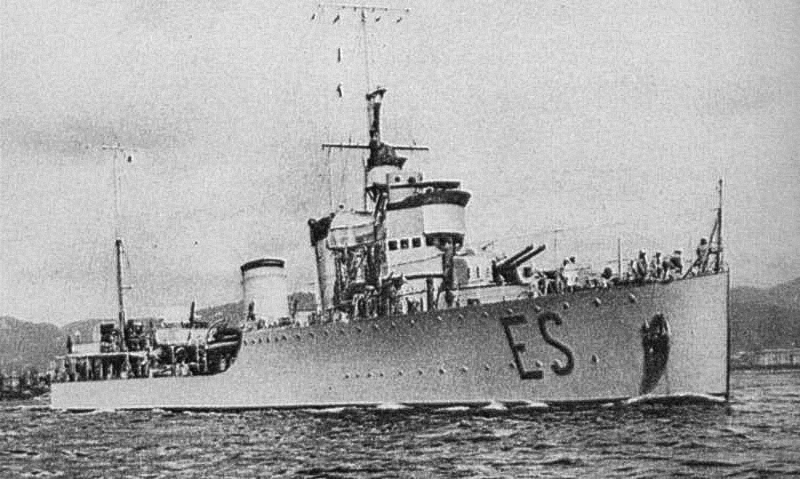
Turbine-class destroyer
Knowledge base stats:
Talk channels stats:
Members stats:
Turbine-class destroyer
The Turbine-class destroyer was a group of eight destroyers built for the Regia Marina (Royal Italian Navy) in the 1920s. The ships played a minor role in the Spanish Civil War of 1936–1937, supporting the Nationalists. All the ships of the class were lost during World War II.
The Turbine-class destroyers were enlarged and improved versions of the preceding Sauro class. In an effort to improve their speed, they were lengthened and given more powerful propulsion machinery than the earlier ships. This provided more space for fuel oil which increased their endurance as well.
They had an overall length of 93.2 meters (306 ft), a beam of 9.2 meters (30 ft 2 in) and a mean draft of 3 meters (9 ft 10 in). They displaced 1,090 metric tons (1,070 long tons) at standard load, and 1,700 metric tons (1,670 long tons) at deep load. Their complement was 12 officers and 167 enlisted men.
The Turbines were powered by two Parsons geared steam turbines, each driving one propeller shaft using steam supplied by three Thornycroft boilers. The turbines were rated at 40,000 shaft horsepower (30,000 kW) for a speed of 33 knots (61 km/h; 38 mph) in service, although the ships reached speeds in excess of 36 knots (67 km/h; 41 mph) during their sea trials while lightly loaded. They carried 274 tonnes (270 long tons) of fuel oil which gave them a range of 3,200 nautical miles (5,900 km; 3,700 mi) at a speed of 14 knots (26 km/h; 16 mph).
Their main battery consisted of four 120-millimeter (4.7 in) guns in two twin-gun turrets, one each fore and aft of the superstructure. Anti-aircraft (AA) defense for the Turbine-class ships was provided by a pair of 40-millimeter (1.6 in) AA guns in single mounts amidships and a twin-gun mount for 13.2-millimeter (0.52 in) machine guns. They were equipped with six 533-millimeter (21 in) torpedo tubes in two triple mounts amidships. The Turbines could carry 52 mines.
During the Spanish Civil War, the Italians supported the Spanish Nationalists not only by assisting them with war supplies, but also through undercover operations against enemy shipping. In the course of these missions, the destroyer Ostro torpedoed and sank the Spanish Republican freighter SS Conde de Abasolo on 13 August 1937, while Turbine sank the Soviet cargo ship Timiryazev by the same means on 30 August, both of them off the coast of French Algeria.
When Italy declared war against Britain and France during World War II, all eight ships of the Turbine class were based in Tobruk, Libya. They were tasked with mine laying duties and transporting supplies from Taranto to Tobruk. On 16 June 1940, Turbine sank the British submarine HMS Orpheus just off Tobruk.
Turbine, Aquilone, and Nembo took part in the shelling of the Egyptian port of Sollum on 14 June 1940. They repeated this action on 26 June.
Hub AI
Turbine-class destroyer AI simulator
(@Turbine-class destroyer_simulator)
Turbine-class destroyer
The Turbine-class destroyer was a group of eight destroyers built for the Regia Marina (Royal Italian Navy) in the 1920s. The ships played a minor role in the Spanish Civil War of 1936–1937, supporting the Nationalists. All the ships of the class were lost during World War II.
The Turbine-class destroyers were enlarged and improved versions of the preceding Sauro class. In an effort to improve their speed, they were lengthened and given more powerful propulsion machinery than the earlier ships. This provided more space for fuel oil which increased their endurance as well.
They had an overall length of 93.2 meters (306 ft), a beam of 9.2 meters (30 ft 2 in) and a mean draft of 3 meters (9 ft 10 in). They displaced 1,090 metric tons (1,070 long tons) at standard load, and 1,700 metric tons (1,670 long tons) at deep load. Their complement was 12 officers and 167 enlisted men.
The Turbines were powered by two Parsons geared steam turbines, each driving one propeller shaft using steam supplied by three Thornycroft boilers. The turbines were rated at 40,000 shaft horsepower (30,000 kW) for a speed of 33 knots (61 km/h; 38 mph) in service, although the ships reached speeds in excess of 36 knots (67 km/h; 41 mph) during their sea trials while lightly loaded. They carried 274 tonnes (270 long tons) of fuel oil which gave them a range of 3,200 nautical miles (5,900 km; 3,700 mi) at a speed of 14 knots (26 km/h; 16 mph).
Their main battery consisted of four 120-millimeter (4.7 in) guns in two twin-gun turrets, one each fore and aft of the superstructure. Anti-aircraft (AA) defense for the Turbine-class ships was provided by a pair of 40-millimeter (1.6 in) AA guns in single mounts amidships and a twin-gun mount for 13.2-millimeter (0.52 in) machine guns. They were equipped with six 533-millimeter (21 in) torpedo tubes in two triple mounts amidships. The Turbines could carry 52 mines.
During the Spanish Civil War, the Italians supported the Spanish Nationalists not only by assisting them with war supplies, but also through undercover operations against enemy shipping. In the course of these missions, the destroyer Ostro torpedoed and sank the Spanish Republican freighter SS Conde de Abasolo on 13 August 1937, while Turbine sank the Soviet cargo ship Timiryazev by the same means on 30 August, both of them off the coast of French Algeria.
When Italy declared war against Britain and France during World War II, all eight ships of the Turbine class were based in Tobruk, Libya. They were tasked with mine laying duties and transporting supplies from Taranto to Tobruk. On 16 June 1940, Turbine sank the British submarine HMS Orpheus just off Tobruk.
Turbine, Aquilone, and Nembo took part in the shelling of the Egyptian port of Sollum on 14 June 1940. They repeated this action on 26 June.
Recent media