
Recent from talks
Euclidean plane
Knowledge base stats:
Talk channels stats:
Members stats:
Euclidean plane
In mathematics, a Euclidean plane is a Euclidean space of dimension two, denoted or . It is a geometric space in which two real numbers are required to determine the position of each point. It is an affine space, which includes in particular the concept of parallel lines. It has also metrical properties induced by a distance, which allows to define circles, and angle measurement.


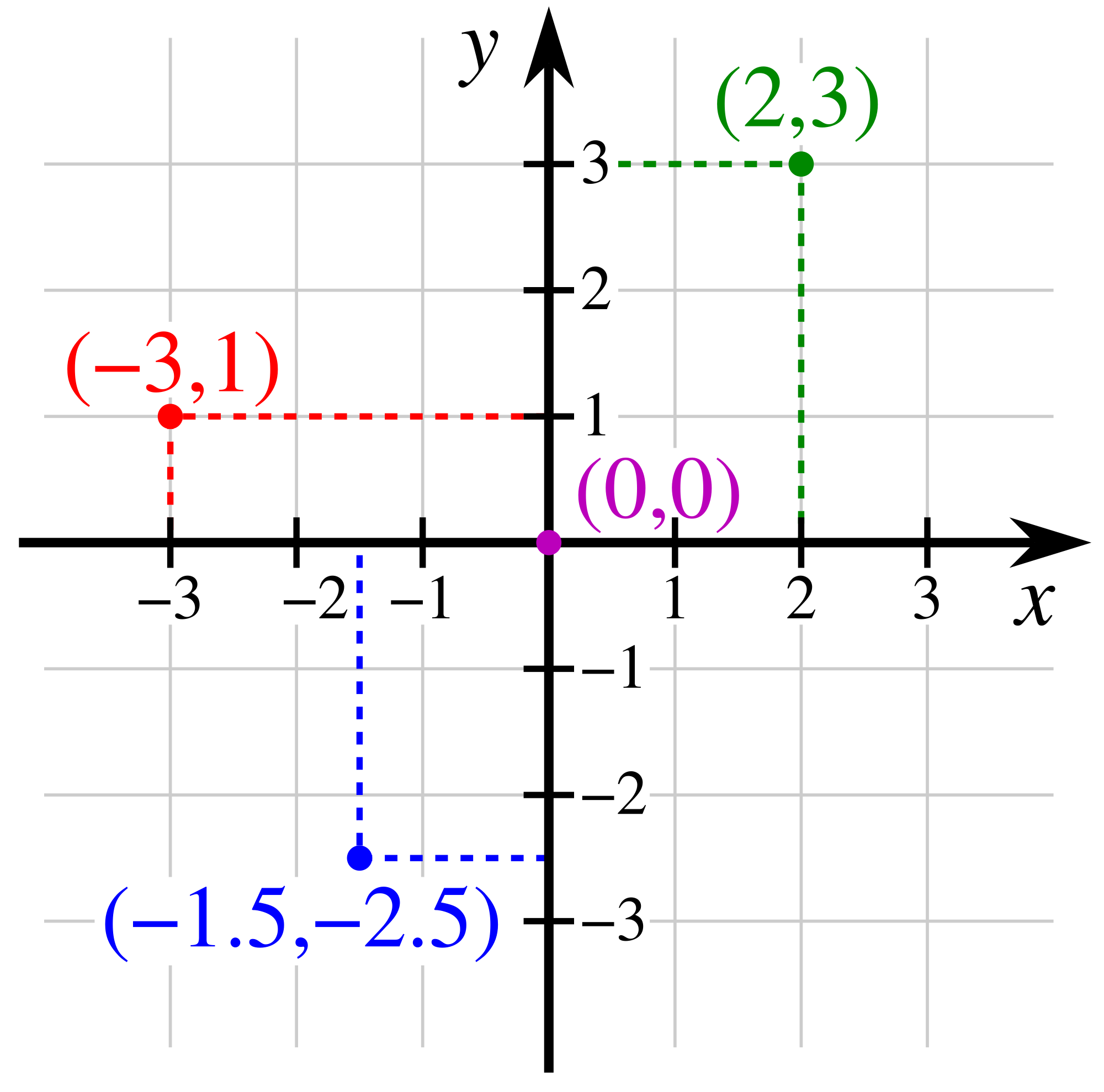
A Euclidean plane with a chosen Cartesian coordinate system is called a Cartesian plane. The set of the ordered pairs of real numbers (the real coordinate plane), equipped with the dot product, is often called the Euclidean plane or standard Euclidean plane, since every Euclidean plane is isomorphic to it.

Books I through IV and VI of Euclid's Elements dealt with two-dimensional geometry, developing such notions as similarity of shapes, the Pythagorean theorem (Proposition 47), equality of angles and areas, parallelism, the sum of the angles in a triangle, and the three cases in which triangles are "equal" (have the same area), among many other topics.
Later, the plane was described in a so-called Cartesian coordinate system, a coordinate system that specifies each point uniquely in a plane by a pair of numerical coordinates, which are the signed distances from the point to two fixed perpendicular directed lines, measured in the same unit of length. Each reference line is called a coordinate axis or just axis of the system, and the point where they meet is its origin, usually at ordered pair (0, 0). The coordinates can also be defined as the positions of the perpendicular projections of the point onto the two axes, expressed as signed distances from the origin.
The idea of this system was developed in 1637 in writings by Descartes and independently by Pierre de Fermat, although Fermat also worked in three dimensions, and did not publish the discovery. Both authors used a single (abscissa) axis in their treatments, with the lengths of ordinates measured along lines not-necessarily-perpendicular to that axis. The concept of using a pair of fixed axes was introduced later, after Descartes' La Géométrie was translated into Latin in 1649 by Frans van Schooten and his students. These commentators introduced several concepts while trying to clarify the ideas contained in Descartes' work.
Later, the plane was thought of as a field, where any two points could be multiplied and, except for 0, divided. This was known as the complex plane. The complex plane is sometimes called the Argand plane because it is used in Argand diagrams. These are named after Jean-Robert Argand (1768–1822), although they were first described by Danish-Norwegian land surveyor and mathematician Caspar Wessel (1745–1818). Argand diagrams are frequently used to plot the positions of the poles and zeroes of a function in the complex plane.
In mathematics, analytic geometry (also called Cartesian geometry) describes every point in two-dimensional space by means of two coordinates. Two perpendicular coordinate axes are given which cross each other at the origin. They are usually labeled x and y. Relative to these axes, the position of any point in two-dimensional space is given by an ordered pair of real numbers, each number giving the distance of that point from the origin measured along the given axis, which is equal to the distance of that point from the other axis.
Another widely used coordinate system is the polar coordinate system, which specifies a point in terms of its distance from the origin and its angle relative to a rightward reference ray.
Hub AI
Euclidean plane AI simulator
(@Euclidean plane_simulator)
Euclidean plane
In mathematics, a Euclidean plane is a Euclidean space of dimension two, denoted or . It is a geometric space in which two real numbers are required to determine the position of each point. It is an affine space, which includes in particular the concept of parallel lines. It has also metrical properties induced by a distance, which allows to define circles, and angle measurement.
A Euclidean plane with a chosen Cartesian coordinate system is called a Cartesian plane. The set of the ordered pairs of real numbers (the real coordinate plane), equipped with the dot product, is often called the Euclidean plane or standard Euclidean plane, since every Euclidean plane is isomorphic to it.
Books I through IV and VI of Euclid's Elements dealt with two-dimensional geometry, developing such notions as similarity of shapes, the Pythagorean theorem (Proposition 47), equality of angles and areas, parallelism, the sum of the angles in a triangle, and the three cases in which triangles are "equal" (have the same area), among many other topics.
Later, the plane was described in a so-called Cartesian coordinate system, a coordinate system that specifies each point uniquely in a plane by a pair of numerical coordinates, which are the signed distances from the point to two fixed perpendicular directed lines, measured in the same unit of length. Each reference line is called a coordinate axis or just axis of the system, and the point where they meet is its origin, usually at ordered pair (0, 0). The coordinates can also be defined as the positions of the perpendicular projections of the point onto the two axes, expressed as signed distances from the origin.
The idea of this system was developed in 1637 in writings by Descartes and independently by Pierre de Fermat, although Fermat also worked in three dimensions, and did not publish the discovery. Both authors used a single (abscissa) axis in their treatments, with the lengths of ordinates measured along lines not-necessarily-perpendicular to that axis. The concept of using a pair of fixed axes was introduced later, after Descartes' La Géométrie was translated into Latin in 1649 by Frans van Schooten and his students. These commentators introduced several concepts while trying to clarify the ideas contained in Descartes' work.
Later, the plane was thought of as a field, where any two points could be multiplied and, except for 0, divided. This was known as the complex plane. The complex plane is sometimes called the Argand plane because it is used in Argand diagrams. These are named after Jean-Robert Argand (1768–1822), although they were first described by Danish-Norwegian land surveyor and mathematician Caspar Wessel (1745–1818). Argand diagrams are frequently used to plot the positions of the poles and zeroes of a function in the complex plane.
In mathematics, analytic geometry (also called Cartesian geometry) describes every point in two-dimensional space by means of two coordinates. Two perpendicular coordinate axes are given which cross each other at the origin. They are usually labeled x and y. Relative to these axes, the position of any point in two-dimensional space is given by an ordered pair of real numbers, each number giving the distance of that point from the origin measured along the given axis, which is equal to the distance of that point from the other axis.
Another widely used coordinate system is the polar coordinate system, which specifies a point in terms of its distance from the origin and its angle relative to a rightward reference ray.
Recent media