



Community hub
Community hub
Recent from talks
Knowledge base stats:
Talk channels stats:
Members stats:
Type II supernova
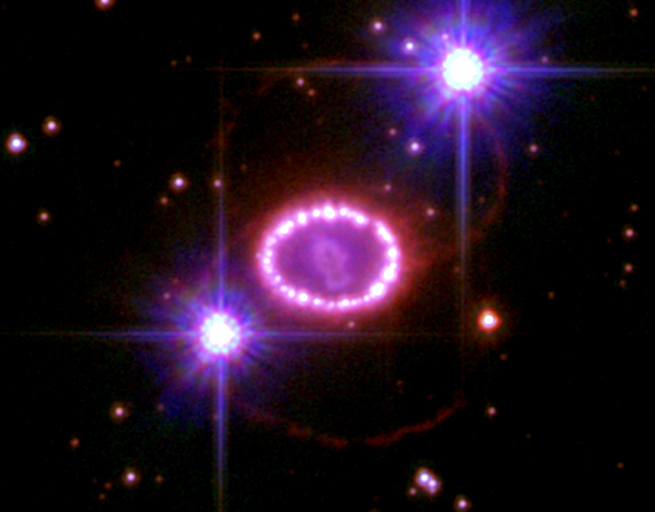
A Type II supernova or SNII (plural: supernovae) results from the violent explosion of a massive star following the rapid collapse of its core. A star must have at least eight times, but no more than 40 to 50 times, the mass of the Sun (M☉) to undergo this type of explosion. Type II supernovae are distinguished from other types of supernovae by the presence of hydrogen in their spectra. They are usually observed in the spiral arms of galaxies and in H II regions, but not in elliptical galaxies; those are generally composed of older, low-mass stars, with few of the young, very massive stars necessary to cause a supernova.
Stars generate energy by the nuclear fusion of elements. Unlike the Sun, massive stars possess the mass needed to fuse elements that have an atomic mass greater than hydrogen and helium, albeit at increasingly higher temperatures and pressures, causing correspondingly shorter stellar life spans. The degeneracy pressure of electrons and the energy generated by these fusion reactions are sufficient to counter the force of gravity and prevent the star from collapsing, maintaining stellar equilibrium. The star fuses increasingly higher mass elements, starting with hydrogen and then helium, progressing up through the periodic table until a core of iron and nickel is produced. Fusion of iron or nickel produces no net energy output, so no further fusion can take place, leaving the nickel–iron core inert. Due to the lack of energy output creating outward thermal pressure, the core contracts due to gravity until the overlying weight of the star can be supported largely by electron degeneracy pressure.
When the compacted mass of the inert core exceeds the Chandrasekhar limit of about 1.4 M☉, electron degeneracy is no longer sufficient to counter the gravitational compression. A cataclysmic implosion of the core takes place within seconds. Without the support of the now-imploded inner core, the outer core collapses inwards under gravity and reaches a velocity of up to 23% of the speed of light, and the sudden compression increases the temperature of the inner core to up to 100 billion kelvins. Neutrons and neutrinos are formed via reversed beta-decay, releasing about 1046 joules (100 foe) in a ten-second burst. The collapse of the inner core is halted by the repulsive nuclear force and neutron degeneracy, causing the implosion to rebound and bounce outward. The energy of this expanding shock wave is sufficient to disrupt the overlying stellar material and accelerate it to escape velocity, forming a supernova explosion. The shock wave and extremely high temperature and pressure rapidly dissipate but are present for long enough to allow for a brief period during which the production of elements heavier than iron occurs. Depending on the star's initial mass, the remnants of the core form a neutron star or a black hole. Because of the underlying mechanism, the resulting supernova is also described as a core-collapse supernova.
There exist several categories of Type II supernova explosions, which are categorized based on the resulting light curve—a graph of luminosity versus time—following the explosion. Type II-L supernovae show a steady (linear) decline of the light curve following the explosion, whereas Type II-P display a period of slower decline (a plateau) in their light curve followed by a normal decay. Type Ib and Ic supernovae are a type of core-collapse supernova for a massive star that has shed its outer envelope of hydrogen and (for Type Ic) helium. As a result, they appear to be lacking in these elements.
Stars far more massive than the sun evolve in complex ways. In the core of the star, hydrogen is fused into helium, releasing thermal energy that heats the star's core and provides outward pressure that supports the star's layers against collapse – a situation known as stellar or hydrostatic equilibrium. The helium produced in the core accumulates there. Temperatures in the core are not yet high enough to cause it to fuse. Eventually, as the hydrogen at the core is exhausted, fusion starts to slow down, and gravity causes the core to contract. This contraction raises the temperature high enough to allow a shorter phase of helium fusion, which produces carbon and oxygen, and accounts for less than 10% of the star's total lifetime.
In stars of less than eight solar masses, the carbon produced by helium fusion does not fuse, and the star gradually cools to become a white dwarf. If they accumulate more mass from another star, or some other source, they may become Type Ia supernovae. But a much larger star is massive enough to continue fusion beyond this point.
The cores of these massive stars directly create temperatures and pressures needed to cause the carbon in the core to begin to fuse when the star contracts at the end of the helium-burning stage. The core gradually becomes layered like an onion, as progressively heavier atomic nuclei build up at the center, with an outermost layer of hydrogen gas, surrounding a layer of hydrogen fusing into helium, surrounding a layer of helium fusing into carbon via the triple-alpha process, surrounding layers that fuse to progressively heavier elements. As a star this massive evolves, it undergoes repeated stages where fusion in the core stops, and the core collapses until the pressure and temperature are sufficient to begin the next stage of fusion, reigniting to halt collapse.
The factor limiting this process is the amount of energy that is released through fusion, which is dependent on the binding energy that holds together these atomic nuclei. Each additional step produces progressively heavier nuclei, which release progressively less energy when fusing. In addition, from carbon-burning onwards, energy loss via neutrino production becomes significant, leading to a higher rate of reaction than would otherwise take place. This continues until nickel-56 is produced, which decays radioactively into cobalt-56 and then iron-56 over the course of a few months. As iron and nickel have the highest binding energy per nucleon of all the elements, energy cannot be produced at the core by fusion, and a nickel-iron core grows. This core is under huge gravitational pressure. As there is no fusion to further raise the star's temperature to support it against collapse, it is supported only by degeneracy pressure of electrons. In this state, matter is so dense that further compaction would require electrons to occupy the same energy states. However, this is forbidden for identical fermion particles, such as the electron – a phenomenon called the Pauli exclusion principle.
Hub AI
Type II supernova AI simulator
(@Type II supernova_simulator)
Type II supernova
A Type II supernova or SNII (plural: supernovae) results from the violent explosion of a massive star following the rapid collapse of its core. A star must have at least eight times, but no more than 40 to 50 times, the mass of the Sun (M☉) to undergo this type of explosion. Type II supernovae are distinguished from other types of supernovae by the presence of hydrogen in their spectra. They are usually observed in the spiral arms of galaxies and in H II regions, but not in elliptical galaxies; those are generally composed of older, low-mass stars, with few of the young, very massive stars necessary to cause a supernova.
Stars generate energy by the nuclear fusion of elements. Unlike the Sun, massive stars possess the mass needed to fuse elements that have an atomic mass greater than hydrogen and helium, albeit at increasingly higher temperatures and pressures, causing correspondingly shorter stellar life spans. The degeneracy pressure of electrons and the energy generated by these fusion reactions are sufficient to counter the force of gravity and prevent the star from collapsing, maintaining stellar equilibrium. The star fuses increasingly higher mass elements, starting with hydrogen and then helium, progressing up through the periodic table until a core of iron and nickel is produced. Fusion of iron or nickel produces no net energy output, so no further fusion can take place, leaving the nickel–iron core inert. Due to the lack of energy output creating outward thermal pressure, the core contracts due to gravity until the overlying weight of the star can be supported largely by electron degeneracy pressure.
When the compacted mass of the inert core exceeds the Chandrasekhar limit of about 1.4 M☉, electron degeneracy is no longer sufficient to counter the gravitational compression. A cataclysmic implosion of the core takes place within seconds. Without the support of the now-imploded inner core, the outer core collapses inwards under gravity and reaches a velocity of up to 23% of the speed of light, and the sudden compression increases the temperature of the inner core to up to 100 billion kelvins. Neutrons and neutrinos are formed via reversed beta-decay, releasing about 1046 joules (100 foe) in a ten-second burst. The collapse of the inner core is halted by the repulsive nuclear force and neutron degeneracy, causing the implosion to rebound and bounce outward. The energy of this expanding shock wave is sufficient to disrupt the overlying stellar material and accelerate it to escape velocity, forming a supernova explosion. The shock wave and extremely high temperature and pressure rapidly dissipate but are present for long enough to allow for a brief period during which the production of elements heavier than iron occurs. Depending on the star's initial mass, the remnants of the core form a neutron star or a black hole. Because of the underlying mechanism, the resulting supernova is also described as a core-collapse supernova.
There exist several categories of Type II supernova explosions, which are categorized based on the resulting light curve—a graph of luminosity versus time—following the explosion. Type II-L supernovae show a steady (linear) decline of the light curve following the explosion, whereas Type II-P display a period of slower decline (a plateau) in their light curve followed by a normal decay. Type Ib and Ic supernovae are a type of core-collapse supernova for a massive star that has shed its outer envelope of hydrogen and (for Type Ic) helium. As a result, they appear to be lacking in these elements.
Stars far more massive than the sun evolve in complex ways. In the core of the star, hydrogen is fused into helium, releasing thermal energy that heats the star's core and provides outward pressure that supports the star's layers against collapse – a situation known as stellar or hydrostatic equilibrium. The helium produced in the core accumulates there. Temperatures in the core are not yet high enough to cause it to fuse. Eventually, as the hydrogen at the core is exhausted, fusion starts to slow down, and gravity causes the core to contract. This contraction raises the temperature high enough to allow a shorter phase of helium fusion, which produces carbon and oxygen, and accounts for less than 10% of the star's total lifetime.
In stars of less than eight solar masses, the carbon produced by helium fusion does not fuse, and the star gradually cools to become a white dwarf. If they accumulate more mass from another star, or some other source, they may become Type Ia supernovae. But a much larger star is massive enough to continue fusion beyond this point.
The cores of these massive stars directly create temperatures and pressures needed to cause the carbon in the core to begin to fuse when the star contracts at the end of the helium-burning stage. The core gradually becomes layered like an onion, as progressively heavier atomic nuclei build up at the center, with an outermost layer of hydrogen gas, surrounding a layer of hydrogen fusing into helium, surrounding a layer of helium fusing into carbon via the triple-alpha process, surrounding layers that fuse to progressively heavier elements. As a star this massive evolves, it undergoes repeated stages where fusion in the core stops, and the core collapses until the pressure and temperature are sufficient to begin the next stage of fusion, reigniting to halt collapse.
The factor limiting this process is the amount of energy that is released through fusion, which is dependent on the binding energy that holds together these atomic nuclei. Each additional step produces progressively heavier nuclei, which release progressively less energy when fusing. In addition, from carbon-burning onwards, energy loss via neutrino production becomes significant, leading to a higher rate of reaction than would otherwise take place. This continues until nickel-56 is produced, which decays radioactively into cobalt-56 and then iron-56 over the course of a few months. As iron and nickel have the highest binding energy per nucleon of all the elements, energy cannot be produced at the core by fusion, and a nickel-iron core grows. This core is under huge gravitational pressure. As there is no fusion to further raise the star's temperature to support it against collapse, it is supported only by degeneracy pressure of electrons. In this state, matter is so dense that further compaction would require electrons to occupy the same energy states. However, this is forbidden for identical fermion particles, such as the electron – a phenomenon called the Pauli exclusion principle.