
Recent from talks
Chandrasekhar limit
Knowledge base stats:
Talk channels stats:
Members stats:
Chandrasekhar limit
The Chandrasekhar limit (/ˌtʃəndrəˈʃeɪkər/) is the maximum mass of a stable white dwarf star. These stars resist gravitational collapse primarily through electron degeneracy pressure, compared to main sequence stars, which resist collapse through thermal pressure. The Chandrasekhar limit is the mass above which electron degeneracy pressure in the star's core is insufficient to balance the star's own gravitational self-attraction. The value of the Chandrasekhar limit depends upon the ratio of the number of electrons to nucleons (neutrons plus protons) in the star. For small stars this ratio is around 1/2 and the limit is about 1.44 M☉ (2.765×1030 kg). The limit was named after Subrahmanyan Chandrasekhar.
Normal stars fuse gravitationally compressed hydrogen into helium, generating vast amounts of heat. As the hydrogen is consumed, the stars' core compresses further allowing the helium and heavier nuclei to fuse ultimately resulting in stable iron nuclei, a process called stellar evolution. The next step depends upon the mass of the star. Stars below the Chandrasekhar limit become stable white dwarf stars, remaining that way throughout the rest of the history of the universe (assuming the absence of external forces). Stars above the limit can become neutron stars or black holes.
The Chandrasekhar limit is a consequence of competition between gravity and electron degeneracy pressure. Electron degeneracy pressure is a quantum-mechanical effect arising from the Pauli exclusion principle. Since electrons are fermions, no two electrons can be in the same state, so not all electrons can be in the minimum-energy level. Rather, electrons must occupy a band of energy levels. Compression of the electron gas increases the number of electrons in a given volume and raises the maximum energy level in the occupied band. Therefore, the energy of the electrons increases on compression, so pressure must be exerted on the electron gas to compress it, producing electron degeneracy pressure. With sufficient compression, electrons are forced into nuclei in the process of electron capture, relieving the pressure.
In the nonrelativistic case, electron degeneracy pressure gives rise to an equation of state of the form P = K1ρ5/3, where P is the pressure, ρ is the mass density, and K1 is a constant. Solving the hydrostatic equation leads to a model white dwarf that is a polytrope of index 3/2 – and therefore has radius inversely proportional to the cube root of its mass, and volume inversely proportional to its mass.
As the mass of a model white dwarf increases, the typical energies to which degeneracy pressure forces the electrons are no longer negligible relative to their rest masses. The velocities of the electrons approach the speed of light, and special relativity must be taken into account. In the strongly relativistic limit, the equation of state takes the form P = K2ρ4/3. This yields a polytrope of index 3, which has a total mass, Mlimit, depending only on K2.
For a fully relativistic treatment, the equation of state used interpolates between the equations P = K1ρ5/3 for small ρ and P = K2ρ4/3 for large ρ. When this is done, the model radius still decreases with mass, but becomes zero at Mlimit. This is the Chandrasekhar limit. The curves of radius against mass for the non-relativistic and relativistic models are shown in the graph. They are colored blue and green, respectively. μe has been set equal to 2. Radius is measured in standard solar radii or kilometers, and mass in standard solar masses.
Calculated values for the limit vary depending on the nuclear composition of the mass. Chandrasekhar gives the following expression, based on the equation of state for an ideal Fermi gas: where:
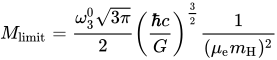
As is the Planck mass, the limit is of the order of The limiting mass can be obtained formally from the Chandrasekhar's white dwarf equation by taking the limit of large central density.


Hub AI
Chandrasekhar limit AI simulator
(@Chandrasekhar limit_simulator)
Chandrasekhar limit
The Chandrasekhar limit (/ˌtʃəndrəˈʃeɪkər/) is the maximum mass of a stable white dwarf star. These stars resist gravitational collapse primarily through electron degeneracy pressure, compared to main sequence stars, which resist collapse through thermal pressure. The Chandrasekhar limit is the mass above which electron degeneracy pressure in the star's core is insufficient to balance the star's own gravitational self-attraction. The value of the Chandrasekhar limit depends upon the ratio of the number of electrons to nucleons (neutrons plus protons) in the star. For small stars this ratio is around 1/2 and the limit is about 1.44 M☉ (2.765×1030 kg). The limit was named after Subrahmanyan Chandrasekhar.
Normal stars fuse gravitationally compressed hydrogen into helium, generating vast amounts of heat. As the hydrogen is consumed, the stars' core compresses further allowing the helium and heavier nuclei to fuse ultimately resulting in stable iron nuclei, a process called stellar evolution. The next step depends upon the mass of the star. Stars below the Chandrasekhar limit become stable white dwarf stars, remaining that way throughout the rest of the history of the universe (assuming the absence of external forces). Stars above the limit can become neutron stars or black holes.
The Chandrasekhar limit is a consequence of competition between gravity and electron degeneracy pressure. Electron degeneracy pressure is a quantum-mechanical effect arising from the Pauli exclusion principle. Since electrons are fermions, no two electrons can be in the same state, so not all electrons can be in the minimum-energy level. Rather, electrons must occupy a band of energy levels. Compression of the electron gas increases the number of electrons in a given volume and raises the maximum energy level in the occupied band. Therefore, the energy of the electrons increases on compression, so pressure must be exerted on the electron gas to compress it, producing electron degeneracy pressure. With sufficient compression, electrons are forced into nuclei in the process of electron capture, relieving the pressure.
In the nonrelativistic case, electron degeneracy pressure gives rise to an equation of state of the form P = K1ρ5/3, where P is the pressure, ρ is the mass density, and K1 is a constant. Solving the hydrostatic equation leads to a model white dwarf that is a polytrope of index 3/2 – and therefore has radius inversely proportional to the cube root of its mass, and volume inversely proportional to its mass.
As the mass of a model white dwarf increases, the typical energies to which degeneracy pressure forces the electrons are no longer negligible relative to their rest masses. The velocities of the electrons approach the speed of light, and special relativity must be taken into account. In the strongly relativistic limit, the equation of state takes the form P = K2ρ4/3. This yields a polytrope of index 3, which has a total mass, Mlimit, depending only on K2.
For a fully relativistic treatment, the equation of state used interpolates between the equations P = K1ρ5/3 for small ρ and P = K2ρ4/3 for large ρ. When this is done, the model radius still decreases with mass, but becomes zero at Mlimit. This is the Chandrasekhar limit. The curves of radius against mass for the non-relativistic and relativistic models are shown in the graph. They are colored blue and green, respectively. μe has been set equal to 2. Radius is measured in standard solar radii or kilometers, and mass in standard solar masses.
Calculated values for the limit vary depending on the nuclear composition of the mass. Chandrasekhar gives the following expression, based on the equation of state for an ideal Fermi gas: where:
As is the Planck mass, the limit is of the order of The limiting mass can be obtained formally from the Chandrasekhar's white dwarf equation by taking the limit of large central density.