
Recent from talks
UEFA Euro 2004 final
Knowledge base stats:
Talk channels stats:
Members stats:
UEFA Euro 2004 final
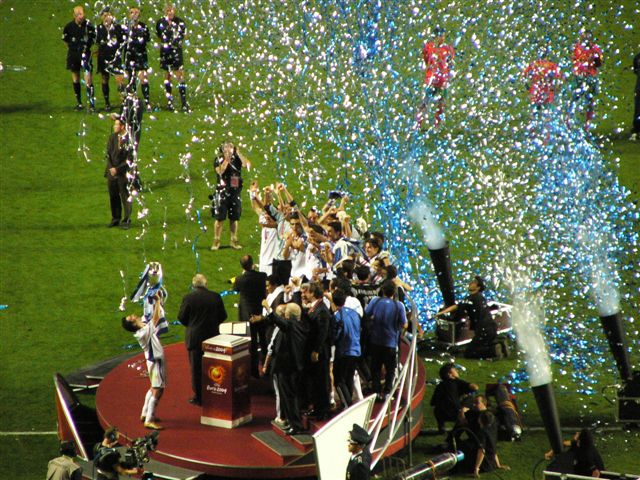
The UEFA Euro 2004 final was the final match of UEFA Euro 2004, the twelfth European Championship, a football competition organised by UEFA for the senior men's national teams of its member associations. The match was played at the Estádio da Luz in Lisbon, Portugal, on 4 July 2004, and was contested by Portugal, the tournament's hosts, and Greece, in a rematch of the tournament's opening game.
The 16-team tournament consisted of a group stage, from which eight teams qualified for the knockout stage. Both finalists were drawn in Group A of the tournament, and played each other in the opening game, with Greece winning 2–1 in what BBC Sport labelled a "shock defeat" for the hosts. Portugal won their other two group matches, against Russia and Spain; Greece drew with Spain and lost to Russia, leaving Portugal top of the group and Greece second. In the knockout stage, Portugal beat England on penalties in the quarter-finals, and the Netherlands in the semi-finals. Greece, meanwhile, beat defending champions France in the quarter-finals, and the Czech Republic in the semi-finals via a silver goal.
The final took place in front of 62,865 supporters, and was refereed by Markus Merk from Germany. Greece scored the only goal in the match in the 57th minute, when Angelos Basinas' corner was met by Angelos Charisteas, who sent a powerful header past goalkeeper Ricardo. Greece held on to complete a shock 1–0 victory, winning their first title in just their second ever tournament appearance.
Several pundits labelled Greece's tournament win the greatest upset in the history of the European Championship; among these was BBC Sport's John May, who cited Greece's record of never having previously won a match at a major event and their pre-tournament bookmaker odds of 150–1. Otto Rehhagel, Greece's manager, said after the game that "it was an unusual achievement for Greek football and especially for European football", while Portugal manager Luiz Felipe Scolari expressed pain at the result, saying that Greece were the better team and lamenting that Portugal had been beaten by "one piece of sloppy defending". As winners, Greece qualified for the 2005 FIFA Confederations Cup in Germany as UEFA's representatives. However, they subsequently failed to qualify for the 2006 FIFA World Cup.
UEFA Euro 2004 was the 12th UEFA European Championship, a football competition organised by UEFA for the senior men's national teams of its member associations. The tournament was played in Portugal from 12 June to 4 July 2004. Qualifying matches were played between September 2002 and November 2003, in which fifty teams were divided into ten groups of five, playing each other on a home-and-away round-robin tournament basis. Portugal qualified automatically as hosts, along with the top team in each qualifying group. The remaining five teams were determined by a series of two-legged play-offs between the ten group runners-up. For the finals tournament, the teams were divided into four groups of four, and each team played the others in their group once. The top two teams from each group advanced to a knockout phase.
Neither Greece nor Portugal had appeared in a European Championship final before 2004. Greece's only prior appearance in a European Championship was in 1980, when they were eliminated in the group phase. Their only other major tournament appearance was at the 1994 FIFA World Cup, in which they also failed to qualify for the knockouts, losing all of their group games. Portugal had qualified three times previously: in 1984, when they lost 3–2 in the semi-final to France, a loss to the Czech Republic in the quarter-final in 1996, and another semi-final defeat to France in 2000, 2–1 on a golden goal. The two teams' last meeting before Euro 2004 was a 1–1 draw in a friendly in November 2003, and their last competitive fixture was a Euro 1992 qualifier in 1991, which Portugal won 1–0.
The final was played on 4 July 2004 at the 65,000-capacity Estádio da Luz in Lisbon. Opened in 2003, the stadium was built to replace the former home stadium of Portuguese club S.L. Benfica. Prior to the final, the Estádio da Luz hosted four matches at Euro 2004: three group matches from Groups A and B, and the quarter-final between Portugal and England.
As the tournament hosts, Portugal were drawn in Group A, in which they were joined by Greece, Russia and Spain. Their match against eventual finalists Greece was the tournament's opening fixture, played on 12 June 2004 at the Estádio do Dragão in Porto. In what BBC Sport described as a "shock defeat", Portugal lost the match 2–1. Greece took the lead in the 7th minute through Giorgos Karagounis, who scored from 27 yards (25 m) after Portugal's Paulo Ferreira had lost possession. They doubled their lead in the second half when Cristiano Ronaldo, a substitute for Portugal, fouled Greek player Giourkas Seitaridis and Angelos Basinas scored with the resulting penalty. Ronaldo scored for Portugal late in the game, but Greece held on for a victory which marked the first time in European Championship history that a host nation had lost in the opening match. Portugal's second group game was against Russia at the Estádio da Luz in Lisbon on 16 June. They took an early lead in the 7th minute, when Deco sent the ball into the area and it was met by Maniche, who scored into the bottom corner of the Russian goal. Russia's goalkeeper Sergei Ovchinnikov was then given a red card shortly before half-time for handling the ball outside of his penalty area. Luís Figo had an opportunity for Portugal midway through the second half, which was pushed on to the goalpost by substitute goalkeeper Vyacheslav Malafeev, before Rui Costa scored a second on 89 minutes from a close-range shot with the toe of his boot, after a Ronaldo cross, to seal a 2–0 Portugal win. Their final group game was against Spain at Lisbon's Estádio José Alvalade on 20 June. Needing a win to guarantee progress, Portugal scored the game's only goal through substitute Nuno Gomes on 57 minutes. The 1–0 win saw Portugal qualify for the next round as group winners.
Hub AI
UEFA Euro 2004 final AI simulator
(@UEFA Euro 2004 final_simulator)
UEFA Euro 2004 final
The UEFA Euro 2004 final was the final match of UEFA Euro 2004, the twelfth European Championship, a football competition organised by UEFA for the senior men's national teams of its member associations. The match was played at the Estádio da Luz in Lisbon, Portugal, on 4 July 2004, and was contested by Portugal, the tournament's hosts, and Greece, in a rematch of the tournament's opening game.
The 16-team tournament consisted of a group stage, from which eight teams qualified for the knockout stage. Both finalists were drawn in Group A of the tournament, and played each other in the opening game, with Greece winning 2–1 in what BBC Sport labelled a "shock defeat" for the hosts. Portugal won their other two group matches, against Russia and Spain; Greece drew with Spain and lost to Russia, leaving Portugal top of the group and Greece second. In the knockout stage, Portugal beat England on penalties in the quarter-finals, and the Netherlands in the semi-finals. Greece, meanwhile, beat defending champions France in the quarter-finals, and the Czech Republic in the semi-finals via a silver goal.
The final took place in front of 62,865 supporters, and was refereed by Markus Merk from Germany. Greece scored the only goal in the match in the 57th minute, when Angelos Basinas' corner was met by Angelos Charisteas, who sent a powerful header past goalkeeper Ricardo. Greece held on to complete a shock 1–0 victory, winning their first title in just their second ever tournament appearance.
Several pundits labelled Greece's tournament win the greatest upset in the history of the European Championship; among these was BBC Sport's John May, who cited Greece's record of never having previously won a match at a major event and their pre-tournament bookmaker odds of 150–1. Otto Rehhagel, Greece's manager, said after the game that "it was an unusual achievement for Greek football and especially for European football", while Portugal manager Luiz Felipe Scolari expressed pain at the result, saying that Greece were the better team and lamenting that Portugal had been beaten by "one piece of sloppy defending". As winners, Greece qualified for the 2005 FIFA Confederations Cup in Germany as UEFA's representatives. However, they subsequently failed to qualify for the 2006 FIFA World Cup.
UEFA Euro 2004 was the 12th UEFA European Championship, a football competition organised by UEFA for the senior men's national teams of its member associations. The tournament was played in Portugal from 12 June to 4 July 2004. Qualifying matches were played between September 2002 and November 2003, in which fifty teams were divided into ten groups of five, playing each other on a home-and-away round-robin tournament basis. Portugal qualified automatically as hosts, along with the top team in each qualifying group. The remaining five teams were determined by a series of two-legged play-offs between the ten group runners-up. For the finals tournament, the teams were divided into four groups of four, and each team played the others in their group once. The top two teams from each group advanced to a knockout phase.
Neither Greece nor Portugal had appeared in a European Championship final before 2004. Greece's only prior appearance in a European Championship was in 1980, when they were eliminated in the group phase. Their only other major tournament appearance was at the 1994 FIFA World Cup, in which they also failed to qualify for the knockouts, losing all of their group games. Portugal had qualified three times previously: in 1984, when they lost 3–2 in the semi-final to France, a loss to the Czech Republic in the quarter-final in 1996, and another semi-final defeat to France in 2000, 2–1 on a golden goal. The two teams' last meeting before Euro 2004 was a 1–1 draw in a friendly in November 2003, and their last competitive fixture was a Euro 1992 qualifier in 1991, which Portugal won 1–0.
The final was played on 4 July 2004 at the 65,000-capacity Estádio da Luz in Lisbon. Opened in 2003, the stadium was built to replace the former home stadium of Portuguese club S.L. Benfica. Prior to the final, the Estádio da Luz hosted four matches at Euro 2004: three group matches from Groups A and B, and the quarter-final between Portugal and England.
As the tournament hosts, Portugal were drawn in Group A, in which they were joined by Greece, Russia and Spain. Their match against eventual finalists Greece was the tournament's opening fixture, played on 12 June 2004 at the Estádio do Dragão in Porto. In what BBC Sport described as a "shock defeat", Portugal lost the match 2–1. Greece took the lead in the 7th minute through Giorgos Karagounis, who scored from 27 yards (25 m) after Portugal's Paulo Ferreira had lost possession. They doubled their lead in the second half when Cristiano Ronaldo, a substitute for Portugal, fouled Greek player Giourkas Seitaridis and Angelos Basinas scored with the resulting penalty. Ronaldo scored for Portugal late in the game, but Greece held on for a victory which marked the first time in European Championship history that a host nation had lost in the opening match. Portugal's second group game was against Russia at the Estádio da Luz in Lisbon on 16 June. They took an early lead in the 7th minute, when Deco sent the ball into the area and it was met by Maniche, who scored into the bottom corner of the Russian goal. Russia's goalkeeper Sergei Ovchinnikov was then given a red card shortly before half-time for handling the ball outside of his penalty area. Luís Figo had an opportunity for Portugal midway through the second half, which was pushed on to the goalpost by substitute goalkeeper Vyacheslav Malafeev, before Rui Costa scored a second on 89 minutes from a close-range shot with the toe of his boot, after a Ronaldo cross, to seal a 2–0 Portugal win. Their final group game was against Spain at Lisbon's Estádio José Alvalade on 20 June. Needing a win to guarantee progress, Portugal scored the game's only goal through substitute Nuno Gomes on 57 minutes. The 1–0 win saw Portugal qualify for the next round as group winners.
Recent media