
UEFA Euro 2004 final
View on Wikipedia
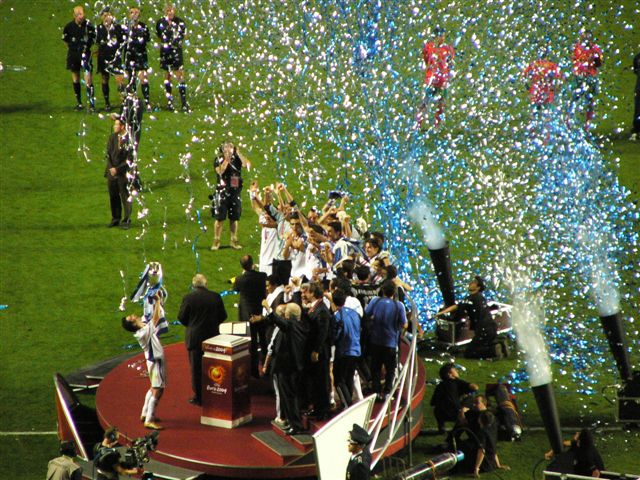
 The Greece national team celebrating their win | |||||||
| Event | UEFA Euro 2004 | ||||||
|---|---|---|---|---|---|---|---|
| |||||||
| Date | 4 July 2004 | ||||||
| Venue | Estádio da Luz, Lisbon | ||||||
| Man of the Match | Theodoros Zagorakis (Greece) | ||||||
| Referee | Markus Merk (Germany) | ||||||
| Attendance | 62,865 | ||||||
| Weather | Sunny 28 °C (82 °F) 37% humidity | ||||||
The UEFA Euro 2004 final was the final match of UEFA Euro 2004, the twelfth European Championship, a football competition organised by UEFA for the senior men's national teams of its member associations. The match was played at the Estádio da Luz in Lisbon, Portugal, on 4 July 2004, and was contested by Portugal, the tournament's hosts, and Greece, in a rematch of the tournament's opening game.
The 16-team tournament consisted of a group stage, from which eight teams qualified for the knockout stage. Both finalists were drawn in Group A of the tournament, and played each other in the opening game, with Greece winning 2–1 in what BBC Sport labelled a "shock defeat" for the hosts. Portugal won their other two group matches, against Russia and Spain; Greece drew with Spain and lost to Russia, leaving Portugal top of the group and Greece second. In the knockout stage, Portugal beat England on penalties in the quarter-finals, and the Netherlands in the semi-finals. Greece, meanwhile, beat defending champions France in the quarter-finals, and the Czech Republic in the semi-finals via a silver goal.
The final took place in front of 62,865 supporters, and was refereed by Markus Merk from Germany. Greece scored the only goal in the match in the 57th minute, when Angelos Basinas' corner was met by Angelos Charisteas, who sent a powerful header past goalkeeper Ricardo. Greece held on to complete a shock 1–0 victory, winning their first title in just their second ever tournament appearance.
Several pundits labelled Greece's tournament win the greatest upset in the history of the European Championship; among these was BBC Sport's John May, who cited Greece's record of never having previously won a match at a major event and their pre-tournament bookmaker odds of 150–1. Otto Rehhagel, Greece's manager, said after the game that "it was an unusual achievement for Greek football and especially for European football", while Portugal manager Luiz Felipe Scolari expressed pain at the result, saying that Greece were the better team and lamenting that Portugal had been beaten by "one piece of sloppy defending". As winners, Greece qualified for the 2005 FIFA Confederations Cup in Germany as UEFA's representatives. However, they subsequently failed to qualify for the 2006 FIFA World Cup.
Background
[edit]UEFA Euro 2004 was the 12th UEFA European Championship, a football competition organised by UEFA for the senior men's national teams of its member associations. The tournament was played in Portugal from 12 June to 4 July 2004.[1][2] Qualifying matches were played between September 2002 and November 2003, in which fifty teams were divided into ten groups of five, playing each other on a home-and-away round-robin tournament basis. Portugal qualified automatically as hosts, along with the top team in each qualifying group. The remaining five teams were determined by a series of two-legged play-offs between the ten group runners-up.[2][3] For the finals tournament, the teams were divided into four groups of four, and each team played the others in their group once. The top two teams from each group advanced to a knockout phase.[2]
Neither Greece nor Portugal had appeared in a European Championship final before 2004.[1] Greece's only prior appearance in a European Championship was in 1980, when they were eliminated in the group phase.[4] Their only other major tournament appearance was at the 1994 FIFA World Cup, in which they also failed to qualify for the knockouts, losing all of their group games.[5] Portugal had qualified three times previously: in 1984, when they lost 3–2 in the semi-final to France, a loss to the Czech Republic in the quarter-final in 1996, and another semi-final defeat to France in 2000, 2–1 on a golden goal.[6] The two teams' last meeting before Euro 2004 was a 1–1 draw in a friendly in November 2003, and their last competitive fixture was a Euro 1992 qualifier in 1991, which Portugal won 1–0.[7]
The final was played on 4 July 2004 at the 65,000-capacity Estádio da Luz in Lisbon.[8] Opened in 2003, the stadium was built to replace the former home stadium of Portuguese club S.L. Benfica.[8] Prior to the final, the Estádio da Luz hosted four matches at Euro 2004: three group matches from Groups A and B,[9] and the quarter-final between Portugal and England.[10]
Route to the final
[edit]Portugal
[edit]| Opponent | Result | |
|---|---|---|
| 1 | Greece | 1–2 |
| 2 | Russia | 2–0 |
| 3 | Spain | 1–0 |
| QF | England | 2–2 (a.e.t.) (6–5 p) |
| SF | Netherlands | 2–1 |
As the tournament hosts, Portugal were drawn in Group A, in which they were joined by Greece, Russia and Spain.[11] Their match against eventual finalists Greece was the tournament's opening fixture, played on 12 June 2004 at the Estádio do Dragão in Porto.[12][13] In what BBC Sport described as a "shock defeat", Portugal lost the match 2–1.[13] Greece took the lead in the 7th minute through Giorgos Karagounis, who scored from 27 yards (25 m) after Portugal's Paulo Ferreira had lost possession. They doubled their lead in the second half when Cristiano Ronaldo, a substitute for Portugal, fouled Greek player Giourkas Seitaridis and Angelos Basinas scored with the resulting penalty. Ronaldo scored for Portugal late in the game, but Greece held on for a victory which marked the first time in European Championship history that a host nation had lost in the opening match.[12] Portugal's second group game was against Russia at the Estádio da Luz in Lisbon on 16 June.[14] They took an early lead in the 7th minute, when Deco sent the ball into the area and it was met by Maniche, who scored into the bottom corner of the Russian goal. Russia's goalkeeper Sergei Ovchinnikov was then given a red card shortly before half-time for handling the ball outside of his penalty area.[15] Luís Figo had an opportunity for Portugal midway through the second half, which was pushed on to the goalpost by substitute goalkeeper Vyacheslav Malafeev, before Rui Costa scored a second on 89 minutes from a close-range shot with the toe of his boot, after a Ronaldo cross, to seal a 2–0 Portugal win.[16] Their final group game was against Spain at Lisbon's Estádio José Alvalade on 20 June. Needing a win to guarantee progress,[17] Portugal scored the game's only goal through substitute Nuno Gomes on 57 minutes.[18] The 1–0 win saw Portugal qualify for the next round as group winners.[3]
Portugal's quarter-final match was against England, on 24 June at the Estádio da Luz.[19] England took the lead through Michael Owen on 3 minutes, which they held until the 83rd minute, when Hélder Postiga headed into the goal following a cross from Simão Sabrosa.[20] The match went to extra time, and Rui Costa gave Portugal the lead on 110 minutes with a powerful shot from 20 yards (18 m) out.[21] Frank Lampard equalised for England five minutes later, and with the match finishing 2–2 it was decided by a penalty shoot-out.[20] David Beckham missed England's first penalty, but Rui Costa then missed with Portugal's third, both players shooting over the crossbar. With all other penalties scored, the shoot-out went to sudden death at 4–4. Taking England's seventh penalty, Darius Vassell had his shot saved by goalkeeper Ricardo, who then took Portugal's next penalty himself, to seal a 6–5 shoot-out win.[21] The hosts returned to the Estádio José Alvalade for the semi-final on 30 June, in which they played the Netherlands.[3][22] Ronaldo scored after 26 minutes with a header,[23] following what BBC Sport described as "slack Dutch marking".[24] Maniche then scored Portugal's second on 58 minutes, with a curving shot from the edge of the penalty area from a Ronaldo pass. Jorge Andrade scored an own goal five minutes later, under pressure from the Netherlands' Ruud van Nistelrooy, but Portugal held on for a 2–1 win and a place in the final.[23]
Greece
[edit]| Opponent | Result | |
|---|---|---|
| 1 | Portugal | 2–1 |
| 2 | Spain | 1–1 |
| 3 | Russia | 1–2 |
| QF | France | 1–0 |
| SF | Czech Republic | 1–0 (a.e.t.) |
After defeating Portugal in the opening game, Greece's second Group A fixture was against Spain at Porto's Estádio do Bessa.[25] Spain took the lead shortly before the half-hour mark through a low shot by Fernando Morientes, after Raúl had taken the ball from Greece's Michalis Kapsis on the edge of the penalty area.[26] Raúl had a chance to make it 2–0 with a header in the second half, but it was Greece who scored the next goal, when Angelos Charisteas intercepted a long pass from Vasilios Tsiartas for the equaliser. The match finished 1–1,[27] leaving Greece on 4 points and needing only a draw from their final group game to guarantee progress to the next round. That match took place on 20 June 2004, against already-eliminated Russia at the Estádio Algarve in Faro. Greece suffered an early setback, when Dmitri Kirichenko opened the scoring for Russia after 67 seconds,[28] which until Euro 2024 was the fastest goal in the history of the European Championship.[29] Greece went further behind on 17 minutes, through a Dmitri Bulykin header following a Russian corner kick. Shortly before half-time, Zisis Vryzas scored a goal for Greece to reduce the deficit, but they could not find an equaliser and the game finished 2–1 to Russia. Spain's defeat to Portugal meant that Greece and Spain were level on points but Greece progressed as they had scored more goals than Spain.[28]
In the quarter-finals, Greece faced France on 25 June at the Estádio José Alvalade.[3][30] France were the defending champions, having won the Euro 2000 final, but Greece won the game 1–0 with a performance described by Kevin McCarra of The Guardian as "undaunted and controlled".[31] The winning goal was scored by Charisteas in the 65th minute with a header, after Theodoros Zagorakis had run with the ball down the right and crossed to him.[32] Thierry Henry had a late chance to equalise for France, but his header went wide.[31] Greece's semi-final opponents were the Czech Republic, whom they faced on 1 July at the Estádio do Dragão.[3][33] The Czech Republic had two early chances – a powerful volley by Tomáš Rosický which struck the crossbar and a shot by Marek Jankulovski, which Greek goalkeeper Antonios Nikopolidis saved. The remainder of the match was described by Mark Chaplin for UEFA as a "tight contest between the Czechs' superior technique and Greece's industry and commitment", and despite chances for both sides, it remained 0–0 after 90 minutes.[34] The game went to extra time, and in injury time of the first period, Traianos Dellas headed Greece into the lead from a corner.[33][35] Euro 2004 made use of the silver goal rule, in which the game would end if any team were leading at half-time in extra time. Greece thus won the match 1–0, without the second period of extra time being played. It was the only major international game decided by a silver goal before the rule was abolished.[36]
Match
[edit]
Pre-match
[edit]Portugal made one change from the team that started the semi-final; Ronaldo started on the right wing, while Simão dropped to the substitutes' bench.[24][37] Greece's Karagounis was suspended for the game, and Stelios Giannakopoulos started in his place.[37] The referee for the game was Markus Merk of Germany.[38] The assistant referees were Christian Schräer and Jan-Hendrik Salver, also of Germany, and Sweden's Anders Frisk was the fourth official.[39]
First half
[edit]Greece kicked off the match at 7:45 pm local time (6:45 pm UTC) in temperatures of 28 °C (82 °F) with 37% humidity at the end of a sunny day, with 62,865 spectators in attendance.[38][40] Phil McNulty of BBC Sport characterised the opening as Greece "[retreating] quickly into defence in typical style, leaving Portugal to take the early initiative".[40] Portugal made several early runs towards the Greek goal, first through Pauleta, who lost the ball to a tackle by Zagorakis, and then through Ronaldo, Deco and Figo, but after 10 minutes neither side had had any serious opportunities to score in the opening.[37] Nikopolidis had to make the first save of the match in the 13th minute when he tipped behind a low shot on goal by Miguel.[40] Greece almost scored two minutes later when Charisteas was in possession 10 yards (9 m) from goal following a Portuguese defensive error, Ricardo running off his line to save the toe-poked shot. Maniche hit a shot from the edge of the Greek penalty area on 23 minutes, which went narrowly wide of the right-hand goalpost.[37]
Around the half-hour mark, Greece launched several attacks down the left. Portugal had an opportunity with a free kick taken by Figo on the edge of the Greek penalty area, but it was too high for Ronaldo's attempted header. Both defences continued to prevent many goal-scoring opportunities as the half progressed. Katsouranis had one opportunity on 38 minutes, but his header was weak and went wide of the goal. Miguel was replaced by Paulo Ferreira in the 41st minute, after sustaining an injury, then Basinas received a yellow card shortly before half-time for a deliberate handball as Ronaldo attempted to pass the ball to Figo. That was the last action of the half, which finished 0–0, as Barry Glendenning of The Guardian described the game thus far as "dull".[37]
Second half
[edit]
No substitutions were made by either team at half-time, and Portugal kicked off the second half. Pauleta ran with the ball into the Greek penalty area on 48 minutes, but his shot was blocked by Greek defender Takis Fyssas. Deco then fell to the ground in the penalty area and appealed to the referee for a penalty, but it was not given. Five minutes into the second half, Glendenning wrote that Greece's defence looked "completely impenetrable". Maniche then had an opportunity to shoot outside the penalty area on 53 minutes, but Giannakopoulos tackled him before he could shoot.[37] Greece won their first corner of the match on 57 minutes, which Basinas took, sending the ball into the Portuguese penalty area. It was met by Charisteas around 8 yards (7 m) from goal; he sent a powerful header past Ricardo to give Greece the lead.[40] Journalist Matthew Gibbs of These Football Times later described the goal as "practically a carbon copy" of Greece's headed winners against France and the Czech Republic in the quarter-final and semi-final, opining that Portugal's defence should have prepared for it.[41]
Ronaldo had a chance to equalise shortly after the Greece goal, shooting from 20 yards (18 m), but it was saved by Nikopolidis.[40] They had another chance with a free kick, but it was struck over the Greek crossbar. Portugal's manager Luiz Felipe Scolari brought on Rui Costa in place of Costinha. Then, on 63 minutes, Figo ran with the ball into the Greek penalty area. He attempted a shot at goal, but Nikopolidis prevented it going in. He then sent the ball upfield for a Greek counter-attack; Zagorakis passed it over the top of the Portuguese defenders into the path of two attackers but Ricardo prevented them reaching the ball. On 67 minutes, a Portuguese free kick from the right was claimed by Nikopolidis in the air. Glendenning queried whether Portugal should have had a penalty during the attack, as a Greek player had his arms wrapped around Andrade, but nothing was given.[37] Ronaldo had what McNulty described as his best chance of the match on 74 minutes, when he was through on goal with only the goalkeeper to beat. He ran wide with the ball, and when Nikopolidis ran towards him, he hit his shot over the crossbar.[37][40] Maniche had a shot on goal from distance on 80 minutes; Nikopolidis parried the shot, but no Portugal attackers were available to collect the rebound. Shortly before the end, Figo took a shot on the turn from inside the Greek box, which went narrowly wide, and Andrade had an attempt with a header which went over the crossbar. Greece held on to complete a 1–0 victory.[37]
Details
[edit]Portugal  | 0–1 |  Greece Greece |
|---|---|---|
| Report |
|

          Portugal
|
    Greece
|
|

|
| |||||||||||||||||||||||||||||||||||||||||||||||||||||||||||||||||||||||||||||||||||||||||||||||||||||||||||||||||||||||||||||||


|
Man of the Match:
Assistant referees:[39]
|
Match rules[43]
|
Statistics
[edit]| Statistic | Portugal | Greece |
|---|---|---|
| Goals scored | 0 | 1 |
| Total shots | 17 | 4 |
| Shots on target | 5 | 1 |
| Ball possession | 58% | 42% |
| Corner kicks | 10 | 1 |
| Fouls committed | 18 | 19 |
| Offsides | 4 | 3 |
| Yellow cards | 2 | 4 |
| Red cards | 0 | 0 |
Post-match
[edit]


After the match, BBC Sport's John May labelled Greece's victory as the most surprising tournament win in European Championship history, ahead of Denmark's at Euro 1992. May cited Greece's record of never having previously won a match at a major event, as well as their pre-tournament odds, which were as long as 150–1 with some bookmakers.[36][45] In 2020, Gibbs similarly labelled it the greatest upset in the tournament's history, writing "They entered this grand stage as underdogs but calling the final result a shock almost does them an injustice in reality."[41] Gibbs noted that the calibre of Euro 2004's teams was high; several of the teams were experiencing a golden generation, and "future icons" such as Ronaldo and England's Wayne Rooney made their first appearances at a major tournament.[41] Writers in France's Le Parisien wrote that the Greeks were "heroes of modern mythology who entered into legend and broke the hearts of all of Portugal", and Spain's Marca commented on Greece's style of play, saying "all winners deserve to win and although the debate as to whether they played football or anti-football is valid, the only thing that matters here is winning".[46]
Greece's German manager Otto Rehhagel became the first person to coach a nation other than his own to victory in a major championship.[40] He said after the game that "it was an unusual achievement for Greek football and especially for European football".[47] He accepted that Portugal had been the better team technically, but that Greece had won as a result of taking their chances in the game. Charisteas said "We're the best team in Europe and we deserved it", going on to add that it was a "unique moment, which many of us may never experience again".[47] Zagorakis was named as man of the match, and was also given the player-of-the-tournament award by UEFA. Gérard Houllier, one of the decision-makers for the latter award, commented that "Throughout the tournament, as well as in the final against Portugal, he showed leadership quality and skill and technical ability as well as his character".[48] When interviewed, Zagorakis said "I want to congratulate the players. We proved once again that the Greek soul is, and always will be, our strength."[47] After returning home on 5 July, Greece's players held a celebration in the Panathenaic Stadium, and more than 100,000 supporters assembled on the streets between the airport and the stadium to welcome them back. Alluding to construction delays for the upcoming Olympic Games in Athens, Prime Minister Kostas Karamanlis said "These boys taught us a lesson as to what Greeks can do when we really believe in something".[49]
Portugal manager Scolari expressed his pain at the result, saying that Greece were the better team and lamenting that Portugal had been beaten by "one piece of sloppy defending". He was upbeat about the future, labelling his side "European vice-champions" and predicting that they would win a trophy in the future.[50] Greece failed to qualify for the next major tournament, the 2006 FIFA World Cup,[51] and also failed in their defence of the European Championship at Euro 2008, being eliminated in the group stage.[52] Portugal reached the semi-finals of the 2006 World Cup, where they were beaten by France,[53] and the quarter-finals at Euro 2008.[54] They eventually won the European Championship at Euro 2016.[55]
See also
[edit]References
[edit]- ^ a b Augustyn, Adam; Shepherd, Melinda C.; Chauhan, Yamini; Levy, Michael; Lotha, Gloria; Tikkanen, Amy (19 November 2020). "European Championship". Encyclopædia Britannica. Archived from the original on 29 June 2021. Retrieved 10 July 2021.
- ^ a b c "Euro 2004: all you need to know". UEFA. 20 February 2020. Archived from the original on 14 July 2021. Retrieved 2 August 2021.
- ^ a b c d e Burkert, Sturmius; Sivritepe, Erdinç (14 March 2013). "European Championship 2004". RSSSF. Archived from the original on 28 September 2015. Retrieved 28 August 2021.
- ^ Chaudhry, Ijaz (3 July 2016). "The Greek miracle". The News on Sunday. Archived from the original on 2 August 2021. Retrieved 2 August 2021.
- ^ Stokkermans, Karel; Jarreta, Sergio Henrique (5 July 2018). "World Cup 1994". RSSSF. Archived from the original on 16 July 2021. Retrieved 2 August 2021.
- ^ "Portugal: all their Euro records and stats". UEFA. 27 June 2021. Archived from the original on 23 August 2021. Retrieved 20 August 2021.
- ^ "Portugal national football team: record v Greece". 11v11. AFS Enterprises. Archived from the original on 20 August 2021. Retrieved 20 August 2021.
- ^ a b "Characteristics and areas". S.L. Benfica. Archived from the original on 22 July 2019. Retrieved 17 December 2019.
- ^ "UEFA Euro 2004 – Matches". UEFA. Archived from the original on 12 October 2019. Retrieved 17 December 2019.
- ^ Harte, Adrian. "Portugal hold their nerve against England". UEFA. Archived from the original on 8 May 2012. Retrieved 17 December 2019.
- ^ "Neighbours face finals meeting". UEFA. 30 November 2003. Archived from the original on 27 August 2021. Retrieved 27 August 2021.
- ^ a b Szreter, Adam (12 June 2004). "Greece spoil party for hosts Portugal". UEFA. Archived from the original on 4 December 2020. Retrieved 27 August 2021.
- ^ a b "Portugal 1–2 Greece". BBC Sport. 12 June 2004. Archived from the original on 27 August 2021. Retrieved 27 August 2021.
- ^ "Portugal v Russia, 16 June 2004". 11v11. AFS Enterprises. Archived from the original on 28 August 2021. Retrieved 28 August 2021.
- ^ Harte, Adrian (16 June 2004). "Portugal down Russia to restore home pride in Euro 2004 Group A". UEFA. Archived from the original on 28 August 2021. Retrieved 28 August 2021.
- ^ "Portugal send Russia packing". The Guardian. 16 June 2004. Archived from the original on 28 August 2021. Retrieved 28 August 2021.
- ^ McNulty, Phil (21 June 2004). "Portugal comes alive". BBC Sport. Archived from the original on 24 June 2004. Retrieved 28 August 2021.
- ^ "Spain 0–1 Portugal". BBC Sport. 20 June 2004. Archived from the original on 1 August 2017. Retrieved 28 August 2021.
- ^ "Portugal–England". UEFA. Archived from the original on 28 June 2021. Retrieved 28 August 2021.
- ^ a b "Portugal hold their nerve against England to reach Euro 2004 semi-finals". UEFA. 24 June 2004. Archived from the original on 28 August 2021. Retrieved 28 August 2021.
- ^ a b Ingle, Sean (24 June 2004). "Portugal 2–2 England (Portugal win 6–5 on penalties)". The Guardian. Archived from the original on 31 July 2021. Retrieved 28 August 2021.
- ^ "Portugal–Netherlands". UEFA. Archived from the original on 12 June 2021. Retrieved 28 August 2021.
- ^ a b McCarra, Kevin (1 July 2004). "Portugal 2–1 Holland". The Guardian. Archived from the original on 4 December 2013. Retrieved 28 August 2021.
- ^ a b "Portugal 2–1 Holland". BBC Sport. 30 June 2004. Archived from the original on 3 September 2007. Retrieved 28 August 2021.
- ^ "Greece–Spain". UEFA. Archived from the original on 20 August 2021. Retrieved 28 August 2021.
- ^ Spiro, Matthew (16 June 2004). "Greece profit as Charisteas stops Spain surge in Euro 2004 Group A". UEFA. Archived from the original on 28 August 2021. Retrieved 28 August 2021.
- ^ "Greece 1–1 Spain". BBC Sport. 16 June 2004. Archived from the original on 25 November 2005. Retrieved 28 August 2021.
- ^ a b "Russia 2–1 Greece". BBC Sport. 20 June 2004. Archived from the original on 10 July 2004. Retrieved 28 August 2021.
- ^ "Who scored the fastest goals at UEFA European Championship final tournaments?". UEFA. 2 July 2024. Archived from the original on 11 July 2024. Retrieved 13 July 2024.
- ^ "France-Greece". UEFA. Archived from the original on 28 June 2021. Retrieved 29 August 2021.
- ^ a b McCarra, Kevin (26 June 2004). "France 0–1 Greece". The Guardian. Archived from the original on 29 August 2021. Retrieved 29 August 2021.
- ^ "France 0–1 Greece". BBC Sport. 25 June 2004. Archived from the original on 14 June 2012. Retrieved 29 August 2021.
- ^ a b "Greece–Czech Republic". UEFA. Archived from the original on 30 June 2021. Retrieved 29 August 2021.
- ^ Chaplin, Mark (1 July 2004). "Dellas delights Greece and stuns Czech Republic in Euro 2004 semi-final". UEFA. Archived from the original on 29 August 2021. Retrieved 29 August 2021.
- ^ "Greece 1–0 Czech Rep". BBC Sport. 1 July 2004. Archived from the original on 6 May 2021. Retrieved 29 August 2021.
- ^ a b Smith, Rory (31 May 2016). "How 'boring' Greece stunned the world to win Euro 2004". ESPN. Archived from the original on 13 September 2021. Retrieved 6 September 2021.
- ^ a b c d e f g h i Glendenning, Barry (4 July 2004). "Portugal 0–1 Greece". The Guardian. Archived from the original on 15 August 2018. Retrieved 29 August 2021.
- ^ a b "Portugal–Greece". UEFA. Archived from the original on 24 August 2021. Retrieved 29 August 2021.
- ^ a b Mezzasalma, Nicole (3 July 2004). "Just another game – Merk". UEFA. Archived from the original on 5 July 2004. Retrieved 4 September 2014.
- ^ a b c d e f g McNulty, Phil (4 July 2004). "Greece win Euro 2004". BBC Sport. Archived from the original on 19 February 2009. Retrieved 29 August 2021.
- ^ a b c Gibbs, Matthew (4 July 2020). "Greece 1–0 Portugal at Euro 2004: the greatest upset in European Championship history". These Football Times. Archived from the original on 4 July 2021. Retrieved 3 September 2021.
- ^ "UEFA EURO 2004 – Fanzone – Carlsberg Man of the Match". UEFA. 4 July 2004. Archived from the original on 5 July 2004. Retrieved 24 June 2012.
- ^ "Format". UEFA. 3 August 2002. Archived from the original on 30 September 2021. Retrieved 4 July 2012.
- ^ "Team statistics". UEFA. 4 July 2004. Archived from the original on 6 July 2004. Retrieved 4 September 2014.
- ^ May, John (5 July 2004). "Greatest Euro shock ever?". BBC Sport. Archived from the original on 10 September 2017. Retrieved 4 September 2021.
- ^ "Zagorakis the king of Europe". The Guardian. 5 July 2004. Archived from the original on 5 September 2021. Retrieved 5 September 2021.
- ^ a b c "Greeks hail historic triumph". BBC Sport. 5 July 2004. Archived from the original on 24 March 2020. Retrieved 5 September 2021.
- ^ "Zagorakis named top man". Eurosport. 5 July 2004. Archived from the original on 30 September 2021. Retrieved 5 September 2021.
- ^ "Greece welcomes back squad". BBC Sport. 5 July 2004. Archived from the original on 13 September 2007. Retrieved 5 September 2021.
- ^ "Scolari accuses defenders". BBC Sport. 4 July 2004. Archived from the original on 3 October 2007. Retrieved 5 September 2021.
- ^ "End of the road for Greece". Eurosport. 13 October 2005. Archived from the original on 30 September 2021. Retrieved 5 September 2021.
- ^ McKenzie, Andrew (18 June 2008). "Greece 1–2 Spain". BBC Sport. Retrieved 5 September 2021.
- ^ "Portugal 0–1 France". BBC Sport. 5 July 2006. Archived from the original on 24 December 2008. Retrieved 5 September 2021.
- ^ "Portugal–Germany". UEFA. 19 June 2008. Archived from the original on 29 June 2021. Retrieved 5 September 2021.
- ^ McNulty, Phil (11 July 2016). "Portugal 1–0 France (AET)". BBC Sport. Archived from the original on 21 October 2018. Retrieved 5 September 2021.
External links
[edit]| Tournaments |
|
|---|---|
| Qualifying | |
| Finals | |
| Squads | |
| Bids | |
| Statistics | |
| Broadcasting rights | |
| Other records | |
| Miscellaneous | |


UEFA Euro 2004 final
View on GrokipediaBackground
Tournament Context
The UEFA European Championship 2004, the 12th edition of the tournament, was hosted by Portugal and took place from 12 June to 4 July 2004 across ten venues in eight cities. As the first time Portugal staged the event, it marked a significant moment for the nation, with matches distributed to showcase the country's infrastructure, including newly built stadiums prepared specifically for the competition.[7] The tournament format involved 16 national teams divided into four groups of four, where each team played three round-robin matches within their group. The top two teams from each group advanced to the knockout phase, which consisted of quarter-finals, semi-finals, and a single final match to determine the champion.[8] This structure, in place since 1996, ensured a balance between group-stage competition and decisive elimination rounds, culminating in 31 matches overall.[7] Qualification for the finals began in 2002 and involved 50 UEFA member associations, excluding hosts Portugal who received automatic entry. The process featured ten qualifying groups, with the winners advancing directly and the runners-up entering playoffs to determine the remaining five spots, resulting in a diverse field of participants. Greece, viewed as underdogs due to their limited prior success in major tournaments, earned their qualification through these playoffs.[9] The final was staged at the Estádio da Luz in Lisbon, a state-of-the-art venue that opened in October 2003 with a capacity of 65,000 spectators, designed to host high-profile international events like this championship decider.[10]Team Histories and Expectations
Portugal entered UEFA Euro 2004 as hosts for the first time in their history, having qualified automatically for the tournament while benefiting from significant infrastructure investments, including the construction and upgrading of ten stadiums across the country.[1] Under coach Luiz Felipe Scolari, appointed in 2003 following his success with Brazil at the 2002 FIFA World Cup, the team boasted a talented squad featuring captain Luís Figo, the creative midfielder Deco—who had recently contributed to FC Porto's 2002–03 UEFA Cup victory—and the emerging 19-year-old Cristiano Ronaldo, whose flair was anticipated to add dynamism.[11] Portugal's recent form included a third-place finish at the 2003 FIFA Confederations Cup, positioning them as strong contenders with high national expectations amplified by the home advantage.[12] In contrast, Greece approached the tournament with limited major international experience, having made only one prior appearance at a European Championship in 1980, where they exited the group stage without a victory.[13] The team was led by German coach Otto Rehhagel, who had taken charge in August 2001 and transformed their fortunes through rigorous defensive organization, achieving 15 wins in 26 matches and qualifying for Euro 2004 for the first time since 1980.[14] Rehhagel's tactical emphasis on a compact defense and counter-attacks, often described as a "wooden horse" strategy, marked a shift from Greece's previous inconsistencies, though the squad lacked star power compared to other participants.[14] Pre-tournament assessments positioned Portugal as one of the title favorites at odds of around 13/2, buoyed by their hosting role and talented roster, while Greece were dismissed as 150-1 outsiders, predicted to face an uphill battle in Group A alongside powerhouses like Portugal and Spain.[15] The matchup in the final was thus seen as a stark contrast between established pedigree and improbable underdog status, with little anticipation of Greece mounting a serious challenge.[1]Route to the Final
Portugal's Campaign
As hosts of UEFA Euro 2004, Portugal entered the tournament as strong favorites, buoyed by a talented squad and home advantage. Portugal's group stage campaign in Group A began disastrously with a 1-2 defeat to Greece in the opening match on 12 June 2004 at the Estádio do Dragão in Porto. Despite dominating possession, Portugal conceded early to Giorgos Karagounis in the 7th minute and added a second via a penalty by Angelos Basinas in the 51st minute, failing to equalize effectively until Nuno Gomes scored late.[16] This shock loss prompted coach Luiz Felipe Scolari to make significant changes, dropping three defenders and adopting a more ruthless approach.[17] The hosts recovered in their second match against Russia on 16 June 2004 at the Estádio da Luz in Lisbon, securing a 2-0 victory with goals from Maniche and Rui Costa. This result kept their qualification hopes alive, as Portugal controlled the game after Russia were reduced to ten men.[18] In the decisive final group game versus Spain on 20 June 2004, also at the Estádio da Luz, Portugal edged a 1-0 win through a second-half header by substitute Nuno Gomes, eliminating their Iberian rivals and advancing as Group A runners-up behind Greece.[19] In the quarter-finals, Portugal faced England on 24 June 2004 at the Estádio da Luz, drawing 2-2 after extra time before triumphing 6-5 in a dramatic penalty shoot-out. Michael Owen and Frank Lampard scored for England, while Hélder Postiga and Rui Costa replied for Portugal; despite misses from Luís Figo and Rui Costa in the shoot-out, goalkeeper Ricardo saved Darius Vassell's effort and scored the decisive penalty himself.[20][21] Portugal's semi-final against the Netherlands on 30 June 2004 at the Estádio José Alvalade in Lisbon ended in a 2-1 victory, securing their place in the final. Cristiano Ronaldo opened the scoring with a header in the 26th minute and assisted Maniche's long-range strike seven minutes later; the Dutch pulled one back via Anderson but could not equalize despite late pressure.[22] Under Scolari, Portugal employed a high-possession style emphasizing midfield control and quick transitions, with key players like Deco orchestrating play, Figo providing leadership on the wing, and emerging talent Ronaldo adding dynamism up front.[23] The passionate home crowds, filling stadiums across the country, provided crucial energy, particularly in knockout matches where the atmosphere intensified Portugal's resolve.[11]Greece's Campaign
Greece entered UEFA Euro 2004 as significant underdogs, with pre-tournament odds of 150/1 to win the competition.[15] Under coach Otto Rehhagel, the team adopted a pragmatic approach focused on defensive organization to compensate for their lack of star power compared to favorites like Portugal, France, and the Czech Republic. In Group A, Greece began with a stunning 2-1 upset victory over hosts Portugal on 12 June in Porto, taking the lead through Angelos Karagounis in the 7th minute and adding a penalty from Stelios Basinas in the 51st, despite a late consolation from Nuno Gomes.[24] Four days later, they secured a vital 1-1 draw against Spain in Faro-Loulé, equalizing via a header from Charisteas in the 32nd minute after Fernando Morientes had opened the scoring for the Spaniards in the 28th minute.[25] Greece concluded the group with a 2-1 loss to Russia on 20 June in Algarve, falling behind early to goals from Dmitri Kirichenko (2') and Dmitri Bulykin (17') before Zisis Vryzas pulled one back just before halftime; nevertheless, they topped the group on goal difference ahead of Portugal, Spain, and Russia.[26] Advancing to the quarter-finals, Greece faced defending champions France on 25 June at the Estádio José Alvalade in Lisbon and delivered another shock with a 1-0 win, courtesy of Charisteas' header from a corner in the 65th minute, holding firm against a star-studded attack led by Zinedine Zidane.[27] In the semi-final against the Czech Republic on 1 July in Porto, the match remained goalless through 90 minutes and the first period of extra time until Traianos Dellas scored a silver goal with a header in the 105+1st minute, securing a 1-0 victory and propelling Greece to their first-ever major final.[28] Rehhagel's tactics emphasized a compact defensive structure, often likened to catenaccio for its emphasis on man-marking and deep lines, allowing Greece to absorb pressure and launch counter-attacks or exploit set pieces.[29] Goalkeeper Antonios Nikopolidis was instrumental, keeping clean sheets in all three knockout wins with crucial saves that underscored the team's resilience.[4]The Match
Pre-Match
The UEFA Euro 2004 final took place on 4 July 2004 at 20:45 WEST (UTC+1) at the Estádio da Luz in Lisbon, Portugal, pitting the host nation against the surprise finalists in a highly anticipated clash following Greece's upset victory over Portugal in the tournament opener.[1] The match attracted 62,865 spectators to the newly built 65,000-capacity stadium, creating an electric atmosphere dominated by Portuguese supporters but with vocal Greek contingents adding to the tension.[30] German referee Markus Merk officiated the final, assisted by his compatriots Christian Schraer and Jan-Hendrik Gille, with Anders Frisk of Sweden serving as the fourth official; Merk's appointment reflected UEFA's confidence in his experience from earlier tournament matches.[31] Pre-match formalities commenced with the playing of the national anthems, "A Portuguesa" for the hosts and "Hymn to Liberty" for Greece, amid a sea of flags and chants that underscored the stakes for both underdog Greece and title-hoping Portugal. The evening's clear weather, with temperatures around 22°C, provided ideal conditions under the floodlights, enhancing the spectacle.[2] Team news for Portugal confirmed a settled lineup under coach Luiz Felipe Scolari, with no major injuries reported in the lead-up, allowing key players like Luís Figo and Cristiano Ronaldo to feature prominently in the anticipated starting XI. For Greece, coach Otto Rehhagel faced uncertainty over central defender Michalis Kapsis, who was doubtful due to a knee injury sustained in training, while striker Demis Nikolaidis was ruled out with a back problem, prompting adjustments to the squad announced just before kickoff. These developments heightened the drama as both teams emerged from the tunnel, ready for the decisive encounter.[32]Match Summary
The first half unfolded with Portugal dominating proceedings through sustained pressure and multiple attacking forays, yet they were repeatedly denied by Greece's resolute backline, resulting in a goalless scoreline at the break. Luís Figo tested Antonios Nikopolidis with a pair of well-struck shots, both of which the Greek goalkeeper parried to safety, while other Portuguese probes, including efforts from Cristiano Ronaldo, lacked the finishing touch to pierce the defense. The electric atmosphere in Lisbon's Estádio da Luz heightened the stakes, underscoring the hosts' determination to claim the trophy on home soil.[33][2] Greece shattered the deadlock in the 57th minute of the second half, as Angelos Charisteas leaped unmarked to head in Angelos Basinas' corner kick, sending the underdogs into an unexpected lead against the run of play. Portugal responded aggressively, ramping up their assaults with Ronaldo prominent in driving forward, but his close-range attempts were either cleared off the line or deflected away by alert Greek defenders. Despite this onslaught, no equalizer materialized, as Greece clung tenaciously to their advantage.[2][33] Throughout the encounter, Portugal controlled 58% of possession, reflecting their territorial superiority, but Greece's disciplined resilience and tight man-marking on stars like Figo and Ronaldo neutralized the hosts' creative threats effectively. The match concluded after full time at 0-1, sparing both sides extra time and crowning Greece as champions in one of the tournament's most improbable triumphs.[34][6]Details
The UEFA Euro 2004 final was contested with the following starting lineups. Portugal (4-2-3-1):GK: Ricardo
DF: Miguel, Ricardo Carvalho, Jorge Andrade, Nuno Valente
MF: Costinha, Maniche, Luís Figo (captain), Deco, Cristiano Ronaldo
FW: Pauleta
[35] Greece (4-4-2):
GK: Antonios Nikopolidis
DF: Giourkas Seitaridis, Michalis Kapsis, Traianos Dellas, Takis Fyssas
MF: Theodoros Zagorakis (captain), Angelos Basinas, Kostas Katsouranis, Stelios Giannakopoulos
FW: Angelos Charisteas, Zisis Vryzas
[35] Substitutions were made as follows: For Portugal: Paulo Ferreira replaced Miguel in the 43rd minute, Rui Costa replaced Costinha in the 60th minute, and Nuno Gomes replaced Pauleta in the 74th minute.[35][2] For Greece: Panagiotis Venetidis replaced Stelios Giannakopoulos in the 76th minute, and Dimitris Papadopoulos replaced Zisis Vryzas in the 81st minute.[35][2] The match featured several disciplinary actions, all yellow cards with no red cards issued: Costinha (Portugal, 12th minute), Angelos Basinas (Greece, 45+1st minute), Giourkas Seitaridis (Greece, 63rd minute), Takis Fyssas (Greece, 67th minute), Dimitris Papadopoulos (Greece, 85th minute), and Nuno Valente (Portugal, 90+4th minute).[2][33][36] The sole goal was scored by Angelos Charisteas for Greece in the 57th minute, a header from a corner kick taken by Angelos Basinas.[34]
Statistics
The statistics from the UEFA Euro 2004 final illustrate Portugal's control of the game through superior possession and attacking volume, while Greece relied on a compact defensive setup to limit opportunities. According to contemporary reports, Portugal held 58% of the ball compared to Greece's 42%.[2] Portugal generated far more chances, recording 17 total shots (5 on target) against Greece's 4 (1 on target), and won 10 corners to Greece's single one.[2] The match featured physical play, with Portugal committing 18 fouls and Greece 19; Portugal was flagged offside 4 times, Greece 3 times.[2] Greece received 4 yellow cards to Portugal's 2, reflecting their higher foul count and defensive intensity.[2] Detailed metrics such as pass accuracy and tackles were not comprehensively tracked or reported at the time, but Greece's approach emphasized defensive solidity, contributing to their higher foul total and effective containment of Portugal's attacks.[2]| Statistic | Portugal | Greece |
|---|---|---|
| Possession | 58% | 42% |
| Total shots | 17 | 4 |
| Shots on target | 5 | 1 |
| Corners | 10 | 1 |
| Fouls committed | 18 | 19 |
| Offsides | 4 | 3 |
| Yellow cards | 2 | 4 |