



Community hub
Recent from talks
Contribute something
Nothing was collected or created yet.
Unit (ring theory)
View on WikipediaIn algebra, a unit or invertible element[a] of a ring is an invertible element for the multiplication of the ring. That is, an element u of a ring R is a unit if there exists v in R such that where 1 is the multiplicative identity; the element v is unique for this property and is called the multiplicative inverse of u.[1][2] The set of units of R forms a group R× under multiplication, called the group of units or unit group of R.[b] Other notations for the unit group are R∗, U(R), and E(R) (from the German term Einheit).

Less commonly, the term unit is sometimes used to refer to the element 1 of the ring, in expressions like ring with a unit or unit ring, and also unit matrix. Because of this ambiguity, 1 is more commonly called the "unity" or the "identity" of the ring, and the phrases "ring with unity" or a "ring with identity" may be used to emphasize that one is considering a ring instead of a rng.
Examples
[edit]The multiplicative identity 1 and its additive inverse −1 are always units. More generally, any root of unity in a ring R is a unit: if rn = 1, then rn−1 is a multiplicative inverse of r. In a nonzero ring, the element 0 is not a unit, so R× is not closed under addition. A nonzero ring R in which every nonzero element is a unit (that is, R× = R ∖ {0}) is called a division ring (or a skew-field). A commutative division ring is called a field. For example, the unit group of the field of real numbers R is R ∖ {0}.
Integer ring
[edit]In the ring of integers Z, the only units are 1 and −1.
In the ring Z/nZ of integers modulo n, the units are the congruence classes (mod n) represented by integers coprime to n. They constitute the multiplicative group of integers modulo n.
Ring of integers of a number field
[edit]In the ring Z[√3] obtained by adjoining the quadratic integer √3 to Z, one has (2 + √3)(2 − √3) = 1, so 2 + √3 is a unit, and so are its powers, so Z[√3] has infinitely many units.
More generally, for the ring of integers R in a number field F, Dirichlet's unit theorem states that R× is isomorphic to the group where is the (finite, cyclic) group of roots of unity in R and n, the rank of the unit group, is where are the number of real embeddings and the number of pairs of complex embeddings of F, respectively.




This recovers the Z[√3] example: The unit group of (the ring of integers of) a real quadratic field is infinite of rank 1, since .

Polynomials and power series
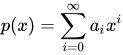
[edit]For a commutative ring R, the units of the polynomial ring R[x] are the polynomials such that a0 is a unit in R and the remaining coefficients are nilpotent, i.e., satisfy for some N.[4] In particular, if R is a domain (or more generally reduced), then the units of R[x] are the units of R. The units of the power series ring are the power series such that a0 is a unit in R.[5]


![{\displaystyle R[[x]]}](https://wikimedia.org/api/rest_v1/media/math/render/svg/5aacb21250f99f332a57763ecb7f92e3637ade19)
Matrix rings
[edit]The unit group of the ring Mn(R) of n × n matrices over a ring R is the group GLn(R) of invertible matrices. For a commutative ring R, an element A of Mn(R) is invertible if and only if the determinant of A is invertible in R. In that case, A−1 can be given explicitly in terms of the adjugate matrix.
In general
[edit]For elements x and y in a ring R, if is invertible, then is invertible with inverse ;[6] this formula can be guessed, but not proved, by the following calculation in a ring of noncommutative power series: See Hua's identity for similar results.




Group of units
[edit]A commutative ring is a local ring if R ∖ R× is a maximal ideal.
As it turns out, if R ∖ R× is an ideal, then it is necessarily a maximal ideal and R is local since a maximal ideal is disjoint from R×.
If R is a finite field, then R× is a cyclic group of order |R| − 1.
Every ring homomorphism f : R → S induces a group homomorphism R× → S×, since f maps units to units. In fact, the formation of the unit group defines a functor from the category of rings to the category of groups. This functor has a left adjoint which is the integral group ring construction.[7]
The group scheme is isomorphic to the multiplicative group scheme over any base, so for any commutative ring R, the groups and are canonically isomorphic to U(R). Note that the functor (that is, R ↦ U(R)) is representable in the sense: for commutative rings R (this for instance follows from the aforementioned adjoint relation with the group ring construction). Explicitly this means that there is a natural bijection between the set of the ring homomorphisms and the set of unit elements of R (in contrast, represents the additive group , the forgetful functor from the category of commutative rings to the category of abelian groups).


![{\displaystyle \mathbb {G} _{m}(R)\simeq \operatorname {Hom} (\mathbb {Z} [t,t^{-1}],R)}](https://wikimedia.org/api/rest_v1/media/math/render/svg/8c7385d9d048f7923fa85690937000b3e2b015cd)
![{\displaystyle \mathbb {Z} [t,t^{-1}]\to R}](https://wikimedia.org/api/rest_v1/media/math/render/svg/097602f428d486a9ea02003085c0fddf8b8a4ee6)
![{\displaystyle \mathbb {Z} [t]}](https://wikimedia.org/api/rest_v1/media/math/render/svg/55e65744a826d17b7e9fa264dc341006b9be5d55)

Associatedness
[edit]Suppose that R is commutative. Elements r and s of R are called associate if there exists a unit u in R such that r = us; then write r ~ s. In any ring, pairs of additive inverse elements[c] x and −x are associate, since any ring includes the unit −1. For example, 6 and −6 are associate in Z. In general, ~ is an equivalence relation on R.
Associatedness can also be described in terms of the action of R× on R via multiplication: Two elements of R are associate if they are in the same R×-orbit.
In an integral domain, the set of associates of a given nonzero element has the same cardinality as R×.
The equivalence relation ~ can be viewed as any one of Green's semigroup relations specialized to the multiplicative semigroup of a commutative ring R.
See also
[edit]Notes
[edit]- ^ In the case of rings, the use of "invertible element" is taken as self-evidently referring to multiplication, since all elements of a ring are invertible for addition.
- ^ The notation R×, introduced by André Weil, is commonly used in number theory, where unit groups arise frequently.[3] The symbol × is a reminder that the group operation is multiplication. Also, a superscript × is not frequently used in other contexts, whereas a superscript * often denotes dual.
- ^ x and −x are not necessarily distinct. For example, in the ring of integers modulo 6, one has 3 = −3 even though 1 ≠ −1.
Citations
[edit]- ^ Dummit & Foote 2004
- ^ Lang 2002
- ^ Weil 1974
- ^ Watkins 2007, Theorem 11.1
- ^ Watkins 2007, Theorem 12.1
- ^ Jacobson 2009, §2.2 Exercise 4
- ^ Cohn 2003, §2.2 Exercise 10
Sources
[edit]- Cohn, Paul M. (2003). Further algebra and applications (Revised ed. of Algebra, 2nd ed.). London: Springer-Verlag. ISBN 1-85233-667-6. Zbl 1006.00001.
- Dummit, David S.; Foote, Richard M. (2004). Abstract Algebra (3rd ed.). John Wiley & Sons. ISBN 0-471-43334-9.
- Jacobson, Nathan (2009). Basic Algebra 1 (2nd ed.). Dover. ISBN 978-0-486-47189-1.
- Lang, Serge (2002). Algebra. Graduate Texts in Mathematics. Springer. ISBN 0-387-95385-X.
- Watkins, John J. (2007), Topics in commutative ring theory, Princeton University Press, ISBN 978-0-691-12748-4, MR 2330411
- Weil, André (1974). Basic number theory. Grundlehren der mathematischen Wissenschaften. Vol. 144 (3rd ed.). Springer-Verlag. ISBN 978-3-540-58655-5.