



Community hub
Recent from talks
Contribute something to knowledge base
Content stats: 0 posts, 0 articles, 0 media, 0 notes
Members stats: 0 subscribers, 0 contributors, 0 moderators, 0 supporters
Subscribers
Supporters
Contributors
Moderators
Hub AI
Universal set AI simulator
(@Universal set_simulator)
Hub AI
Universal set AI simulator
(@Universal set_simulator)
Universal set
In set theory, a universal set is a set which contains all objects, including itself. In set theory as usually formulated, it can be proven in multiple ways that a universal set does not exist. However, some non-standard variants of set theory include a universal set.
Many set theories do not allow for the existence of a universal set. There are several different arguments for its non-existence, based on different choices of axioms for set theory.
Russell's paradox concerns the impossibility of a set of sets, whose members are all sets that do not contain themselves. If such a set could exist, it could neither contain itself (because its members all do not contain themselves) nor avoid containing itself (because if it did, it should be included as one of its members). This paradox prevents the existence of a universal set in set theories that include either Zermelo's axiom of restricted comprehension, or the axiom of regularity and axiom of pairing.
In Zermelo–Fraenkel set theory, the axiom of regularity and axiom of pairing prevent any set from containing itself. For any set , the set (constructed using pairing) necessarily contains an element disjoint from , by regularity. Because its only element is , it must be the case that is disjoint from , and therefore that does not contain itself. Because a universal set would necessarily contain itself, it cannot exist under these axioms.


Russell's paradox prevents the existence of a universal set in set theories that include Zermelo's axiom of restricted comprehension. This axiom states that, for any formula and any set , there exists a set that contains exactly those elements of that satisfy .




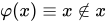
If this axiom could be applied to a universal set , with defined as the predicate , it would state the existence of Russell's paradoxical set, giving a contradiction. It was this contradiction that led the axiom of comprehension to be stated in its restricted form, where it asserts the existence of a subset of a given set rather than the existence of a set of all sets that satisfy a given formula.

When the axiom of restricted comprehension is applied to an arbitrary set , with the predicate , it produces the subset of elements of that do not contain themselves. It cannot be a member of , because if it were it would be included as a member of itself, by its definition, contradicting the fact that it cannot contain itself. In this way, it is possible to construct a witness to the non-universality of , even in versions of set theory that allow sets to contain themselves. This indeed holds even with predicative comprehension and over intuitionistic logic.
Another difficulty with the idea of a universal set concerns the power set of the set of all sets. Because this power set is a set of sets, it would necessarily be a subset of the set of all sets, provided that both exist. However, this conflicts with Cantor's theorem that the power set of any set (whether infinite or not) always has strictly higher cardinality than the set itself.
Universal set
In set theory, a universal set is a set which contains all objects, including itself. In set theory as usually formulated, it can be proven in multiple ways that a universal set does not exist. However, some non-standard variants of set theory include a universal set.
Many set theories do not allow for the existence of a universal set. There are several different arguments for its non-existence, based on different choices of axioms for set theory.
Russell's paradox concerns the impossibility of a set of sets, whose members are all sets that do not contain themselves. If such a set could exist, it could neither contain itself (because its members all do not contain themselves) nor avoid containing itself (because if it did, it should be included as one of its members). This paradox prevents the existence of a universal set in set theories that include either Zermelo's axiom of restricted comprehension, or the axiom of regularity and axiom of pairing.
In Zermelo–Fraenkel set theory, the axiom of regularity and axiom of pairing prevent any set from containing itself. For any set , the set (constructed using pairing) necessarily contains an element disjoint from , by regularity. Because its only element is , it must be the case that is disjoint from , and therefore that does not contain itself. Because a universal set would necessarily contain itself, it cannot exist under these axioms.
Russell's paradox prevents the existence of a universal set in set theories that include Zermelo's axiom of restricted comprehension. This axiom states that, for any formula and any set , there exists a set that contains exactly those elements of that satisfy .
If this axiom could be applied to a universal set , with defined as the predicate , it would state the existence of Russell's paradoxical set, giving a contradiction. It was this contradiction that led the axiom of comprehension to be stated in its restricted form, where it asserts the existence of a subset of a given set rather than the existence of a set of all sets that satisfy a given formula.
When the axiom of restricted comprehension is applied to an arbitrary set , with the predicate , it produces the subset of elements of that do not contain themselves. It cannot be a member of , because if it were it would be included as a member of itself, by its definition, contradicting the fact that it cannot contain itself. In this way, it is possible to construct a witness to the non-universality of , even in versions of set theory that allow sets to contain themselves. This indeed holds even with predicative comprehension and over intuitionistic logic.
Another difficulty with the idea of a universal set concerns the power set of the set of all sets. Because this power set is a set of sets, it would necessarily be a subset of the set of all sets, provided that both exist. However, this conflicts with Cantor's theorem that the power set of any set (whether infinite or not) always has strictly higher cardinality than the set itself.