Hubbry Logo
search
logo

Universal set

logo
Community Hub0 Subscribers
Read side by side
from Wikipedia

In set theory, a universal set is a set which contains all objects, including itself.[1] In set theory as usually formulated, it can be proven in multiple ways that a universal set does not exist. However, some non-standard variants of set theory include a universal set.

Reasons for nonexistence

[edit]

Many set theories do not allow for the existence of a universal set. There are several different arguments for its non-existence, based on different choices of axioms for set theory.

Russell's paradox

[edit]

Russell's paradox concerns the impossibility of a set of sets, whose members are all sets that do not contain themselves. If such a set could exist, it could neither contain itself (because its members all do not contain themselves) nor avoid containing itself (because if it did, it should be included as one of its members).[2] This paradox prevents the existence of a universal set in set theories that include either Zermelo's axiom of restricted comprehension, or the axiom of regularity and axiom of pairing.

Regularity and pairing

[edit]

In Zermelo–Fraenkel set theory, the axiom of regularity and axiom of pairing prevent any set from containing itself. For any set , the set (constructed using pairing) necessarily contains an element disjoint from , by regularity. Because its only element is , it must be the case that is disjoint from , and therefore that does not contain itself. Because a universal set would necessarily contain itself, it cannot exist under these axioms.[3]

Comprehension

[edit]

Russell's paradox prevents the existence of a universal set in set theories that include Zermelo's axiom of restricted comprehension. This axiom states that, for any formula and any set , there exists a set that contains exactly those elements of that satisfy .[2]


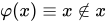
If this axiom could be applied to a universal set , with defined as the predicate , it would state the existence of Russell's paradoxical set, giving a contradiction. It was this contradiction that led the axiom of comprehension to be stated in its restricted form, where it asserts the existence of a subset of a given set rather than the existence of a set of all sets that satisfy a given formula.[2]

When the axiom of restricted comprehension is applied to an arbitrary set , with the predicate , it produces the subset of elements of that do not contain themselves. It cannot be a member of , because if it were it would be included as a member of itself, by its definition, contradicting the fact that it cannot contain itself. In this way, it is possible to construct a witness to the non-universality of , even in versions of set theory that allow sets to contain themselves. This indeed holds even with predicative comprehension and over intuitionistic logic.
Cantor's theorem

[edit]

Another difficulty with the idea of a universal set concerns the power set of the set of all sets. Because this power set is a set of sets, it would necessarily be a subset of the set of all sets, provided that both exist. However, this conflicts with Cantor's theorem that the power set of any set (whether infinite or not) always has strictly higher cardinality than the set itself.

Theories of universality

[edit]

The difficulties associated with a universal set can be avoided either by using a variant of set theory in which the axiom of comprehension is restricted in some way, or by using a universal object that is not considered to be a set.

Restricted comprehension

[edit]

There are set theories known to be consistent (if the usual set theory is consistent) in which the universal set V does exist (and is true). In these theories, Zermelo's axiom of comprehension does not hold in general, and the axiom of comprehension of naive set theory is restricted in a different way. A set theory containing a universal set is necessarily a non-well-founded set theory. The most widely studied set theory with a universal set is Willard Van Orman Quine's New Foundations. Alonzo Church and Arnold Oberschelp also published work on such set theories. Church speculated that his theory might be extended in a manner consistent with Quine's,[4] but this is not possible for Oberschelp's, since in it the singleton function is provably a set,[5] which leads immediately to paradox in New Foundations.[6]

Another example is positive set theory, where the axiom of comprehension is restricted to hold only for the positive formulas (formulas that do not contain negations). Such set theories are motivated by notions of closure in topology.

Universal objects that are not sets

[edit]

The idea of a universal set seems intuitively desirable in the Zermelo–Fraenkel set theory, particularly because most versions of this theory do allow the use of quantifiers over all sets (see universal quantifier). One way of allowing an object that behaves similarly to a universal set, without creating paradoxes, is to describe V and similar large collections as proper classes rather than as sets. Russell's paradox does not apply in these theories because the axiom of comprehension operates on sets, not on classes.

The category of sets can also be considered to be a universal object that is, again, not itself a set. It has all sets as elements, and also includes arrows for all functions from one set to another. Again, it does not contain itself, because it is not itself a set.

See also

[edit]

Notes

[edit]

References

[edit]
[edit]
Revisions and contributorsEdit on WikipediaRead on Wikipedia
from Grokipedia
In set theory, the universal set, often denoted as $ U $ or $ V $, is defined as the set that contains all possible objects or elements within a specified universe of discourse or context of discussion.[1] This concept serves as a foundational tool in basic set operations, such as defining complements (where the complement of a set $ S $ is $ U \setminus S $) and ensuring that all subsets are well-defined relative to a bounded domain.[2] For instance, in applications like probability or logic, the universal set might be restricted to real numbers, integers, or other relevant collections to maintain consistency in computations.[1] However, the idea of a truly global universal set—one encompassing all sets without restriction—leads to fundamental logical paradoxes in naive set theory, which assumes unrestricted comprehension (the principle that any definable property determines a set).[3] The most famous of these is Russell's paradox, discovered by Bertrand Russell in 1901, which considers the set $ R = { x \mid x \notin x } $ (the set of all sets that do not contain themselves as members).[4] If $ R \in R $, then by definition $ R \notin R $, and if $ R \notin R $, then $ R \in R $, yielding a contradiction that undermines the coherence of a universal set containing all sets.[4] This paradox, rooted in Georg Cantor's early development of set theory in the 1870s and 1880s, exposed flaws in naive assumptions and prompted the rejection of a total universal set in modern foundations. To resolve such issues, axiomatic set theories like Zermelo-Fraenkel set theory (ZF) and its extension ZFC (with the axiom of choice) explicitly avoid the universal set by limiting comprehension to subsets of existing sets and incorporating the axiom of foundation, which prevents sets from containing themselves.[4] In these systems, there is no single set of all sets; instead, the cumulative hierarchy (or von Neumann universe) provides a structured, infinite progression of sets approximating universality without paradox.[3] Despite these limitations, the universal set remains a useful heuristic in restricted contexts, such as educational introductions to sets or applied fields like computer science, where a finite or context-specific "universe" suffices.[5]

Conceptual Foundations

Definition and Naive Conception

In naive set theory, the universal set, often denoted VV, is intuitively conceived as the set that contains every possible set as an element, thereby serving as a comprehensive universe for all mathematical objects. This notion posits VV as a total collection encompassing all entities treated as sets, providing a foundational backdrop against which subsets and operations can be defined without reference to external bounds.[6] A key example illustrating this conception is the formulation V={xx=x}V = \{ x \mid x = x \}, where the property x=xx = x holds universally for any entity considered a set, intending to capture the entirety of the set-theoretic domain in a single structure. The motivation behind such universality lies in its potential to streamline mathematical discourse: by housing all sets within one container, it obviates the construction of increasingly larger encompassing collections, thus avoiding the complexities of an unending hierarchy of sets.[6] Underpinning this naive view are foundational assumptions, including the unrestricted axiom of comprehension, which asserts that for any definable property ϕ(x)\phi(x), the collection {xϕ(x)}\{ x \mid \phi(x) \} forms a set. This principle, coupled with the permissiveness allowing sets to contain themselves or other sets without hierarchical constraints, enables the apparent existence of VV as a legitimate object.[7] The conception emerged from late 19th-century efforts by Georg Cantor and Gottlob Frege to establish rigorous foundations for mathematics through set-theoretic and logical frameworks.[8]

Historical Development

The concept of the universal set emerged within the broader development of set theory during the late 19th century, primarily through Georg Cantor's pioneering work. Cantor introduced the foundational ideas of set theory in the late 19th century, beginning in the 1870s, and further developed transfinite numbers in the 1890s to describe infinite cardinalities and their hierarchies. His investigations implied the need for a comprehensive mathematical universe to encompass all sets, yet he initially avoided explicitly defining a universal set, instead emphasizing the unending progression of infinities via power sets.[9] This approach is evident in his 1895 paper "Beiträge zur Begründung der transfiniten Mengenlehre," where he rigorously defined cardinal numbers and demonstrated that the power set of any set has a strictly larger cardinality, laying groundwork for understanding set sizes without invoking a total aggregate.[10] Parallel to Cantor's mathematical innovations, Gottlob Frege pursued a logical foundation for arithmetic that inadvertently incorporated elements of a universal set. In the first volume of Grundgesetze der Arithmetik published in 1893, Frege formalized his logicist program through a system of axioms and rules, including Basic Law V. This law enabled unrestricted comprehension, allowing the construction of a set for any definable property of objects within his value-range framework, which implicitly permitted the existence of a universal set comprising all such values.[11] Early signs of trouble for the naive universal set appeared in the early 1900s, highlighted by Bertrand Russell's discovery of a fundamental contradiction in 1901, which he communicated to Frege in a letter dated June 16, 1902. Russell's paradox exposed inconsistencies in systems permitting unrestricted set formation, directly challenging Frege's Basic Law V and the viability of an all-encompassing set.[12] Concurrently, in 1905, Henri Poincaré raised philosophical objections to impredicative definitions—those that quantify over a totality including the entity being defined—contending that such circularity undermined the rigor of foundational mathematics and contributed to paradoxes in set-theoretic constructions.[13] These critiques prompted a shift toward axiomatic restrictions, culminating in Ernst Zermelo's 1908 axiomatization of set theory. In his paper "Untersuchungen über die Grundlagen der Mengenlehre I," Zermelo introduced a system of axioms that explicitly precluded a universal set by confining the axiom schema of comprehension to formulas bounded by existing sets, ensuring subsets could only be formed from previously established collections.[14] This bounded approach, combined with axioms for extensionality, pairing, union, power set, infinity, and separation, provided a paradox-free framework while supporting Cantor's transfinite hierarchy.

Paradoxes Precluding Existence

Russell's Paradox

Russell's paradox arises within naive set theory from the consideration of the set $ R $ defined as the collection of all sets that do not contain themselves as members, formally expressed as
R={xxx}. R = \{ x \mid x \notin x \}.
This definition leads to a direct contradiction: assuming $ R \in R $ implies $ R \notin R $ by the defining property, while assuming $ R \notin R $ implies $ R \in R $. Thus, the biconditional $ R \in R \leftrightarrow R \notin R $ holds, demonstrating an inconsistency in the naive framework.[4] This paradox directly undermines the existence of a universal set $ V $, which would purportedly contain all sets as members. If such a $ V $ existed, then $ R $, being a set composed of certain sets, would be a subset of $ V $. However, the contradictory nature of $ R $ means it cannot consistently belong to $ V $, as membership in $ V $ would require resolving the self-referential inconsistency. Consequently, no set can encompass every possible set without engendering this contradiction.[4] The paradox emerges from the naive axiom of unrestricted comprehension, which posits that for any property $ \phi(x) $, the set $ { x \mid \phi(x) } $ exists. This axiom permits the formation of $ R $ via the property $ x \notin x $. Additionally, naive set theory often implicitly assumes well-foundedness through axioms like pairing (which allows constructing sets from existing elements without cycles) or regularity (which prohibits sets from containing themselves, i.e., $ x \notin x $ for all $ x $), yet these fail to block the paradoxical comprehension. Without restrictions, self-membership considerations amplify the issue, as the definition probes potential violations of such assumptions.[4] Bertrand Russell discovered the paradox in the late spring of 1901 while working on The Principles of Mathematics. He communicated it in a letter to Gottlob Frege dated June 16, 1902, revealing a fatal flaw in Frege's Grundgesetze der Arithmetik and prompting Frege to halt further development of its second volume, appending an acknowledgment of the inconsistency. This event marked a pivotal crisis in foundational mathematics. The paradox profoundly influenced Russell's collaboration with Alfred North Whitehead on Principia Mathematica (published in three volumes between 1910 and 1913), where they developed ramified type theory to stratify sets by order and avoid self-reference, thereby circumventing the paradox while rebuilding mathematics on logical types.[4][12][15] A variant of the paradox considers simply the set of all sets that do not contain themselves, which is equivalent to the original construction and yields the same contradictory outcome under naive comprehension. This formulation highlights the self-referential nature inherent in unrestricted set formation.[4]

Cantor's Theorem

Cantor's theorem asserts that for any set AA, the power set P(A)\mathcal{P}(A), which consists of all subsets of AA, has strictly greater cardinality than AA itself: P(A)>A|\mathcal{P}(A)| > |A|. This result, fundamental to set theory, establishes a strict hierarchy among cardinalities and precludes the existence of a set containing all possible sets.[16] The proof relies on Cantor's diagonal argument, originally developed in 1891 to demonstrate the uncountability of the real numbers and later generalized to arbitrary sets in 1897.[17][16] Assume, for contradiction, that there exists a surjective function f:AP(A)f: A \to \mathcal{P}(A). Construct the set B={xAxf(x)}B = \{ x \in A \mid x \notin f(x) \}. Since BAB \subseteq A, there must exist some yAy \in A such that B=f(y)B = f(y). However, if yBy \in B, then by definition of BB, yf(y)=By \notin f(y) = B, a contradiction. Conversely, if yBy \notin B, then yf(y)=By \in f(y) = B, again a contradiction. Thus, no such surjection exists, implying there is no injection from P(A)\mathcal{P}(A) into AA, and hence P(A)>A|\mathcal{P}(A)| > |A|.[16] This theorem directly undermines the notion of a universal set VV, the putative set of all sets. If VV existed, then P(V)V\mathcal{P}(V) \subseteq V, since every subset of VV would be a set and thus an element of VV. But P(V)>V|\mathcal{P}(V)| > |V| would then imply an injection from a strictly larger cardinal into V|V|, which is impossible. Iterating this process would yield an infinite ascending sequence of cardinals $ |V| < |\mathcal{P}(V)| < |\mathcal{P}(\mathcal{P}(V))| < \cdots $, violating the well-ordering of cardinals.[18] Beyond precluding a universal set, Cantor's theorem reveals that there is no largest cardinal number, as the power set operation always produces a larger one. Related concepts include the absence of fixed points for the power set function—no cardinal κ\kappa satisfies 2κ=κ2^\kappa = \kappa—and aleph-fixed points, which are cardinals κ=κ\kappa = \aleph_\kappa arising in the hierarchy of infinite cardinals, though these do not contradict the theorem's strict inequality.

Resolutions in Set Theory

Restricted Comprehension Axioms

In axiomatic set theories such as Zermelo-Fraenkel set theory (ZF), the axiom schema of comprehension is restricted to ensure the existence of subsets defined by properties relative to an already existing set, thereby avoiding the paradoxes arising from unrestricted comprehension.[19] This schema, also known as the axiom schema of separation or specification, states that for any set AA and any formula ϕ(x)\phi(x) (with xx free and not depending on free variables other than those in AA), there exists a set BB such that
x(xBxAϕ(x)), \forall x \left( x \in B \leftrightarrow x \in A \land \phi(x) \right),
where ϕ\phi is bounded in the sense that it is formulated relative to elements of AA, preventing the formation of sets without a bounding domain.[19] This formulation, originally introduced by Ernst Zermelo in 1908 and refined by Abraham Fraenkel in 1922, limits comprehension to definable subclasses of given sets, ensuring that new sets are proper subsets and thus controlling the iterative construction of the set-theoretic universe.[19] The restriction inherent in this schema precludes the existence of a universal set in ZF (and its extension ZFC with the axiom of choice). A universal set VV, intended to contain all sets, would require an impredicative definition via unrestricted comprehension over the entire universe, which is not permitted; instead, the universe of sets is modeled as the proper class V=αOrdVαV = \bigcup_{\alpha \in \mathrm{Ord}} V_\alpha, where the VαV_\alpha form the cumulative hierarchy of rank ordinals α\alpha, with each Vα+1=P(Vα)V_{\alpha+1} = \mathcal{P}(V_\alpha) and limit stages as unions. This hierarchy ensures that no single VαV_\alpha captures all sets, as the process continues transfinitely without bound, rendering VV a proper class rather than a set, consistent with Cantor's theorem that no set can contain its own power set. The Von Neumann–Bernays–Gödel (NBG) set theory extends ZF by incorporating proper classes as primitive notions alongside sets, allowing for a universal class UU that contains all sets but is explicitly not a set itself.[20] In NBG, classes are defined by formulas similar to those in ZF, but the axioms distinguish sets (classes that are members of other classes) from proper classes, with comprehension for classes being unrestricted while set comprehension remains bounded by existing sets.[20] This framework is a conservative extension of ZFC, proving the same theorems about sets, but it formalizes the notion of the universe as the proper class UU, avoiding paradoxes by denying UU's status as a set.[20] The implications of these restricted comprehension axioms are foundational to the consistency of ZFC, which assumes the non-existence of a universal set as a theorem derivable from the axioms (e.g., via the negation of yx(xy)\exists y \forall x (x \in y), contradicted by applying the power set axiom to any purported universal set). As an extension, Grothendieck's axiom of universes posits the existence of inaccessible cardinals serving as Grothendieck universes—sets UU closed under standard operations and satisfying ZFC internally—allowing localized "universal" sets within the hierarchy without global universality.[21] A sketch of how bounded comprehension avoids paradoxes like Russell's illustrates the restriction's efficacy: the Russell set R={xxx}R = \{x \mid x \notin x\} cannot be formed in ZFC, as its definition requires comprehension over the entire universe without an ambient set AA to bound the formula ϕ(x):xx\phi(x) : x \notin x; attempting to derive RR relative to some existing set AA yields only RAR \subseteq A, preventing the self-referential contradiction where membership in RR toggles based on whether RRR \in R.[19]

Grothendieck Universes and Similar Constructions

In the 1960s, Alexander Grothendieck introduced the concept of universes in the context of algebraic geometry to provide a foundational framework for handling large collections of sets without invoking global set-theoretic paradoxes. A Grothendieck universe is defined as a transitive set $ U $ satisfying the following properties: it contains the empty set and is closed under pairing (if $ x, y \in U $, then $ {x, y} \in U $); closed under power sets (if $ x \in U $, then $ \mathcal{P}(x) \in U $); closed under unions indexed by elements of $ U $ (if $ x \in U $ and $ f: x \to U $ is a function, then $ \bigcup_{i \in x} f(i) \in U $); and contains the set of natural numbers $ \omega \in U $.[22] This construction assumes the existence of a strongly inaccessible cardinal $ \kappa $, where $ U $ consists of all sets of rank less than $ \kappa $, ensuring $ U $ models ZFC internally and allows for "local" set theory within algebraic geometry, such as defining schemes and toposes over sets in $ U $.[22] Every set belongs to some Grothendieck universe, enabling hierarchical stacking of universes to encompass broader mathematical structures.[22] Grothendieck universes facilitate working with categories whose objects and morphisms are "small" relative to $ U $, avoiding the need for proper classes in standard ZFC by treating $ U $ as a bounded model of set theory. For instance, in étale cohomology, universes ensure that presheaf categories over schemes are well-defined without cardinality issues. However, their existence requires axioms beyond ZFC, such as the universe axiom, which posits a proper class of such universes.[22] As alternatives to Grothendieck universes, Michael Makkai and Robert Paré introduced the notion of accessible categories in 1989 to describe large categories approximatively via small generators and filtered colimits, bypassing explicit set-theoretic size assumptions.[23] A category is $ \lambda $-accessible if it has all $ \lambda $-small filtered colimits and a small set of $ \lambda $-presentable objects whose filtered colimits generate the category, allowing categories like the category of sets or modules to be embedded into presheaf categories over finite limits sketches. This framework provides a way to handle "large" structures categorically without relying on inaccessible cardinals, emphasizing accessibility over closure under set operations.[23] In the setting of topos theory, elementary toposes equipped with a natural numbers object (NNO) serve as analogous "universes," where the topos itself acts as a bounded universe for intuitionistic logic and set-like constructions. An elementary topos is a category with finite limits, exponentials, a subobject classifier, and power objects, and the NNO enables recursive definitions and arithmetic internally, modeling Peano arithmetic in a way that supports impredicative type theory. Such toposes, as explored in works on universes within toposes, allow for internal Grothendieck-Bénabou universes, providing a categorical approximation to universal sets while remaining class-sized or site-specific, as in sheaf toposes over manifolds.[24] Another approach is Willard Van Orman Quine's New Foundations (NF) set theory, proposed in 1937, which permits a universal set $ V $ through stratified comprehension while avoiding paradoxes via type-like restrictions on formulas. NF's axioms include extensionality and unrestricted stratified comprehension, allowing sets to be formed from any stratified formula over the universe, thus including $ V = { x \mid x = x } $ as the set of all sets, but stratification prevents self-referential issues like Russell's paradox. This system supports a universal set but imposes syntactic constraints akin to simple type theory, enabling constructions like the cumulative hierarchy within $ V $, though it diverges from ZFC by allowing impredicative definitions. Despite these innovations, Grothendieck universes and similar constructions do not yield true universal sets, as they remain bounded by inaccessible cardinals or categorical embeddings, functioning more as class-like proxies within extended theories. In NF, the universal set exists but is restricted by stratification, and the theory's consistency remains an open problem, with no proof relative to ZFC despite partial results on subsystems like NFU. These approaches thus approximate universality in specialized contexts, such as algebraic geometry or alternative foundations, without resolving the global paradoxes of naive set theory.[22]

Implications and Broader Context

Role in Category Theory

In category theory, the category Set\mathbf{Set} has all sets as objects and functions as morphisms between them. Unlike the naive set-theoretic universal set, Set\mathbf{Set} lacks a universal object containing all sets via injections, but it features a terminal object, the singleton set 1={}1 = \{*\}, to which every set XX maps uniquely via the constant function sending all elements to *.[25] Categories such as Set\mathbf{Set} are classified as small, meaning both their collections of objects and morphisms form sets. The category Cat\mathbf{Cat} of all small categories and functors, however, is large, with its class of objects constituting a proper class rather than a set, thus evading paradoxes akin to those precluding universal sets. Grothendieck universes facilitate the treatment of such categories as small within set-theoretic frameworks by imposing size restrictions on their components.[21] Category theory circumvents the need for a universal set through universal properties realized via limits, colimits, and adjoint functors. A limit of a diagram is an object equipped with projections that is universal among all such cones, uniquely mediating morphisms from other cones; colimits serve the dual role for cocones. Adjoint functors embody universality by ensuring one functor, say the left adjoint FGF \dashv G, satisfies Hom(F(X),Y)Hom(X,G(Y))\mathrm{Hom}(F(X), Y) \cong \mathrm{Hom}(X, G(Y)) naturally, providing canonical "universal arrows" like free constructions without centralizing all objects in a single set.[25] This framework avoids set-theoretic paradoxes by eschewing the aggregation of all objects into one set, instead defining objects via their morphism relations. The Yoneda lemma embeds each object XX faithfully into the presheaf category by identifying it with the representable functor Hom(X,)\mathrm{Hom}(X, -), asserting that natural transformations from Hom(X,)\mathrm{Hom}(X, -) to any functor FF correspond bijectively to elements of F(X)F(X), thereby capturing an object's essence through its hom-sets. In the 1960s, William Lawvere advanced this perspective in his functorial semantics, positing categories as universes for algebraic theories, where an equational theory is a small category A\mathbb{A} and its models are product-preserving functors ASet\mathbb{A} \to \mathbf{Set}.[25][26]

Philosophical Perspectives

The discovery of paradoxes in naive set theory, such as Russell's paradox, profoundly undermined Gottlob Frege's logicist program, which sought to ground all of mathematics in pure logic without appealing to intuitive notions of sets or collections. Frege's Grundgesetze der Arithmetik (1893–1903) posited unrestricted comprehension, allowing the formation of any set defined by a property, but Russell's 1902 letter revealed that this leads to contradictions, like the set of all sets not containing themselves. As a result, the foundational crisis prompted a philosophical shift toward formalism, exemplified by David Hilbert's program in the 1920s, which advocated formalizing mathematics in axiomatic systems and proving their consistency through finitary methods to secure mathematics against such paradoxes.[27][28] In response to these issues, mathematical platonism, defended by Kurt Gödel, posits sets as real, abstract entities inhabiting a hierarchical universe structured by the cumulative hierarchy V_α, where no universal set exists to encompass the entire hierarchy, preserving consistency through well-foundedness. Gödel argued that this ontology aligns with mathematical intuition, viewing sets as discovered rather than invented, independent of human construction. Conversely, intuitionism, developed by L.E.J. Brouwer, rejects impredicative definitions—those that quantify over totalities including the object being defined—as they presuppose unconstructible infinities and enable paradoxical assumptions of universality; instead, intuitionists emphasize mental constructions and reject the law of excluded middle for infinite domains, rendering a universal set philosophically untenable.[29][30] Structuralism offers an alternative to set-theoretic reductionism, with Stewart Shapiro arguing that mathematics concerns structures defined by relational properties and isomorphisms, rather than the intrinsic nature of objects like sets; under this view, the universal set is superfluous, as mathematical significance lies in how elements relate within systems, not in a totalizing collection. Shapiro's framework, elaborated in Philosophy of Mathematics: Structure and Ontology (1997), treats numbers and other objects as positions in structures, sidestepping ontological commitments to a singular set-theoretic foundation.[31] Contemporary philosophical debates on the universal set extend to the multiverse perspective, advanced by Joel David Hamkins in the 2010s, which conceives set theory as comprising multiple, equally valid universes, each satisfying different axioms like V = L or forcing extensions, thereby rejecting a unique, universal ontology in favor of pluralism and impacting questions of mathematical realism. This view echoes Paul Benacerraf's seminal 1965 essay "What Numbers Could Not Be," which critiques set-theoretic and other reductions of numbers by highlighting the underdetermination of their identity—multiple isomorphic structures realize the naturals—thus questioning the pursuit of a definitive foundational ontology that might include a universal set.[32][33]

References

User Avatar
No comments yet.