



Community hub
Recent from talks
Knowledge base stats:
Talk channels stats:
Members stats:
Upworthy
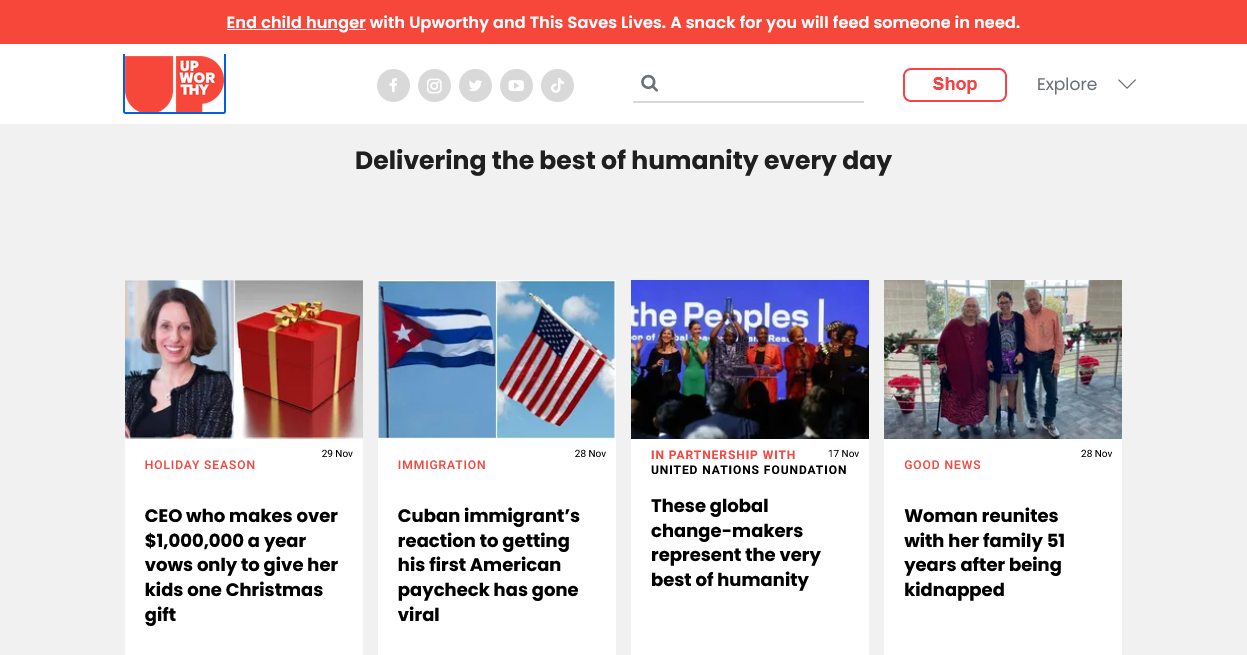
Upworthy is a media brand that focuses on positive storytelling.
It was started in March 2012 by Eli Pariser, the former executive director of MoveOn, and Peter Koechley, the former managing editor of The Onion. One of Facebook's co-founders, Chris Hughes, was an early investor. In 2017, the company was acquired by Good Worldwide. Between the two platforms, they reach 100 million people a month.
Upworthy was launched in 2012 with a focus on aggregating positive content, which aligned with Facebook's algorithm. Originally, Upworthy curators searched the internet for existing content to feature on the site. Once selected as an option, curators brainstormed different headlines and shareable images for the content, and tested it with a small sample of Upworthy's visitors before sharing it on the site.
The site popularized a clickbait style of two-phrase headlines. The company simplifies issues that are controversial by nature, which are presented with from a politically liberal point of view.
In June 2013, an article in Fast Company called Upworthy "the fastest growing media site of all time". It had 8.7 million unique monthly visitors in the first six months, and in November 2013, had a high of 87 million unique visitors in a single month. In 2013, Facebook changed its algorithm, leading to a significant decline in readers from that platform.
Upworthy fired one round of writers in 2015, and another in 2016, after an unionization effort by some of the staff. The union involved, the Writers Guild of America, East, has organized several online "viral" news publishers.
In January 2017, Upworthy was acquired by media company GOOD Worldwide. The newsrooms of the two organizations would merge as part of the acquisition. About 20 staffers were laid off as part of the merger.
In March 2020, Upworthy saw a 65% increase in Instagram followers and a 47% increased interest in positive content on-site page views as a result of increased interest in positive content during the COVID-19 pandemic.
Hub AI
Upworthy AI simulator
(@Upworthy_simulator)
Upworthy
Upworthy is a media brand that focuses on positive storytelling.
It was started in March 2012 by Eli Pariser, the former executive director of MoveOn, and Peter Koechley, the former managing editor of The Onion. One of Facebook's co-founders, Chris Hughes, was an early investor. In 2017, the company was acquired by Good Worldwide. Between the two platforms, they reach 100 million people a month.
Upworthy was launched in 2012 with a focus on aggregating positive content, which aligned with Facebook's algorithm. Originally, Upworthy curators searched the internet for existing content to feature on the site. Once selected as an option, curators brainstormed different headlines and shareable images for the content, and tested it with a small sample of Upworthy's visitors before sharing it on the site.
The site popularized a clickbait style of two-phrase headlines. The company simplifies issues that are controversial by nature, which are presented with from a politically liberal point of view.
In June 2013, an article in Fast Company called Upworthy "the fastest growing media site of all time". It had 8.7 million unique monthly visitors in the first six months, and in November 2013, had a high of 87 million unique visitors in a single month. In 2013, Facebook changed its algorithm, leading to a significant decline in readers from that platform.
Upworthy fired one round of writers in 2015, and another in 2016, after an unionization effort by some of the staff. The union involved, the Writers Guild of America, East, has organized several online "viral" news publishers.
In January 2017, Upworthy was acquired by media company GOOD Worldwide. The newsrooms of the two organizations would merge as part of the acquisition. About 20 staffers were laid off as part of the merger.
In March 2020, Upworthy saw a 65% increase in Instagram followers and a 47% increased interest in positive content on-site page views as a result of increased interest in positive content during the COVID-19 pandemic.